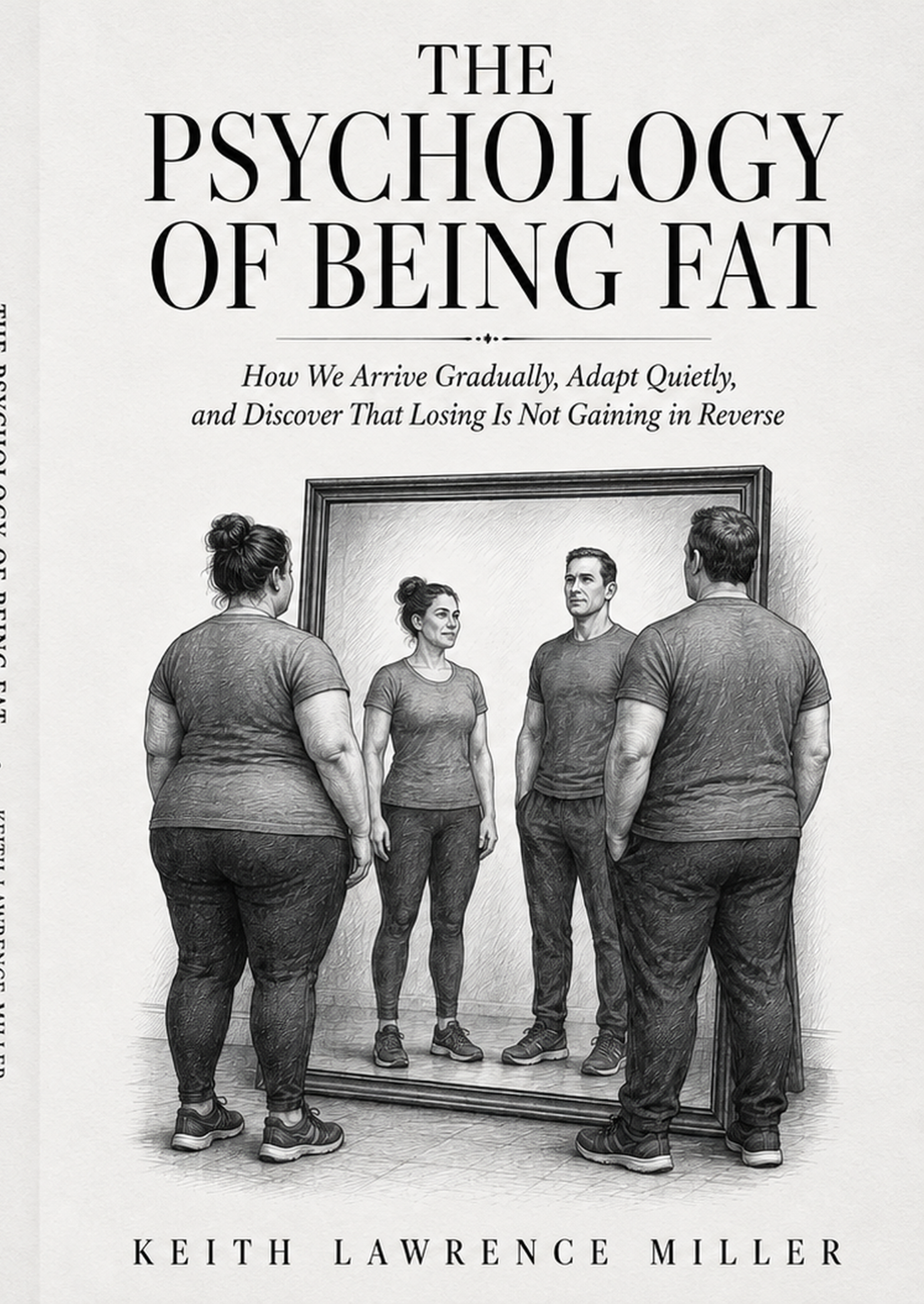
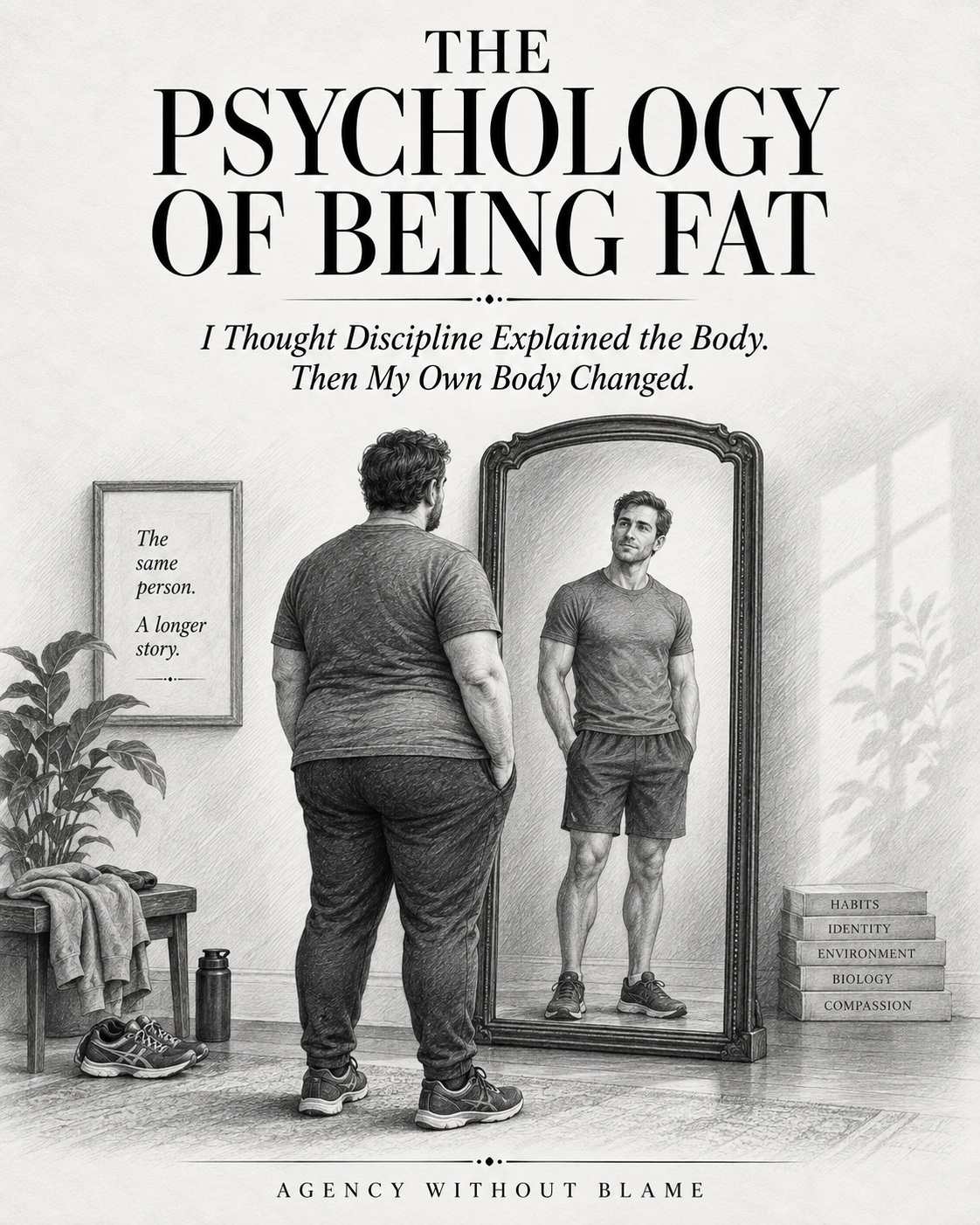
The Psychology of Being Fat: I Thought Discipline Explained the Body. Then My Own Body Changed.
By Keith Lawrence Miller, M.A.
At twenty-seven, I believed I understood weight.
I had reduced my body weight from approximately 210 pounds to 167. I was extraordinarily lean, muscular, and strong, and I could bench-press 225 pounds for nineteen repetitions. I remember being told that my body fat was near 3 percent, although I no longer have the original measurement or method and therefore do not treat that number as precise. What I knew with certainty was that I had transformed my body through deliberate effort.
That experience gave me a lesson that was partly true and therefore especially persuasive: discipline matters. I had learned to tolerate hunger, structure food, train consistently, and pursue a physical objective until the mirror reflected what I wanted to see.
Then I made the mistake of turning a useful truth into a theory of other people.
I looked at people living in ordinary bodies and believed their bodies told me something about their character. I had discipline. They did not. From inside the body I had built, that explanation felt less like judgment than evidence.
Years later, I would become the person I thought I understood.
That experience became The Psychology of Being Fat.
The Body at the End Hides the Process That Produced It
One of the easiest mistakes to make about weight is to look at the finished body and imagine the entire history behind it.
An observer sees a person at 220, 250, or 300 pounds all at once. The person living inside that body did not experience the change that way.
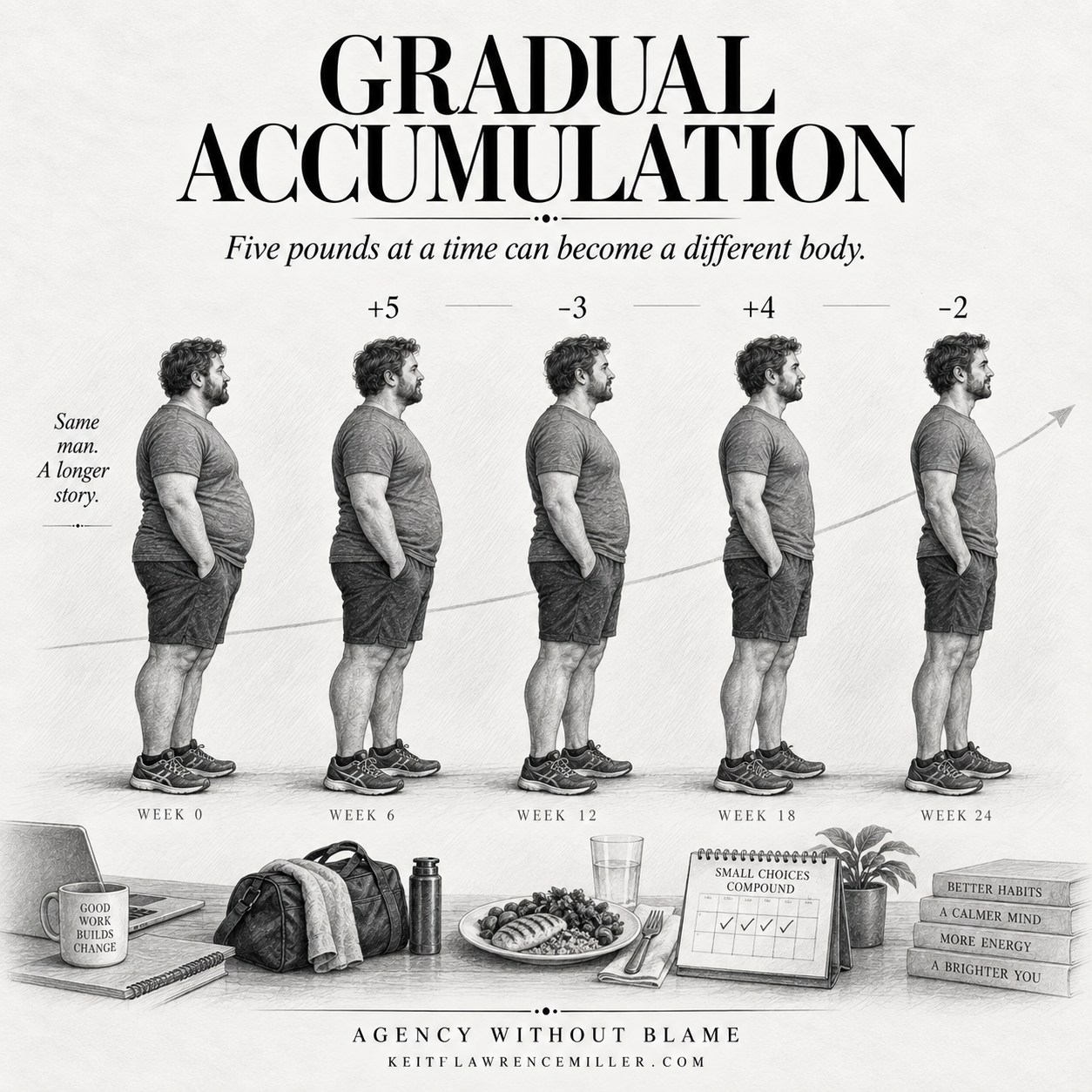
Nobody gains eighty pounds in one meal. Substantial change can be assembled through increments that never feel substantial enough to demand a new identity. Five pounds may mean a tighter shirt. A few pounds lost afterward can restore confidence that everything remains under control. Another increase can be explained by age, schedule, travel, family life, reduced activity, or temporary stress. The baseline can move without any individual moment announcing that something fundamental has changed.
That became one of the central psychological questions in the book.
How can a person who once paid extraordinary attention to his body fail to recognize what is happening to that body over time?
The answer was more complicated than denial.
Identity Can Change More Slowly Than the Body
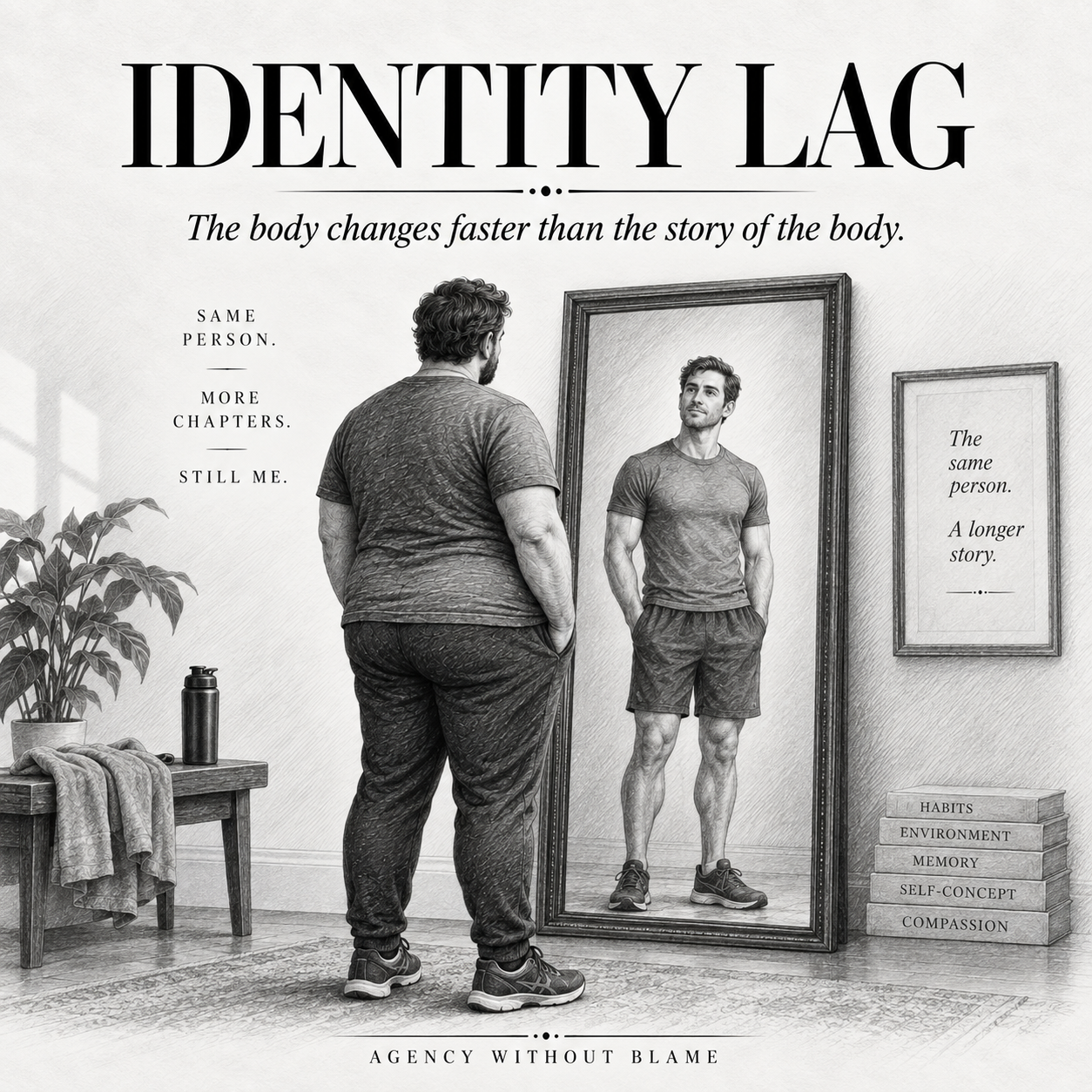
I call one part of that experience Identity Lag.
It is not a clinical diagnosis, a validated scale, or a recognized disorder. It is my term for a mismatch I experienced personally: the physical body can change gradually while the autobiographical self remains anchored to an earlier version.
My earlier identity was not imaginary. I really had been lean. I really had been muscular and unusually strong. I really had changed my body deliberately before.
That truth gave the old identity enormous staying power.
As my body changed, I could continue interpreting the change through the person I had been. I was still muscular, just heavier. I still knew how to lose weight. I was busy now, but I could return to normal whenever I decided the time had come.
Every individual explanation could contain some truth while the total picture remained increasingly inaccurate.
That is what makes gradual change psychologically difficult. The mind does not need to deny each new fact. It can absorb every fact individually without ever totaling them.
The Former Self Can Become Evidence Against the Present
A related idea in the book is what I call the Former-Self Effect.
For years I had good reason to be skeptical of simple weight-for-height measures such as BMI. A muscular athlete can legitimately be classified as overweight by BMI even when the label does not accurately describe adiposity. That limitation is real.
My error came from carrying a valid objection forward after it stopped being sufficient.
A fact about my former body became protection against information about my current one.
I still had substantial muscle. That did not mean substantial fat had not also accumulated. The correct response to an imperfect measure should have been to gather more information. Instead, the earlier athletic identity helped me conclude that the category itself did not meaningfully apply to me.
The broader lesson reaches well beyond weight.
An explanation can remain true after it stops being complete.
Family Life Changed What Health Had to Compete With
Starting a family did not make me stop caring about my health. It changed what caring about my health had to compete with.
Before children, personal time can feel more individually controlled. Exercise, food, sleep, and recovery are negotiated primarily with your own schedule. Family life changes the ownership of the day.
Meals become shared environments. Sleep can become less predictable. Work and caregiving compete for the same hours. An exercise session that once required only motivation may now compete with responsibilities to other people.
None of that eliminates personal agency, and I do not use family as an alibi for weight gain. The point is that choices occur inside conditions, and conditions can change dramatically while intention remains the same.
The manuscript calls this the Family Effect while carefully avoiding the claim that parenthood mechanically causes obesity. The evidence supports multiple possible pathways and considerable individual variation rather than one universal trajectory.
That distinction became increasingly important to me: context can matter without becoming an excuse.

The Five-Pound Ratchet
Substantial weight gain often looks dramatic only from the endpoint.
From inside the process, it may consist of many periods that barely feel consequential. A vacation contributes something. Activity changes. Food portions remain appropriate for an earlier level of expenditure. Sleep deteriorates. A few pounds arrive, some leave, and then slightly more return.
I think of this as the Five-Pound Ratchet.
The phrase is an interpretive framework from the book, not a validated obesity construct. Its purpose is to describe how small changes can accumulate while each individual increment remains psychologically easy to explain.
This is very different from the popular image of someone simply deciding every day to become heavier.
There may never be a decisive moment.
That matters because outside observers often infer character from the final total while the person inside the process experienced dozens of ordinary adjustments spread across years.
Accommodation Can Make Major Change Feel Ordinary
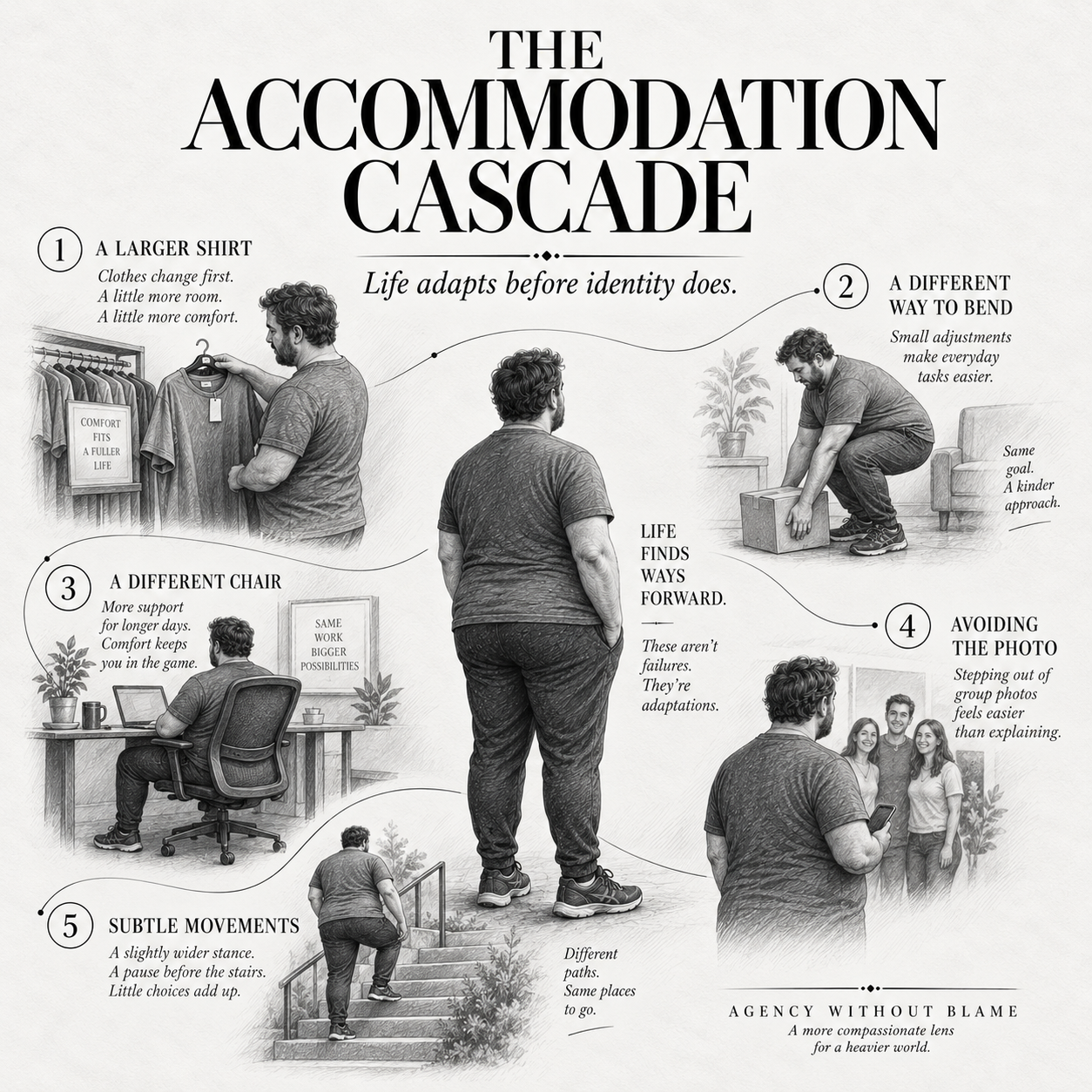
Eventually, the body changes enough that life begins adapting around it.
A shirt is replaced with a larger one. Bending changes. A different chair feels more comfortable. A photograph becomes less appealing. Stairs become easier to avoid. An activity gets postponed.
Each adjustment can be perfectly sensible.
I call the cumulative pattern the Accommodation Cascade. Again, this is an organizing concept from my experience rather than a validated clinical sequence. It draws on broader ideas involving adaptation, symptom normalization, avoidance, and functional compensation.
Accommodation is not weakness.
Buying clothing that fits is more humane than punishing yourself with clothing that does not. Choosing a less painful movement may be the appropriate response at that moment.
The psychological issue appears when each local solution makes the total pattern less visible.
One larger shirt is clothing. One uncomfortable bend may be stiffness. One avoided photograph is preference. One skipped activity is a busy day.
When the adaptations accumulate, life can become organized around a changed body while the person never experiences one event large enough to force a new interpretation.
The World Can Shrink Before Life Appears Broken
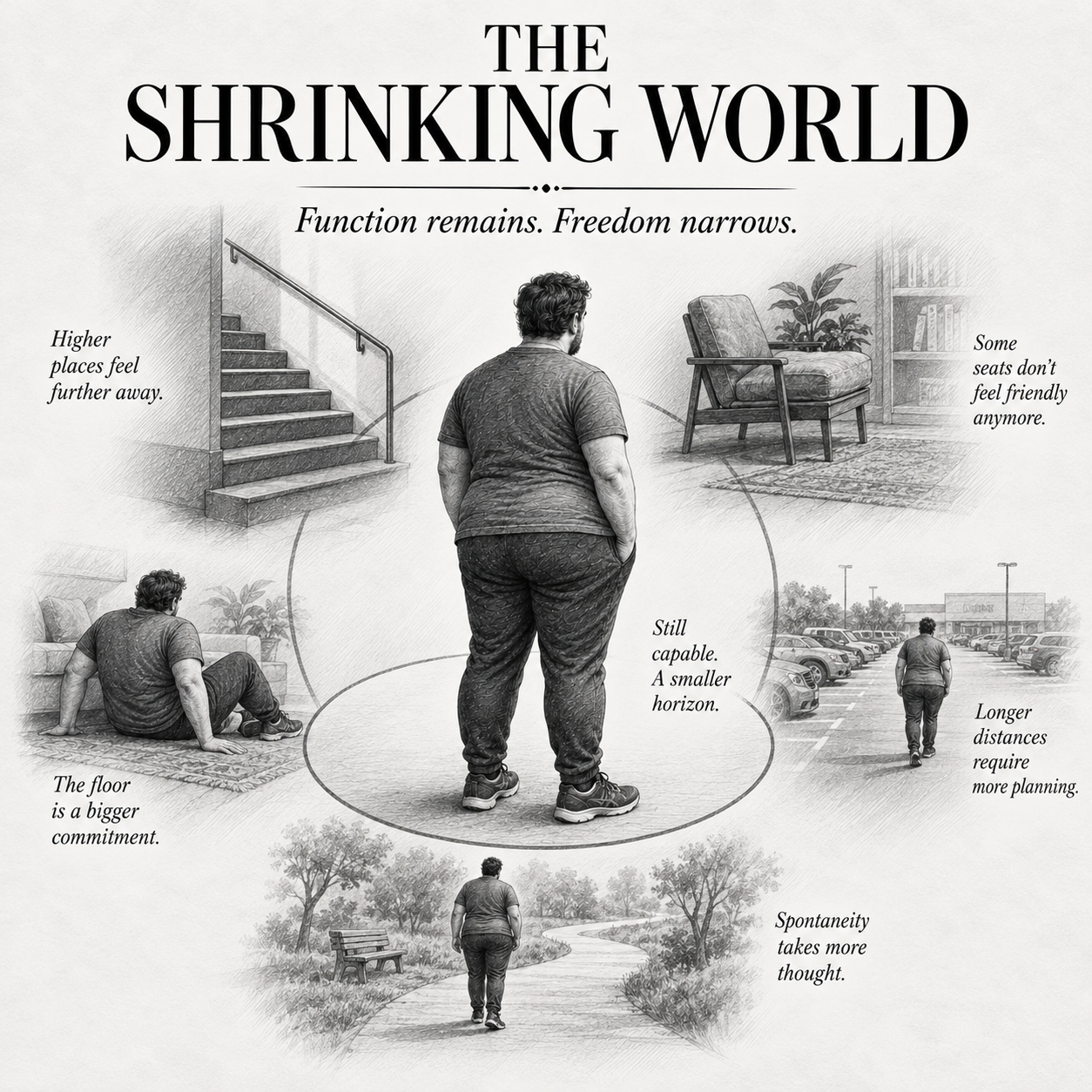
One of the more difficult realizations for me was that function is not binary.
A person may continue working, driving, shopping, raising a family, and meeting responsibilities while the range of easy, spontaneous physical possibilities becomes narrower.
You stop sitting in certain places.
You choose the closer parking space.
You think differently about stairs.
You calculate whether getting down on the floor will require an uncomfortable effort to stand again.
You remain functional, but the edges of the world begin requiring negotiation.
The book calls this the Shrinking World. It is not a diagnosis. It is a way of describing how physical friction can gradually change behavior before a person thinks of themselves as substantially limited.
That experience helped me understand why appearance is such an incomplete measure of what body change means.
Numbers Can Clarify and Mislead at the Same Time
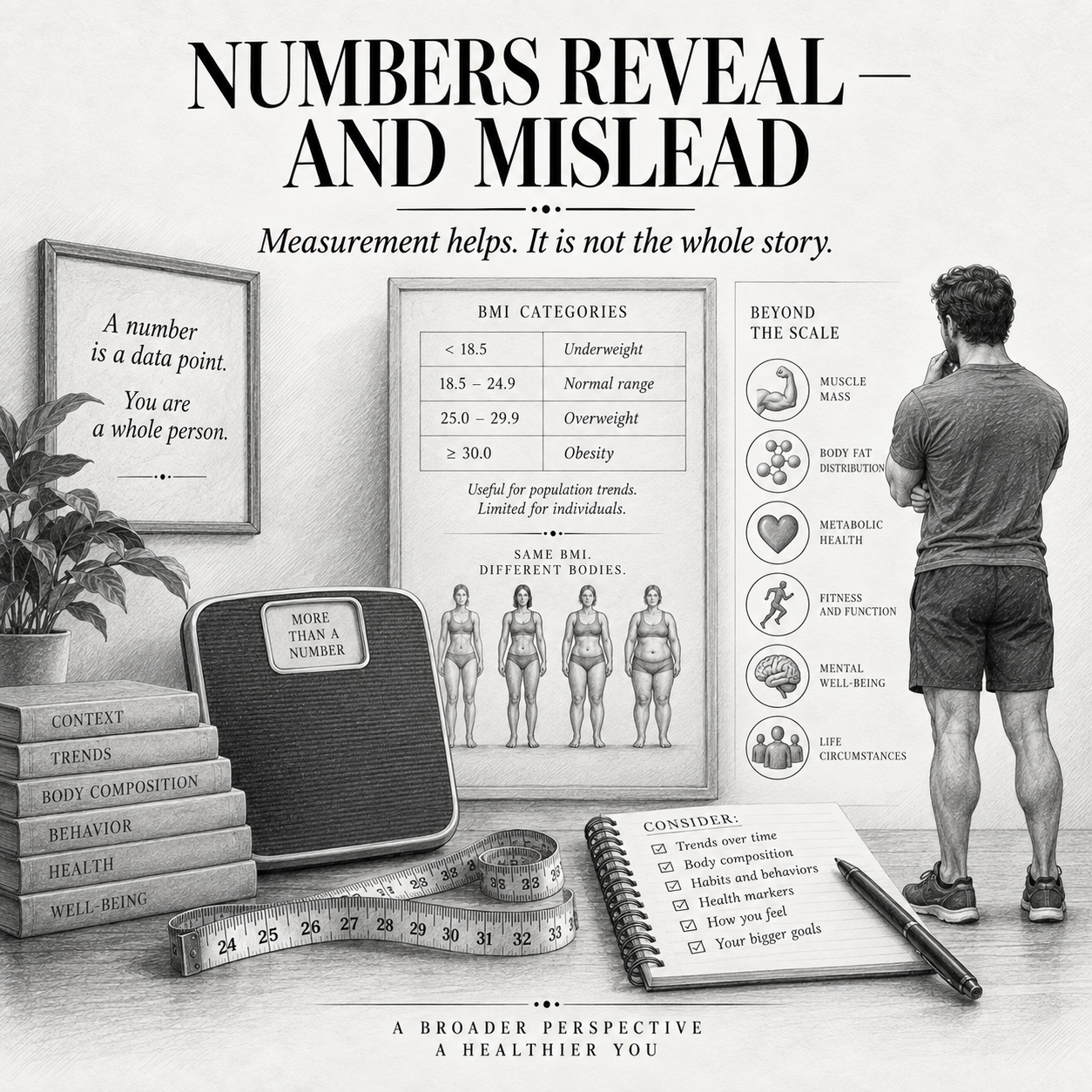
Weight creates another psychological trap because numbers appear objective.
A scale gives a number.
BMI gives a category.
A consumer device may provide body-fat and visceral-fat estimates with impressive-looking precision.
Numbers are useful. They also come from methods, assumptions, and measurement error.
BMI can provide useful population-level risk information while remaining less specific for muscular individuals. Consumer body-composition devices can measure weight reasonably well while estimating composition much less accurately. Waist measures, imaging, body-composition techniques, laboratory values, symptoms, medical history, and physical function answer different questions.
The appropriate response to an imperfect measure is rarely to discard measurement altogether.
It is to understand what the measure can and cannot tell us.
That lesson was especially important for someone like me because I had once had a legitimate reason to distrust a weight category. I later had to recognize that being right about the limitation of one measure did not make every contradictory signal irrelevant.
Other People See a Body. They Do Not See the Causal History.
This is where the book becomes a story about stigma as much as physiology.
People can look at a body and infer laziness, lack of discipline, ignorance, gluttony, weakness, or indifference to health.
I know because I once made versions of those judgments myself.
The body is visible.
The causal history is not.
An observer does not see the accumulation of ordinary decisions, changing responsibilities, appetite, sleep, pain, medications, environment, prior weight-loss attempts, family context, biological responses, financial constraints, or the psychological effects of repeated loss and regain.
That does not mean every causal explanation applies to every person.
It means body size does not provide enough evidence to infer character.
That was one of the hardest corrections for me because it required more than learning a scientific fact.
It required admitting that I had been wrong about people.
Losing Weight Is Not Gaining It in Reverse
This idea became the subtitle because it captures one of the central mistakes in the way weight is discussed.
If weight accumulated gradually through small shifts in intake, activity, schedule, appetite, environment, and life circumstances, it is tempting to assume that reversal simply requires running the same process backward.
The biology and psychology of weight loss are more complicated.
A smaller body generally requires less energy than a larger one. Appetite can change after weight loss. Energy expenditure can adapt. Food cues do not disappear because weight has been lost. Family schedules remain. Restaurants remain. Stress remains. Habits and rewards remain. The environment usually does not lose weight with the person.
This is the boundary behind another metaphor I use in the book:
Fat is like glue.
The phrase does not mean adipose tissue literally behaves like adhesive, and it does not mean weight loss is impossible. It describes persistence across a system involving appetite, habits, portions, movement, schedule, reward, identity, pain, environment, and physiological responses to reduced weight.
Gain can occur while attention is elsewhere.
Sustained loss usually requires continuing attention.
That asymmetry changed how I understood both my own experience and the experience of people I had once judged.
Maintenance Is Its Own Job
Losing weight and maintaining lost weight should not be treated as the same behavioral task.
During active loss, progress itself can reinforce behavior. The scale changes. Clothes change. Movement changes. Other people may notice. The goal has momentum.
Maintenance is quieter.
The visible reward becomes ordinary while many of the behaviors that helped produce the result still require repetition.
Research on long-term weight management shows substantial variation. Regain is common, but long-term maintenance is possible, and no single percentage should be treated as an inevitable forecast for an individual. The book uses this evidence to make a simpler psychological point: the skills that produce change are not automatically the systems that preserve it.
That distinction matters in many areas of life.
Achievement and maintenance are different jobs.
Treatment Changed One of the Conditions Under Which Choice Operated
My own experience also forced me to reconsider the relationship between agency and treatment.
The book discusses my experience with an appetite-modifying product represented to me as retatrutide. The manuscript is explicit that this personal account is not a recommendation, does not establish the identity, purity, potency, sterility, dose, or safety of the material I received, and does not make an investigational product equivalent to anything studied in controlled clinical trials. The edition records its regulatory status as of the manuscript's August 25, 2026 research cutoff.
The psychologically important part of the experience was what happened to my understanding of control.
When hunger became quieter, a decision that had previously required repeated effort became easier.
My character had not suddenly improved.
My intelligence had not changed.
My moral worth had not increased.
One condition under which agency operated had changed.
That experience helped me understand something I had previously underestimated: control is not simply present or absent. Its range can expand or contract according to biology, environment, treatment, money, time, sleep, pain, support, and other conditions.
That does not eliminate responsibility.
It makes responsibility more accurate.
Agency Without Blame
The argument about weight is often forced into two equally unhelpful positions.
One says the person chose the body and therefore deserves blame.
The other says biology caused the body and therefore the person has no meaningful agency.
I reject that binary.
Choices matter.
Energy balance matters.
Food matters.
Movement matters.
Health conditions matter.
Medication can matter.
Sleep can matter.
Pain can matter.
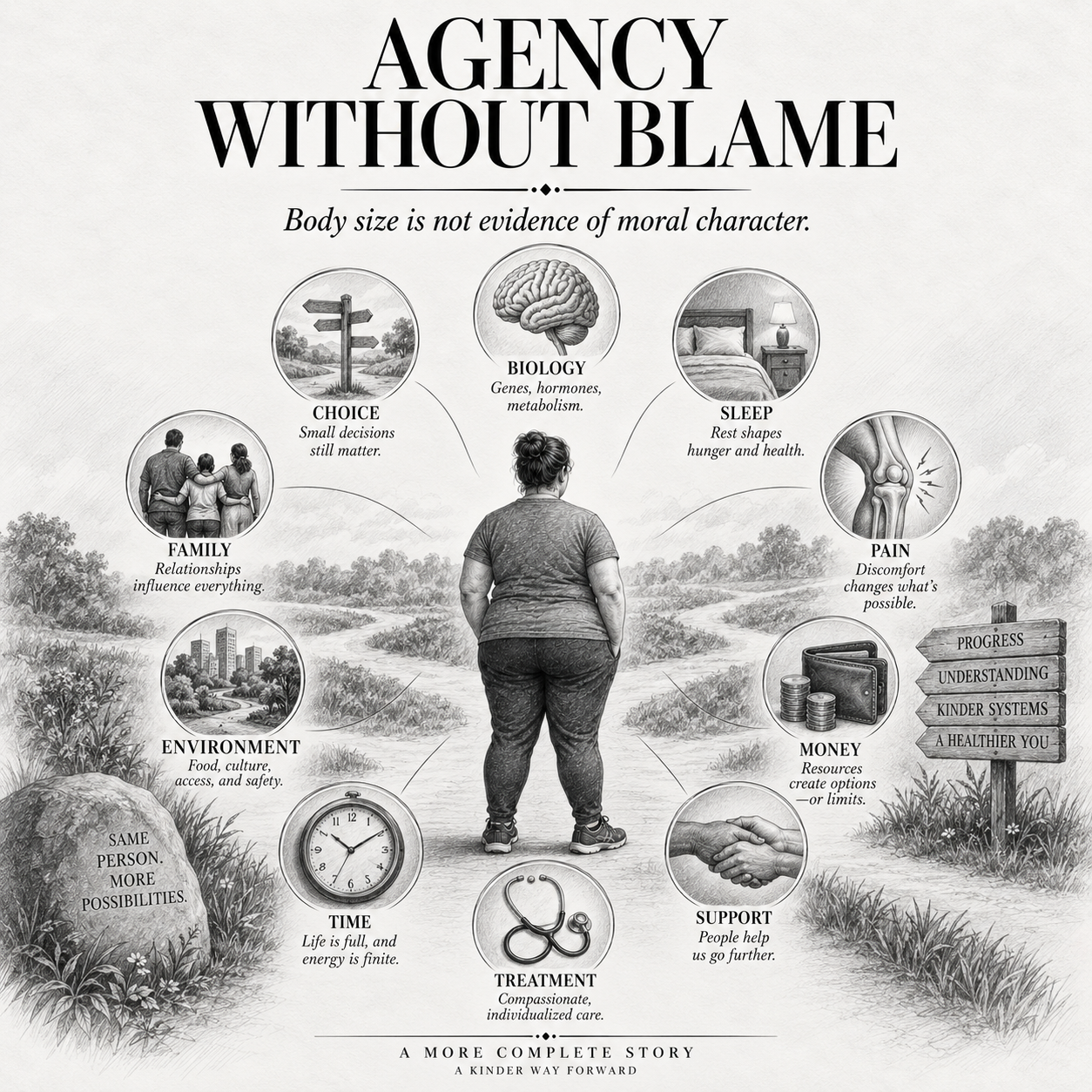
Environment, income, schedule, family, history, biology, access to care, and appetite can matter too.
Those statements can coexist.
The manuscript calls the resulting position Agency Without Blame. Responsibility becomes more useful when it faces forward and asks what can be changed rather than looking backward for evidence of moral failure.
A person can make a choice without choosing every condition under which that choice occurs.
That may sound obvious.
It completely changes the moral story.
A Body Is Not a Moral Résumé
This became one of the central conclusions of the book.
Body size can carry information relevant to health.
It cannot tell you whether someone is intelligent.
Whether they love their children.
Whether they work hard.
Whether they are disciplined in every other part of life.
Whether they have tried to lose weight before.
Whether they are currently trying.
Whether they have pain.
Whether medication affects their weight.
Whether they sleep enough.
Whether they can afford particular food or treatment.
Whether the person standing in front of you has already lost forty pounds.
The body is evidence of a body.
Turning it into evidence of moral character is an additional inference.
I used to make that inference with confidence.
Living through the experience destroyed my confidence in it.
Compassion Does Not Require Pretending Health Does Not Matter
I also reject the idea that reducing stigma requires pretending body fat has no potential health consequences.
That would replace one distortion with another.
Excess adiposity can matter medically. Distribution can matter. Metabolic health can matter. Mobility can matter. Liver health can matter. Pain, sleep, glucose regulation, cardiovascular risk, and other factors may matter according to the individual.
Compassion and accuracy are compatible.
A person can pursue better health without accepting humiliation as treatment.
A clinician can discuss risk without reducing a patient to body size.
A person can want to lose weight without hating the body they currently inhabit.
And someone can respect themselves while acknowledging that their present condition is not the condition they want to maintain.
The book's position is neither denial nor contempt.
It is honest agency.
The Person I Misjudged
The hardest sentence in this book was not that I became fat.
It was that I had been wrong about people.
When the boundary between my younger athletic identity and the people I judged disappeared, I could have protected the old belief by declaring myself an exception.
My weight gain was complicated.
Theirs was simple.
My family responsibilities mattered.
Their explanations were excuses.
My biology deserved investigation.
Their bodies told me everything I needed to know.
That would have preserved my hierarchy.
I could no longer defend it.
The person outside a larger body sees the finished product. The person inside that body lived the production. I once believed the product told me enough about the person.
Now I think it tells me where inquiry begins.
What Being Fat Means to Me Now
My understanding of the word fat is far less simple than it was at twenty-seven.
It describes tissue and stored energy, but a person's experience of body weight can also involve appetite, satiety, identity, movement, stigma, pain, environment, measurement, treatment, habit, family life, and the long work of maintenance.
That is why the book uses the word directly without using it as an insult.
Fat is not intelligence.
It is not discipline.
It is not dignity.
It is not morality.
And it is not destiny.
People can have meaningful agency over health while body size remains poor evidence of character.
The book ends with a transformation that matters more to me than a number on the scale.
I once looked at people in larger bodies and believed I understood what separated us.
Then I lived inside the experience I had judged from the outside.
The experience did not teach me that choices are irrelevant. It taught me how incomplete my theory of choice had been.
Agency is not blame. Compassion is not denial. Responsibility does not require contempt.
That is what The Psychology of Being Fat is ultimately about.
About the Book
The Psychology of Being Fat: How We Arrive Gradually, Adapt Quietly, and Discover That Losing Is Not Gaining in Reverse is a work of narrative nonfiction combining personal experience, psychological interpretation, and scientific evidence.
Keith Lawrence Miller begins with an uncomfortable confession: as an extraordinarily lean and muscular young man, he interpreted his body as evidence of discipline and larger bodies as evidence of its absence. Decades later, after substantial weight gain and repeated experiences of loss, regain, accommodation, measurement, stigma, changing function, and treatment, the explanation no longer survived his own life.
The book develops interpretive frameworks including Identity Lag, the Former-Self Effect, the Five-Pound Ratchet, the Accommodation Cascade, Fat Is Like Glue, Addicted to the Results, and Agency Without Blame. These are organizing concepts rather than clinical diagnoses. The book distinguishes personal experience from population evidence and does not present one person's sequence as proof of universal causation.
The work is educational and reflective rather than a diet plan or individualized medical guide. Decisions about weight, nutrition, medication, surgery, liver disease, or other health conditions belong with appropriately qualified clinicians.
Keith Lawrence Miller First Edition · 2026 ISBN: 9798194959853 224 pages Source status: Complete