Psychology of Tattoos: The Body as Autobiography
By Keith Lawrence Miller, M.A.
Much of my professional work has centered on identity: how people understand who they are, how they explain who they have been, and how they make sense of the person they are becoming.
Tattoos interested me because they place that process directly on the body.
Most expressions of identity can be changed quickly. Clothes can be replaced. A job title disappears when someone changes careers. A house can be sold. Photographs can be stored away. Social-media profiles can be rewritten overnight.
A tattoo creates a different relationship with time. Someone makes a decision at one point in life and asks the body to continue carrying that decision after the circumstances, relationships, beliefs, priorities, and even the person who made it may have changed.
That makes the tattoo psychologically interesting.
I did not write Psychology of Tattoos to tell people what their tattoos mean. The book was created to improve the quality of the questions we ask about them. It rejects two shallow interpretations that have followed tattooing for generations: treating the marked person as psychologically suspect, and treating every tattoo as meaningless decoration. The book takes the wearer seriously enough to assume that a permanent choice may contain information while remaining disciplined enough to avoid pretending that an outsider can decode a person from an image.
That distinction governs everything that follows.

A Tattoo Is a Decision Before It Is a Symbol
We usually begin with the image.
A name, date, cross, portrait, animal, flower, set of coordinates, phrase, religious symbol, military insignia, or a child's handwriting may be what the observer can see.
Psychologically, however, the image may be only the visible endpoint of a much larger decision.
Someone first considered making a mark permanent. They selected one image from countless alternatives. They chose placement, size, visibility, style, color, timing, and the degree of permanence they were willing to accept. They spent money, tolerated pain, cared for the wound, and then continued carrying the result into work, relationships, family life, aging, and whatever came next.
Even a spontaneous tattoo has a context.
That context may involve celebration, grief, intoxication, rebellion, love, belonging, aesthetic experimentation, spirituality, friendship, identity, impulse, or simply the desire to mark a particular moment.
The tattoo therefore gives us something worth examining.
It does not give us permission to invent the answer.
Permanence Meets a Changing Self
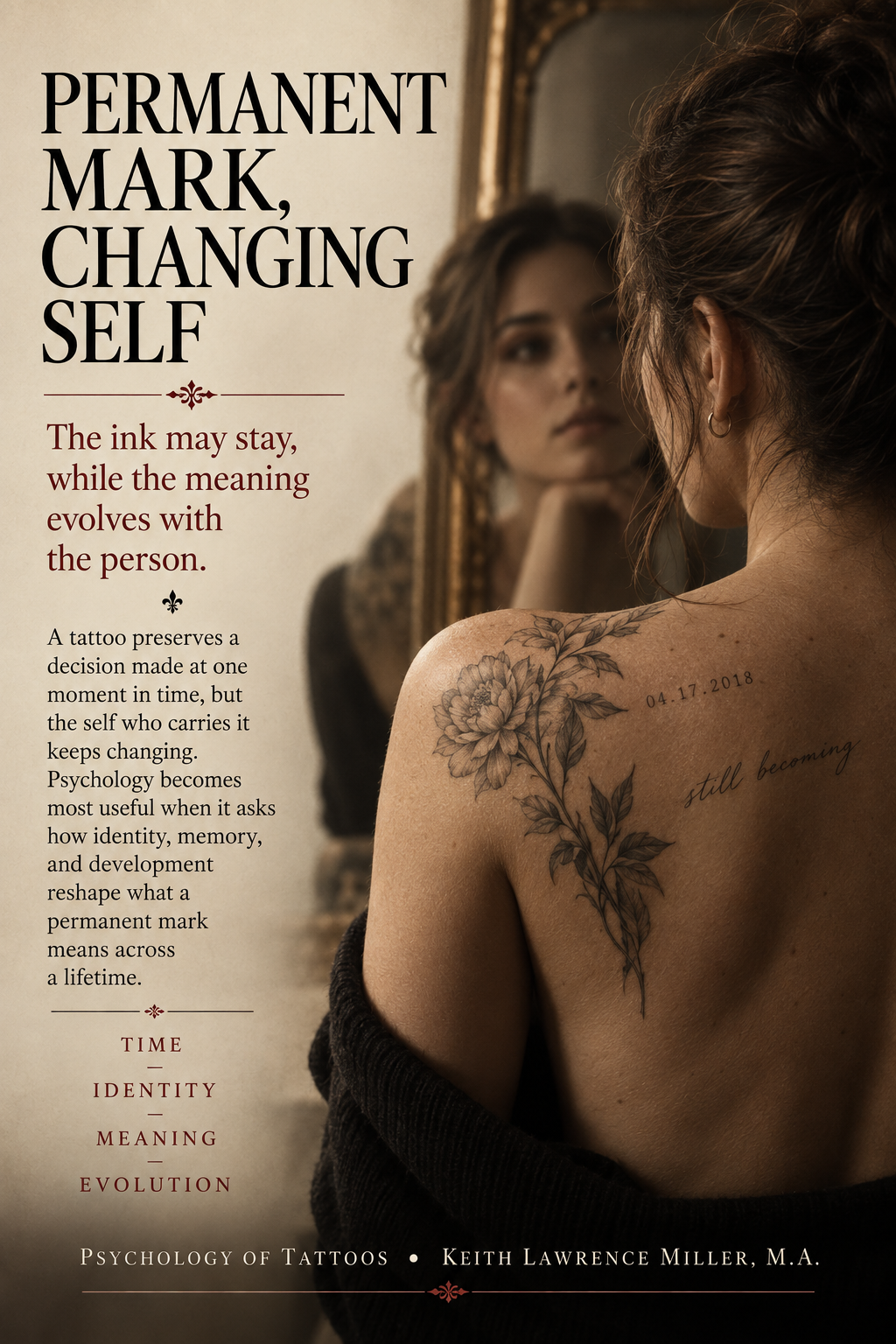
One of the central tensions in the book is simple: the ink may remain relatively stable while the person continues developing.
The person who chooses a tattoo at nineteen is not psychologically identical to the person carrying it at forty-nine.
That does not make the earlier self foolish.
Development works this way.
At one stage of life, a relationship may feel permanent. A belief may appear unquestionable. A profession may seem central to identity. A friendship may feel like family. A spiritual commitment may organize the world. A loss may feel impossible to survive. A victory may seem like the defining achievement of a lifetime.
When someone places that meaning on the body, the tattoo becomes evidence of what mattered deeply enough at that time to deserve permanence.
That is why I think the chooser matters as much as the symbol.
The same image worn by two people can have completely different psychological meanings because the histories producing those choices are different.
And the same tattoo can mean something different to one person twenty years later without the ink changing at all.
The Body Can Become an Autobiography
We normally keep our histories outside ourselves.
Photographs go into albums. Letters go into boxes. Awards hang on walls. Important documents are stored. Keepsakes preserve relationships. Religious objects preserve sacred commitments.
Tattoos move some of that archival function onto the body.
A date can preserve a birth or a death.
Coordinates can preserve a place.
A signature can preserve a person.
A memorial portrait can maintain a relationship with someone who is gone.
A symbol can preserve a faith, nationality, military experience, cultural affiliation, recovery milestone, family lineage, or private promise.
A collection of tattoos can therefore begin to resemble an autobiography written nonchronologically across the skin.
A mark can hold the past while also making a declaration about the self who carries it in the present.
That does not mean every tattoo contains profound symbolism.
It means the possibility of meaning deserves inquiry before dismissal.
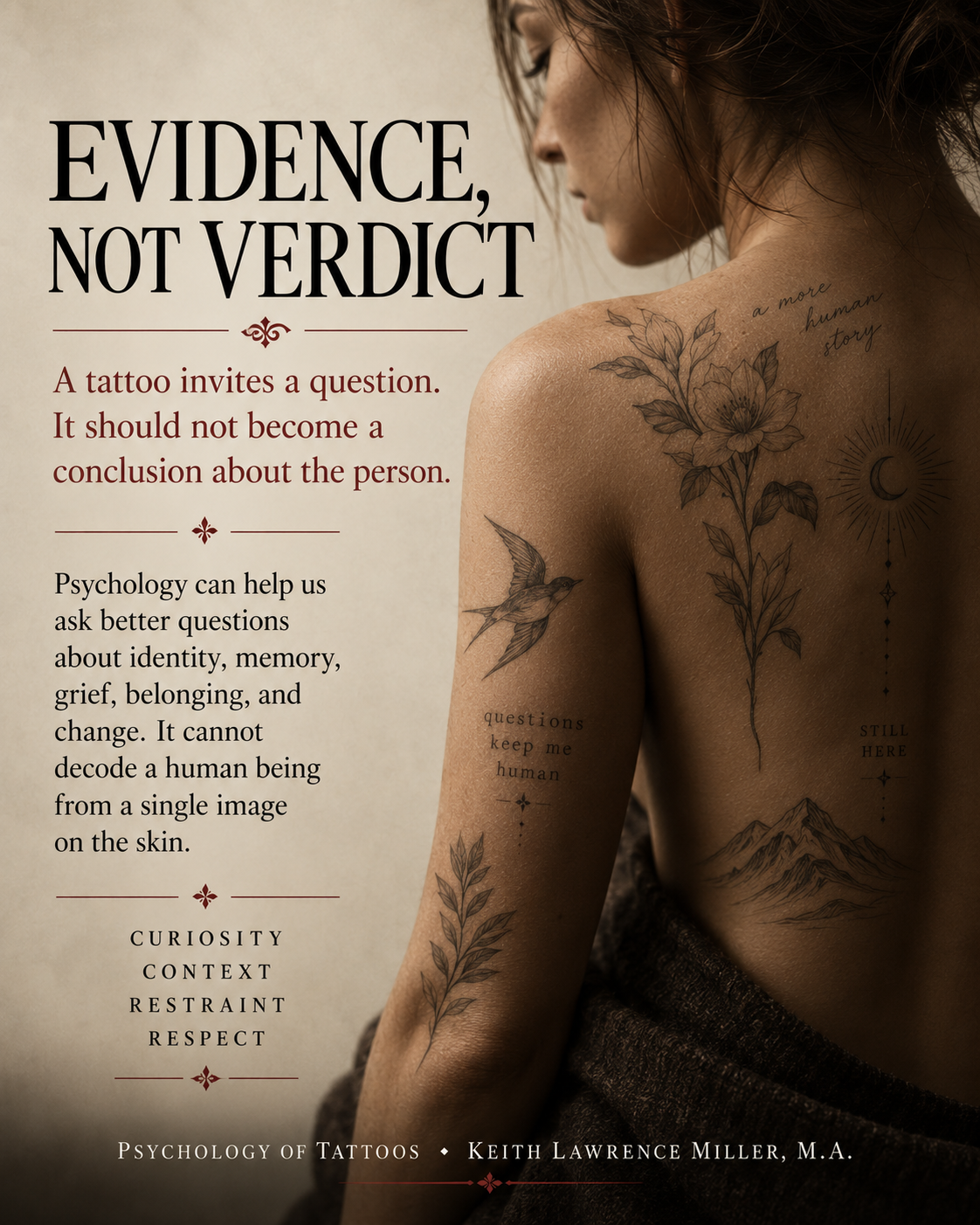
Evidence Is Different From Verdict
This may be the most important methodological rule in the book.
A tattoo is evidence.
Evidence allows us to ask a question.
A verdict pretends the question has already been answered.
A skull does not prove aggression.
A religious symbol does not prove devotion.
A memorial tattoo does not tell us the quality of the relationship being remembered.
A scattered collection does not prove psychological instability.
A hidden tattoo does not prove shame.
A highly organized sleeve does not prove an organized personality.
An impulsive tattoo does not establish an impulsive person.
The interpretation becomes stronger only when the wearer supplies the missing context.
This is particularly important because psychology can become dangerous when people learn enough terminology to sound sophisticated while making unsupported judgments.
A stranger's skin should never become a projective test.
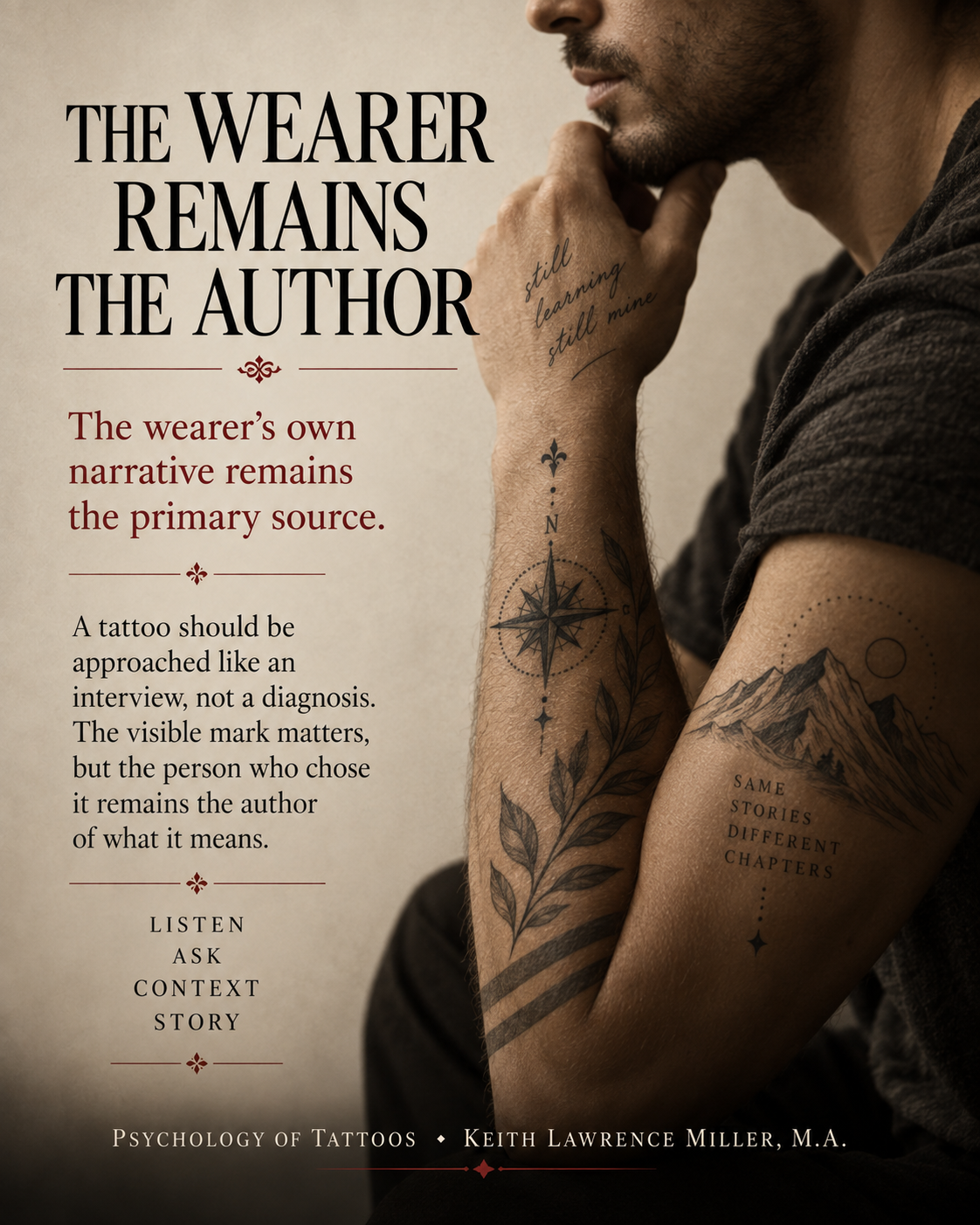
The wearer remains the primary source.
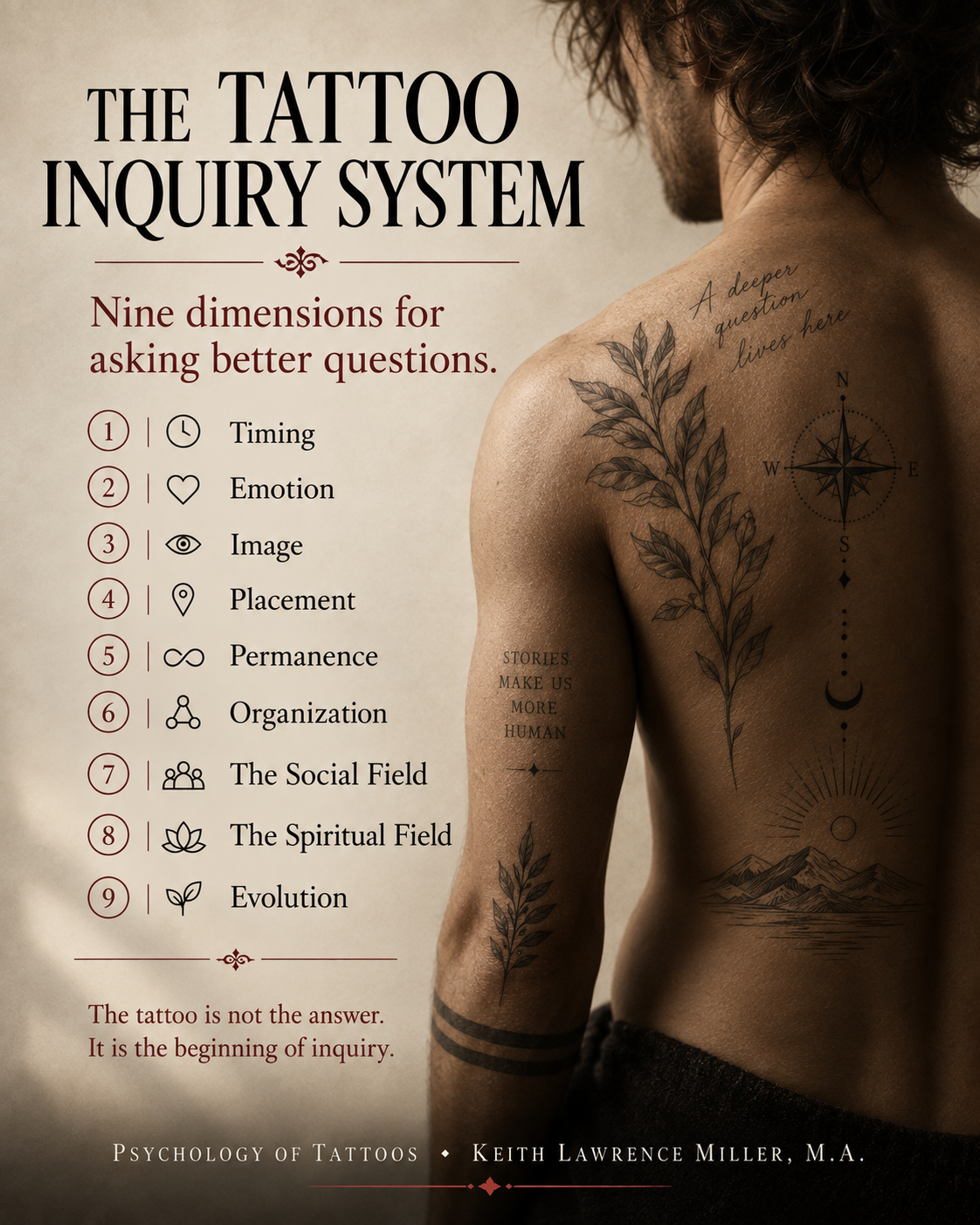
The Tattoo Inquiry System
To make that discipline practical, I developed the Tattoo Inquiry System around nine dimensions. None produces an answer by itself. Together they create a structured way to understand the story surrounding a mark.
- Timing: When was the tattoo chosen, and what was happening in the person's life?
- Emotion: What emotional state surrounded the decision?
- Image: Why this particular symbol, word, figure, date, or design?
- Placement: Why was this part of the body chosen, and was visibility important?
- Permanence: Why did this meaning need to become permanent?
- Organization: How does the mark relate to the person's other tattoos, if any?
- Social Field: Who was the tattoo meant for—the wearer, a relationship, a group, the dead, the public, or someone else?
- Spiritual Field: Did the wearer experience the mark as ordinary, sacred, protective, devotional, ancestral, or spiritually significant?
- Evolution: What did the tattoo mean when it was created, and what does it mean now?
The system is intentionally built around questions because the person wearing the tattoo has information the observer does not.
That information changes everything.
Memory Can Be Carried on the Skin
Memory is one of the strongest themes in the book.
People are surrounded by ways to preserve memory, yet tattoos create an unusual form of remembering because the reminder travels with the body.
A memorial tattoo may become part of grief.
A parent's handwriting may preserve a relationship.
A date may hold an event whose meaning outsiders could never infer from the numbers.
A scar incorporated into a tattoo may transform the meaning of an injury or surgery.
A symbol chosen after recovery may preserve evidence of survival.
None of these marks tells us exactly how the wearer feels today.
The mark tells us that a moment became significant enough to be carried forward.
That difference matters.
Psychology should help us understand the function of memory without reducing the mark to a symptom.

Trauma Should Never Be Assumed From Ink
The relationship between tattoos and trauma requires particular caution.
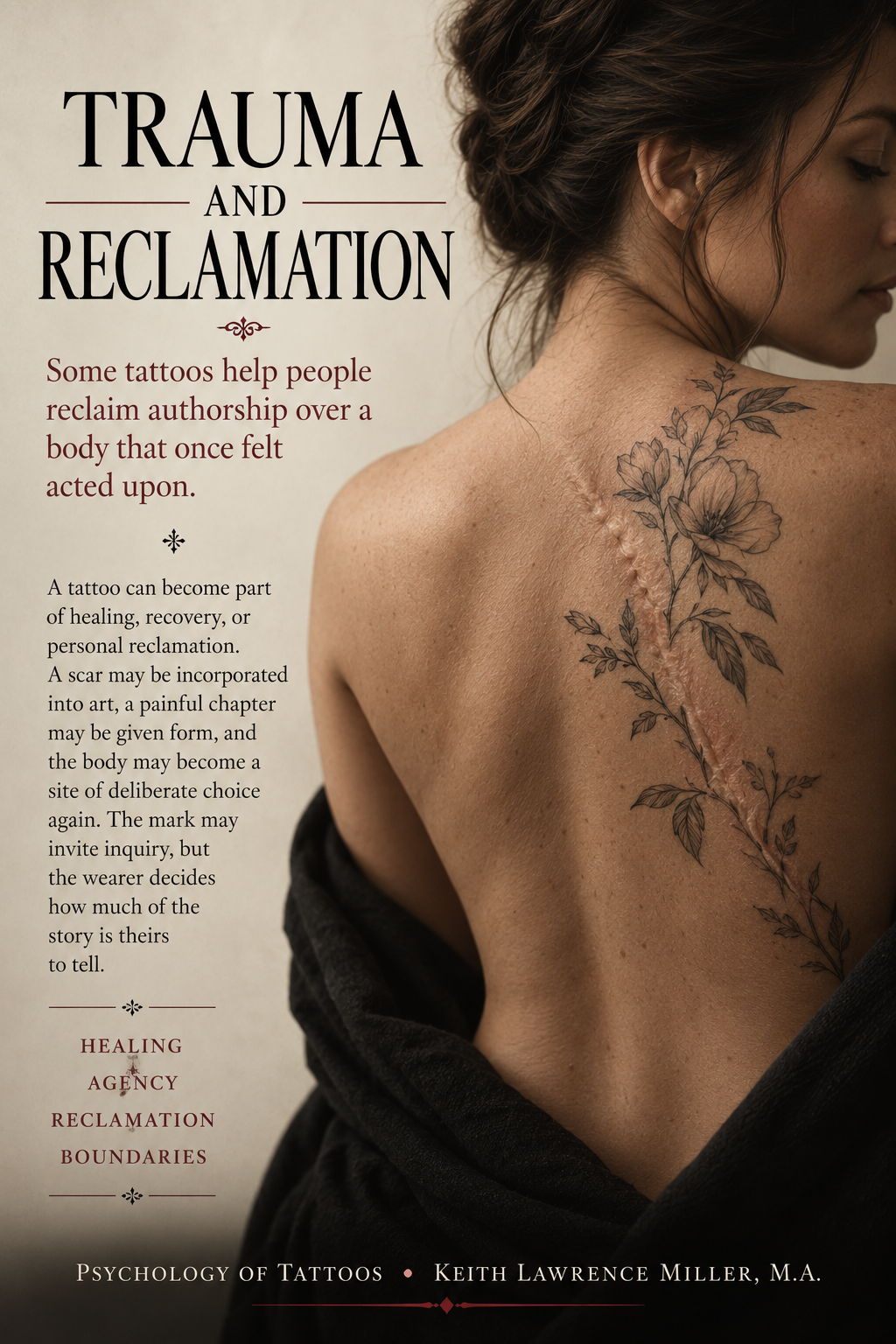
Some people use tattoos as part of reclamation after trauma, violence, illness, surgery, self-harm, grief, or major bodily change.
The tattoo may give someone greater authorship over a body that previously felt acted upon.
A scar becomes incorporated into art.
A painful event receives a boundary.
A body associated with vulnerability becomes a site of deliberate choice.
Those experiences deserve serious attention.
They do not justify looking at a tattooed stranger and inferring trauma.
The same image could arise from entirely different histories.
Even imagery that appears dark, violent, or painful does not reveal whether the person chose it from trauma, aesthetic preference, spirituality, music, humor, cultural symbolism, personal history, or some combination.
Trauma-informed interpretation begins with restraint.
The mark may open a door to conversation.
The wearer decides whether that door leads anywhere.
Grief Changes the Meaning of Permanence
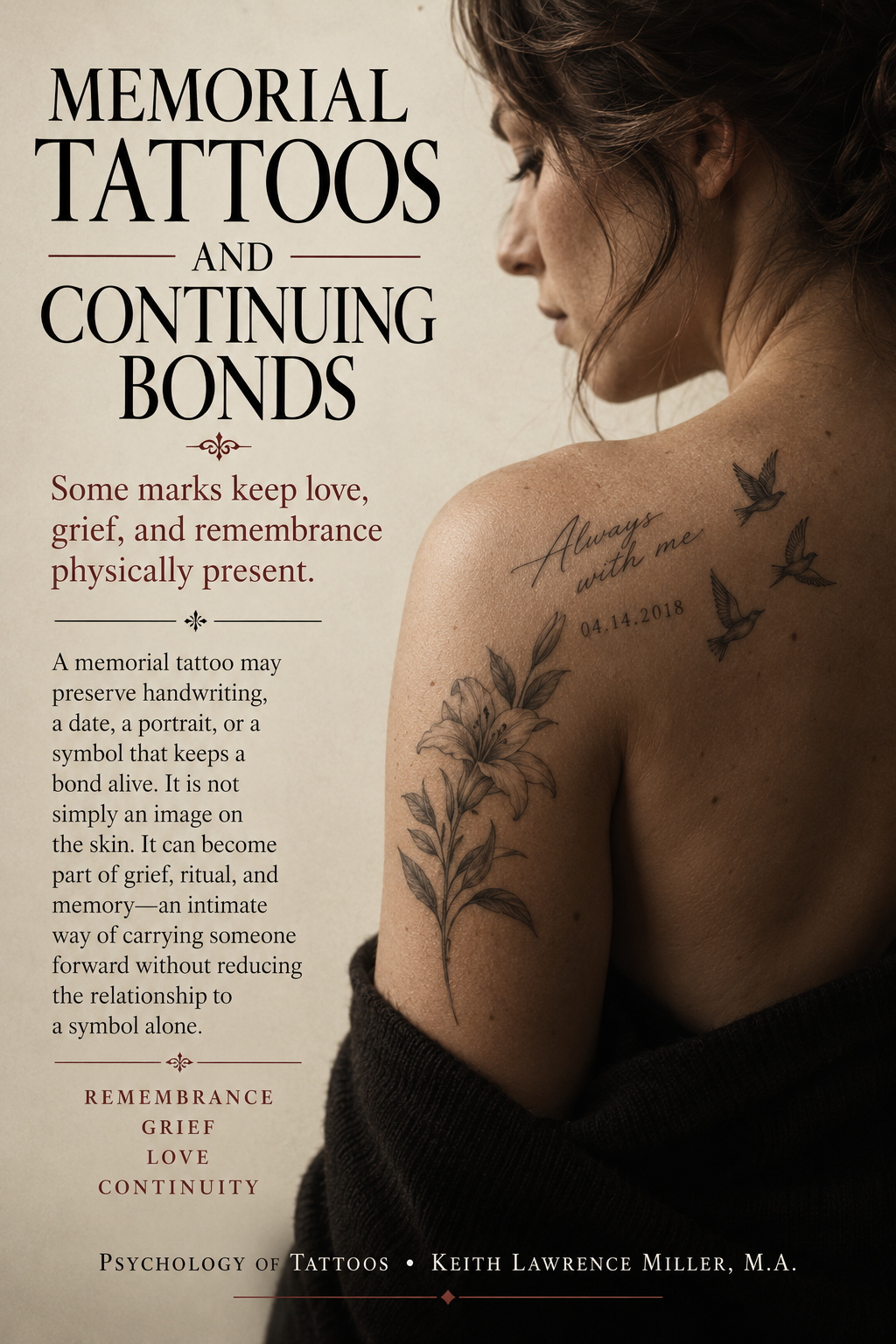
Memorial tattoos reveal another important psychological function.
Grief does not necessarily involve severing every internal relationship with someone who died.
People continue relationships through memory, ritual, stories, objects, photographs, anniversaries, prayer, places, and inherited practices.
A tattoo can become part of that continuing bond.
This helps explain why a person's handwriting, portrait, date, phrase, or symbol may carry emotional weight far beyond its visual content.
The tattoo makes absence physically present.
The wearer may touch it, see it every morning, show it selectively, protect it from interpretation, use it during anniversaries, and allow its meaning to change as grief changes.
Psychological explanation can help us understand these processes.
It should never cheapen them by pretending the tattoo can be understood independently of the relationship.
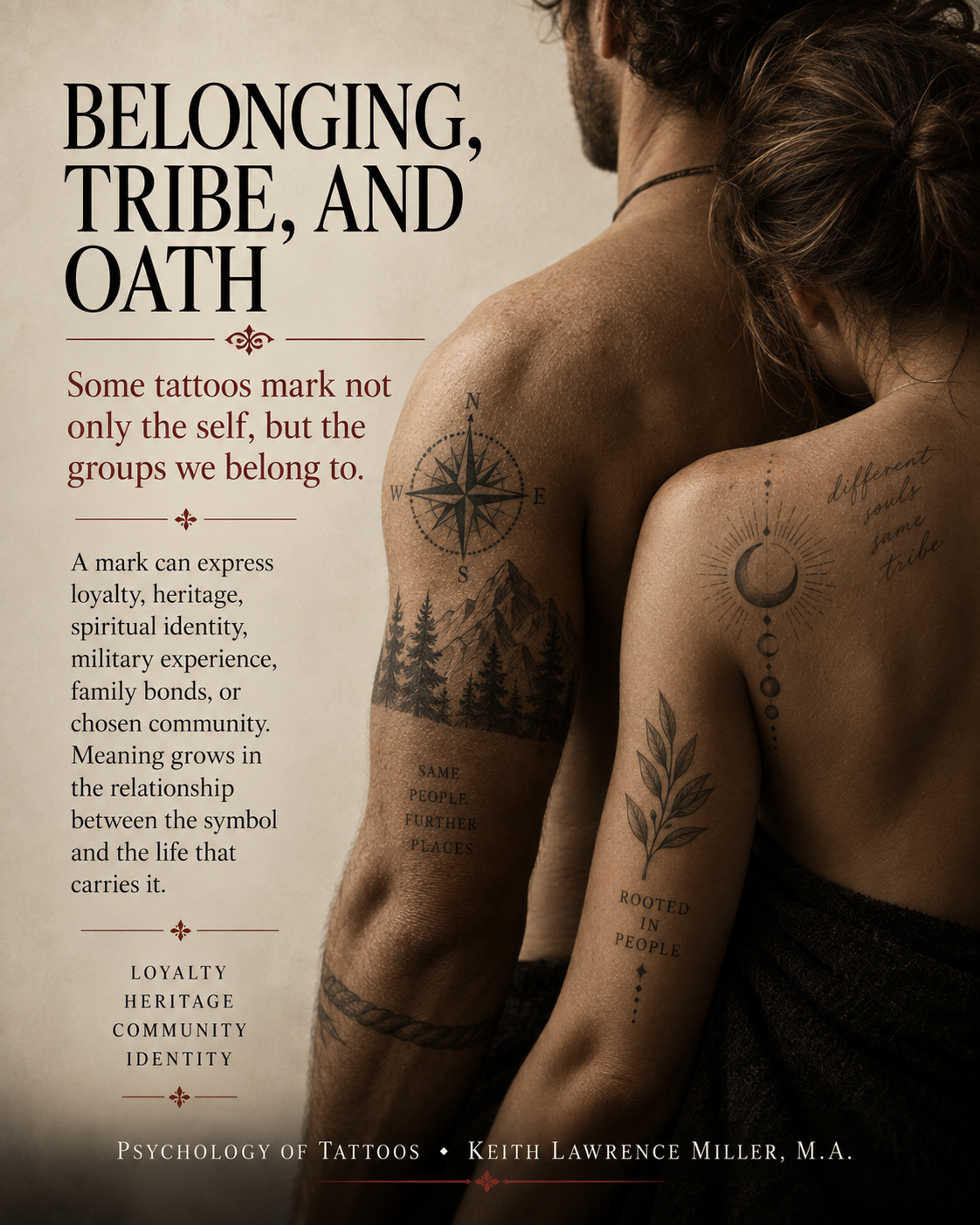
Tattoos Can Mark Belonging
Identity is partly individual and partly social.
People define themselves through families, professions, religions, communities, military units, neighborhoods, nations, teams, movements, friendships, and cultural traditions.
Tattoos can make those memberships visible.
A group symbol may communicate loyalty.
A family name may communicate lineage.
Matching tattoos may preserve a relationship.
A military mark may connect someone to service and shared experience.
A sacred symbol may connect the wearer with a tradition extending far beyond individual identity.
Belonging can be psychologically protective.
It can also create obligation, hierarchy, expectation, and pressure.
That is why group tattoos should be understood in their social context rather than treated simply as signs of conformity.
The question remains the same:
What did this mark mean to the person who chose it?
Sacred Marks Require Cultural Humility
Some tattoos occupy cultural or spiritual traditions in which the mark has meaning that cannot responsibly be separated from history, ritual, ancestry, authority, or community.
An outsider may recognize the image while completely misunderstanding the practice.
This is where interpretation requires cultural humility.
A symbol can carry religious significance.
A placement may have traditional meaning.
The right to wear a mark may be connected to lineage, initiation, status, ritual, gender, achievement, protection, or community authority.
A psychological interpretation should not erase those dimensions.
Nor should psychology treat sacred meaning as merely a disguised symptom.
The wearer may understand the mark simultaneously as identity, spirituality, ancestry, protection, memory, and responsibility.
Human beings do not experience these categories as neatly as academic disciplines sometimes divide them.
Visibility Is Its Own Decision
Placement deserves more attention than it usually receives.
A tattoo on the hand enters public interaction immediately.
A tattoo beneath clothing may remain private for years.
A mark can be displayed deliberately, revealed selectively, or protected from casual observation.
Hidden tattoos are especially easy to misinterpret.
Concealment can reflect shame.
It can also reflect privacy, professional considerations, intimacy, safety, reverence, or the belief that something meaningful should not be available to every observer.
The same behavior can therefore come from opposite psychological meanings.
Again, the image cannot answer the question without the person.

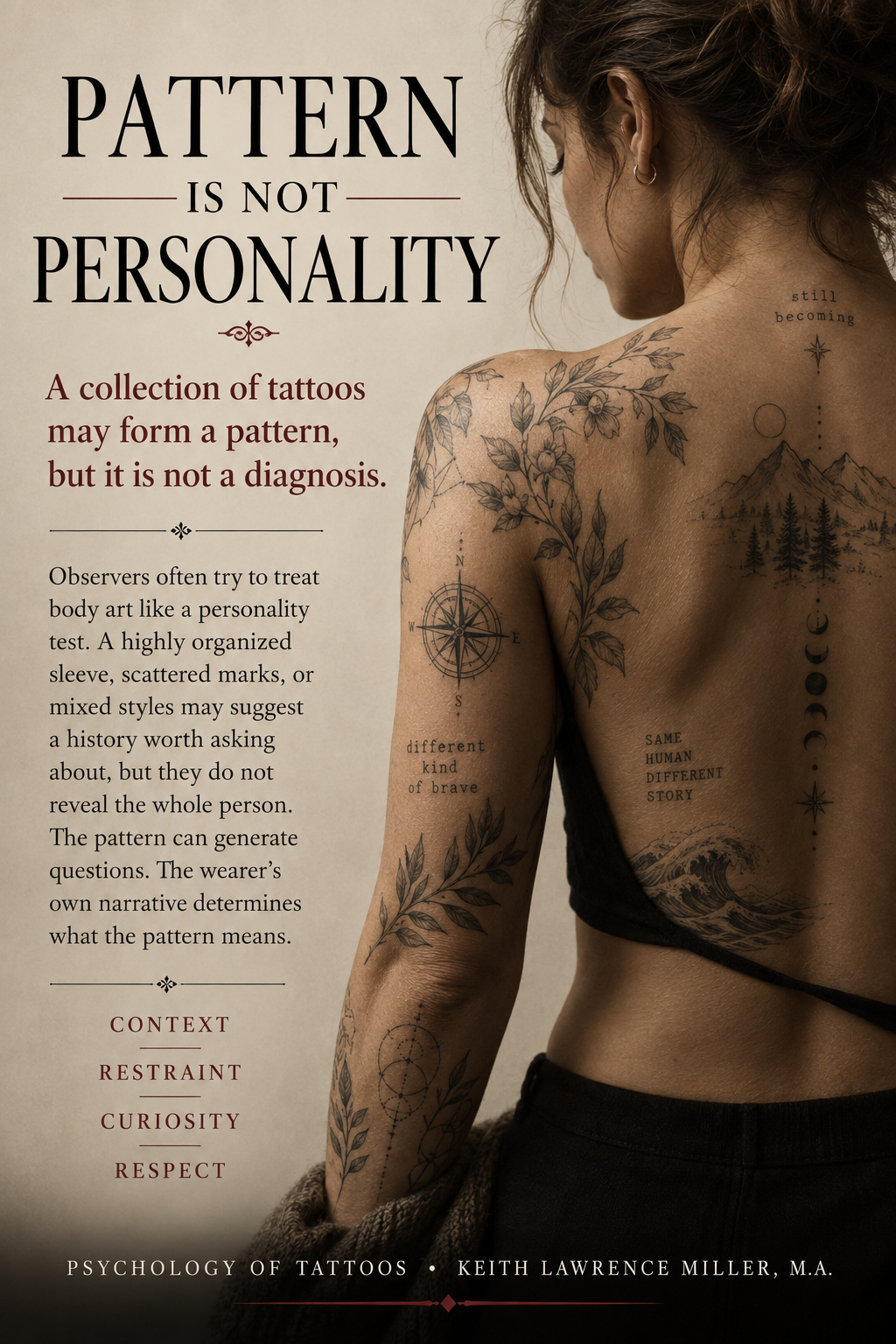
A Collection Is a Pattern, Not a Personality Test
Once someone has many tattoos, observers often begin interpreting the collection.
A carefully designed body suit can appear intentional and controlled.
A collection accumulated across decades may contain different artists, styles, colors, qualities, subjects, and levels of completion.
The temptation is obvious.
The organized body belongs to an organized person.
The scattered body belongs to a chaotic person.
That conclusion exceeds the evidence.
A changing tattoo style may reflect changing taste.
Different artists may reflect different cities or financial circumstances.
Unfinished work may reflect cost.
Cover-ups may document changing identity.
A scattered pattern may reflect spontaneity, experimentation, or a life lived in distinct chapters.
The pattern is worth noticing.
It is never enough to diagnose the person.
Organization on the skin can generate hypotheses, while the wearer's account determines whether those hypotheses have any relationship to the life.
Regret Does Not Erase the Meaning the Tattoo Once Had
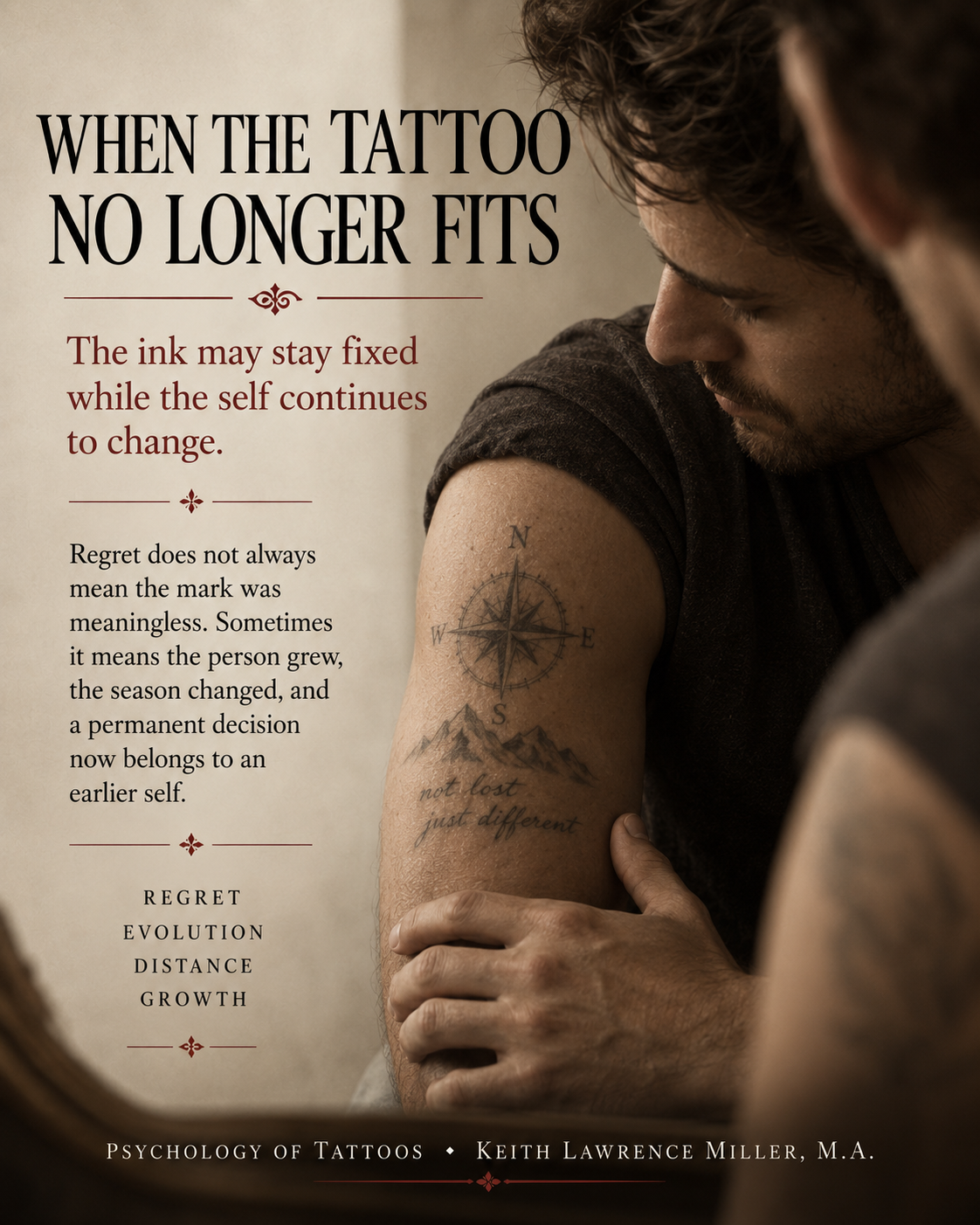
Regret may be one of the most psychologically revealing parts of tattooing.
A person looks at a tattoo they chose years earlier and realizes it no longer fits.
The easy conclusion is that the original decision was meaningless or foolish.
Sometimes that is accurate.
Other times the tattoo fit perfectly when it was chosen.
The person changed.
A former partner's name once represented love.
A religious symbol once represented conviction.
A political or cultural identity once provided belonging.
A phrase once captured exactly what the person needed to believe.
Years later, the fixed mark remains while the psychological self has continued moving.
Regret can therefore represent poor judgment, developmental change, painful memory, changing privacy needs, or an identity that has evolved beyond what the tattoo expresses.
That gap between permanent ink and an evolving self is central evidence rather than proof that the original mark meant nothing.
That distinction allows people to respect who they were without requiring themselves to remain that person forever.
Removal and Cover-Ups Are Also Acts of Meaning
Changing or removing a tattoo does not necessarily destroy the story.
It may become the next chapter.
A cover-up can reclaim an image associated with a former relationship.
Removal can represent separation.
An altered design can integrate an earlier identity with a newer one.
A tattoo can even remain physically unchanged while its meaning is psychologically rewritten.
The body is stable enough to carry history and flexible enough for history to be reinterpreted.
That is why I resist treating tattoos as frozen psychological statements.
The ink may be fixed.
Meaning remains alive.
What Psychology Can Responsibly Say
Psychology can help us examine why human beings externalize identity, preserve memories, seek belonging, ritualize transitions, mark grief, assert autonomy, reclaim the body, protect sacred meaning, and use symbols to organize experience.
It can also help us ask whether a choice was impulsive or deliberative, private or social, identity-building or memory-preserving.
Those are legitimate areas of inquiry.
Psychology cannot look at a tattoo and reliably tell us who the person is.
It cannot assign a personality type from body art.
It cannot determine trauma from symbolism.
It cannot infer emotional intelligence from a sleeve.
It cannot diagnose pathology from placement, quantity, darkness, organization, or aesthetic style.
That limit makes the inquiry more interesting, not less.
Once we stop pretending the tattoo contains a secret code, we become free to ask about the life that produced it.
The Question I Would Ask Before Interpreting Any Tattoo
The most important shift in the book is methodological.
Instead of asking, “What does that tattoo mean?”, I would ask:
“What did it mean to you when you chose it?”
Then I would listen.
That question gives the person authority over their own story while still allowing serious psychological exploration.
From there we can ask about timing, emotion, placement, permanence, belonging, spirituality, memory, change, and the relationship between the person who chose the tattoo and the person carrying it now.
That process produces something far more valuable than decoding.
It produces understanding.
The Skin Remembers
The body moves through time differently from memory.
We forget details.
Relationships change.
Places disappear.
Careers end.
People die.
Beliefs evolve.
The body ages while carrying evidence of versions of ourselves that once felt permanent.
A tattoo makes that tension visible.
The mark may preserve love, loss, belonging, faith, defiance, survival, humor, aesthetic preference, a private promise, a bad decision, or a beautiful one.
Often, several meanings can occupy the same mark across one lifetime.
That is why I ultimately think of the tattooed body as a form of autobiography.
An autobiography cannot be understood by staring at one sentence and guessing the rest of the book.
You have to ask about the life.
The tattoo is evidence. The wearer remains the author.
About the Book
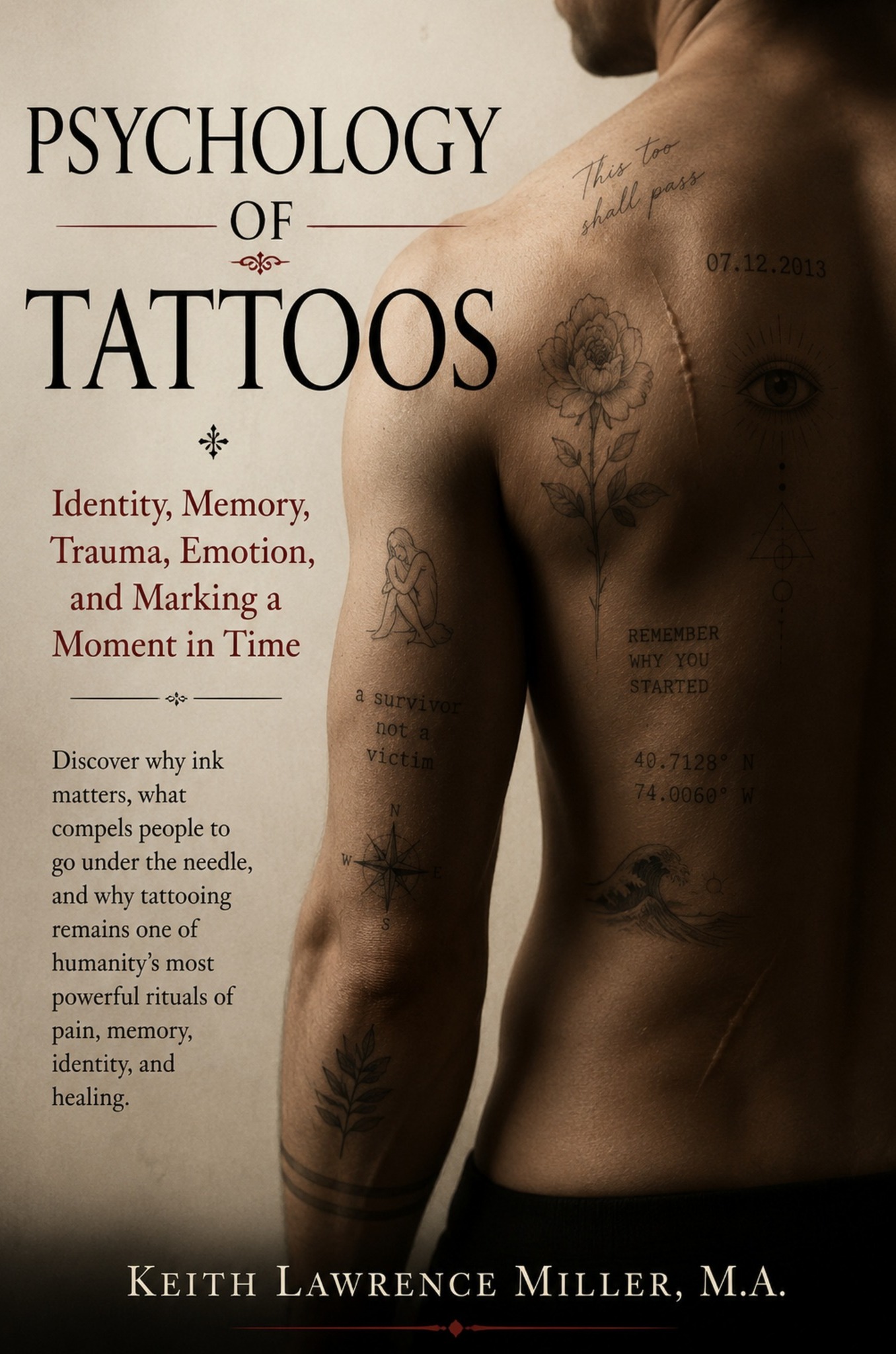
Psychology of Tattoos: Identity, Memory, Trauma, Belonging, and the Body examines tattooing through identity, memory, emotion, grief, trauma, reclamation, belonging, culture, spirituality, visibility, regret, and personal change.
At the center of the book is the Tattoo Inquiry System, a nine-dimensional framework organized around timing, emotion, image, placement, permanence, organization, social meaning, spiritual meaning, and evolution. It is an interpretive framework rather than a diagnostic instrument.
The book's governing principle is simple: tattoos are meaning-rich human evidence, and the wearer's own narrative remains the primary source for understanding them.
Keith Lawrence Miller, M.A. First Edition · 2026 ISBN: 9798186434887 264 pages Source status: Complete
Educational scope
The book is educational and interpretive, not a substitute for medical or mental-health care. The Tattoo Inquiry System is a reflective framework, not a diagnostic instrument, personality test, validated clinical scale, or forensic tool.