Mind Games: What Feels Obvious Deserves a Second Look
By Keith Lawrence Miller, M.A.
For more than fifteen years, much of my professional work has involved people making consequential decisions: whether to accept an offer, change careers, pursue a promotion, trust an opportunity, hire someone, leave an organization, negotiate compensation, follow a leader, or reconsider what they believe about themselves.
What interested me was how often those decisions were later described as though facts had moved directly into action.
That is rarely how human judgment works.
Between information and action sits an entire psychological system. Attention determines which facts become visible. Memory reconstructs rather than simply retrieves. Emotion changes urgency. Expectations alter interpretation. Context creates reference points. Relationships produce feedback loops. Identity affects which conclusions feel safe to reconsider. Environments make some choices easier than others.
We still make decisions and remain responsible for them. But responsibility becomes more useful when we understand what is participating in the decision.
That is why I wrote Mind Games.
The book examines one hundred psychological phenomena that influence perception, memory, judgment, relationships, money, work, leadership, belief, and everyday behavior. Its purpose is not to turn psychology into a collection of clever labels. It is to make the invisible parts of ordinary judgment more visible.
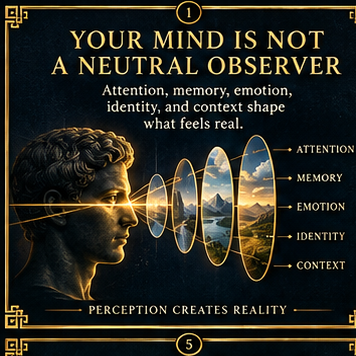
Your Mind Is Not a Neutral Observer
We tend to experience perception as though we are simply looking at the world.
Psychology gives us a more complicated picture.
Before deliberate reasoning begins, attention has already selected part of the available information. Memory has connected the present to previous experience. Emotion has assigned urgency. Identity has made some interpretations more comfortable than others. Context has established the comparisons through which value, danger, success, or failure will be judged.
None of this requires a defective mind.
It is how a functioning mind makes an unmanageable amount of information usable.
Human beings could not give equal attention to every sound, number, face, possibility, memory, threat, opportunity, and interpretation at once. Psychological shortcuts make action possible.
The problem appears when a shortcut that normally helps us operates in an environment where it produces a distorted result—or where someone deliberately designs the environment to exploit it.
The relevant question is therefore not whether we use shortcuts.
We do.
The question is whether we recognize when the shortcut has become a poor guide.
What You Notice Becomes Part of the World You Experience
Consider attention.
A dramatic event receives heavy coverage. You see the image repeatedly. The event becomes easy to recall. Soon the danger can feel much more common than it actually is.
That does not mean the danger is imaginary.
It means vivid examples and representative rates answer different questions.
This is where the availability heuristic becomes useful. Ease of recall can influence our judgment about frequency, probability, or importance. Something that comes readily to mind may feel common partly because it is memorable.
The same mechanism appears outside danger.
A dramatic investment success can distort expectations about ordinary returns. A memorable hiring failure can cause a leader to overcorrect future selection decisions. A single terrible customer experience can begin representing an entire company.
The disciplined response is not to distrust experience.
It is to give experience a denominator.
How common is this?
Compared with what?
Over what period?
What happens when the vivid case is placed beside representative data?
That small addition can substantially change judgment.
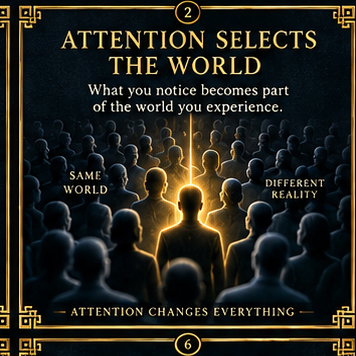
Once We Start Looking for Something, We Find More of It
The frequency illusion demonstrates another feature of attention.
Learn the name of an unfamiliar concept and suddenly it seems to appear everywhere.
Consider buying a particular car and suddenly the roads seem filled with that model.
Learn about a psychological phenomenon and you may begin identifying it in every conversation.
The world may have changed.
More often, your attention changed first.
That distinction matters because people can mistake increased noticing for increased prevalence.
Psychological literacy can actually worsen this problem if we are careless.
Once someone learns the vocabulary of psychology, nearly every difficult person can suddenly appear “narcissistic,” every disagreement can become “gaslighting,” and every mistake can acquire a diagnostic-sounding explanation.
That is precisely the wrong use of psychological knowledge.
A term should help us investigate a pattern.
It should not end the investigation.
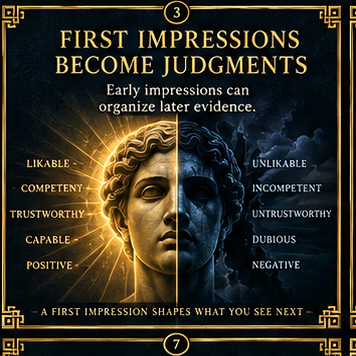
First Impressions Acquire More Authority Than They Deserve
Human beings form impressions quickly because speed has practical value.
The problem is that early impressions can begin organizing later evidence.
The halo effect offers a familiar example. A positive overall impression can spill into judgments about specific qualities that have not actually been demonstrated.
An impressive résumé can make an interview answer sound stronger.
Attractiveness can influence unrelated social judgments.
A charismatic leader can appear more competent across domains than the evidence supports.
A prestigious institution can lend credibility to a claim that still deserves examination.
The reverse happens too. One disliked characteristic can contaminate unrelated judgments.
This matters enormously in hiring and leadership because first impressions can become self-reinforcing.
If I initially believe someone is exceptional, I may interpret ambiguity generously.
If I initially believe someone lacks commitment, I may notice every delay and discount every contrary example.
The solution is procedural rather than aspirational.
“Be objective” is weak protection.
Written criteria, independent judgments, structured evaluation, and delayed global conclusions work better because they reduce the amount of interpretation left to the initial impression.
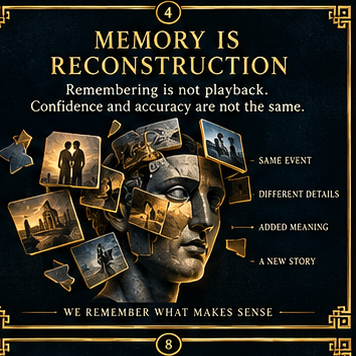
Memory Is Not a Recording
One of the most consequential misconceptions about the mind is the belief that memory works like video storage.
It does not.
Remembering involves reconstruction.
Later information can become integrated with earlier experience. Sources can become confused. Repetition can strengthen confidence even when accuracy does not improve. Emotional peaks and endings can come to represent experiences that were much longer and more complicated.
This does not mean memories are worthless.
It means confidence and accuracy are not identical.
That distinction matters in relationships.
Two people can sincerely remember the same argument differently.
Neither person has to be lying.
They may have attended to different moments, encoded different details, interpreted the event through different expectations, and reconstructed it during later conversations.
The practical implication is significant.
When the stakes are high, preserve contemporaneous records.
Write decisions down.
Document agreements.
Record reasons before the outcome is known.
Separate what you remember happening from what you later learned about what happened.
Memory becomes more useful when we stop requiring it to be something it never was.
Outcomes Rewrite Our Evaluation of Decisions
Imagine making a reasonable decision under uncertainty.
The outcome is terrible.
We often look backward and conclude that the decision itself must have been terrible.
The reverse also happens. A reckless decision produces a good result, and the person feels vindicated.
This is outcome bias.
The problem is that decisions and outcomes are related without being identical.
Chance still exists.
A good process can produce disappointment.
A poor process can receive a lucky reward.
That distinction has become increasingly important to me in business.
If every successful outcome is treated as proof that the decision process was excellent, organizations institutionalize luck.
If every failure is treated as proof of incompetence, people eventually learn to hide uncertainty.
A better review asks what information was available at the time, what alternatives were considered, what assumptions were made, and whether the confidence level matched the evidence.
That is how people learn from decisions rather than merely from results.
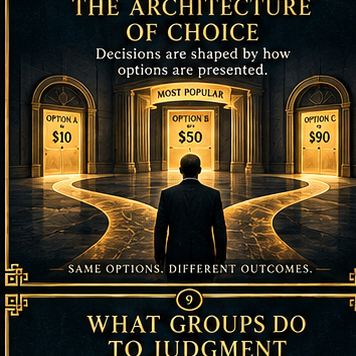
The Architecture of Choice Matters
People often think of preferences as existing fully formed inside us.
Then the world presents options and we select the one we prefer.
Behavioral research shows that the presentation of choices can influence the preference itself.
Anchors affect comparison.
Frames change whether the same outcome feels like a gain or a loss.
Defaults make one action easier than another.
Decoys alter the relative attractiveness of surrounding options.
Scarcity changes urgency.
Loss aversion makes surrendering something psychologically different from never having possessed it.
These effects are especially important because the person usually experiences the final decision as their own.
And in an important sense, it is.
The problem is assuming the surrounding architecture played no role.
A crossed-out price establishes a comparison point.
A subscription preselected by default reduces the effort required to continue.
A “most popular” label provides social information.
A limited-time message compresses the period available for reflection.
The ethical question is not whether environments should influence behavior. Every environment does.
The better distinction concerns how the influence operates.
Does the design make material information easier to understand? Are meaningful alternatives preserved? Can the person refuse without unreasonable friction? Is vulnerability being protected or exploited?
The same psychological knowledge can help create a better warning system or a worse subscription trap.
The Self Has an Interest in Being Right
Some psychological phenomena become particularly powerful when the belief being examined is connected to identity.
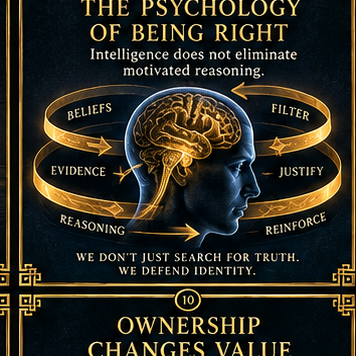
Confirmation bias is frequently described too casually as “people look for information they agree with.”
The mechanism is more consequential than that.
People can ask different questions depending on what they hope to establish.
They may require rigorous evidence from an opposing position while accepting anecdotes from their own side.
A leader convinced that a strategy is working may interpret success as proof of the strategy and failure as poor implementation.
Someone opposed to the same strategy may reverse the explanation.
Both can sincerely believe they are following evidence.
The issue becomes harder when admitting error threatens competence, reputation, belonging, or identity.
At that point, reasoning itself can become defensive.
Intelligence does not eliminate this risk.
A skilled thinker may simply become better at producing sophisticated arguments for a preferred conclusion.
That is why I increasingly value revision conditions.
Before reviewing evidence, decide what would change your mind.
Doing that after seeing the result gives the mind too much freedom to move the goalposts.
Confidence Is Not Competence
Confidence is useful.
Leadership often requires action before certainty is available.
Interviews reward people who can communicate capability clearly.
Entrepreneurship requires enough belief to act under uncertainty.
The problem comes when confidence is treated as evidence.
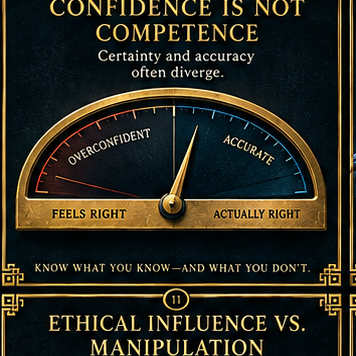
Overconfidence bias describes situations in which certainty exceeds accuracy. People can overestimate their ability, their relative standing, or the precision of their predictions.
This is why sophisticated decision-making should include calibration.
If someone regularly assigns probabilities to predictions, how often is a 90 percent prediction actually correct?
Does confidence change after feedback?
Are ranges wide enough to reflect uncertainty?
Expertise should improve these judgments, but expertise can also create blind spots. A highly successful method may become the lens through which every future problem is interpreted.
The tool begins defining the problem.
That is one reason outside perspectives remain valuable even for highly experienced professionals.
Relationships Create Their Own Psychological Loops
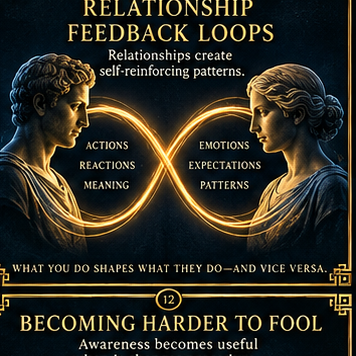
Psychology becomes especially interesting in relationships because one person's behavior becomes part of the environment shaping the other person's next behavior.
An anxious response can produce withdrawal.
Withdrawal increases anxiety.
Increased anxiety creates more pressure.
The withdrawal then appears to confirm the original fear.
Neither person has to intend the cycle.
The interaction itself sustains it.
The empathy gap adds another complication. We are not always good at predicting how a different emotional or physiological state will affect judgment.
A calm person imagines how rationally they will behave during conflict.
Then anger, fear, shame, grief, exhaustion, hunger, or arousal changes the decision environment.
This does not eliminate responsibility.
It suggests that good intentions made in one state may require structural support in another.
If a recurring argument escalates predictably, the solution may involve timing, scripts, pauses, environment, and agreed rules rather than another promise that everyone will simply “stay calm.”
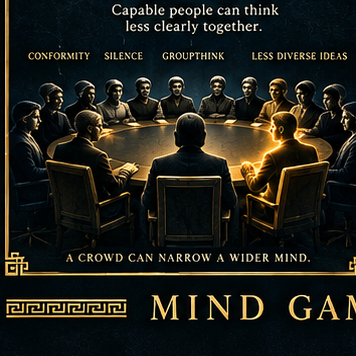
Groups Can Make Smart People Less Intelligent Together
A room full of capable individuals does not automatically produce a capable collective decision.
Groups introduce status, conformity, information sharing, role expectations, diffusion of responsibility, emotional contagion, and pressure toward consensus.
People withhold dissent for understandable reasons.
They do not want to look difficult.
They assume someone else has considered the issue.
They defer to the highest-status person.
They mistake silence for agreement.
They adjust their own estimate after hearing everyone else's.
Soon the group appears to have strong consensus even though very little independent judgment remains.
The solution is not another speech about courageous leadership.
Design matters.
Collect opinions before discussion.
Protect dissent.
Assign someone responsibility for challenging assumptions.
Use anonymous input when hierarchy is likely to suppress candor.
Separate idea generation from evaluation.
Make ownership visible.
Good organizational psychology often involves redesigning the environment so that people do not have to overcome every predictable human tendency through willpower.
Ownership Changes Value
Money and business offer some of the clearest examples of psychology changing valuation.
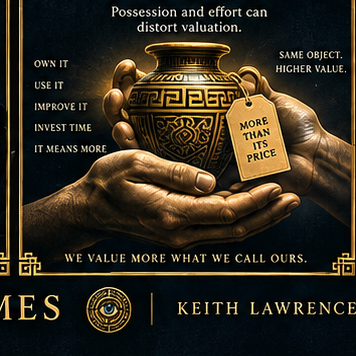
The endowment effect describes how ownership can increase the value people place on something.
The IKEA effect shows how effort invested in creation can increase attachment to the result.
These mechanisms have useful sides.
Participation can build commitment.
Ownership encourages care.
Creating something can generate pride.
The same mechanisms can make it harder to abandon bad investments.
A founder may overvalue a product because of the years invested in building it.
A team may defend a process because they designed it.
An individual may keep an object or business line because surrender now feels like losing part of themselves.
This is why outside evaluation matters.
The question “What is this worth to me?” should sometimes be followed by “What would it be worth if I did not already own it?”
That second perspective can expose the psychological premium attached to possession.
Markets Do More Than Respond to Preference
Businesses study psychology because choice architecture affects behavior.
Social proof can reduce uncertainty.
Scarcity can increase urgency.
Defaults can increase enrollment.
Loss aversion can affect retention.
Pricing structures can shift comparison.
None of these mechanisms is inherently unethical.
A retirement system can use defaults to improve saving.
A public-health campaign can use accurate social norms to encourage safer behavior.
A business can organize information so that customers understand meaningful differences among products.
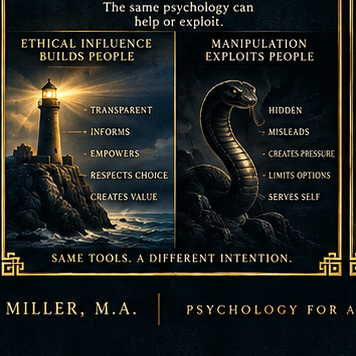
The ethical line becomes clearer when influence depends on concealment, manufactured urgency, confusing cancellation, distorted comparisons, or exploiting vulnerability while pretending the architecture is neutral.
Psychological knowledge creates responsibility for the designer as well as the decision-maker.
Spiritual Meaning and Psychological Mechanism Can Coexist
The book also examines phenomena such as pattern recognition, expectation, ritual, meaning, pareidolia, and experiences that people interpret spiritually.
This requires intellectual restraint.
Psychology can examine how attention makes a symbol suddenly salient.
It can study expectation.
It can examine ritual, social reinforcement, perceptual pattern recognition, and some mechanisms involved in healing experiences.
That does not automatically resolve metaphysical questions.
Explaining part of how an experience occurs does not necessarily determine what the experience ultimately means to the person.
I think it is important to preserve that distinction.
Reductionism can become as intellectually careless as credulity.
A respectful analysis should identify what psychology can support and where interpretation moves into another category of claim.
Psychology Should Be Used as a Mirror Before It Becomes a Weapon
Once people learn psychological terminology, there is a strong temptation to apply it outward.
Your colleague has confirmation bias.
Your partner is projecting.
Your boss is overconfident.
The public is irrational.
The other group is following social proof.
That use of psychology can produce enormous confidence with very little self-examination.
The more difficult application is inward.
What am I failing to notice?
Which evidence receives less scrutiny because I like the conclusion?
What part of my memory may have changed?
Which reference point is influencing my judgment?
What does my preferred explanation protect?
What would I believe about this situation if my identity were not attached to the answer?
The book's standard is to use psychology as a mirror before turning it into a label for someone else.
Awareness Is Necessary. Procedures Are Stronger.
One of the most important lessons across the hundred phenomena is that awareness does not create immunity.
A person can know about anchoring and still be anchored.
They can study overconfidence and remain overconfident.
They can understand confirmation bias and selectively interpret evidence.
That is why I prefer procedures to promises.
Independent estimates can reduce anchoring.
Written criteria can limit halo effects.
Decision journals can expose hindsight distortion.
Automatic saving can help with present bias.
Anonymous input can protect dissent.
Clear cancellation processes can limit exploitation of inertia.
Psychology becomes practical when insight changes the architecture of the next decision.
Five Questions That Improve Judgment
Across very different phenomena, the manuscript repeatedly returns to five questions:
- What information received my attention?
- Which reference point shaped the comparison?
- What story did memory construct?
- Which identity or relationship was being protected?
- What design made one action easier than another?
These questions do not guarantee a correct answer.
They create distance between experience and judgment.
That distance matters because the first interpretation often feels like observation rather than interpretation.
Once we recognize that distinction, revision becomes possible.
Becoming Harder to Fool
The final argument of Mind Games is deliberately modest.
No one becomes impossible to fool.
I would distrust anyone who believes they have.
Psychology does not remove human nature. Learning the names of cognitive phenomena does not create a mind that stands outside cognition.
The more useful goal is to create greater space between experience and conclusion.
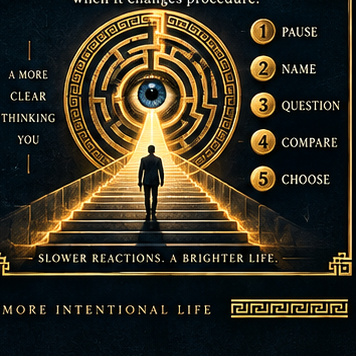
The book reduces that discipline to five actions:
Pause. Name. Question. Compare. Choose.
Pause when emotion or urgency is compressing time.
Name the possible mechanism without turning the label into a verdict.
Question what evidence is missing and what would change the conclusion.
Compare the impression with base rates, alternative explanations, stable criteria, outside perspectives, or written records.
Then choose while acknowledging that uncertainty remains.
Those steps do not guarantee success.
They make correction easier.
That is enough to matter.
The person still encounters headlines, impressions, prices, memories, confident speakers, social pressure, and repeated claims. Human nature remains. What changes is the quality of the process between what happens and what follows.
After years of studying psychology and human behavior, that is the lesson I find most useful.
The mind will continue to simplify.
It will continue to protect identity.
Memory will continue reconstructing.
Emotion will continue changing urgency.
People will continue influencing one another.
Markets will continue shaping choice.
Groups will continue affecting judgment.
The objective is not to eliminate those forces.
It is to see enough of them to make better decisions about when they deserve our trust.
What feels obvious is often what deserves a second look.
About the Book
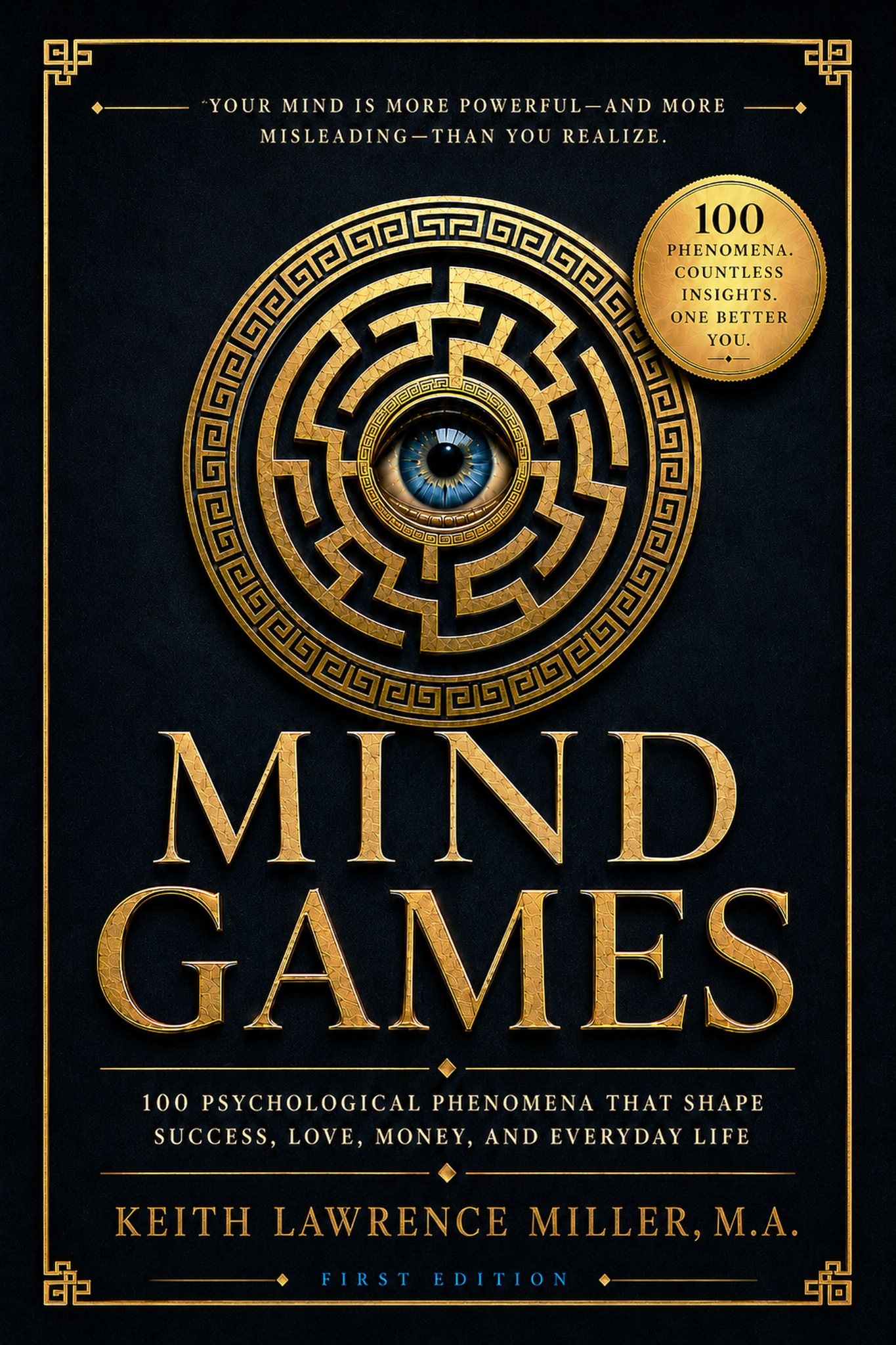
Mind Games: 100 Psychological Phenomena That Shape Success, Love, Money, and Everyday Life is an accessible field guide to the psychological processes influencing perception, memory, decision-making, relationships, work, leadership, money, markets, group behavior, belief, and meaning.
The book organizes 100 distinct psychological phenomena across twenty chapters and eight parts, moving from attention and first impressions through memory, decision architecture, belief defense, relationships, organizational behavior, money, influence, collective judgment, spirituality, and meaning.
Rather than presenting psychological effects as universal laws, the book distinguishes well-established findings from context-dependent, debated, qualified, or commonly misrepresented claims. It emphasizes ethical use, evidence boundaries, internal application before labeling others, and practical procedures that make error easier to detect.
Its concluding five-step practice is:
Pause → Name → Question → Compare → Choose
The book is educational and does not provide medical, psychological, psychiatric, legal, or financial advice. Psychological phenomena describe tendencies and conditions rather than fixed rules governing every individual.
Keith Lawrence Miller, M.A. First Edition · 2026 ISBN: 9798187536399 255 pages Source status: Complete