Full book feature
Great Coaching Creates the Conditions for People to Think More Clearly for Themselves
Great coaching does not begin with advice.
It begins with attention.
A client arrives with a decision, a goal, a conflict, a career problem, a leadership challenge, a pattern they cannot seem to change, or simply the sense that something needs to move.
The easiest response is to tell them what to do.
The harder and more valuable work is helping them understand what is actually happening, what matters, what assumptions they are carrying, what choices they possess, what stands in the way, and what action they are willing to own.
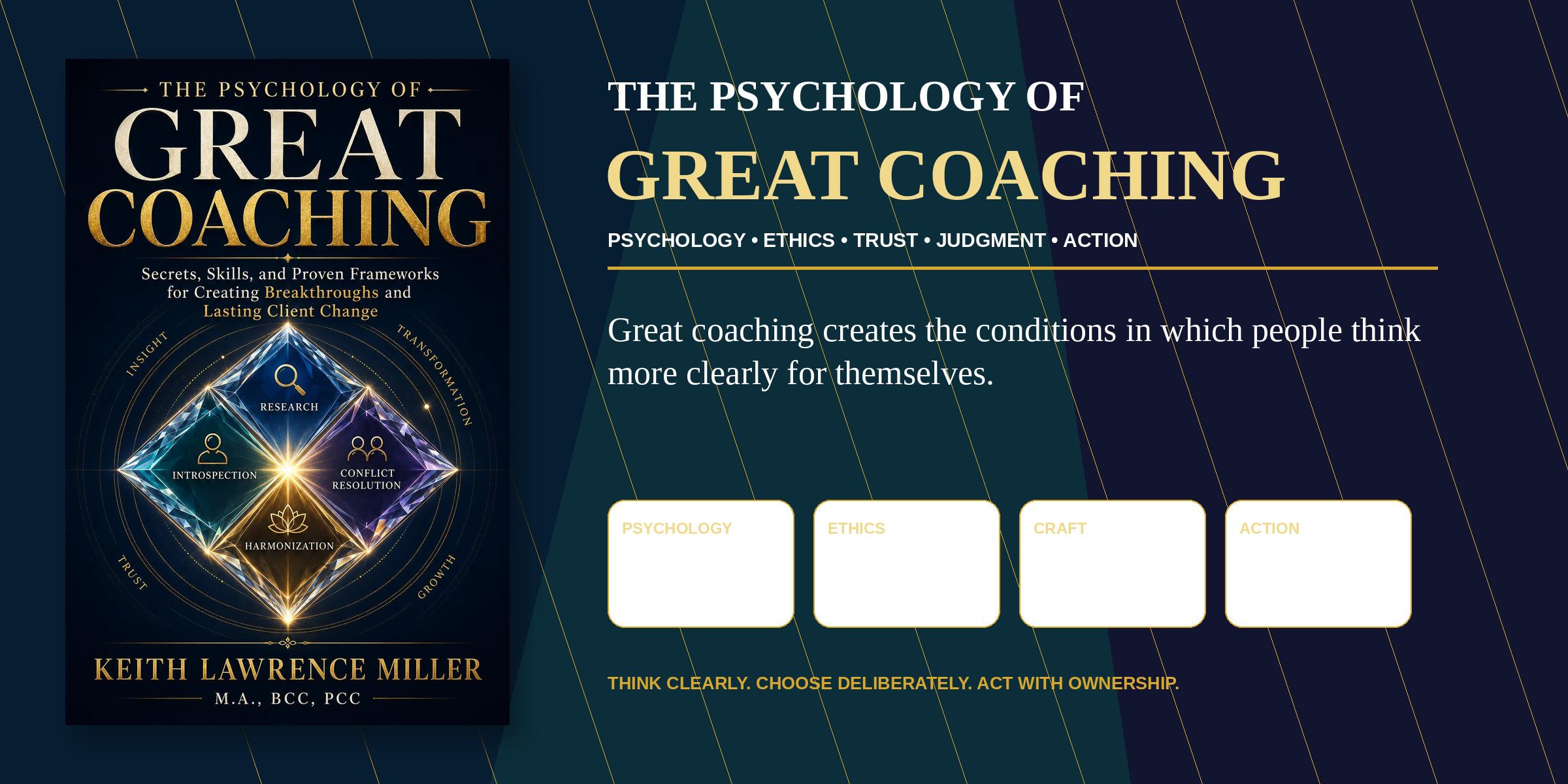
That distinction sits at the center of The Psychology of Great Coaching.
The book examines the psychology, ethics, trust, emotional intelligence, communication skills, professional judgment, and practical frameworks that make coaching useful.
Its central premise is straightforward: People are more likely to grow when coaching helps them think with greater clarity rather than simply thinking for them.
The coach creates conditions in which clients can examine patterns, test assumptions, clarify values, make choices, and convert insight into action.
That work requires much more than asking clever questions. It requires professional craft.
Coaching Works Through the Client
A coach can provide structure. A coach can challenge. A coach can ask questions. A coach can reflect patterns. A coach can offer perspective. A coach can help organize information and decisions.
The client still has to think. The client has to decide. The client has to act. The client has to live with the consequences.
That makes client agency one of the most important principles in coaching.
A coach who becomes too directive may produce compliance while weakening ownership. A coach who refuses to challenge anything may protect comfort while failing to support growth.
Great coaching lives between those extremes.
The coach brings enough structure to keep the work moving and enough restraint to keep the work belonging to the client.
Psychology Helps Explain What Happens Beneath the Goal
Clients rarely arrive as simple problems waiting for a technique.
They arrive with histories, beliefs, values, expectations, habits, emotions, identities, fears, relationships, past successes, and past failures.
The psychology of coaching becomes useful because those factors influence what a person notices, avoids, believes, attempts, and sustains.
Self-awareness helps clients notice patterns. Metacognition helps them observe their thinking. Self-efficacy influences whether they expect effort to work. Values shape which goals deserve commitment. Identity can support action or quietly resist it. Cognitive dissonance can explain why a person defends a position that conflicts with what they say they want. Fear can preserve a familiar situation long after the client consciously wants change.
Trust determines what a client is willing to reveal. Accountability helps intention survive the demands of everyday life.
These ideas give coaches better ways to understand what may be happening. They do not turn coaches into clinicians.
Coaching Has Boundaries
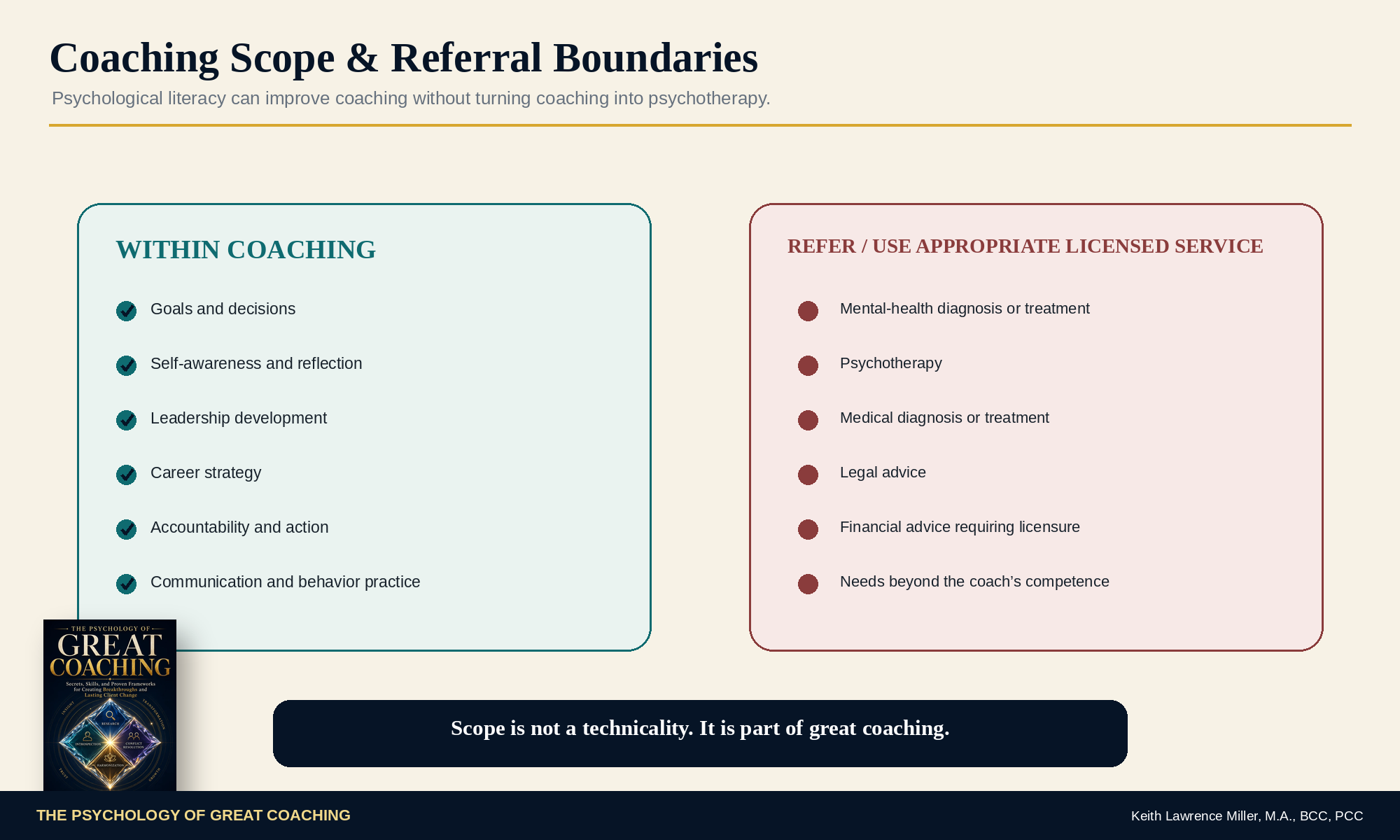
The word psychology in this book is deliberate. So are the boundaries around it.
Coaching can involve emotions, beliefs, motivation, identity, behavior, stress, confidence, decision-making, and change.
That does not authorize a coach to diagnose mental-health conditions or provide psychotherapy unless the practitioner is separately qualified and licensed to perform those services within an appropriate professional role.
Professional competence includes knowing when coaching is no longer the right service.
A client may need a psychologist, therapist, physician, attorney, financial professional, or another licensed specialist.
Referral is part of ethical coaching. Scope is part of competence.
The Difference Between Adequate and Great Coaching Is Integration
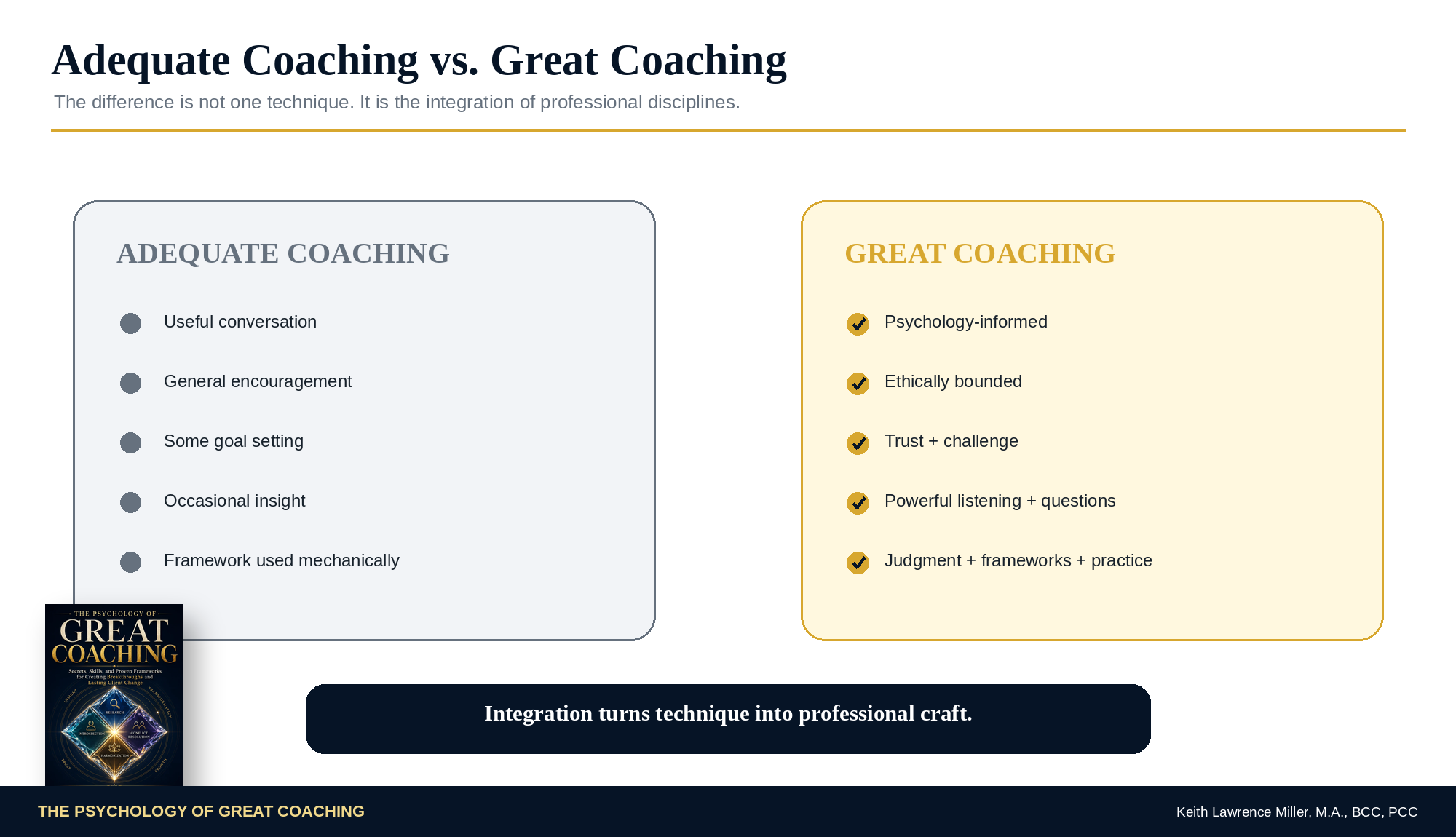
A useful conversation can happen almost accidentally.
Great coaching requires more.
The book argues that quality comes from integrating psychology, ethics, emotional intelligence, trust, communication, professional judgment, frameworks, and disciplined practice.
No single technique creates great coaching.
The integration creates the practice.
Trust Makes Honest Work Possible
Coaching depends on disclosure.
Clients may discuss ambitions they have never said aloud. They may reveal doubts they hide at work. They may discuss organizational politics, leadership conflicts, difficult relationships, fear, uncertainty, identity, or dissatisfaction.
That makes trust foundational.
Trust grows when the coach behaves predictably. Confidentiality is understood. Boundaries are clear. Commitments are kept. The coach listens carefully. Challenge is delivered in service of the client rather than the coach’s ego. The client is treated as capable.
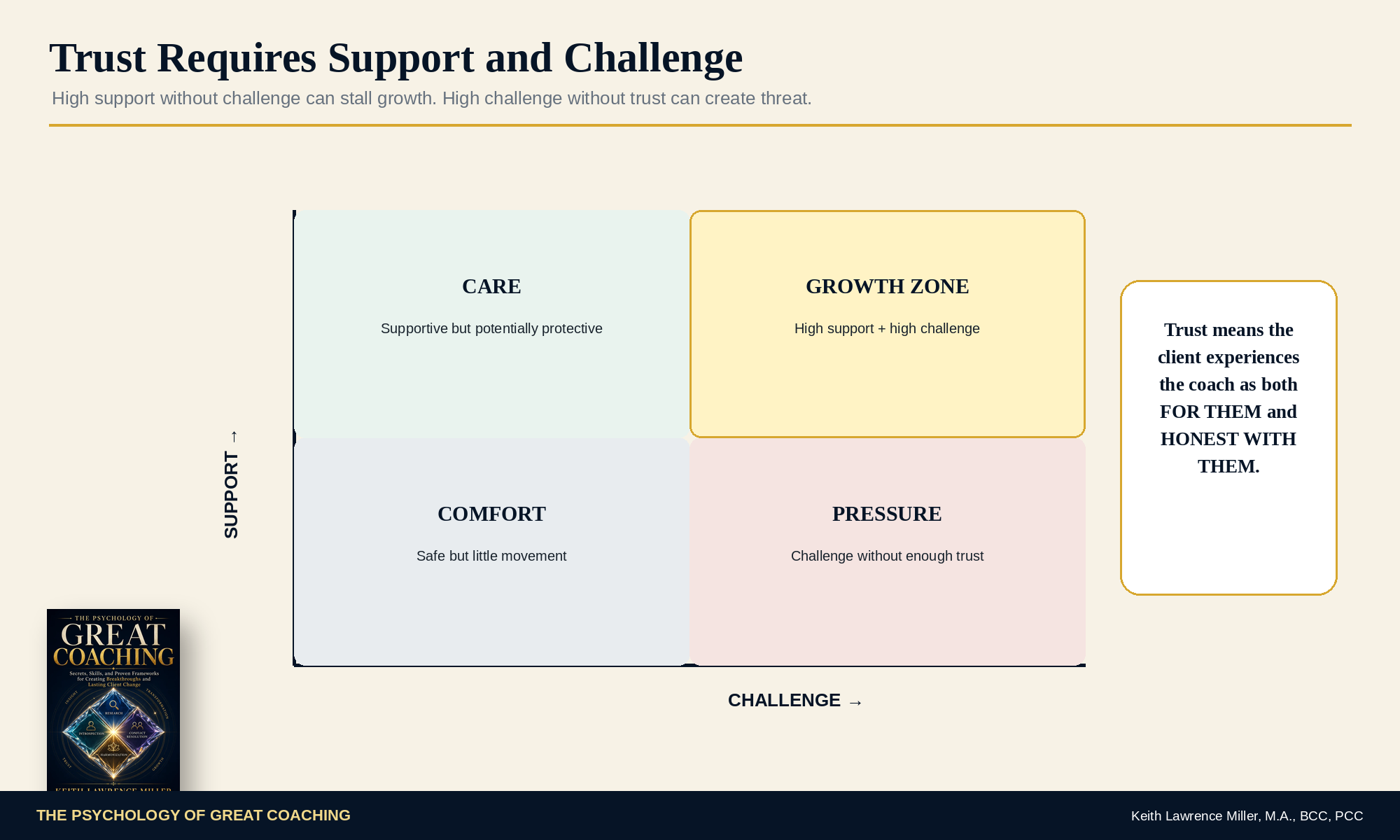
One of the most important balances is the relationship between support and challenge.
Support without challenge can become comfortable stagnation. Challenge without trust can become threat.
When both are strong, the client can experience the coach as someone who is genuinely for them and willing to tell the truth.
Great Coaches Listen for More Than Words
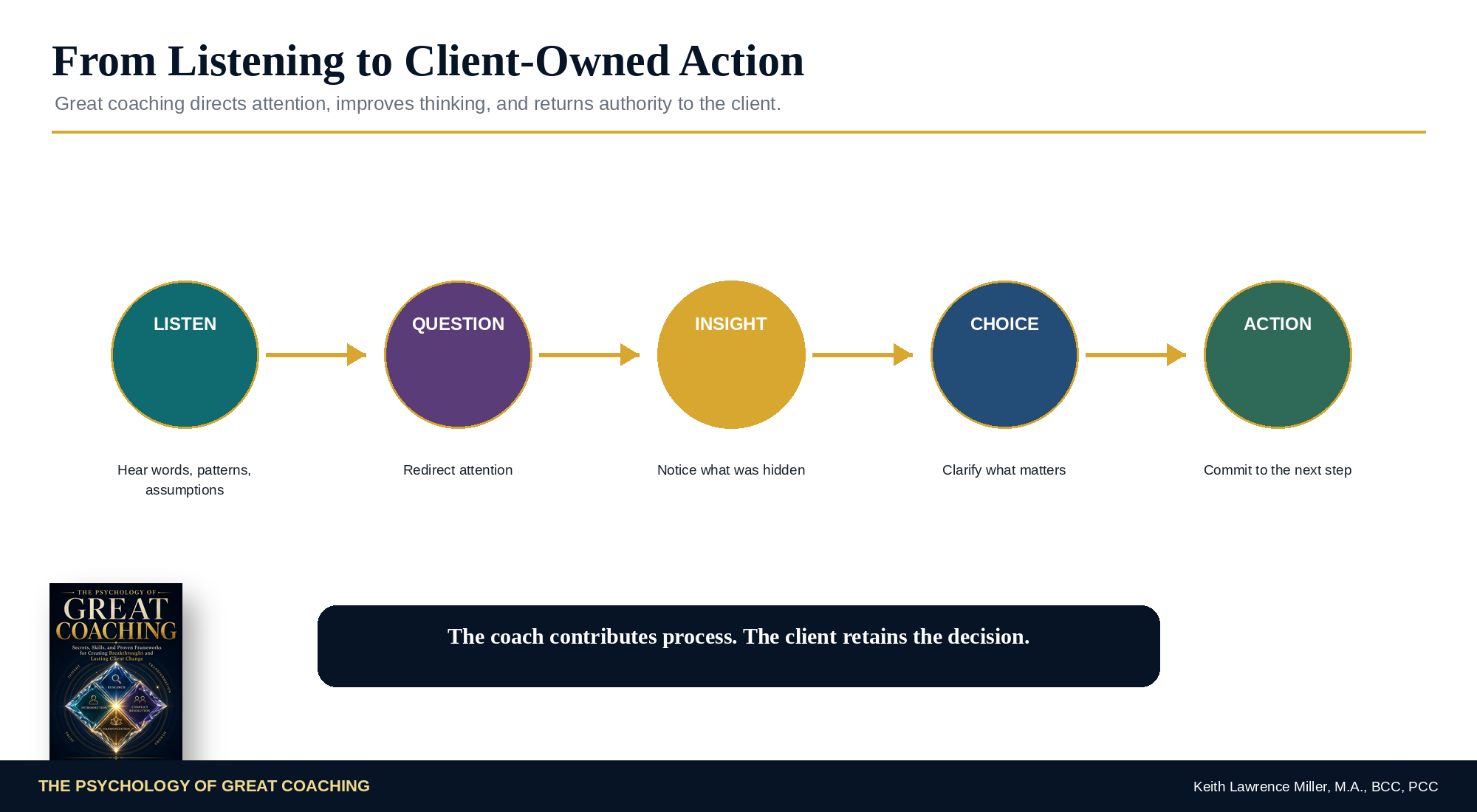
Listening is one of the most underestimated professional skills.
A client says, “I have no options.” The words matter. So does everything around them.
What evidence supports that conclusion? What evidence contradicts it? Is the client describing reality, fear, exhaustion, a previous failure, an assumption, or a temporary constraint being interpreted as a permanent one?
Listening helps reveal patterns in language: repeated phrases, avoided subjects, contradictions, changes in energy, stories the client returns to, and claims that sound factual but have never been tested.
The coach listens for content and structure.
What happened? What meaning did the client assign to it? What assumption connects the two?
That is where a good question can change the conversation.
Powerful Questions Redirect Attention
Questions matter because attention matters.
A good question can make a person notice something they were overlooking. It can expose an assumption, surface evidence, separate fact from interpretation, clarify a value, test an option, identify a contradiction, reveal a fear, or move a vague intention toward a specific action.
Strong questions tend to be concise. They ask one thing at a time. They avoid embedding the coach’s preferred answer. They invite thinking.
The power lies less in sounding profound and more in changing the quality of the client’s thinking.
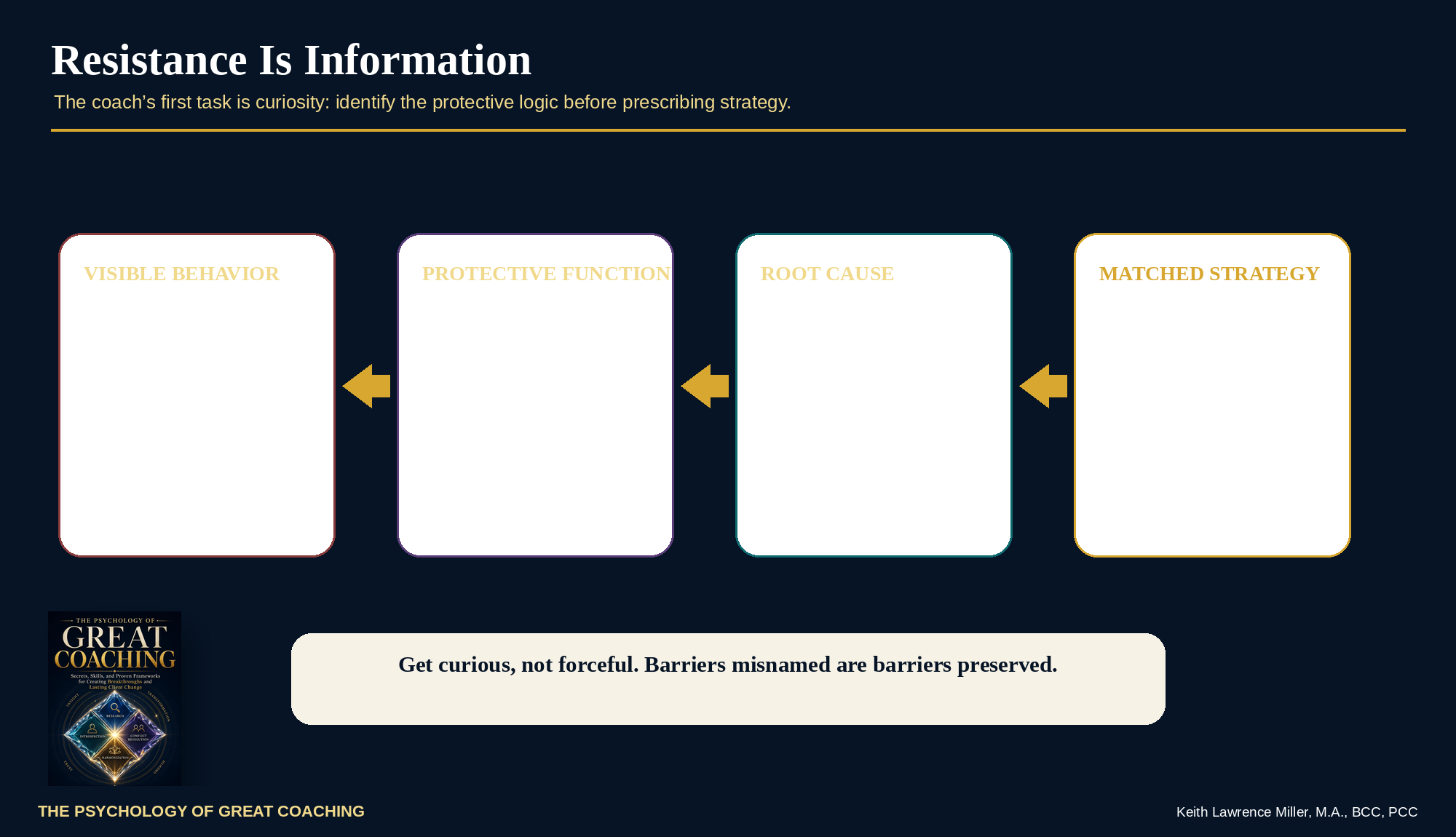
Resistance Is Information
Every coach eventually encounters resistance.
The client who agrees and does nothing. The client who debates every question. The client who suddenly becomes too busy when the work becomes uncomfortable. The client who repeatedly returns to the same problem.
Resistance can be frustrating when interpreted as defiance.
The book takes a more useful approach: resistance is a predictable feature of change and may serve a protective function.
A person who says they want a promotion may fear visibility. A person who wants to leave a job may fear financial instability. A leader who says they want feedback may fear what honest feedback would require them to change. A job seeker who avoids networking may interpret self-promotion as arrogance.
The behavior makes more sense when its protective logic is understood.
The coach’s task is curiosity before force.
When the barrier is named accurately, strategy becomes more useful.
Emotional Intelligence Shapes the Coaching Relationship
Emotional intelligence matters in coaching because coaching is interpersonal work.
A coach needs enough self-awareness to notice their own reactions, enough emotional regulation to remain useful when a client becomes frustrated, defensive, anxious, or angry, enough empathy to understand experience without absorbing it, and enough interpersonal judgment to challenge appropriately.
Emotional intelligence also matters for clients.
Clients may need to identify emotions more precisely, recognize patterns, understand triggers, examine how emotion influences decisions, and practice responses that align better with their goals.
Assessment tools can sometimes support that work when used within their proper scope and administration requirements.
The assessment should support the conversation. It should not replace judgment.
Coaching and Mentoring Are Different Tools
Coaching and mentoring often overlap in ordinary conversation. They serve different purposes.
A mentor typically contributes experience: here is what I did, what I learned, how this industry works, and what I would watch.
The coach more often contributes process: what are you seeing, what options exist, what evidence do you have, what outcome matters, and what will you choose?
Many professionals need both.
The skill lies in knowing which role the situation requires and making that role clear.
Coaching Across Difference Requires Humility
Coaching does not occur outside culture.
Clients bring identities, family systems, social expectations, workplace norms, economic realities, histories, and cultural assumptions into the room. Coaches bring their own.
A question that feels empowering in one context may feel unrealistic in another. A career move considered routine in one family or culture may carry enormous relational consequences in another.
Professional coaching therefore requires cultural humility.
Curiosity is safer than certainty.
Great Coaching Does Not Remove the Client’s Authority
One of the risks in coaching is rescue.
The coach sees the answer, wants progress, and begins constructing the client’s plan. The client may even appreciate it.
The problem appears later: the plan belongs psychologically to the coach.
Client ownership matters because commitment matters.
A client who participates in building the goal, choosing the strategy, and defining the action is more likely to experience the plan as their own.
Great coaching returns authority to the client repeatedly.
Structure Helps Without Replacing Judgment
Coaching frameworks are useful because real conversations are complex.
A framework gives the coach and client a shared map.
Frameworks become dangerous when treated as scripts.
A client is not a worksheet. The conversation may reveal something that requires returning to an earlier stage.
A framework should make judgment easier. It should never make judgment unnecessary.
That principle becomes central in the book’s signature career-coaching architecture.
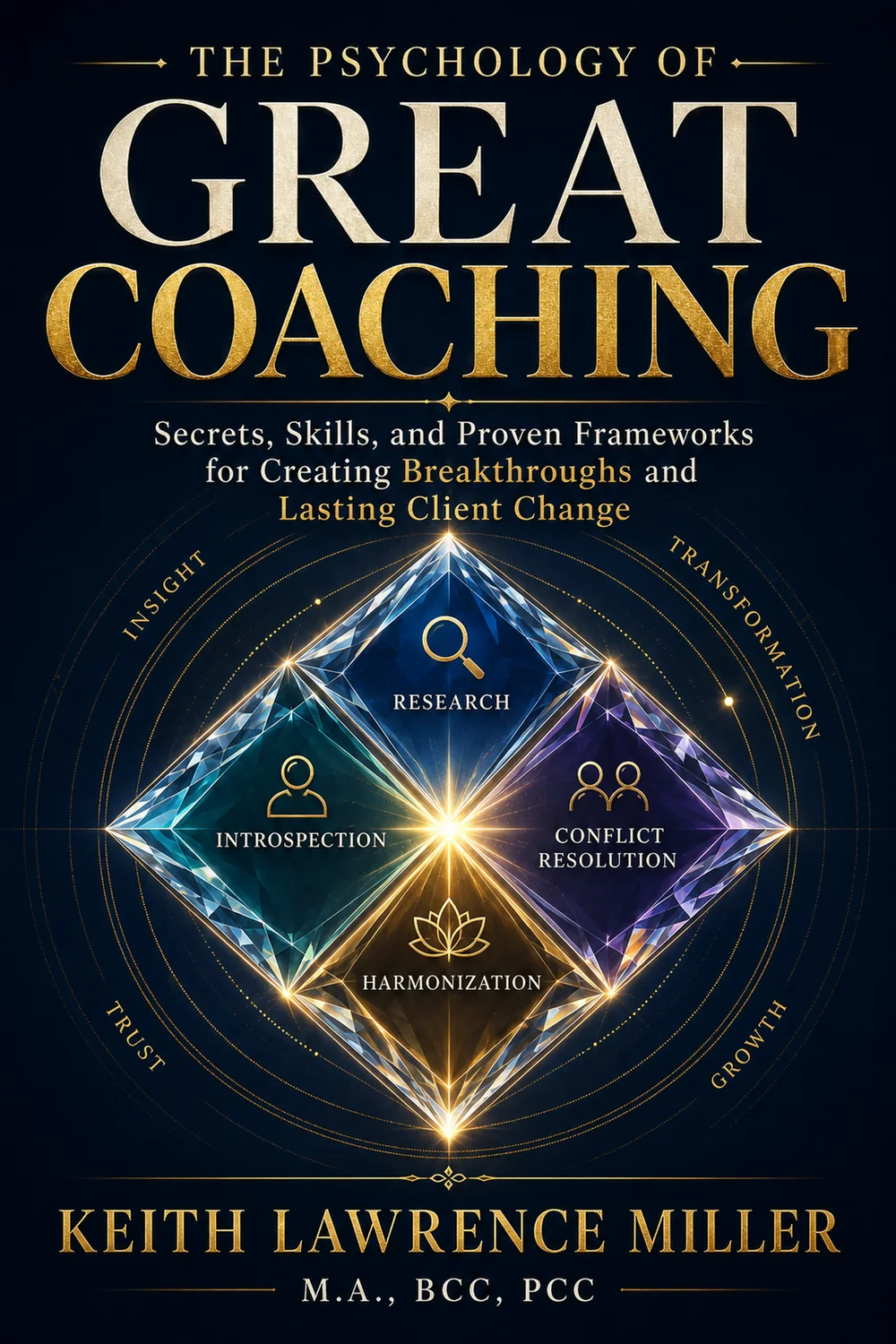
The Diamond Coaching Model
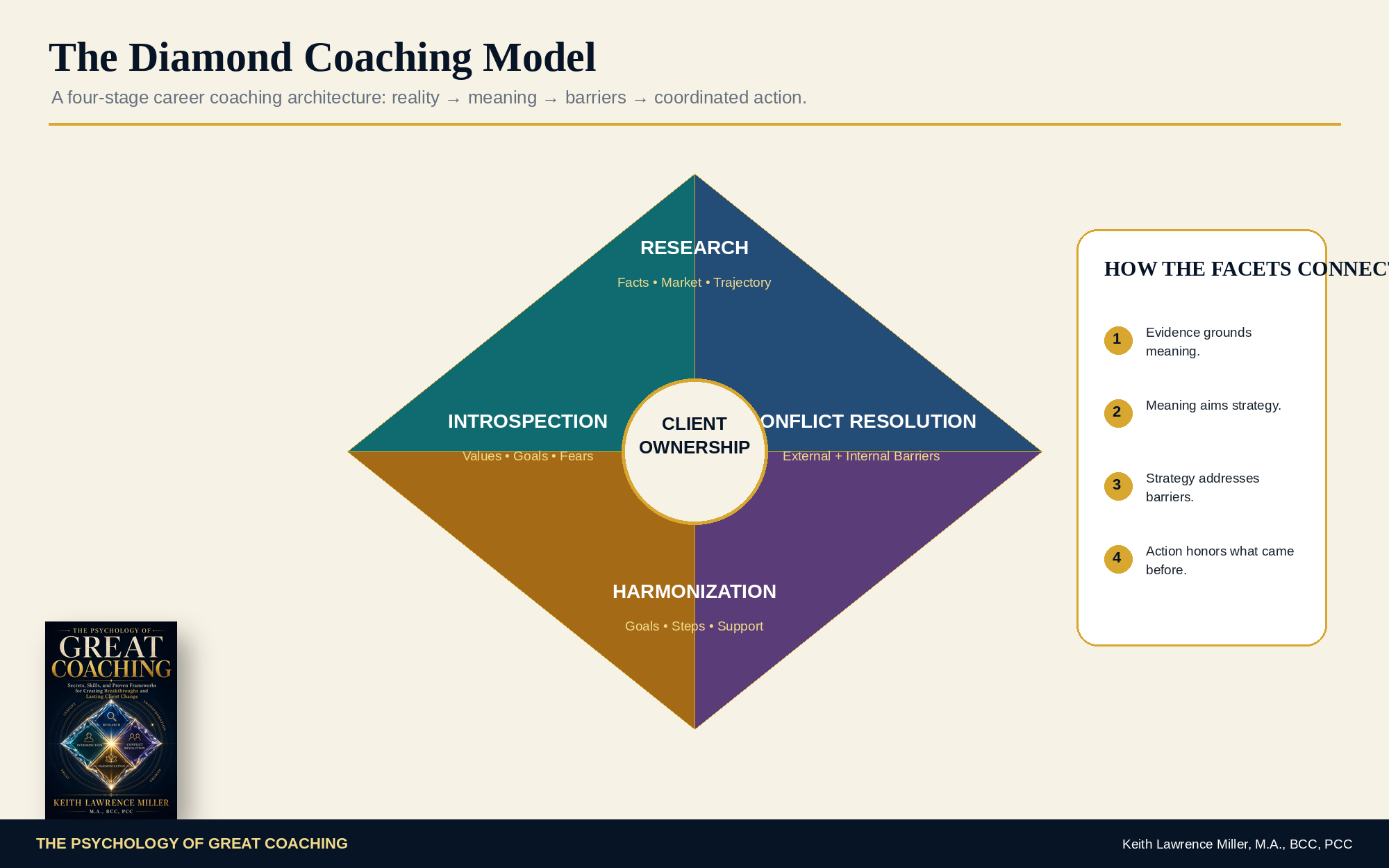
The Diamond Coaching Model is a proprietary, practice-based four-stage framework for career coaching.
Its stages are Research, Introspection, Conflict Resolution, and Harmonization.
The sequence moves from reality to meaning, from meaning to barriers, and from barriers to coordinated action.
Each stage prepares the next.
Stage One: Research — See Reality Clearly
Career decisions are often made from impressions.
“I am underpaid.” “There is nowhere to advance.” “My industry is dying.” “I have no transferable skills.” “No one will hire me at my age.”
Some of those conclusions may contain truth. Some may not.
Research establishes the factual map.
Coach and client examine the current role, organization, industry, career trajectory, compensation, market conditions, skills, experience, strengths, weaknesses, interests, and possible paths.
The purpose is reality testing.
A career strategy built on an inaccurate map will eventually collide with reality. Research improves the map first.
Stage Two: Introspection — Understand What the Facts Mean to You
Facts alone cannot decide a life.
Once the external picture becomes clearer, the model turns inward.
What matters? What does the client want? Which values should govern the decision? Which goals genuinely belong to them? Which fears are influencing the decision? What identity is the client trying to preserve?
Introspection creates meaning from information.
This stage matters because people sometimes pursue goals they inherited from someone else: family, a former boss, a professional culture, status, fear, or expectation.
Stage Three: Conflict Resolution — Identify What Actually Stands in the Way
Once reality and direction become clearer, barriers become easier to name.
Some barriers are external: credential requirements, financial constraints, geography, labor-market conditions, family obligations, or experience gaps.
Some are internal: fear, assumptions, identity conflict, low self-efficacy, avoidance, or unexamined beliefs.
Many situations include both.
Conflict Resolution examines each barrier’s origin, function, and current validity.
That matters because a misnamed barrier produces a weak strategy.
Stage Four: Harmonization — Turn Insight Into Coordinated Action
Insight that never reaches behavior changes very little.
Harmonization converts the previous stages into action.
The client now has a clearer map, a stronger understanding of what matters, and a better view of the barriers.
The client and coach build specific goals, sequenced steps, timelines, support systems, accountability, feedback, resources, and checkpoints.
The plan should fit the person’s actual life: finances, responsibilities, energy, relationships, constraints, and timing.
Harmonization means alignment: plan with values, action with identity, ambition with reality.
The Four Facets Work Together
The Diamond Coaching Model is sequential for a reason.
Research without Introspection can create a technically rational plan the client does not want. Introspection without Research can create aspirations detached from reality. Conflict Resolution without the earlier stages can attack the wrong problem. Harmonization without barrier work can produce an elegant plan that collapses when old fears return.
Evidence grounds meaning. Meaning directs strategy. Strategy addresses barriers. Action honors what the earlier stages uncovered.
The model is designed to remain flexible. Clients differ. Some need more Research. Others require deeper Introspection. Some have mostly external barriers. Others have mostly internal ones. A new discovery may send the work backward before it moves forward again.
That can be the process working.
Structure and Flexibility Must Coexist
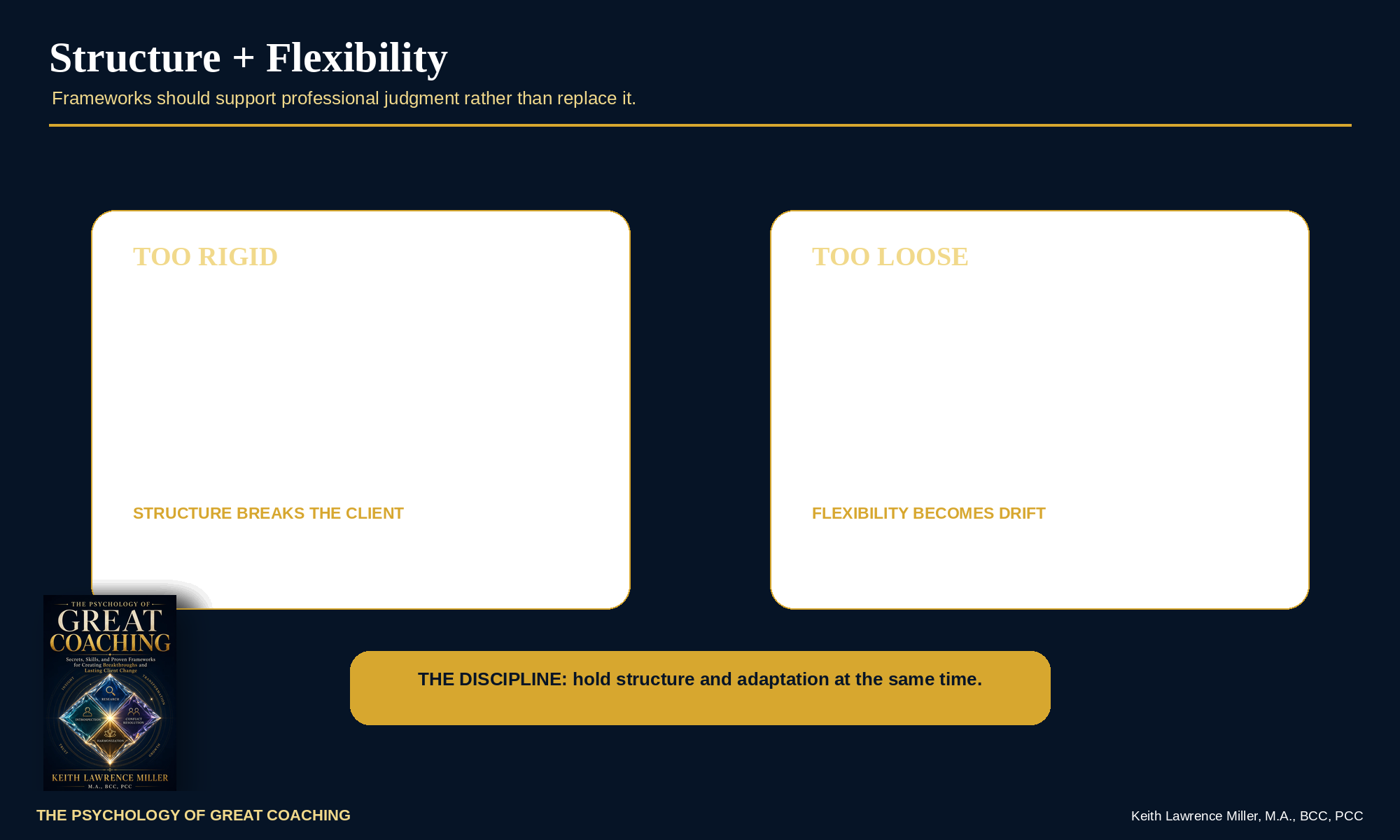
Rigid coaching ignores the person. Unstructured coaching can drift.
Great coaching needs both discipline and adaptation.
The model provides architecture. The coach and client decide how the architecture should operate in the particular engagement.
The client is the author of the decisions. The coach helps improve the process through which those decisions are made.
Ethics Are Part of Performance
Ethics should not be treated as a compliance appendix. They affect the quality of coaching.
A client who does not trust confidentiality will disclose less. A client who is unclear about boundaries may misunderstand the relationship. A coach working outside competence can harm the client. A practitioner using technology without adequate privacy protections can expose sensitive information.
Modern coaching therefore requires attention to confidentiality, informed consent, scope, competence, data security, recording, AI tools, assessment use, conflicts of interest, referral, and clear contracts.
Ethical predictability creates psychological safety. That makes ethics part of the mechanism through which coaching works.
Technology Can Support Coaching Without Becoming the Coach
Technology increasingly influences coaching.
Video platforms make distance less important. Digital tools can support scheduling, accountability, reflection, documentation, and learning. Artificial intelligence can assist with research, brainstorming, organization, and administrative tasks.
It also creates questions: What client information enters the system? Where is it stored? Has the client consented? Can the model retain or expose sensitive information? Is the coach substituting automated output for professional judgment? Does the client know when AI is involved?
Technology should improve coaching while preserving confidentiality, transparency, and human responsibility.
Measure Coaching Without Pretending Every Result Is Simple
Coaching effectiveness matters.
Measurement should reflect what the engagement was actually intended to change.
Possible indicators include goal progress, behavior change, decision quality, leadership effectiveness, career movement, confidence in a defined context, feedback from relevant stakeholders, completion of agreed actions, and capability development.
Measurement should be agreed early enough that progress can actually be evaluated.
Measurement should inform judgment rather than manufacture certainty.
What Great Coaching Ultimately Produces
The most valuable outcome is not permanent dependence on the coach.
The client should become better able to think, notice patterns, examine assumptions, make decisions, respond to barriers, construct plans, and learn from results.
The coaching relationship succeeds partly by helping the client build capabilities they can carry forward.
That is a different standard from simply solving today’s problem.
Who Should Read The Psychology of Great Coaching?
The book is written for professional coaches, career coaches, executive and leadership coaches, coaches in training, managers who coach, HR and talent professionals, mentors, consultants, facilitators, and students of applied psychology.
It is for readers who want a stronger integration of psychology, ethics, communication, frameworks, and professional judgment while preserving clear boundaries around coaching practice.
Great Coaching Is Disciplined Human Work
Coaching will continue evolving.
New technologies will appear. New assessment tools will emerge. New frameworks will be created. Delivery methods will change.
The human work remains.
Listen carefully. Ask better questions. Notice patterns. Protect trust. Respect boundaries. Challenge with care. Distinguish facts from assumptions. Understand what matters. Identify what stands in the way. Build action with the client. Review what happens. Adapt.
Great coaching does not require the coach to possess every answer.
It requires the coach to create the conditions in which better answers can emerge.
The Psychology of Great Coaching is provided for educational and informational purposes only. Coaching is not a substitute for mental-health treatment, medical care, legal advice, financial advice, or another licensed professional service. Coaches should work within the limits of their training, credentials, competence, and applicable ethical standards and refer when client needs fall outside coaching. The Diamond Coaching Model is a proprietary, practice-based framework and is not presented as an independently validated psychological theory. No specific client outcome is promised or guaranteed.