Full book feature
Why Great Résumés Begin With Strategy, Evidence, and Professional Judgment
A résumé can be beautifully formatted and still fail.
It can contain impressive experience and still leave the reader uncertain about the candidate’s value. It can include every keyword from a job posting and still sound generic. It can survive an Applicant Tracking System and then lose the human reader. It can be completely accurate while emphasizing the wrong information.
These are résumé-writing problems, but they are rarely solved by writing alone.
They are solved through strategy.
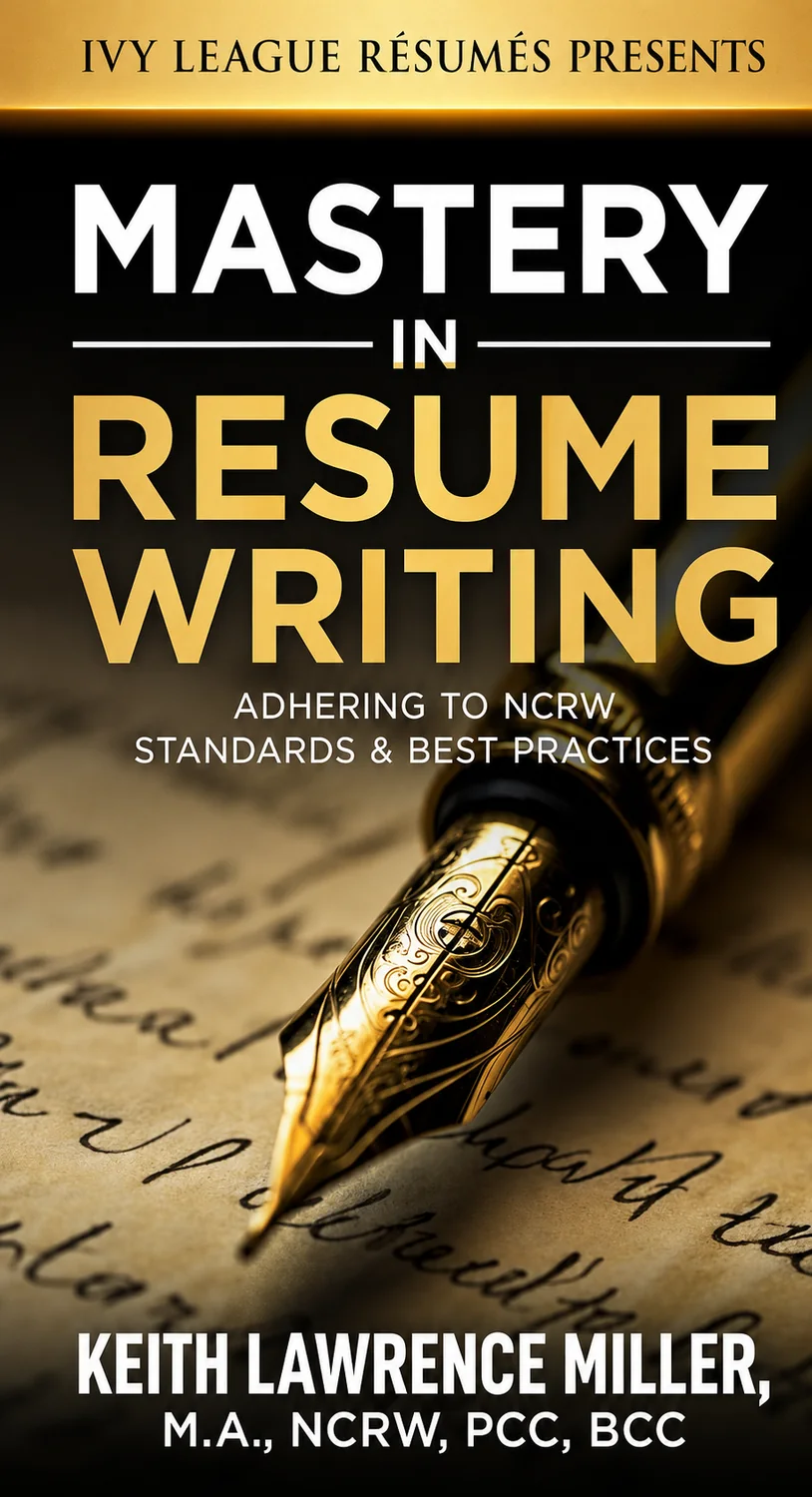
That is the central idea behind Mastery in Résumé Writing: Adhering to NCRW Standards & Best Practices.
Throughout my work as a résumé writer, career coach, recruiter, and organizational psychology practitioner, I have seen thousands of professionals struggle to communicate experience that was genuinely valuable. The problem was often deeper than wording. They had accumulated careers full of decisions, challenges, accomplishments, expertise, leadership, and growth, yet much of that value remained buried inside job descriptions and fragmented career histories.
A strong résumé brings that value into focus. It establishes direction. It identifies the evidence that matters. It organizes that evidence around the needs of an audience. It communicates the candidate’s professional identity with clarity, accuracy, relevance, and credibility.
At its highest level, résumé writing is strategic career communication.
The Résumé Has a Job to Do
A résumé should serve a clear purpose. Its primary objective is to help move a candidate into a meaningful employment conversation.
That sounds simple, but it changes the way the document should be built.
The résumé is an introduction. It is a positioning statement. It is evidence of qualifications. It is a professional marketing asset. It can become a roadmap for the interview. It also contributes to the candidate’s broader professional brand.
Every section should therefore answer an important question for the reader.
Who is this person professionally? What level do they operate at? What do they know? What have they accomplished? What kinds of problems have they solved? How have their responsibilities progressed? What makes their experience relevant to this opportunity? Why should I continue reading?
A résumé becomes stronger when those questions are answered deliberately.
The objective is clarity.
Professional Judgment Is the Foundation
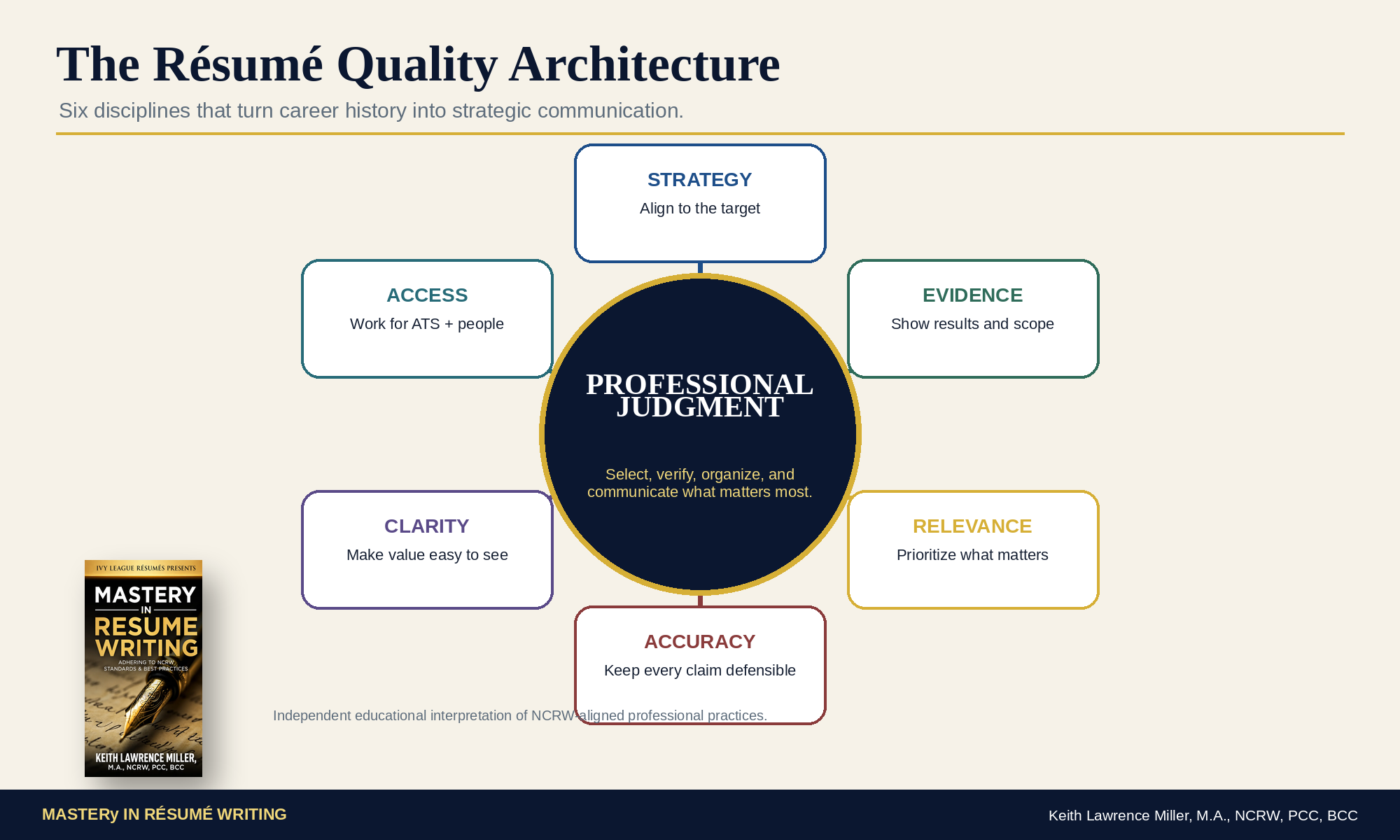
One of the most important themes in Mastery in Résumé Writing is that professional résumé writing requires judgment.
A writer constantly makes decisions. What belongs? What should be removed? Which accomplishment deserves priority? How much context does the reader need? Which keywords matter? Which career challenges require explanation? Which format best serves the candidate? How should an unusual job title be presented accurately while still making sense to the market?
Professional standards give the writer a disciplined way to make those decisions.
The strongest résumé is rarely the document containing the greatest amount of information. It is the document containing the right information, organized around the right objective.
That requires discernment.
Persuasion Must Remain Grounded in Truth
Résumé writing is persuasive communication. That creates an important professional responsibility.
A résumé should elevate a candidate’s value without exaggerating, distorting, or inventing it.
Strong language is appropriate. Strategic positioning is appropriate. Clarifying an obscure title is appropriate. Developing accomplishments from an interview is appropriate. Reframing experience around a target role is appropriate.
Fabricating results, credentials, responsibilities, or expertise is not.
Credibility depends on the candidate being able to defend the document.
A résumé should therefore meet a simple standard: Every important claim should be accurate, relevant, and defensible.
Information Gathering Comes Before Writing
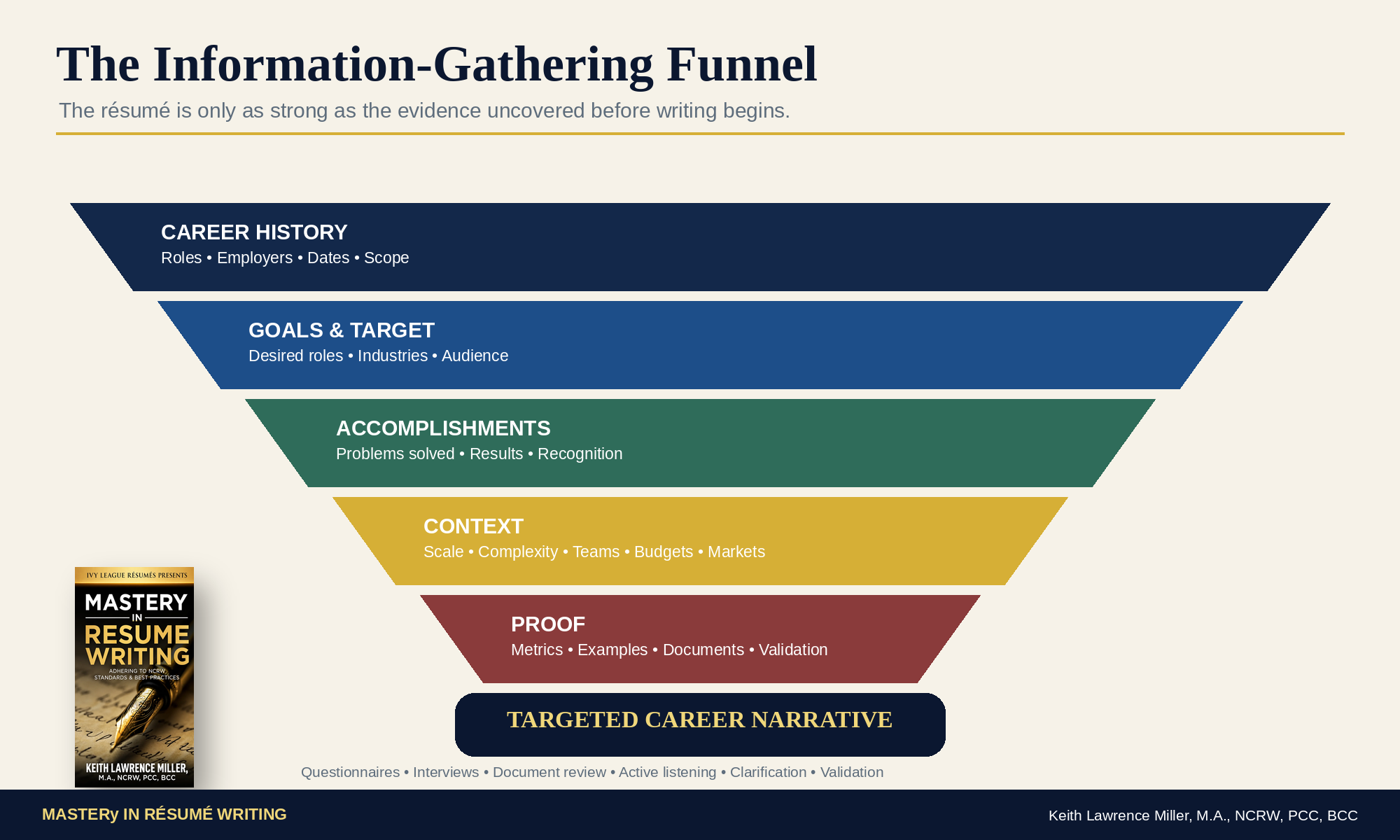
The quality of a résumé is limited by the quality of the information behind it.
That is why one of the most important parts of résumé development happens before a sentence is written.
Information gathering should uncover career history, responsibilities, accomplishments, scope, challenges, leadership, skills, credentials, career goals, industry context, business impact, promotions, recognition, projects, transitions, gaps, and changes in direction.
This can involve questionnaires, interviews, existing résumés, LinkedIn profiles, performance reviews, job descriptions, biographies, project documents, awards, and other relevant materials.
Then comes something even more important: asking better questions.
What changed because of your work? What problem existed before you became involved? How large was the operation? How many people were affected? What was the financial impact? What improved? What did you build? What did you fix? What did you accelerate? What risk did you reduce? What did senior leadership trust you to own?
Those questions often reveal the résumé.
Job Duties Describe the Position. Achievements Describe the Candidate.
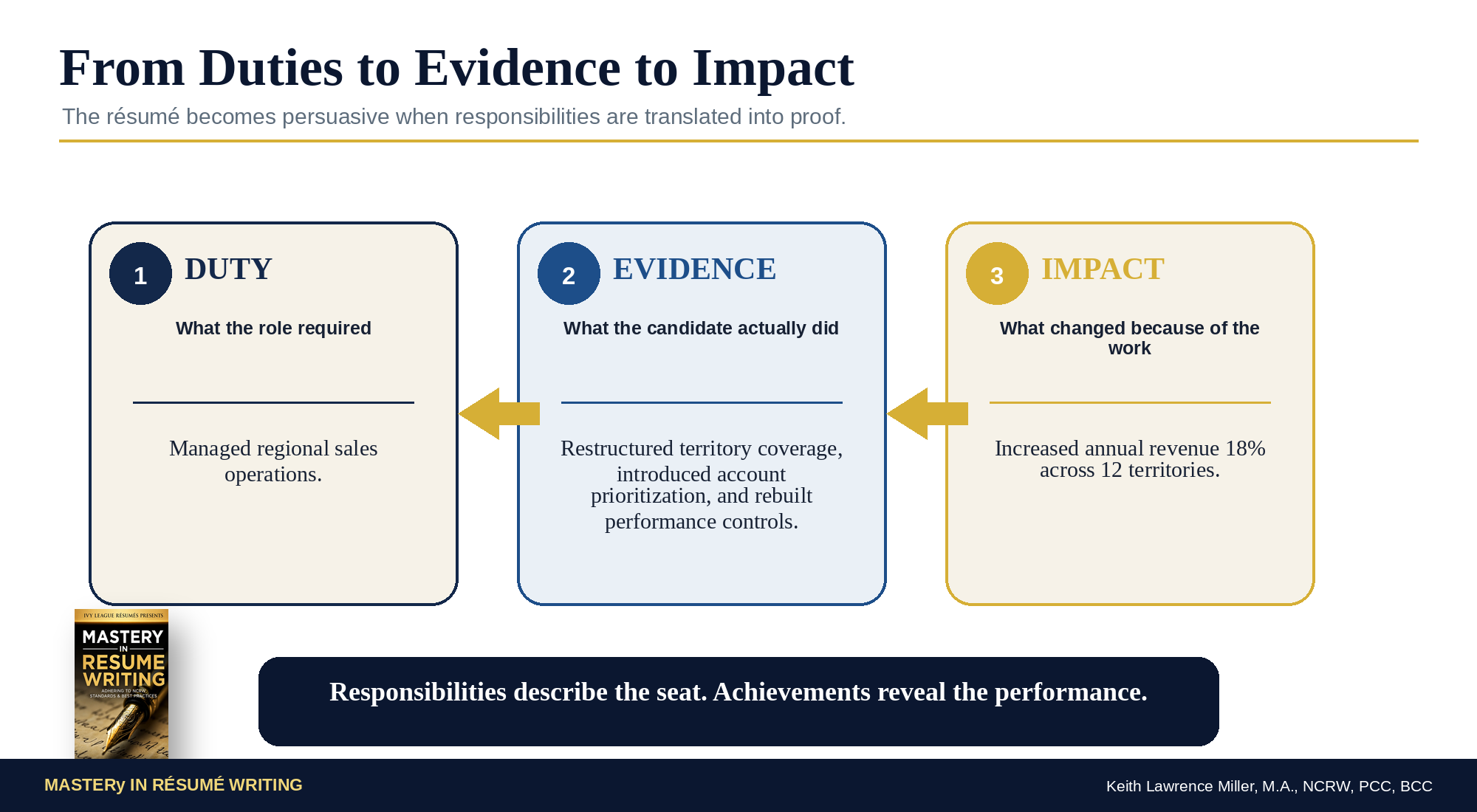
A job description tells the reader what someone was expected to do. An accomplishment tells the reader what the person actually contributed.
That distinction is fundamental.
Consider the difference between “Responsible for managing sales operations” and a statement that shows what happened within that responsibility: “Restructured regional sales operations across 12 territories, introducing performance controls and account prioritization that increased annual revenue 18%.”
The first statement describes the seat. The second gives the reader evidence about the person occupying it.
Whenever possible, strong résumé content should reveal some combination of challenge, action, and result. The result may be quantitative: revenue, savings, growth, productivity, headcount, cycle time, retention, market share, customer satisfaction, quality, risk, volume, or scale.
When meaningful numbers are unavailable, impact can still be demonstrated through scope, complexity, change, influence, recognition, and strategic importance.
The purpose of quantification is evidence.
Build the Career Narrative
A résumé is chronological information organized strategically.
The reader should be able to understand the trajectory. Where did the candidate begin? How did responsibility grow? What capabilities developed? What problems became larger or more complex? What patterns connect the career? Why does the next move make sense?
This is particularly important for senior professionals. An executive résumé should communicate more than a collection of accomplishments. It should reveal leadership scope, organizational influence, strategic judgment, transformation, and the increasing scale of responsibility.
Career changers require a different narrative. The writer may need to emphasize transferable capabilities, relevant achievements, adjacent experience, and the logic connecting the old career with the new direction.
Early-career professionals need another approach. Potential, education, internships, projects, leadership, technical skills, academic achievement, and emerging professional evidence may carry more weight.
The narrative changes with the person. That is why one template cannot solve every résumé problem.
Relevance Is a Competitive Advantage
A résumé should be built for an intended audience.
Review the job description. Study the industry. Identify the required competencies. Understand the terminology. Recognize the problems the employer is trying to solve. Then decide which parts of the candidate’s background deserve emphasis.
A professional may have accomplished 100 meaningful things. The target employer may care deeply about 15 of them. Those 15 deserve disproportionate attention.
Relevance strengthens the document because the reader can see the connection between the candidate’s background and the employer’s needs.
Keywords Need Evidence
Applicant Tracking Systems have made keyword strategy an important part of modern résumé development.
The best source of keywords is often the employer itself. Job postings reveal skills, credentials, job titles, technology, industry terminology, methods, functional responsibilities, and performance expectations.
A strong résumé incorporates relevant terminology when it accurately reflects the candidate’s background.
The key word is accurately.
Keyword strategy should improve discoverability without compromising credibility. Simply repeating terms adds little value. If “process improvement” matters, show the process improvement. If “enterprise transformation” matters, show the transformation. If “P&L leadership” matters, establish the scope.
Keywords help the reader find the evidence. They should never replace it.
Write for Technology and People
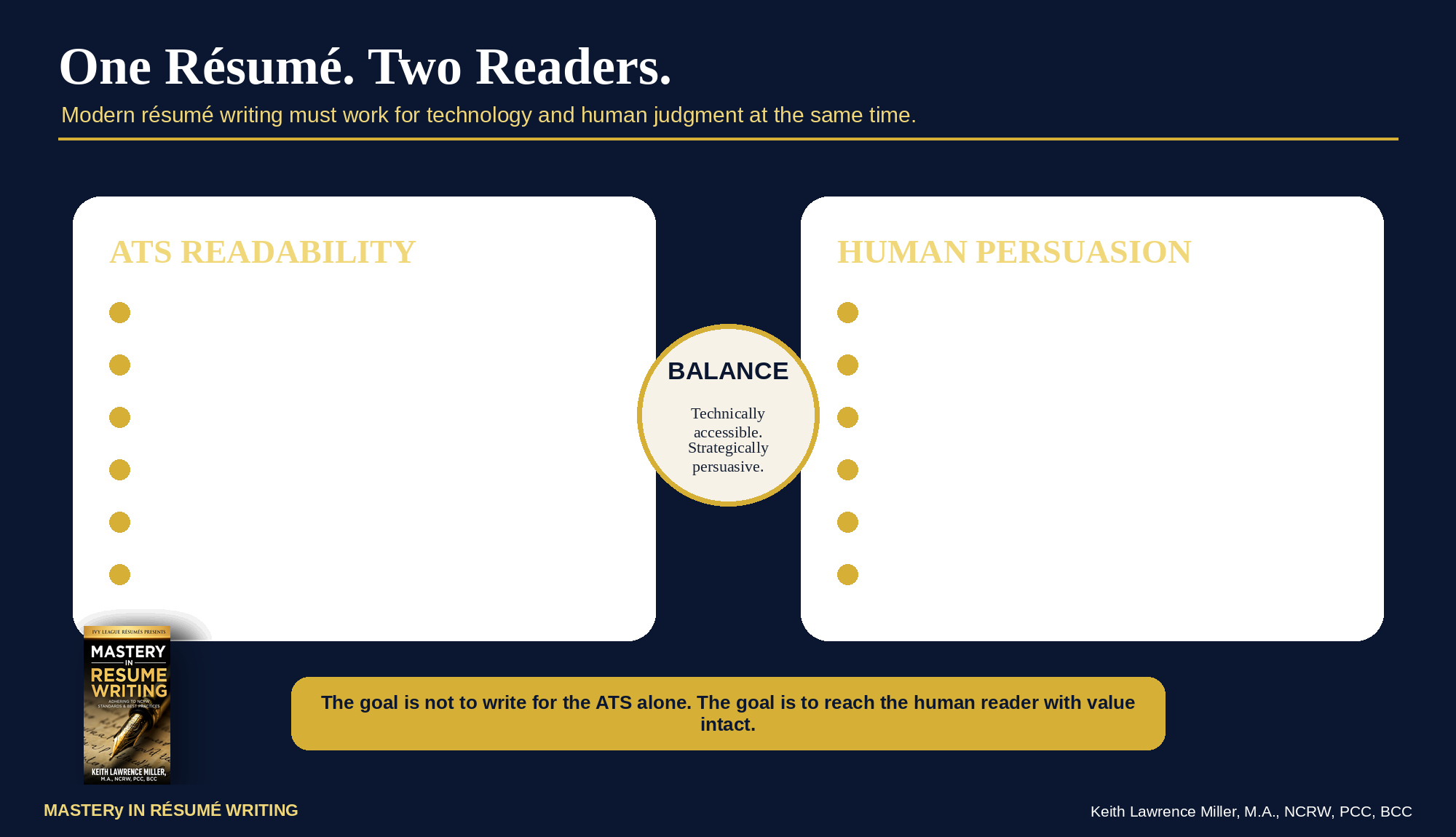
Modern résumé writing involves two audiences. Machines may encounter the document first. People ultimately make employment decisions.
The résumé must work for both.
Use recognizable section headings. Keep important information in accessible document areas. Use professional fonts. Avoid unnecessarily complicated tables, graphics, columns, icons, and text boxes for core content. Keep dates, job titles, employer names, and locations clearly associated. Follow requested file-format instructions. Use relevant keywords naturally.
At the same time, do not reduce the résumé to a machine-readable block of keywords.
A recruiter still needs to understand who this person is, what they have done, why the experience is relevant, what results they produced, and where the evidence is.
A résumé that succeeds technically and fails rhetorically still fails.
Design Should Support the Message
Good résumé design creates hierarchy.
The reader should immediately understand where to look: name, positioning, summary, core capabilities, professional experience, education, credentials, and additional relevant sections.
Formatting helps the reader navigate the argument. White space matters. Typography matters. Spacing matters. Alignment matters. Visual consistency matters. Bullets matter. Page balance matters.
A strong résumé should feel organized before the reader studies a single sentence.
Design becomes a problem when it competes with the content.
Every Section Must Earn Its Space
Résumé space is limited. That makes every section a strategic decision.
The professional summary should establish positioning. Core competencies should reinforce the target. Professional experience should provide evidence. Education and credentials should support qualification. Optional sections should appear when they add meaningful value.
These may include board service, publications, patents, speaking, professional affiliations, technical expertise, languages, awards, military experience, community leadership, selected projects, or research.
The test is relevance. A section belongs when it strengthens the candidate’s case.
Proofreading Is Part of Strategy
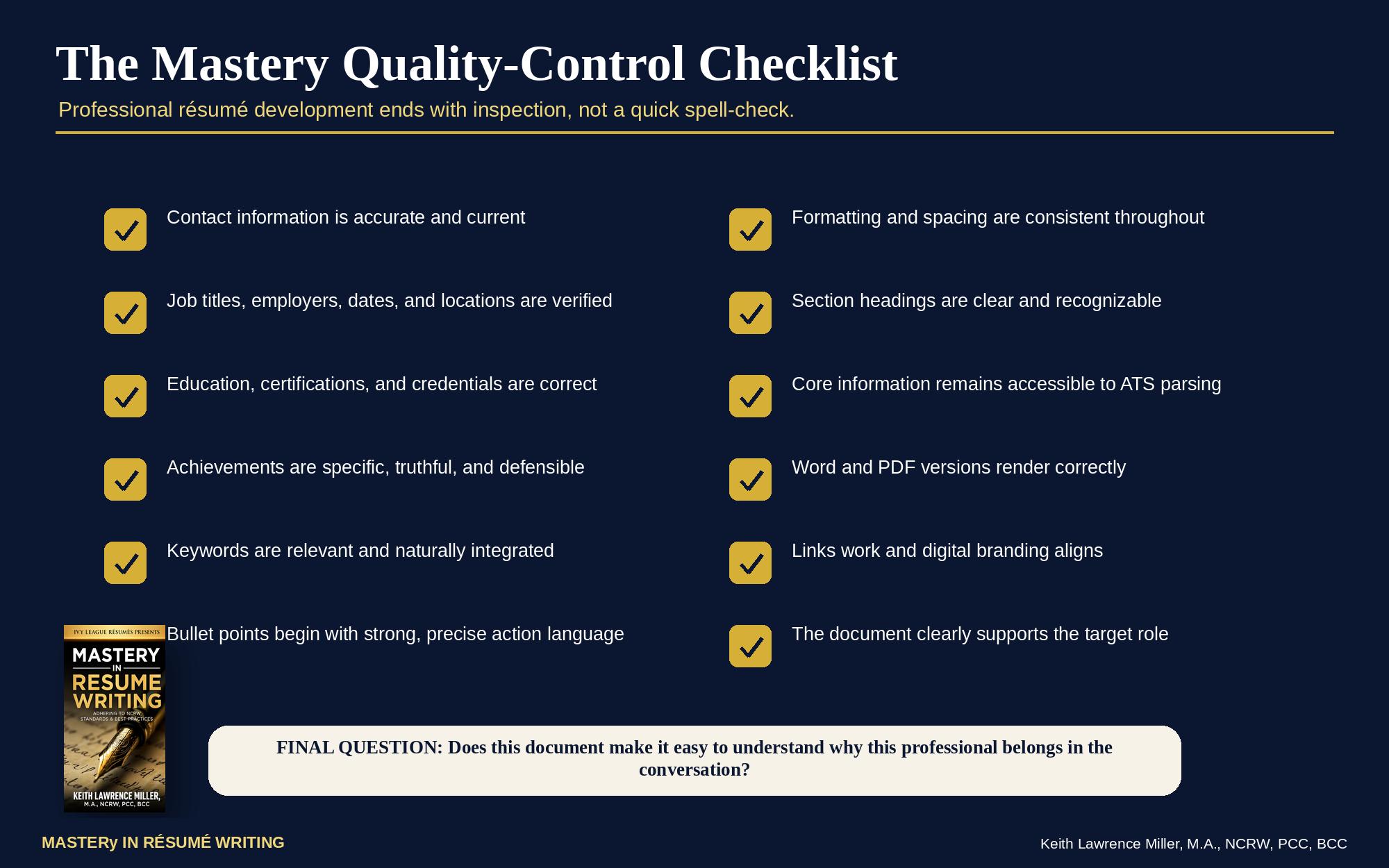
Proofreading is sometimes treated as the final cleanup step. Professional résumé writing demands more than a quick spelling check.
A résumé should be reviewed for accuracy, grammar, punctuation, dates, titles, names, credentials, consistency, formatting, spacing, page breaks, links, parallel construction, clarity, redundancy, keyword integrity, Word and PDF rendering, and ATS readability.
The document should also be examined at the strategic level. Is the most important information easy to find? Does the résumé support the target? Do the bullets communicate value? Does the summary match the evidence? Are claims specific enough? Is anything distracting from the message?
Technology-assisted proofreading can help identify errors, but automated recommendations still require judgment.
Quality control is part of the craft.
Artificial Intelligence Raises the Value of Specificity
Artificial intelligence has made drafting easier. It has also made generic résumé language easier to produce at scale.
That creates a new differentiation problem.
AI-generated documents can sound polished while remaining vague. They may repeat familiar structures. They may overstate accomplishments. They may introduce unsupported claims. They may replace an individual’s professional voice with language that could belong to almost anyone.
AI can be useful for brainstorming, organizing, editing, comparison, and critique.
The final résumé still needs human judgment. Facts must be verified. Accomplishments must be real. Language must fit the candidate. The positioning must reflect the career. Generic content should be replaced with evidence.
In a market containing more machine-assisted writing, specificity becomes more valuable.
The Résumé and LinkedIn Should Reinforce Each Other
Career communication now extends beyond a single document.
Recruiters and hiring managers may compare the résumé with LinkedIn, company biographies, professional websites, portfolios, publications, and other public information.
The résumé and LinkedIn profile do not need to be identical. They should be coherent. Job titles should make sense together. Dates should align. Major accomplishments should not contradict one another. Career direction should be recognizable. Professional branding should feel connected.
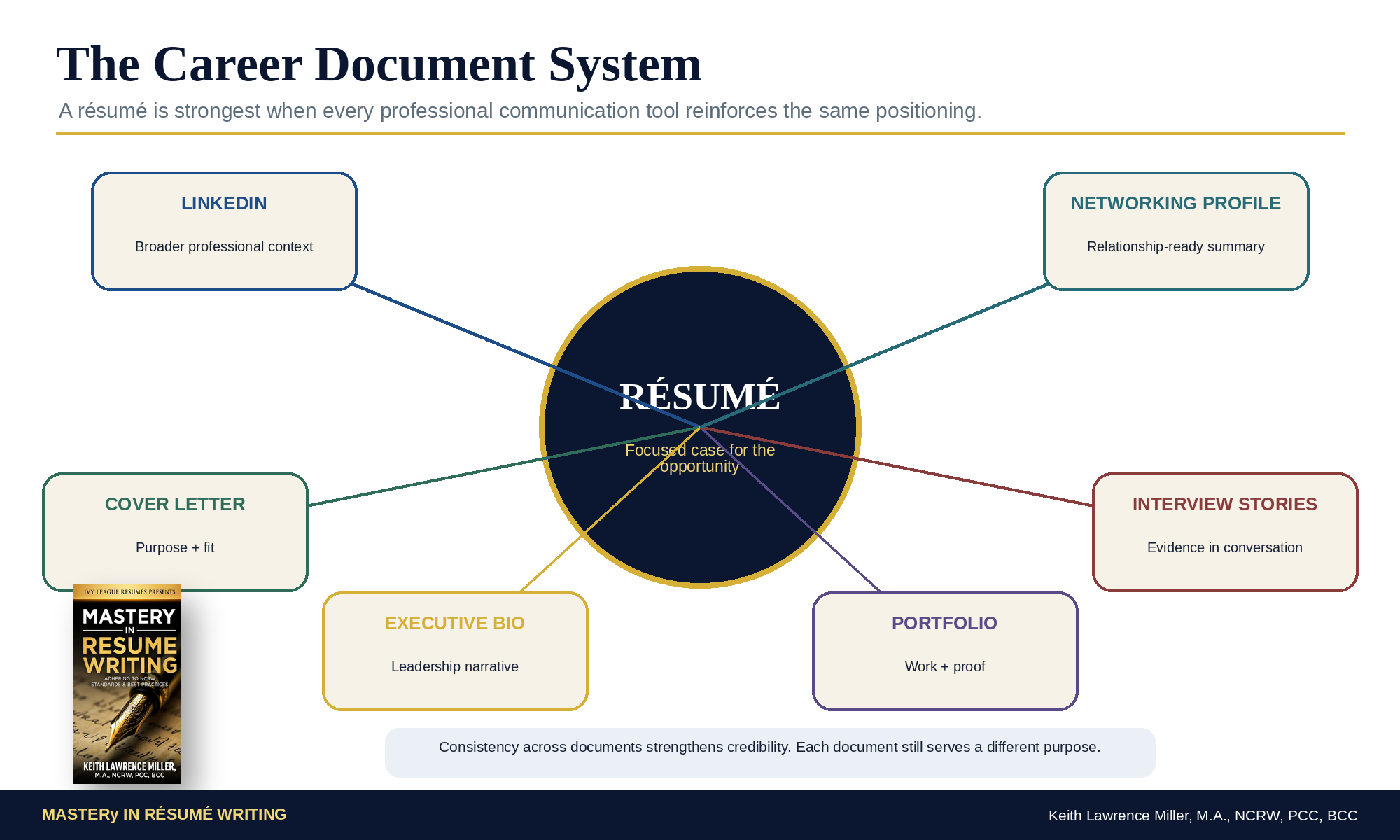
The résumé may provide the tightly focused case for a particular opportunity. LinkedIn can provide broader professional context.
Together they create a stronger professional presence.
The Career Document System
A résumé rarely operates alone.
Depending on the opportunity, the broader career communication package may include a cover letter, LinkedIn profile, executive biography, professional portfolio, networking résumé, board résumé, leadership profile, project portfolio, reference materials, interview stories, or career achievements inventory.
Each document has a different purpose. The strongest career strategy uses them as a coordinated system.
That system allows the candidate to communicate consistently across applications, networking conversations, recruiter outreach, interviews, leadership opportunities, and professional visibility.
What Professional Standards Contribute
Mastery in Résumé Writing was developed with respect for the standards and professional discipline associated with the National Résumé Writers’ Association and the Nationally Certified Résumé Writer credential.
The book emphasizes several connected dimensions of quality.
Strategy and Content
The résumé must be relevant to the candidate’s target and communicate value.
Format and Design
The document should be organized, readable, professional, and compatible with its intended use.
Writing Mechanics
Grammar, spelling, punctuation, sentence construction, and consistency matter.
Value Proposition and Branding
The reader should understand what distinguishes the candidate and how that value relates to the opportunity.
ATS Compatibility
Technology should be able to interpret the document without destroying its effectiveness for human readers.
Professional Development
Résumé writers must continue learning as hiring practices, technology, and career communication evolve.
The larger principle is professionalism. Standards create discipline.
NCRW and the Professional Résumé Writer
The book also provides an educational overview of the Nationally Certified Résumé Writer certification process.
For professional résumé writers, certification represents a commitment to craft, judgment, writing quality, formatting, proofreading, strategy, and client-centered career communication.
The credential itself is only one part of professional development.
Mastery requires continued practice. A writer needs to understand hiring, recruiting, career transitions, business, leadership, industry language, technology, professional branding, and human behavior.
The stronger the writer’s understanding of the world surrounding the résumé, the stronger the document can become.
What Masterful Résumé Writing Can Change
A résumé cannot guarantee an interview. It cannot guarantee a job. It cannot guarantee compensation. It cannot overcome every labor-market condition.
Its value is still significant.
A masterful résumé can improve positioning. It can make accomplishments visible. It can clarify professional identity. It can strengthen confidence. It can create a stronger basis for networking. It can make recruiter conversations more productive. It can help a career changer explain the transition. It can help an executive articulate the scale of leadership.
The résumé-development process can also teach the candidate something about their own career.
Who Should Read Mastery in Résumé Writing?
The book was written for job seekers, professional résumé writers, career coaches, workforce and career development professionals, aspiring NCRW candidates, executives, and experienced professionals whose careers have become too complex to communicate effectively through a simple employment chronology.
For aspiring NCRW candidates, the book provides an educational foundation for understanding professional résumé-writing standards while current official NRWA materials remain the authoritative source for certification requirements.
The Standard Is Clarity With Evidence
There is no single perfect résumé.
There is a disciplined way to think about résumé quality.
Understand the objective. Understand the audience. Gather the information. Find the evidence. Establish the narrative. Prioritize relevance. Write with precision. Quantify where meaningful. Use keywords truthfully. Design for readability. Protect ATS accessibility. Edit relentlessly. Verify everything.
Then ask the most important question:
Does this document help the reader understand why this professional belongs in the conversation?
That is the standard I return to.
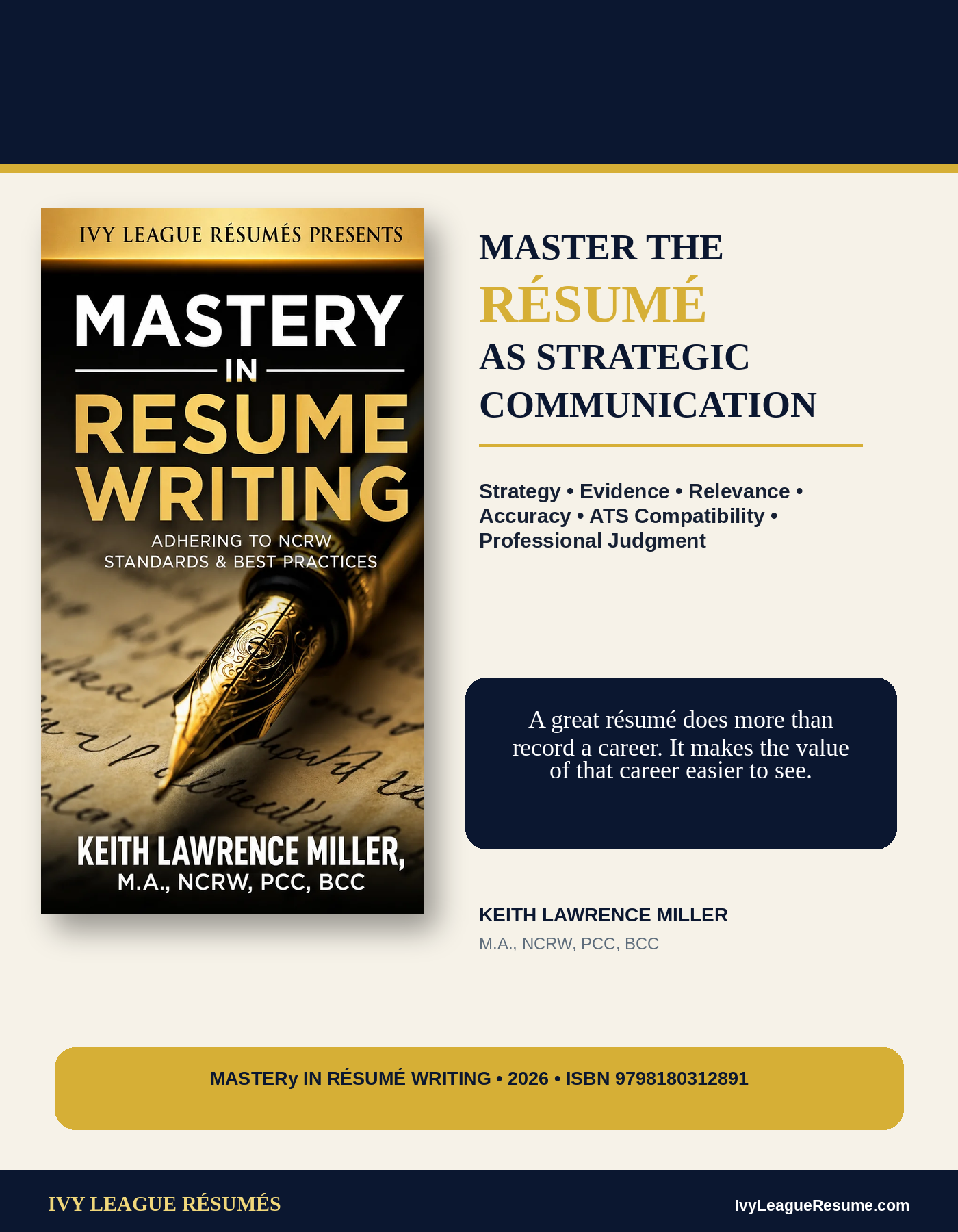
A great résumé does more than record a career. It makes the value of that career easier to see.
Mastery in Résumé Writing is an independent publication. It is not an official publication of the National Résumé Writers’ Association and does not replace the current NRWA Study Guide, certification materials, or guidance from the NRWA Certification Commission. Certification requirements and procedures may change, and readers pursuing NCRW certification should consult current official NRWA resources.