Full book feature
Why a LinkedIn Profile Should Be Built to Be Found, Believed, and Acted On
I have written and refined LinkedIn profiles for professionals at nearly every stage of a career.
Executives. Emerging leaders. Career changers. Entrepreneurs. Technical specialists. Recent graduates. Professionals preparing for promotion. People entering a job search after twenty years with the same employer. People who were already accomplished but whose online presence barely reflected what they had achieved.
Across those experiences, one problem appears again and again.
A professional can be exceptionally qualified and still be almost invisible online.
The profile may exist. The job history may be there. The education may be there. The person may even have hundreds or thousands of connections. Yet the profile can still do very little for them if it does not explain their value clearly, appear for the right searches, provide credible evidence, position them for the opportunities they want, or give the right person a reason to take the next step.
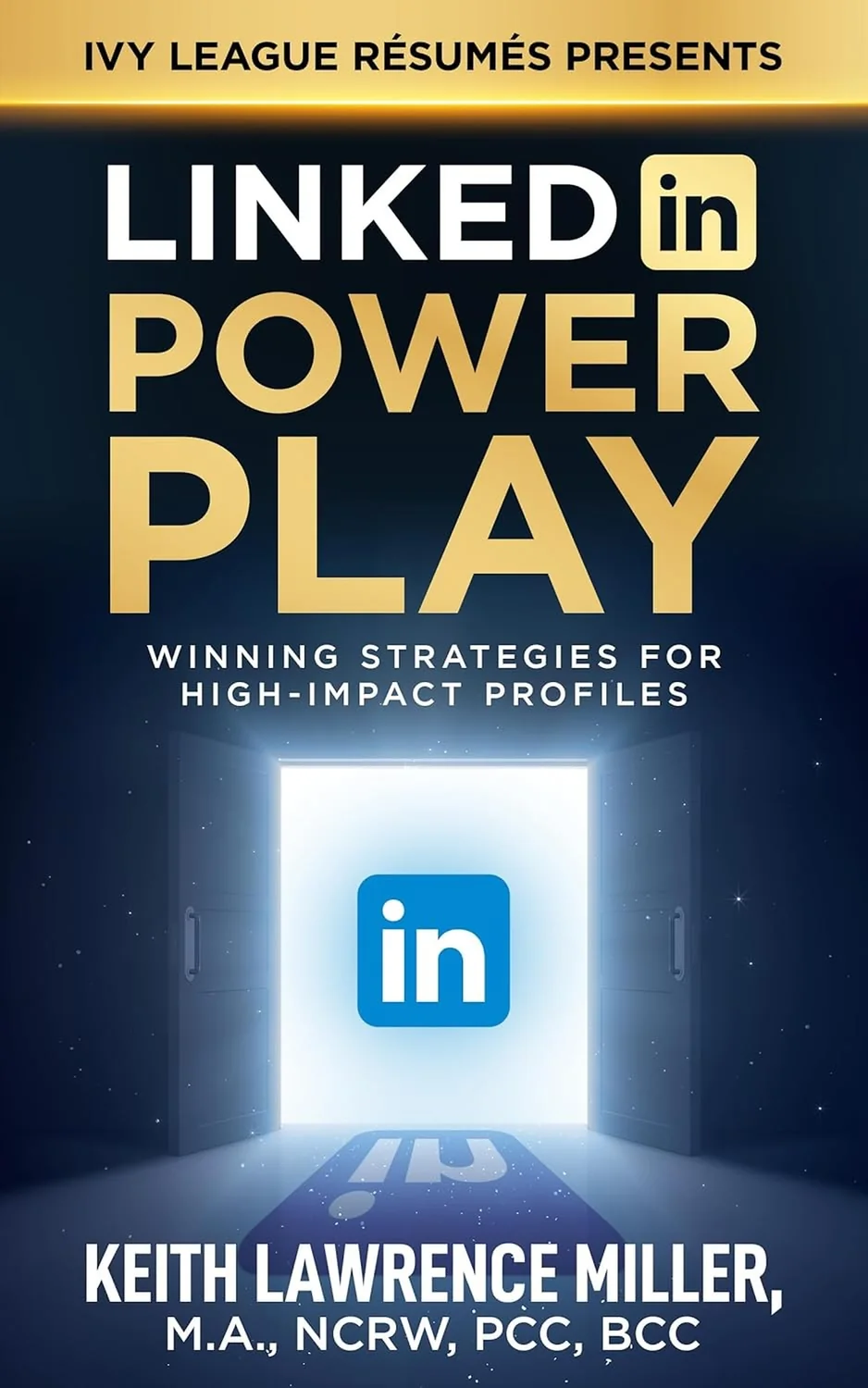
That gap is what LinkedIn Power Play was written to address.
The second edition goes considerably further than the first because LinkedIn itself has changed. Artificial intelligence has become part of professional search and matching. Content has become a major reputation engine. Features appear, evolve, and disappear. Recruiters, buyers, executives, journalists, clients, and professional peers increasingly evaluate people through the digital record surrounding them.
The durable principle remains the same: LinkedIn rewards deliberate professional strategy.
A strong profile is professional infrastructure.
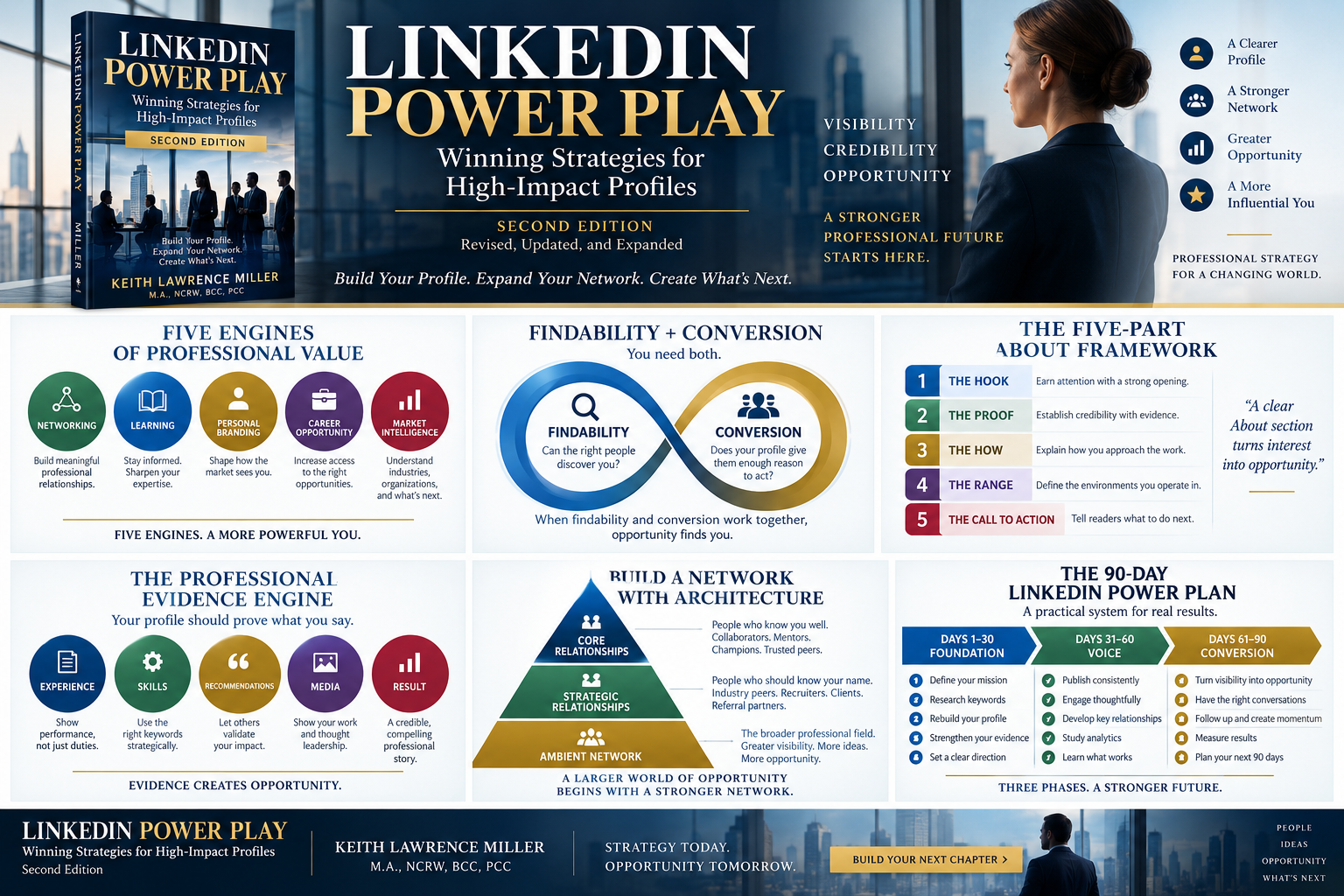
Your Profile Is Working When You Are Not
A résumé travels where you send it. Your LinkedIn profile can be found without an invitation.
A recruiter may discover you while working on a confidential search. A potential client may compare you against several competitors. A hiring manager may review your profile before deciding whether to interview you. A journalist may be looking for an expert. A board member may research you before an introduction. A former colleague may remember you for an opportunity you never knew existed.
Your profile is operating during all of those moments.
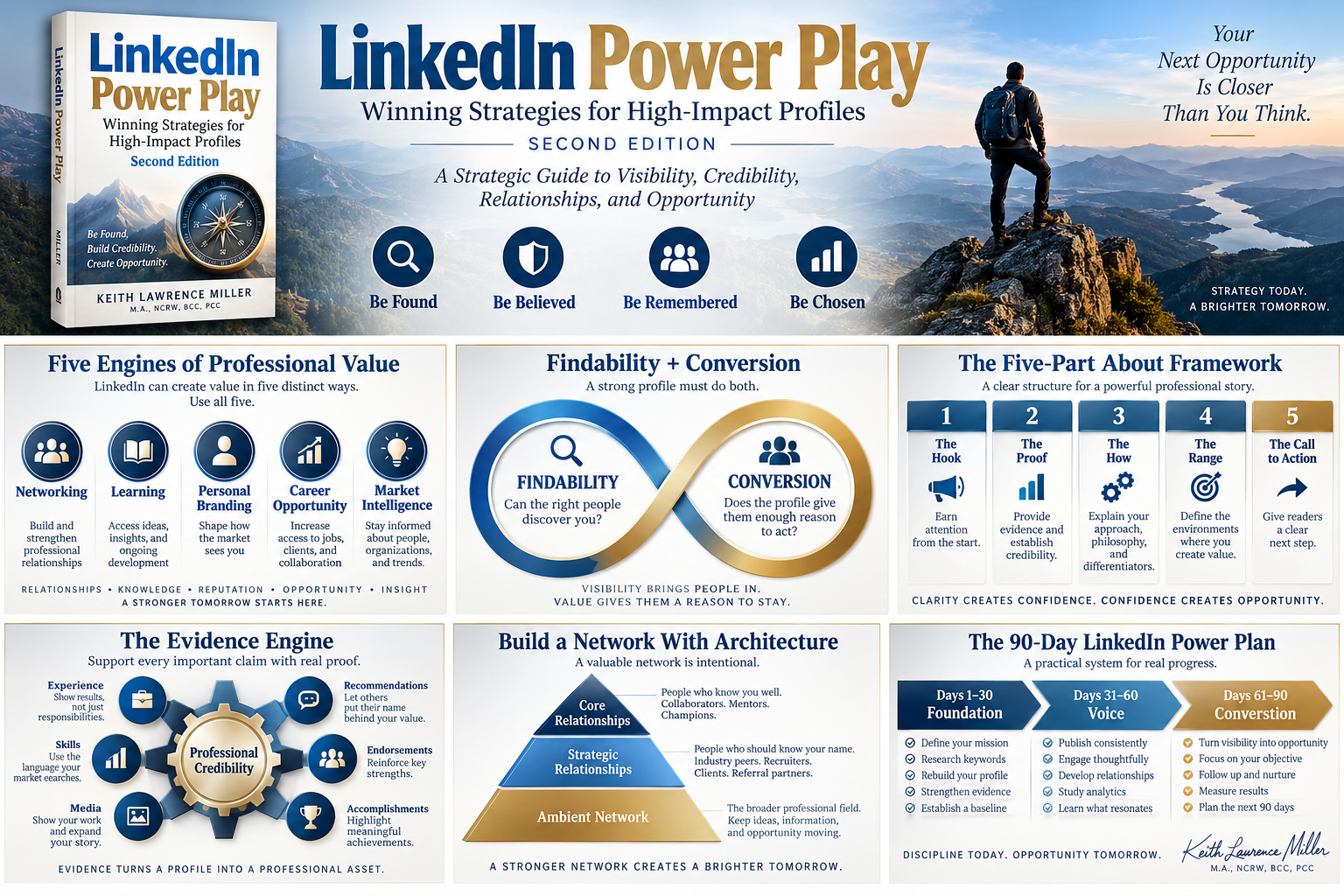
That is why profile optimization should be understood as a strategic discipline. The book reduces that discipline to two fundamental jobs:
Can the right people discover you?
Once they arrive, does the profile give them enough reason to act?
You need both. The objective is to build a profile that can be discovered and that earns the next conversation.
Five Ways LinkedIn Can Create Professional Value
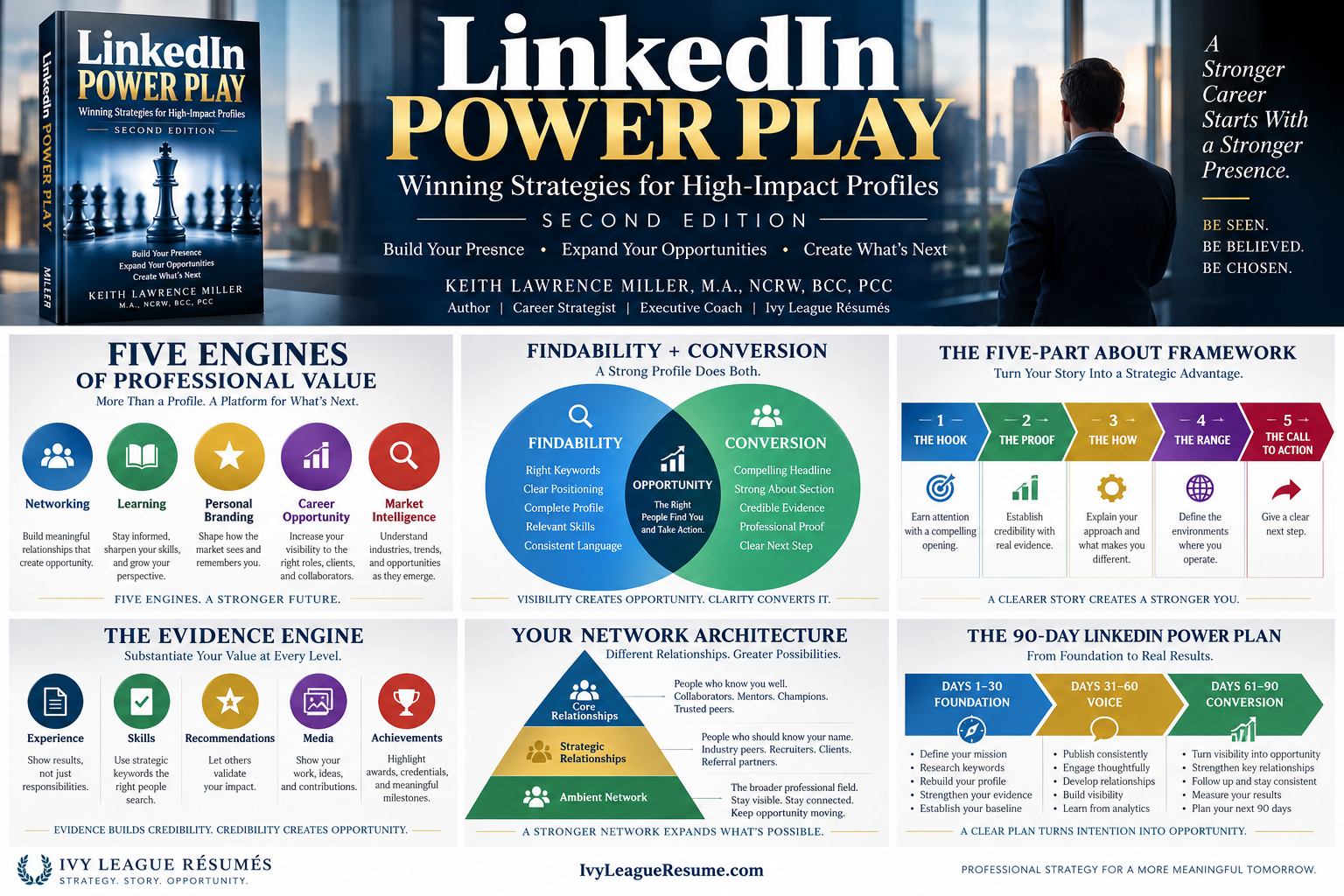
One of the organizing ideas in LinkedIn Power Play is that professionals often underuse LinkedIn because they think of it too narrowly. The platform can create value through five distinct engines.
Build meaningful relationships beyond geography, employer, and hierarchy.
Turn the people and ideas you follow into a professional curriculum.
Shape the professional signal the market receives about you.
Increase the ways recruiters, employers, clients, and collaborators can reach you.
Use hiring, leadership, company, and professional activity as a source of insight.
The important word is deliberate. A network can become an asset. A feed can become a curriculum. A profile can become a professional storefront. A stream of company and industry activity can become intelligence.
Profile Optimization Begins With a Different Question
Many professionals begin a profile rewrite by asking what they should put in their About section.
The stronger starting questions are: Who needs to find me? What do I need them to understand? What evidence will make that understanding credible? What do I want them to do next?
Those questions change how the entire profile gets built.
The book identifies six major payoffs from serious optimization: visibility, clarity, credibility, network gravity, algorithmic alignment, and opportunity flow. Together they create leverage.
The Four Elements That Control the First Impression
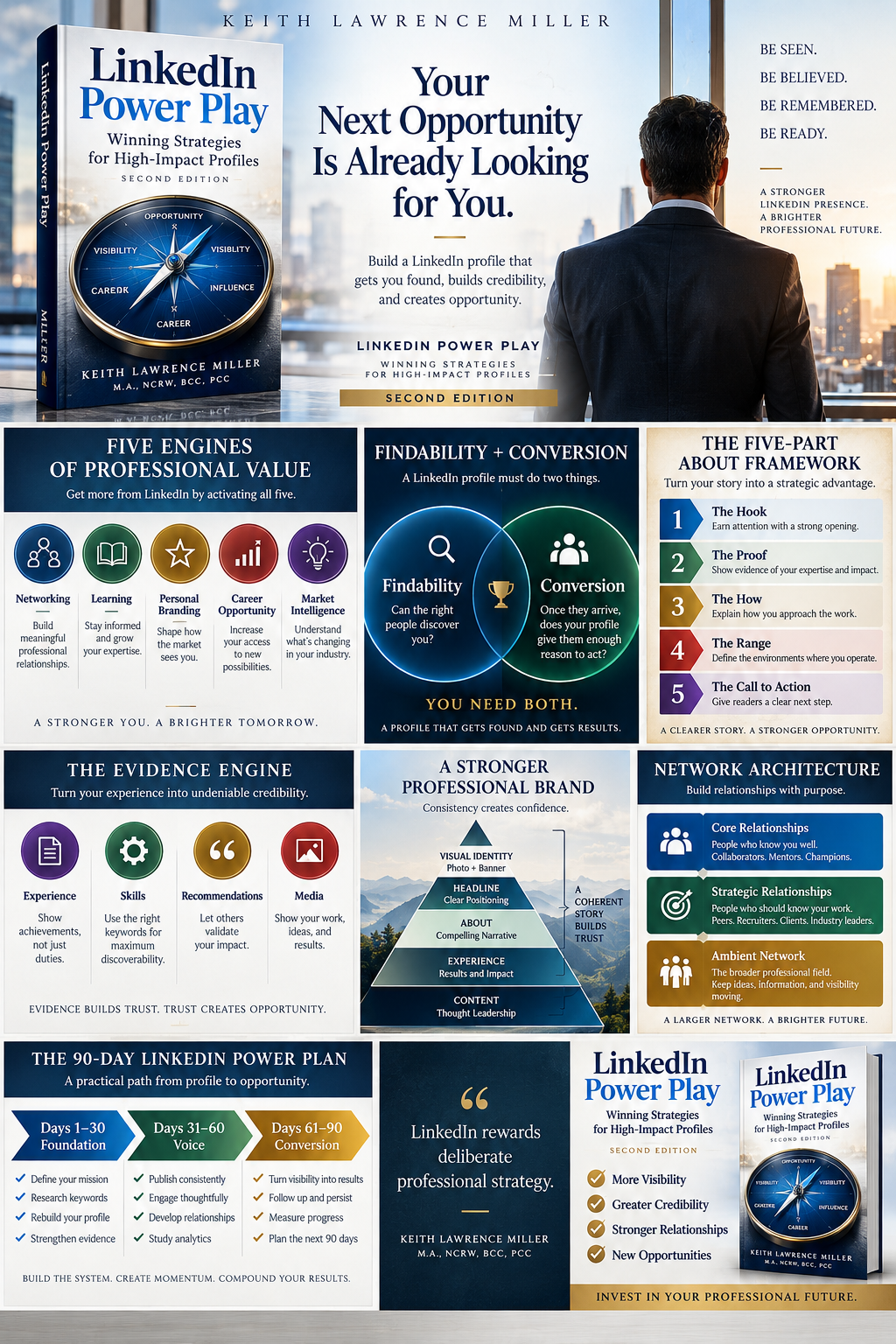
Before anyone reads an entire career history, they encounter a much smaller set of signals: your photo, your banner, your headline, and the opening of your About section.
Those elements need to describe the same professional person pursuing the same objective. Misalignment weakens the message. A polished executive headline beneath an outdated visual identity creates friction. A strong banner paired with a vague headline wastes valuable space. A compelling headline followed by an About section that changes direction creates uncertainty.
The pieces should reinforce each other.
The Headline Has a Job
A headline should do more than repeat a job title. The book presents several structures depending on the professional: role + specialty + outcome; audience + transformation; keywords + proof; or identity + mission.
The standard is simple: every word should contribute either to search or belief.
The Five-Part About Framework
The About section gives you the greatest amount of narrative control on the profile. It should be written as a structured professional argument.
1. The Hook
Earn attention with the problem you solve, a defining result, an important point of view, or the professional territory you occupy.
2. The Proof
Establish evidence with meaningful accomplishments, scope, scale, outcomes, rankings, numbers, or other forms of professional proof.
3. The How
Explain how you approach the work: your method, philosophy, leadership style, operating approach, or differentiators.
4. The Range
Define the environments in which you operate: industries, functions, company stages, markets, geographies, and types of challenges.
5. The Call to Action
Give readers a clear next step: connect, message, email, visit, follow, or explore a service.
Build an Evidence Engine
A profile can make a compelling promise in the headline and About section. The rest of the profile needs to prove it.
That is why LinkedIn Power Play treats the Experience section, skills, recommendations, endorsements, and media as an evidence engine.
Experience Should Describe Performance
Job descriptions explain what a role was responsible for. Achievement statements show what happened because you were there. A strong Experience section establishes scope and then provides evidence of performance.
Use strong action language. Show scale. Quantify meaningful results where possible. Prioritize achievements over routine duties. Weight detail toward the work most relevant to where you are going.
Skills Are Search Infrastructure
Choose skills strategically. Use the terminology employers, recruiters, clients, and professional peers actually search. Remove skills that belong to an earlier version of your career when you no longer want opportunities tied to them.
Recommendations Carry More Weight Than Self-Praise
A recommendation has a quality most profile copy does not: someone else is putting their name behind the claim. Strong recommendations should collectively cover different dimensions of your professional reputation.
Discoverability Is Engineered
Once the profile is persuasive, the next problem is ensuring the right people can find it.
The words you choose matter. If the market searches for one term while your profile uses only an internal company term, you may be describing the same expertise in a language the searcher never uses.
That is why keyword strategy begins with research. Study target job postings. Study client briefs. Study the language used in your field. Identify recurring titles, functions, tools, methods, credentials, and specialties. Include meaningful variants. Prioritize the handful of terms that matter most.
Then distribute them naturally through the strongest parts of the profile: headline, current role, About, Experience, Skills, and Certifications.
The goal is relevance. Professional writing still needs to sound like a human being wrote it.
Your Brand Is What the Market Believes
At the executive level, profile optimization becomes reputation strategy.
The question becomes larger than whether the profile looks good. What do you want the market to associate with your name? What should peers understand about your leadership? What opportunities should this reputation create over the next several years? Which audiences matter most? Which subjects should you become associated with?
An executive brand becomes stronger when the answers remain consistent across profile, content, recommendations, public appearances, and professional relationships.
That requires maintenance. Careers change. Responsibilities grow. Expertise deepens. Strategic goals shift. Public positioning should evolve deliberately with them.
Thought Leadership Requires Specificity
Publishing content does not automatically create thought leadership. Thought leadership is earned authority.
The book encourages professionals to choose their area of authority at the intersection of three things: expertise, where experience runs genuinely deep; appetite, what you can continue exploring over time; and demand, what your intended audience actually needs help understanding.
Specificity makes it possible for people to associate your name with a particular problem or field of expertise.
Content Should Be Sustainable
The strongest content strategy is the one you can continue.
The book uses a simple anatomy for strong content: Hook. Substance. Payoff. Prompt.
Then study what happens. Which topics attract the right audience? Which pieces earn substantive comments? Which ideas get saved? Which formats work best for your goals? Which content produces actual professional conversations?
A monthly review can turn publishing from random activity into a learning system.
Build a Network With Architecture
A large network and a valuable network are different things. LinkedIn Power Play separates relationships into three broad levels.
Core Relationships
Collaborators, mentors, champions, trusted peers, and people who would take your call.
Strategic Relationships
Industry peers, potential employers, recruiters, prospective clients, referral partners, and people whose professional paths meaningfully intersect with yours.
Ambient Network
The larger professional field around you that keeps ideas, information, and visibility moving beyond the relationships you actively maintain.
All three matter. Networking should be intentional.
The Profile, Content, and Network Must Work Together
A profile establishes positioning. Evidence creates credibility. Keywords create discoverability. Content demonstrates thinking. Engagement creates familiarity. Networking builds relationships. Those relationships create access to conversations and opportunities. The profile then reinforces the decision when someone investigates you.
That is why the book treats LinkedIn as a professional operating system rather than a single document. Each part strengthens the others.
Second-edition implementation system
The 90-Day LinkedIn Power Plan
The second edition closes with a practical implementation system because knowledge without sequence often becomes overwhelm. The plan divides ninety days into three stages.
Define the mission. Establish a baseline. Research keywords. Clarify the audience. Rebuild the profile. Strengthen the evidence.
Establish content themes. Publish consistently. Engage thoughtfully. Develop strategic relationships. Study analytics.
Turn stronger visibility and relationships toward the real objective. Follow up. Measure results. Build the next ninety days.
At day ninety, compare the results against the starting baseline and decide what the next ninety days should emphasize. LinkedIn success is a compounding professional practice.
Who Should Read LinkedIn Power Play?
This book is designed for professionals who want LinkedIn to do more than confirm that they exist.
It is for job seekers who want to become discoverable before submitting another application. It is for executives whose online presence does not yet reflect the level at which they operate. It is for career changers who need to reposition their professional story. It is for entrepreneurs, consultants, and sales professionals whose credibility affects whether a prospect responds.
It is also for recruiters and HR professionals who use LinkedIn as a talent environment, professionals building thought leadership, and people who have spent years developing expertise and now need the digital evidence to match it.
LinkedIn Rewards Strategy
LinkedIn will continue changing. Interfaces will change. Features will come and go. Artificial intelligence will continue influencing search, matching, content, recruiting, and professional discovery.
That is why LinkedIn Power Play focuses on principles that survive feature changes.
Know what you want. Understand who needs to find you. Use the language that audience searches. Create a profile that communicates value clearly. Back important claims with evidence. Build relationships deliberately. Share ideas that demonstrate expertise. Measure what matters. Maintain the system.
Your LinkedIn presence should become more valuable as your career becomes more valuable.
That is the Power Play.
LinkedIn Power Play is an independent publication and is not affiliated with, endorsed by, sponsored by, or officially connected with LinkedIn Corporation or Microsoft Corporation. LinkedIn features, pricing, policies, user interfaces, algorithms, statistics, and platform capabilities may change over time; readers should verify current platform-specific information directly with LinkedIn.