Debate Mastery: What Strong Reasoning Looks Like Under Pressure
By Keith Lawrence Miller, M.A.
Much of my professional life has involved watching people make consequential arguments.
An executive explains why a strategy should be funded. A candidate has forty-five minutes to establish why an employer should trust them with a senior role. A leader defends a decision in front of people who already disagree. A client negotiates compensation. A manager confronts an employee. A consultant presents a recommendation to skeptical stakeholders. In each case, the person has information, limited time, competing interpretations, social pressure, and an audience making judgments in real time.
Those situations taught me to become suspicious of one of our easiest assumptions about communication: that the person who appears strongest necessarily has the strongest case.
Confidence can be persuasive without being accurate. Fluency can make weak reasoning easier to accept. Speed can create the appearance of command while concealing assumptions that were never tested. A memorable line can dominate the discussion even when it contributes little to resolving the underlying proposition.
The reverse also happens. Someone with the stronger evidence may communicate it poorly. A careful speaker may appear less certain precisely because they understand the limitations of the evidence. A person who corrects themselves may look weaker in the moment while demonstrating greater intellectual discipline.
That tension became the starting point for Debate Mastery.
The book asks a deceptively difficult question:
What should we actually mean when we say someone is good at debate?
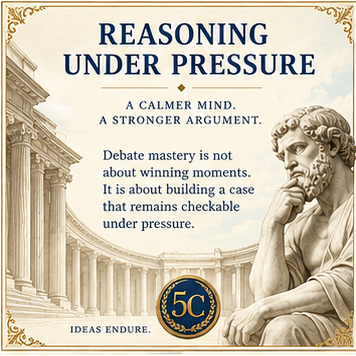
The Winner's Problem
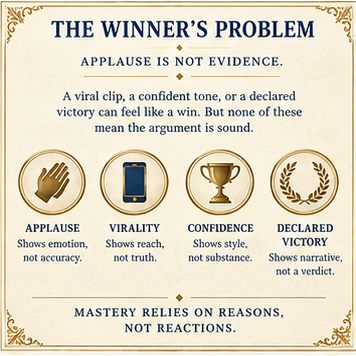
A debate can end with applause, a vote, a viral clip, a favorable headline, or a widespread declaration that one person “won.”
None of those outcomes automatically resolves every question that made the debate important.
Imagine two speakers leaving the same stage. One generated the strongest audience reaction and produced the most memorable moments. The other made narrower claims, used stronger evidence, acknowledged uncertainty, answered the strongest objections, and corrected a mistake when confronted with better information.
Which performance demonstrates greater mastery?
The answer depends entirely on what we are measuring.
This is what I call the winner's problem.
Public debate encourages us to collapse several different judgments into one. We combine factual accuracy, logical strength, rhetorical skill, audience persuasion, strategic performance, confidence, reputation, and entertainment value, then call the result “winning.”
That may be convenient. It is analytically weak.
Debate Mastery separates those dimensions because they answer different questions.
A speaker can be persuasive and factually wrong. Another can be factually correct and strategically ineffective. Someone can win over the room while avoiding the most difficult part of the opposing argument. Someone else can lose an audience while exposing a serious weakness in the proposition.
The discipline begins when we stop asking only, “Who won?” and start asking, “What exactly was established?”
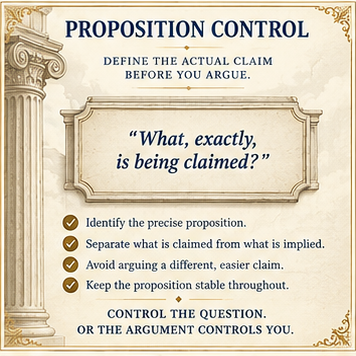
Start With the Proposition
Many weak arguments fail before the discussion truly begins because the participants are arguing different propositions.
Consider a claim such as:
“Artificial intelligence will replace most professional jobs.”
What does “replace” mean?
Does it mean eliminate the occupation completely? Reduce headcount? Automate individual tasks? Lower the market value of some skills? Change entry-level work? Transform how professionals perform their jobs?
What does “most” mean?
More than half of occupations? More than half of tasks? More than half of workers in a particular sector?
What time period are we discussing?
Five years? Twenty years? Eventually?
Until those terms are controlled, two intelligent people can spend an hour appearing to disagree while defending propositions that barely overlap.
This is why one of the earliest disciplines in Debate Mastery is proposition control.
Before building the argument, determine what is actually being argued.
A serious proposition establishes boundaries. It tells us what evidence would matter, who carries which burden, which terms are load-bearing, and what would count as evidence against the claim.
That discipline is useful far beyond formal debate.
I see the same problem in business constantly. Teams argue about whether a strategy “works” without agreeing on what success means. Leaders debate whether an employee is “ready” without defining readiness. People discuss whether AI is “better” without specifying the task, comparator, stakes, or standard.
Poorly defined language can manufacture disagreement.
Precise language makes reasoning inspectable.
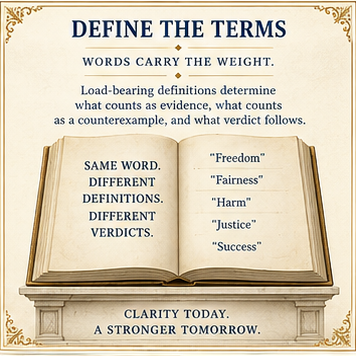
Definition Is Part of the Argument
Words carry assumptions.
Freedom. Fairness. Leadership. Intelligence. Evidence. Harm. Success. Equality. Risk. Expertise. Productivity. Responsibility.
Two people can use the same word while carrying completely different conceptual models into the discussion.
That means defining terms is not a ceremonial exercise.
Definitions influence what evidence becomes relevant and what conclusions can logically follow.
A strong debater therefore asks which terms are doing the most argumentative work.
If changing the definition changes the verdict, the definition deserves scrutiny before the argument proceeds.
This is one reason sophisticated debate requires intellectual flexibility. You may discover that your opponent's objection does not undermine your evidence at all. It exposes a problem in the way you framed the proposition.
Correcting that framing strengthens the argument.
A Good Question Has a Job
People often admire aggressive questioning because pressure creates drama.
I care much more about whether the question performs useful argumentative work.
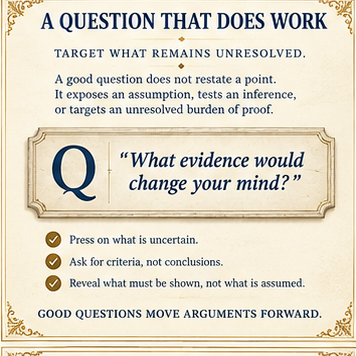
A good question targets an unresolved burden. It gives the other person a fair opportunity to answer. Most importantly, the questioner knows what they will do with the answer.
That final step is frequently missing.
Someone asks a devastating question, receives an answer, and immediately moves to another question.
The exchange may look impressive, but the argument has barely advanced.
The discipline I teach is different.
Ask the question. Listen to the answer. Capture what was actually said. Then explain what the answer changes.
If the answer weakens your position, acknowledge it.
If it narrows the opponent's claim, identify the narrowing.
If it introduces new evidence, evaluate the evidence.
If it leaves the original burden unresolved, explain why.
Questioning becomes powerful when it creates a visible chain of reasoning rather than a sequence of confrontations.
Test the Claim, Not the Person
Arguments become intellectually dangerous when disagreement with a claim turns into judgment of the person making it.
A person's reputation can be relevant. Expertise can matter. Conflicts of interest can matter. Credibility can matter.
Those considerations still do not substitute for evaluating the claim.
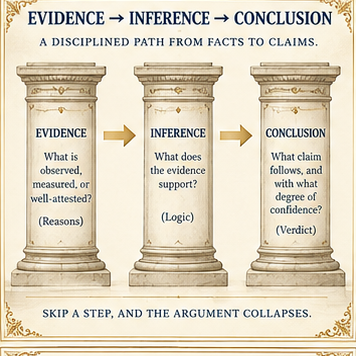
The central questions remain: What is being asserted? What evidence supports it? Does the evidence actually support the conclusion? What inference connects them? How strong is that inference? What credible evidence points the other way? What would change our confidence?
This approach is particularly important in polarized environments, where people often decide whether an argument is trustworthy after identifying the speaker.
That reverses the reasoning process.
A disciplined thinker should be capable of recognizing a strong argument made by someone they dislike and identifying a weak argument made by someone they generally agree with.
That capacity is becoming increasingly valuable.
Rebut the Strongest Case
One of the easiest ways to look impressive in an argument is to attack the weakest available version of the other person's position.
It is also one of the least useful.
Debate Mastery requires the opposite discipline.
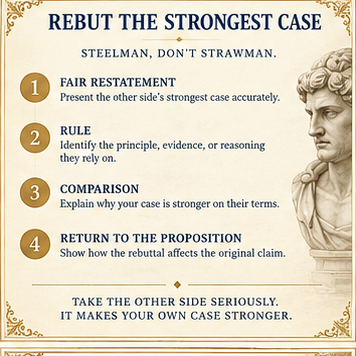
Before rebutting an argument, establish the strongest fair version you can defend as an accurate representation of what the other person actually said.
Then answer that.
This creates an important psychological challenge.
Weak versions of opposing arguments are comfortable. They allow us to preserve certainty.
Strong versions create risk.
If I articulate your argument better than you did, I may discover that part of my own position needs revision.
That possibility is exactly why the exercise matters.
The purpose of disciplined argument should include discovering where our own reasoning fails.
A rebuttal therefore requires more than contradiction.
It should restate the strongest fair answer, identify the governing evidence or reasoning standard, make the comparison explicit, state the narrowest conclusion the evidence warrants, consider the strongest remaining reply, and return to the proposition.
That structure prevents the audience from having to invent the reasoning on the speaker's behalf.
Persuasion Requires Its Own Discipline
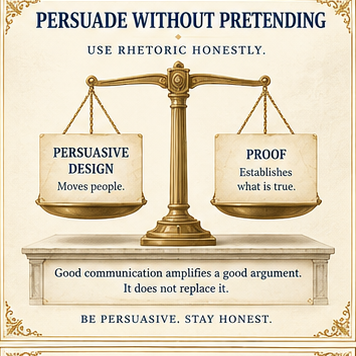
Reasoning and persuasion overlap, but they are not identical activities.
A well-supported argument does not guarantee that anyone will listen to it, remember it, agree with it, or act on it.
That is where persuasion enters.
The book treats persuasion as a design problem.
Who is the audience? What do they currently believe? What evidence will they recognize as credible? What background knowledge can reasonably be assumed? What outcome are you trying to influence? What emotional and narrative elements clarify the argument? What would count as evidence that the communication actually worked?
This last question matters because speakers routinely confuse persuasive intention with persuasive effect.
Someone may say, “That story really connected with people.”
How do we know?
Applause? A post-event survey? Changed opinions? Changed behavior? Retention a month later?
Those are different outcomes.
The book's standard is persuade without pretending. Use rhetoric, narrative, framing, credibility, emotion, and delivery deliberately while keeping those devices inside the boundaries established by the evidence.
A compelling presentation should help people understand the case.
It should not quietly enlarge the case beyond what the evidence supports.
Famous Debaters Are Cases, Not Templates
Debate Mastery studies documented exchanges involving Charlie Kirk, Christopher Hitchens, James Baldwin, William F. Buckley Jr., Stephen Fry, Muhammad Ali, Noam Chomsky, and their interlocutors.
I did not build the course around the idea that one of these people represents the universal model of a great debater.
That would contradict the purpose of the book.
Different speakers operate in different formats, historical periods, roles, topics, power relationships, media environments, and audience conditions. Their strongest moves can be studied. Their limitations can be studied. The responses they provoke can be studied.
The useful question is not, “Which famous person should I imitate?”
It is, “What can this exchange teach me about a specific capability?”
A historical interview can illuminate how someone handles a hostile premise. A formal motion can show how proposition control affects strategy. A contentious exchange can reveal how role power shapes questioning. A strong closing can demonstrate compression. A factual dispute can show why rhetoric and evidence must be scored separately.
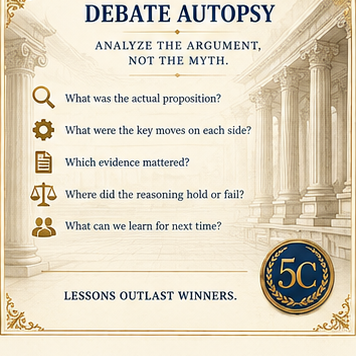
This is why the book uses what I call Debate Autopsies.
An autopsy reconstructs what the record actually allows us to examine: the proposition, format, roles, argument sequence, evidence disputes, strongest responses, turning points, outcomes, and unresolved questions.
It does not transform a famous performance into mythology.
Adapting Without Losing the Argument
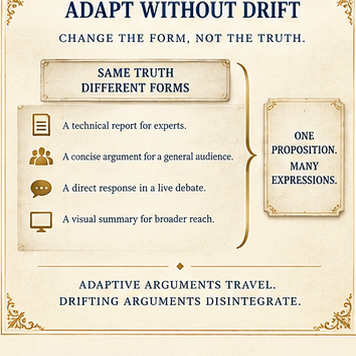
The same argument should not be delivered identically in every environment.
A university debate, television interview, board presentation, congressional hearing, podcast, executive meeting, job interview, and negotiation impose different constraints.
Time changes. Roles change. Power changes. Audience knowledge changes. The number of participants changes. Evidence can be displayed differently. Interruption rules differ.
A capable speaker adapts.
The challenge is preserving the underlying argument while changing its form.
That requires knowing what cannot move: your proposition, your evidence, your uncertainty, your ethical boundaries, and your willingness to correct a material error.
Everything else has considerably more flexibility.
You can shorten an explanation, change examples, reorganize evidence, modify the order of questions, adjust technical language, alter delivery, and choose a different entry point for a different audience.
The argument can change shape without changing its truth conditions.
That is what controlled adaptation looks like.
Recovery May Be More Revealing Than Perfection
I am also skeptical of the mythology surrounding flawless performance.
Live reasoning is difficult.
People misspeak. Forget a statistic. Misunderstand a question. Lose track of a thread. Discover that an opponent has evidence they have never seen.
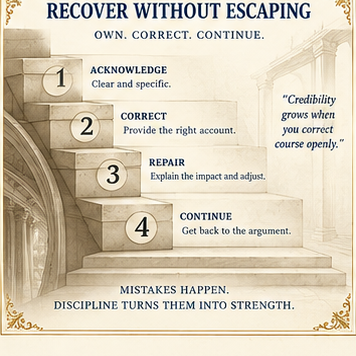
The critical skill is what happens next.
A weak recovery attempts to hide the error, change the subject, attack the questioner, or speak with greater confidence.
A disciplined recovery identifies the problem, repairs the relevant part of the argument, preserves what remains defensible, and continues.
This is intellectually important because the ability to correct yourself is part of reasoning.
A person who cannot revise a position when the evidence changes has confused consistency with integrity.
In serious debate, correction should strengthen credibility rather than automatically count as defeat.
The Final Minute Should Reveal the Argument
Closings create another temptation.
Time is running out. The audience is attentive. The speaker wants the memorable line.
That is exactly when discipline matters.
The book calls the closing process crystallization.
A strong closing compresses the argument without changing it.
It returns to the proposition that was actually debated, selects the decisive evidence, explains the central contrast, acknowledges any material uncertainty that survived the exchange, and states the conclusion with confidence calibrated to what was established.
The closing should make the decision structure visible.
If an argument requires a dramatic new claim in the final thirty seconds to become persuasive, the problem occurred earlier.
Compression should reveal the case that already exists.
Debate Autopsies Change the Way You Watch Arguments
Once you stop watching debates as winner-versus-loser spectacles, they become much more interesting.
I begin separating dimensions.
Was the proposition clear? Were definitions stable? Did the evidence fit the claim? Was correlation treated as causation? Were questions relevant and answerable? Did the questioner use the answers? Did either side materially revise its position? Was the strongest opposing case addressed? Did rhetoric clarify the evidence or substitute for it? Did the closing accurately represent what had been established? What remained unresolved?
This approach produces a much richer analysis than asking who “destroyed” whom.
It also makes debate more useful as a learning system.
Instead of copying personalities, learners can identify observable behaviors, practice them, receive feedback, revise, and repeat.
Why I Turned the Book Into a Course
I eventually decided that Debate Mastery should do more than describe these ideas.
It should require the reader to perform them.
The current edition is therefore structured as an independent certificate course through TheFiveCourse.com. It includes fourteen chapters, diagnostic work, applied exercises, knowledge checks, a cumulative assessment, a Debate Autopsy and Performance Capstone, an oral defense, correction work, and an integrity attestation.
The certificate records successful completion of the published course requirements.
It is a private course-completion credential. It is not university credit, professional licensure, or a promise that someone will win competitive debates.
That boundary is important because the book applies its own standards to itself.
Publishing a method does not prove that the method has produced every outcome someone might attribute to it.
The course can document what was taught, what was completed, what was assessed, and what standards were applied.
Claims about broader transfer, durable persuasion, or universal mastery require separate evidence.
That is the same evidence discipline the course asks learners to apply everywhere else.
Debate Is More Useful Than Debate
The irony of writing a book called Debate Mastery is that I think its most important applications occur outside formal debates.
Leadership requires argument. Strategy requires argument. Hiring requires argument. Coaching requires argument. Negotiation requires argument. Research requires argument. Entrepreneurship requires argument.
A board presentation is an argument about what should happen next. An interview is an argument about capability and fit. A business plan is an argument about an uncertain future. A performance review is an argument about evidence, interpretation, expectations, and consequences.
Even private decision-making is often an argument we conduct with ourselves.
The quality of those decisions improves when reasoning becomes more visible.
That is ultimately what I wanted this book to teach.
The Standard I Now Use
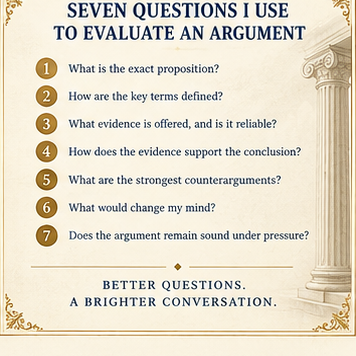
When I evaluate an argument, I increasingly return to seven questions:
- What exactly is the proposition, and who carries the burden of establishing it?
- Which definitions materially affect the conclusion?
- What evidence supports the claim, and what inference connects the evidence to the conclusion?
- What is the strongest fair opposing case?
- What evidence would make me revise my position?
- Which parts of the argument were established, weakened, qualified, or left unresolved?
- If I had to explain the conclusion without the speaker's charisma, reputation, confidence, or audience reaction, would the reasoning still hold?
That final question captures much of what Debate Mastery is trying to accomplish.
Good reasoning should survive inspection after the performance ends.
Reasoning Under Pressure
We live in an environment that rewards immediate reaction.
People are expected to have positions quickly, defend them confidently, compress complex issues into short formats, and respond publicly before they have had enough time to think.
Artificial intelligence can now generate arguments almost instantly, which will make fluency even less reliable as evidence of understanding.
That makes the underlying discipline more important.
Can you define the proposition? Can you identify the burden? Can you distinguish evidence from inference? Can you recognize a strong objection? Can you answer the version of the argument someone actually made? Can you correct yourself without escaping the question? Can you persuade without pretending that persuasion proves truth? Can you leave an argument knowing more than you knew when you entered it?
Those are the capabilities I associate with mastery.
They are less theatrical than winning.
They are much more useful.
About the Book
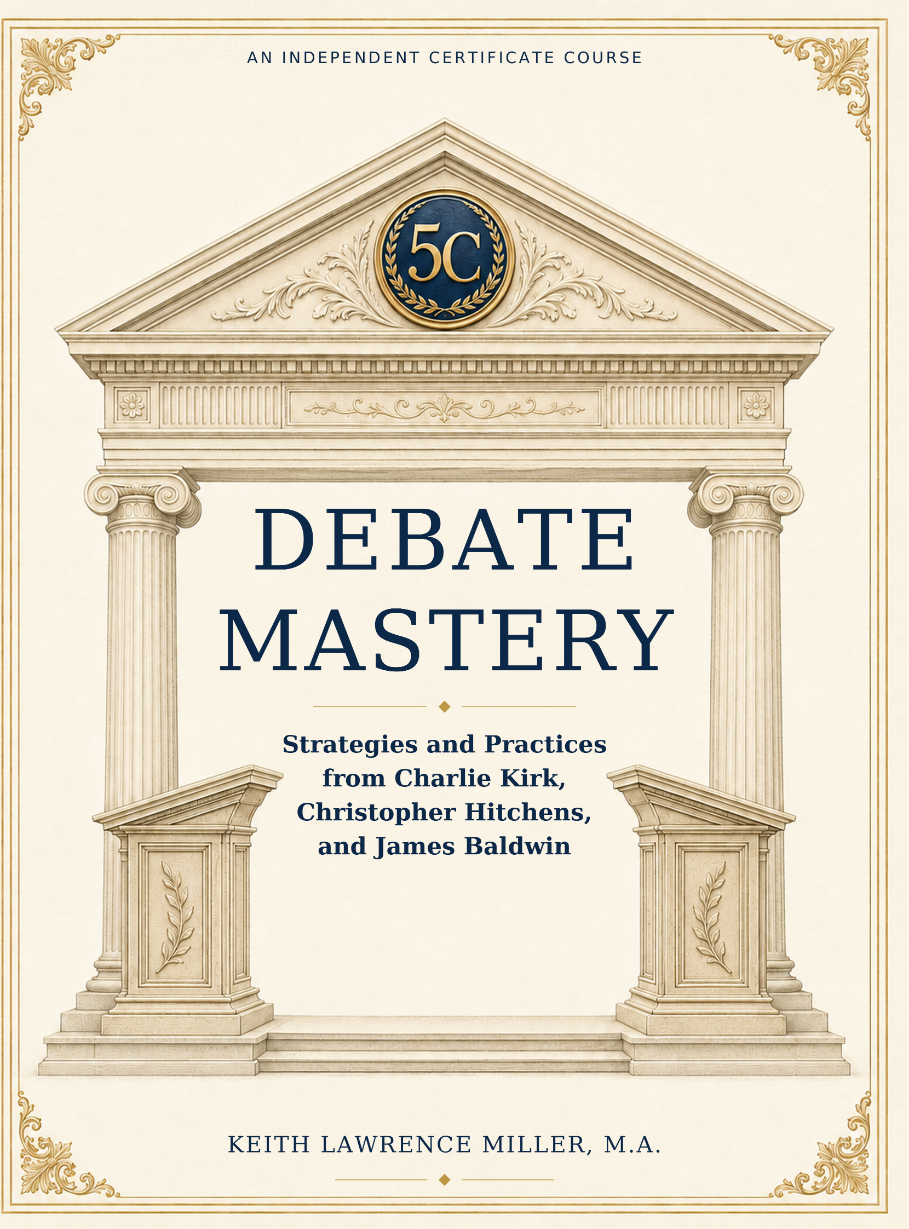
Debate Mastery: Strategies and Practices from Charlie Kirk, Christopher Hitchens, and James Baldwin — Reasoning Under Pressure is an independent certificate course by Keith Lawrence Miller, M.A.
The course uses documented exchanges involving Charlie Kirk, Christopher Hitchens, James Baldwin, William F. Buckley Jr., Stephen Fry, Muhammad Ali, Noam Chomsky, and their interlocutors as bounded cases for examining proposition control, definitions, questioning, evidence, rebuttal, persuasion, adaptation, recovery, closing, and post-debate analysis.
The program consists of four parts and fourteen chapters, moving from preparation and proposition control through pressure, proof, live performance, applied practice, assessment, and certification. The certificate pathway includes diagnostic work, chapter assessments, applied exercises, a cumulative assessment, a Debate Autopsy and Performance Capstone, oral defense, correction work, and learner integrity requirements.
The work is independent and is not affiliated with, sponsored by, or endorsed by the individuals, estates, institutions, publishers, platforms, or organizations discussed.
Keith Lawrence Miller, M.A. First Edition · 2026 ISBN: 9798194895298 Certificate course: TheFiveCourse.com
The Debate Mastery Certificate is a private certificate of course completion. It is not academic credit, a university credential, professional licensure, or a guarantee of competitive success.