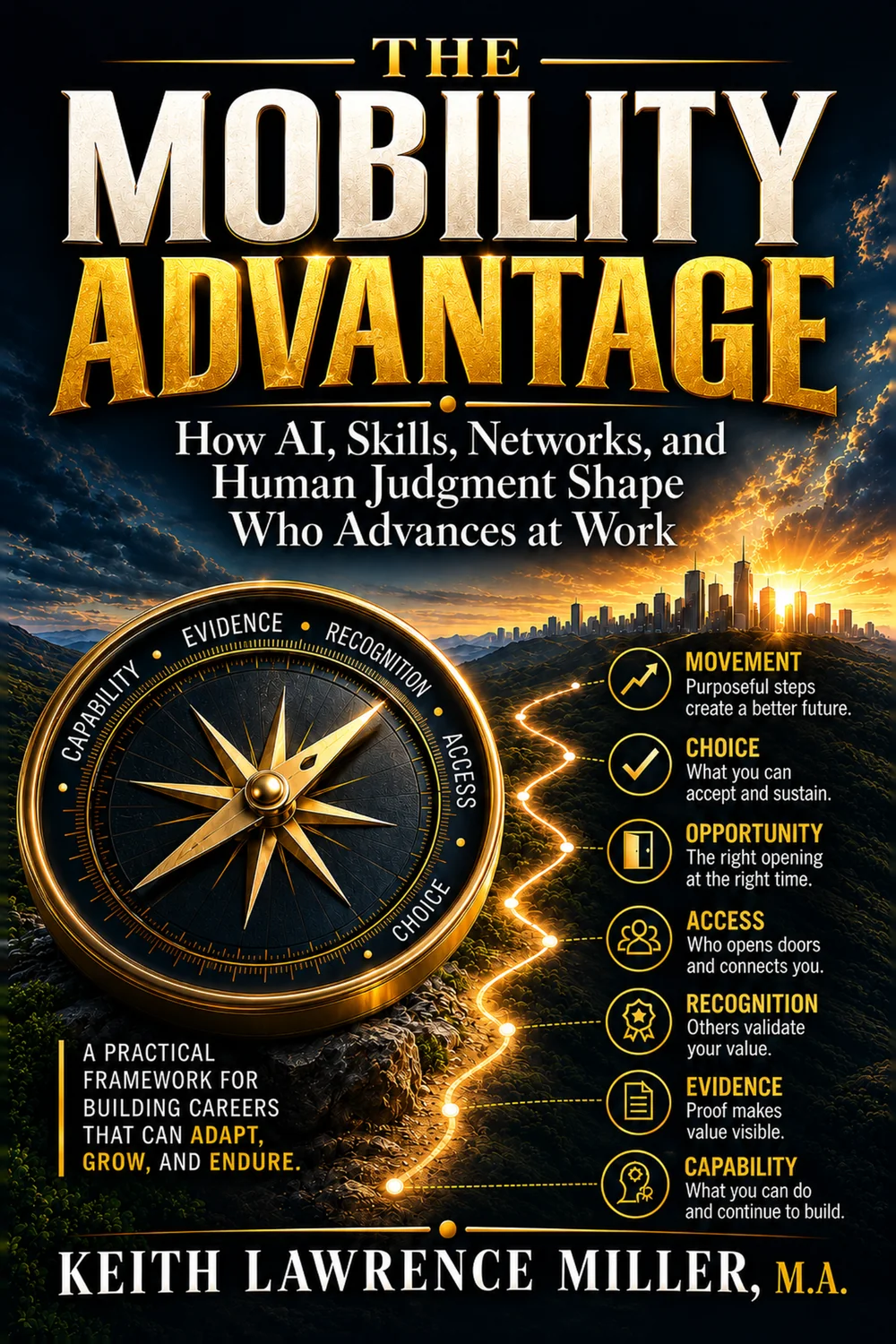
Full book feature
Capability Does Not Automatically Become Opportunity
A professional can be highly capable and still become stuck.
They may have years of experience, strong performance reviews, advanced education, technical expertise, leadership responsibility, a respected title, and a record of solving difficult problems.
Yet when they try to move, the market barely responds.
Applications disappear. Recruiters struggle to understand the background. Internal opportunities go elsewhere. A career change seems to require starting over.
The professional begins asking a painful question: If I am this experienced, why do I have so few good options?
That question sits at the center of The Mobility Advantage.
The book begins from a distinction that conventional career advice often misses.
Professional value does not move automatically. It has to be converted.
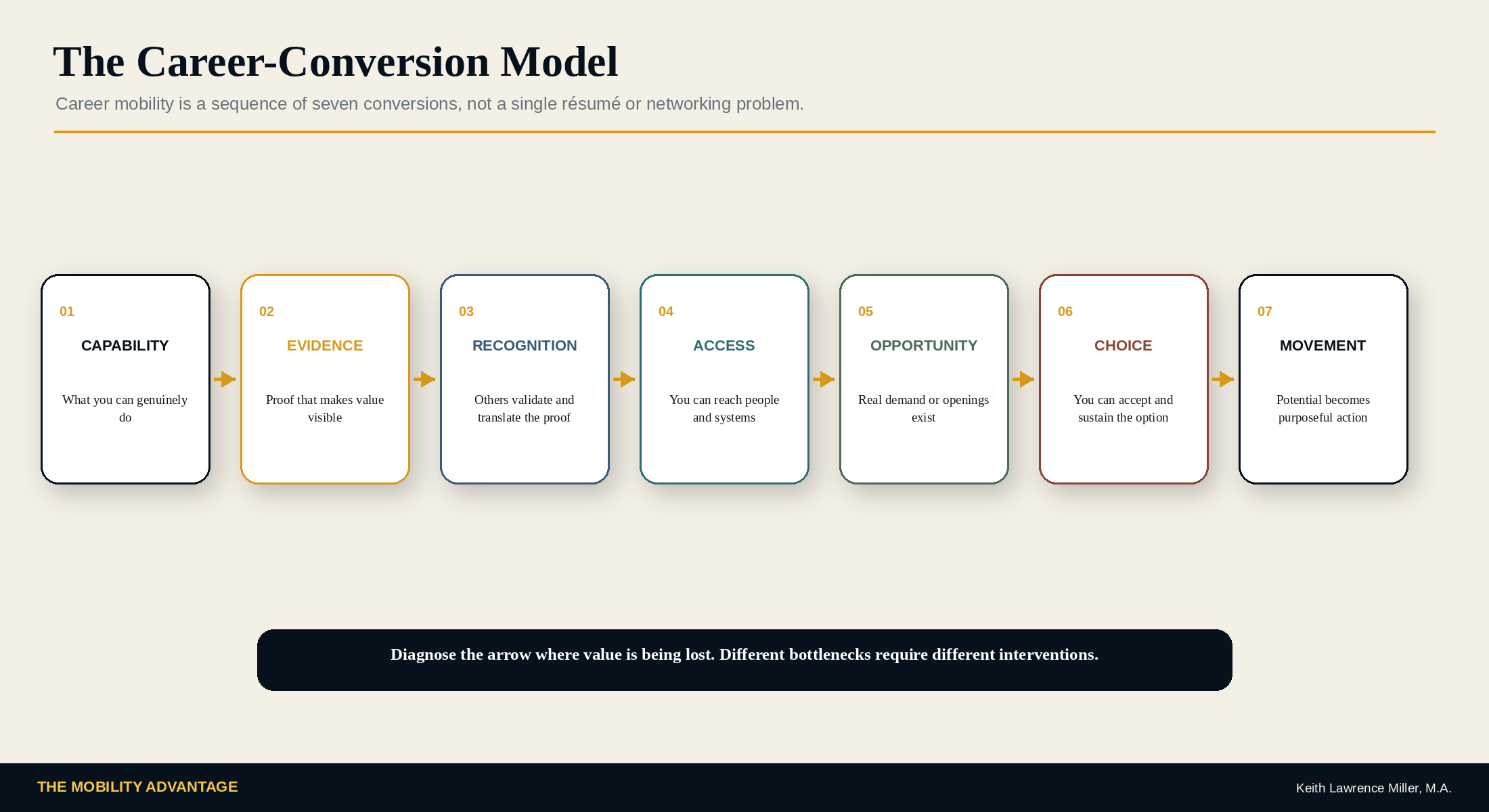
Capability must become evidence. Evidence must receive recognition. Recognition must create access. Access must reveal opportunity. Opportunity must become a viable choice. Only then can potential become movement.
That sequence forms the book's central framework.
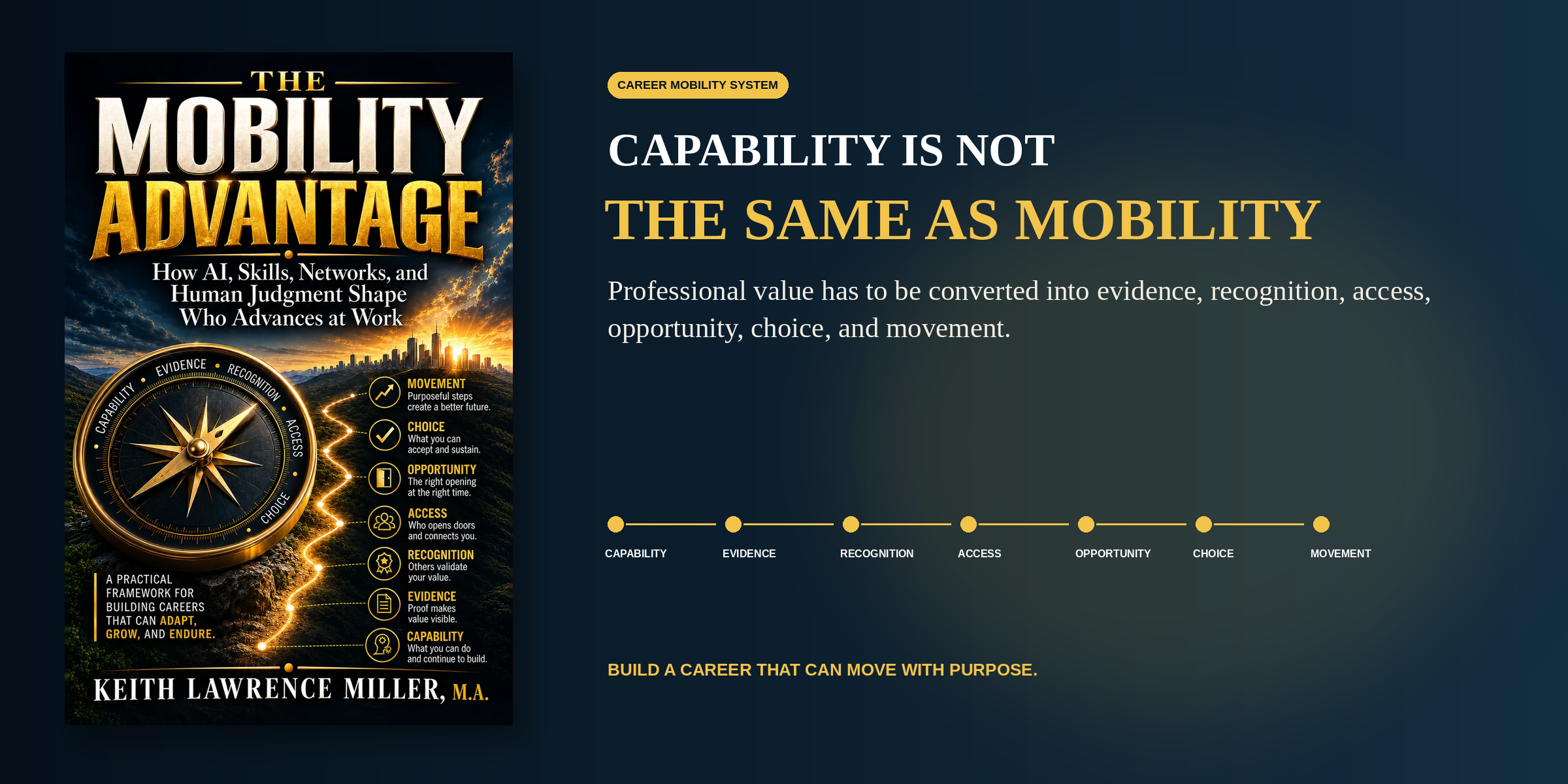
The Career-Conversion Model
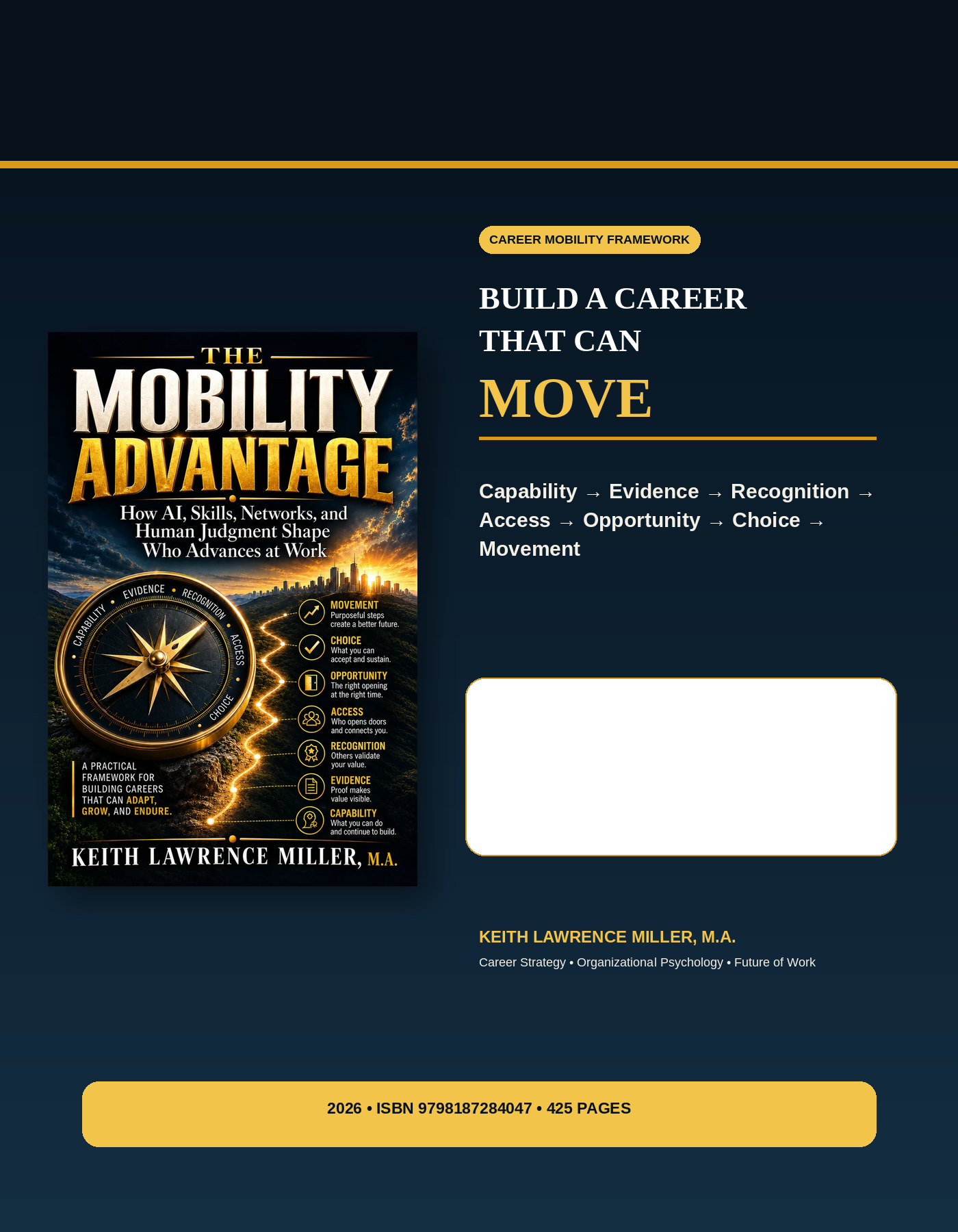
Capability → Evidence → Recognition → Access → Opportunity → Choice → Movement
The model explains why improving a résumé, learning another skill, networking more aggressively, earning another credential, or simply working harder can fail when the real bottleneck sits somewhere else.
Different career problems require different interventions.
A professional with a capability problem needs development. A capable professional whose work is invisible needs evidence. Someone with strong evidence that employers misunderstand needs better recognition. A well-positioned candidate who cannot reach decision-makers needs access. A person with access to a weak market needs opportunity. Someone with an offer they cannot realistically accept needs choice. A person who moves but fails to integrate needs support after movement.
Career strategy becomes more precise once the conversion failure is identified.
The Career Ladder Was Never a Complete Map
The career ladder is attractive because it creates order.
Learn. Perform. Wait. Rise.
The next rung already exists. The direction appears obvious.
Many organizations still operate meaningful ladders through defined job grades, tenure systems, professional licensing, promotion processes, and structured advancement.
The problem is treating the ladder as the complete model of a career.
Real careers move in more directions: upward, sideways, across industries, into entrepreneurship, back into employment, toward specialized expertise, toward management, away from management, into consulting, into teaching, toward greater flexibility, across geography, and across organizational boundaries.
Sometimes the best career decision is to stay.
Sometimes staying is simply the only survivable option.
Those are very different conditions.
Stability and Immobility Are Different
The book does not define career success as constant movement.
A professional can remain with one employer for many years and still possess strong mobility.
Their skills remain current. Their accomplishments are documented. Their reputation extends beyond one manager. Their professional relationships remain active. They understand the external market. They maintain some financial flexibility. Credible alternatives exist.
That person is stable by choice.
Immobility appears when circumstances must remain unchanged because no survivable alternative exists.
A good job becomes more valuable when staying is a decision rather than a trap.
Mobility Is Optionality
The mobility advantage is the ability to respond when circumstances change.
A restructuring. A new leader. A health issue. A family need. A merger. A technology shift. An ethical conflict. A better opportunity. A layoff. A change in purpose.
The professional with mobility does not control these events.
They have more credible responses available when the events occur.
The ability to move changes the power of staying.
Stage One: Capability — What Can You Actually Do?
Career mobility begins with genuine capability.
Technical knowledge, functional skill, communication, leadership, judgment, problem solving, contextual knowledge, commercial understanding, and the ability to create useful consequences.
Credentials can support capability. They are not the capability itself.
Job titles can indicate responsibility. They do not fully describe what someone knows how to do.
A career becomes more resilient when capability can travel beyond one organization's systems and language.
Skills That Travel
Some skills are heavily tied to a specific employer: internal systems, company terminology, unique processes, proprietary products.
Those skills can be extremely valuable inside the organization.
Mobility improves when professionals also build skills that transfer: analytical reasoning, project leadership, financial understanding, negotiation, communication, process improvement, relationship management, strategy, decision-making, technology fluency, industry knowledge, research, and change leadership.
The key question becomes: What part of my professional value still matters when the company logo disappears from the résumé?
Learning Velocity Matters
Capability is not static.
Markets change. Tools change. Roles change. Customer expectations change. Technology changes. Regulation changes.
The professional who once possessed scarce expertise may later find that part of the expertise has become routine.
Career resilience therefore includes the ability to learn: identify what has become important, acquire enough understanding to remain relevant, test the learning in practice, and update again when conditions change.
Stage Two: Evidence — Capability Is Private Until Something Proves It
Professionals often assume experience speaks for itself.
It does not.
Experience exists privately until evidence makes it visible.
Evidence can include results, quantified outcomes, work samples, projects, recommendations, publications, credentials, case examples, awards, promotions, client outcomes, operating metrics, presentations, portfolio work, and documented decisions.
The stronger the evidence, the less the decision-maker has to rely on adjectives.
Evidence Beats Adjectives
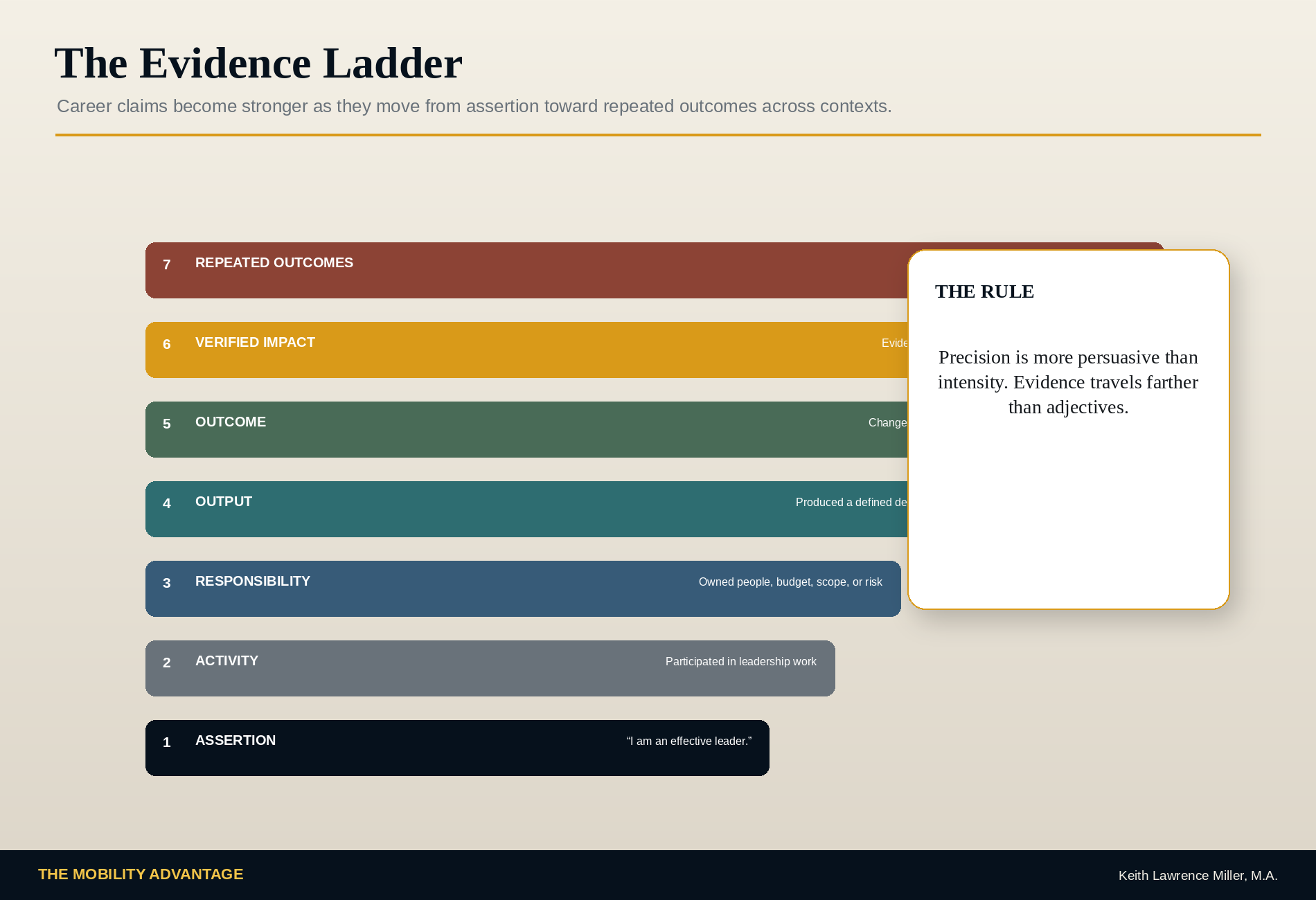
Career communication often relies on claims: strategic, innovative, results-oriented, collaborative, transformational, high-performing, experienced.
Those words are weak when unsupported.
Evidence carries more weight.
The book introduces an Evidence Ladder that moves from assertion to activity, responsibility, output, outcome, verified impact, and repeated outcomes across contexts.
Precision is more persuasive than intensity.
Build a Professional Evidence Bank
Professionals should not wait until a job search to reconstruct years of achievement.
Document evidence while it is available: the problem solved, baseline, action, people affected, result, scale, metric, decision, recognition, and lesson.
Over time, this becomes a professional evidence bank.
The bank supports résumés, LinkedIn profiles, interviews, promotion cases, consulting proposals, board opportunities, compensation discussions, speaking, and career transitions.
Evidence creates portability.
Stage Three: Recognition — Being Good Is Different From Being Understood
Evidence still requires interpretation.
A powerful accomplishment may have little effect when the audience does not understand its relevance.
An internal title may mean something entirely different outside the organization. Military experience may carry substantial leadership responsibility that civilian employers fail to translate. A founder may possess extraordinary commercial judgment while appearing unconventional in a corporate applicant-tracking system. A foreign credential may be respected in one market and poorly understood in another.
Recognition is the conversion point where evidence becomes meaningful to a gatekeeper.
The Market Needs a Coherent Story
Recognition improves when professionals can answer several questions clearly.
What do you do? What problems can you solve? At what level? In what context? What evidence supports the claim? Why does the experience matter here?
A career story does not need to simplify a complex professional into one label.
It does need to make movement understandable.
Professional Identity Can Become Too Narrow
Success can create identity concentration.
“I am a pharmaceutical executive.” “I am a university administrator.” “I am a federal employee.” “I am a finance leader.” “I am a software engineer.”
Those identities may be accurate.
They can also become restrictive when the professional begins treating the current setting as the only place where their capability has meaning.
A stronger identity reaches beneath the title: What judgment do you bring? What problems do you solve? What systems do you understand? What value do you repeatedly create?
Stage Four: Access — Opportunity Moves Through People and Systems
Professionals cannot pursue opportunities they cannot see, reach, afford, or credibly enter.
That is access.
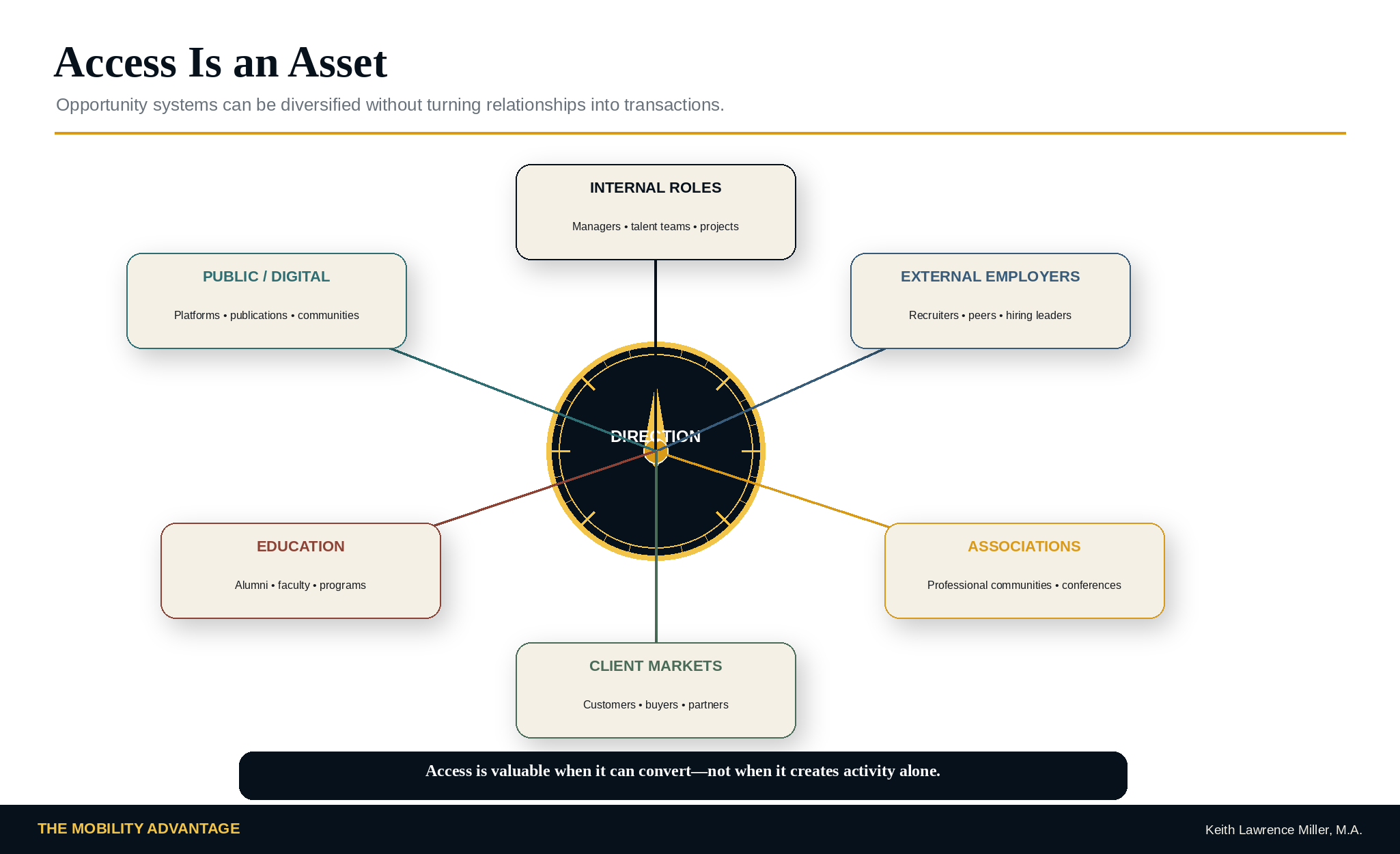
Access includes relationships, recruiters, sponsors, alumni networks, professional associations, internal talent systems, developmental assignments, conferences, educational institutions, geography, technology platforms, clients, and decision-makers.
Access is broader than networking.
Opportunity Moves Through People
Many career opportunities become visible through relationships before formal selection begins.
Someone hears that a team is growing. A colleague recommends a person for a project. An executive mentions a problem. A recruiter asks for referrals. An alumnus explains how a hiring process really works. A sponsor puts a name into a conversation where the person is absent.
These are access events.
They do not eliminate the need for capability. They change who gets considered.
Sponsorship Is Different From Advice
Mentors help people understand.
Sponsors help institutions notice.
A sponsor may recommend someone for a role, assign a developmental project, introduce a candidate to leadership, defend someone's readiness, provide political context, create a stretch opportunity, or advocate during succession planning.
Sponsorship therefore sits between relationships and institutional movement.
Access Is an Asset
A strong network is not measured by contact count alone.
The more important questions are: What information can you reach? Which systems can you enter? Who understands your work? Who would return your call? Who would introduce you? Which professional communities recognize you? Which decision-makers are reachable?
Access should also be connected to direction.
More networking activity is not automatically better.
Access becomes valuable when it can convert.
Access Has Costs
Not every pathway is equally available.
A conference may require travel. An educational program may require schedule control. Networking may require childcare. A geographic move may require housing flexibility. An unpaid developmental opportunity may be possible for one person and impossible for another.
Access can therefore have financial, relational, geographical, technological, and identity costs.
Stage Five: Opportunity — Access Cannot Manufacture Demand
A strong network cannot create a role that does not exist.
A perfect résumé cannot force a market to value a skill.
A sponsor cannot always create headcount.
Opportunity is actual demand: a vacancy, project, client problem, promotion pathway, market opening, new role, board need, or consulting engagement.
Career strategy becomes weaker when people interpret every rejection as a personal failure.
Sometimes the market has limited demand.
The Hidden Labor Market Inside the Company
Employees often imagine internal mobility as a simple process: a role opens, qualified employees apply, and the strongest candidate receives the opportunity.
Organizations are more complicated.
Readiness is shaped by assignments, visibility, succession discussions, manager support, reputation, sponsorship, internal politics, informal evaluations, developmental opportunities, and talent systems.
Who receives evidence-producing work before the vacancy appears often matters.
Managers Can Develop Talent or Contain It
Internal mobility often depends on whether managers release strong people.
A manager may fear losing a high performer.
The employee becomes indispensable.
Indispensability sounds like career security. It can become career containment.
Healthy internal mobility requires an enterprise view of talent.
Internal and External Mobility Pathways
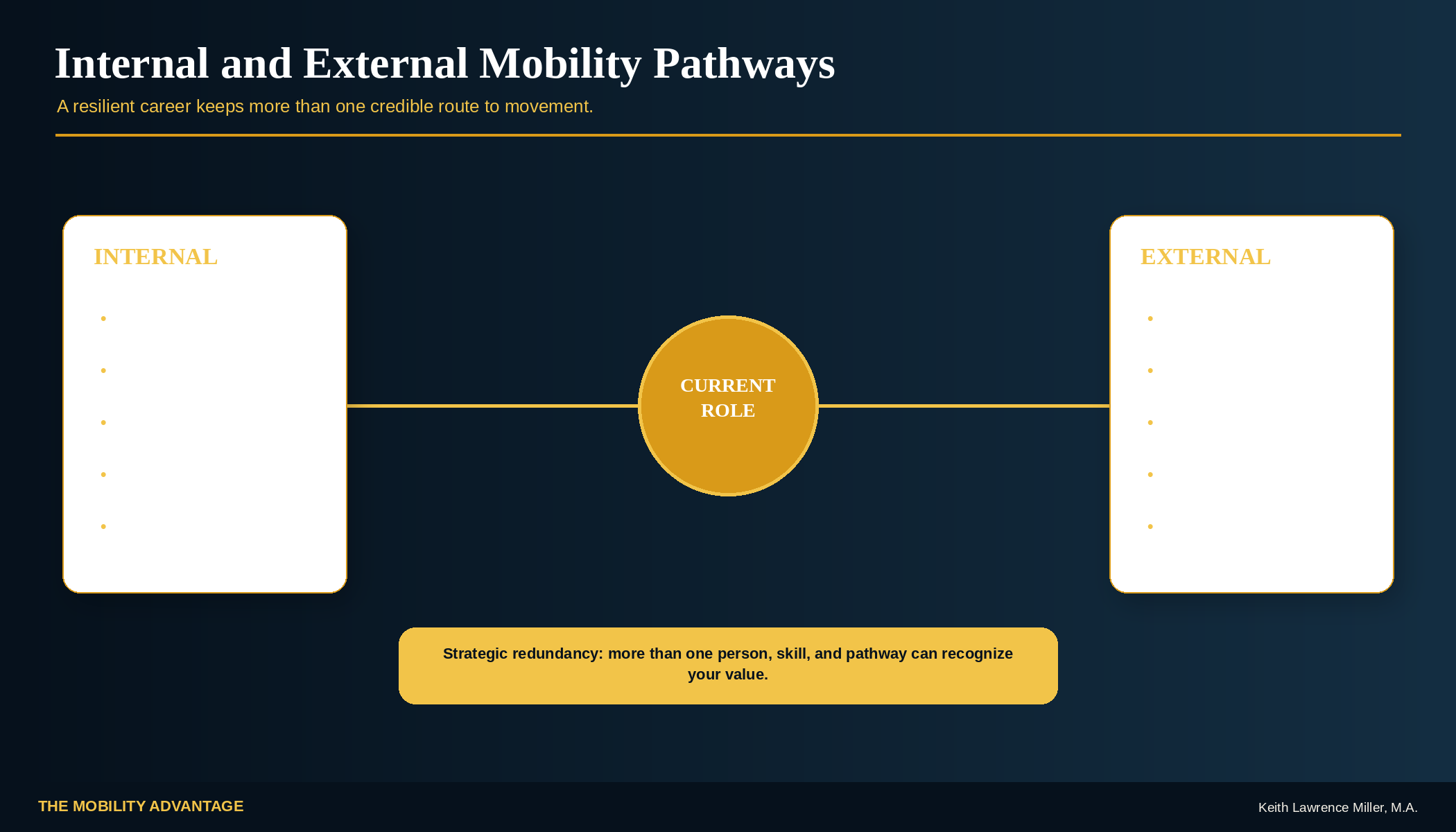
A resilient career keeps more than one credible route to movement.
Internal pathways can include developmental assignments, internal marketplaces, sponsorship, succession pathways, and cross-functional moves.
External pathways can include recruiters, professional networks, clients, adjacent industries, consulting, and entrepreneurship.
The goal is strategic redundancy rather than dependence on one route.
Internal Applications Are Data
Employees reveal something through their behavior.
If qualified people do not apply for internal roles, the organization should ask why.
Do they expect retaliation? Do managers block movement? Are criteria unclear? Do employees believe decisions are predetermined? Are opportunities genuinely open? Can people explore privately?
Application behavior can reveal whether employees trust the mobility system.
Workplace Politics Without Cynicism
Organizational politics exist because people and groups have different interests, resources, priorities, and influence.
Pretending politics do not exist does not remove them.
Career strategy benefits from understanding who controls resources, who defines credibility, who supports the initiative, who bears the cost, who can block movement, which relationships matter, and what history shapes the decision.
Political awareness does not require manipulation.
The Power to Walk
Mobility changes negotiation.
Walking away does not always mean quitting dramatically.
It means possessing enough credible alternatives to decline a term, assignment, environment, or path that no longer makes sense.
That ability rests on accumulated mobility assets.
Capability creates market value. Evidence makes it credible. Access reveals alternatives. Opportunity creates options. Choice makes refusal survivable.
Stage Six: Choice — An Opportunity Is Not Automatically a Viable Choice
Career advice often treats an offer as success.
The Mobility Advantage makes another distinction.
An opportunity exists externally.
Choice exists when the person can realistically act.
Choice can depend on income, savings, debt, health insurance, caregiving, housing, transportation, immigration status, family support, geography, schedule, disability accommodation, contract restrictions, confidence, and identity.
An option can look excellent on paper and remain impossible in practice.
Financial Runway Is Career Strategy
Money changes mobility.
A professional with financial runway can sometimes tolerate a longer search, temporary pay reduction, certification period, business experiment, relocation, transition between industries, or negotiation that requires the willingness to say no.
Financial runway is therefore more than personal finance. It can create career choice.
The book does not prescribe one universal savings number. Runway depends on household expenses, benefits, debt, dependents, transition length, health needs, housing, and the consequences of uncertainty.
The better question is: How long can this transition remain survivable under several realistic scenarios?
Career Insurance Extends Beyond Money
Financial resources matter.
So do relationships, current skills, professional reputation, portable credentials, side capability, evidence, knowledge of the market, and multiple people who understand your value.
A resilient career is rarely protected by one thing.
Identity Can Be the Hardest Thing to Move
A professional may have the capability, evidence, access, opportunity, and finances to change.
They still hesitate.
The existing career may carry status, belonging, expertise, recognition, history, and a title that explains who the person is.
Moving may require becoming less certain, less senior, less known, or temporarily less competent.
The psychological cost can be larger than the practical one.
Fear, Status, and the Sunk-Cost Career
Past investment creates pressure: years of education, years in one industry, years building seniority, years developing specialized knowledge.
The mind naturally asks: How can I leave after investing this much?
Past investment still matters. It should not automatically govern the next decision.
The relevant question is what the current path is likely to produce from this point forward.
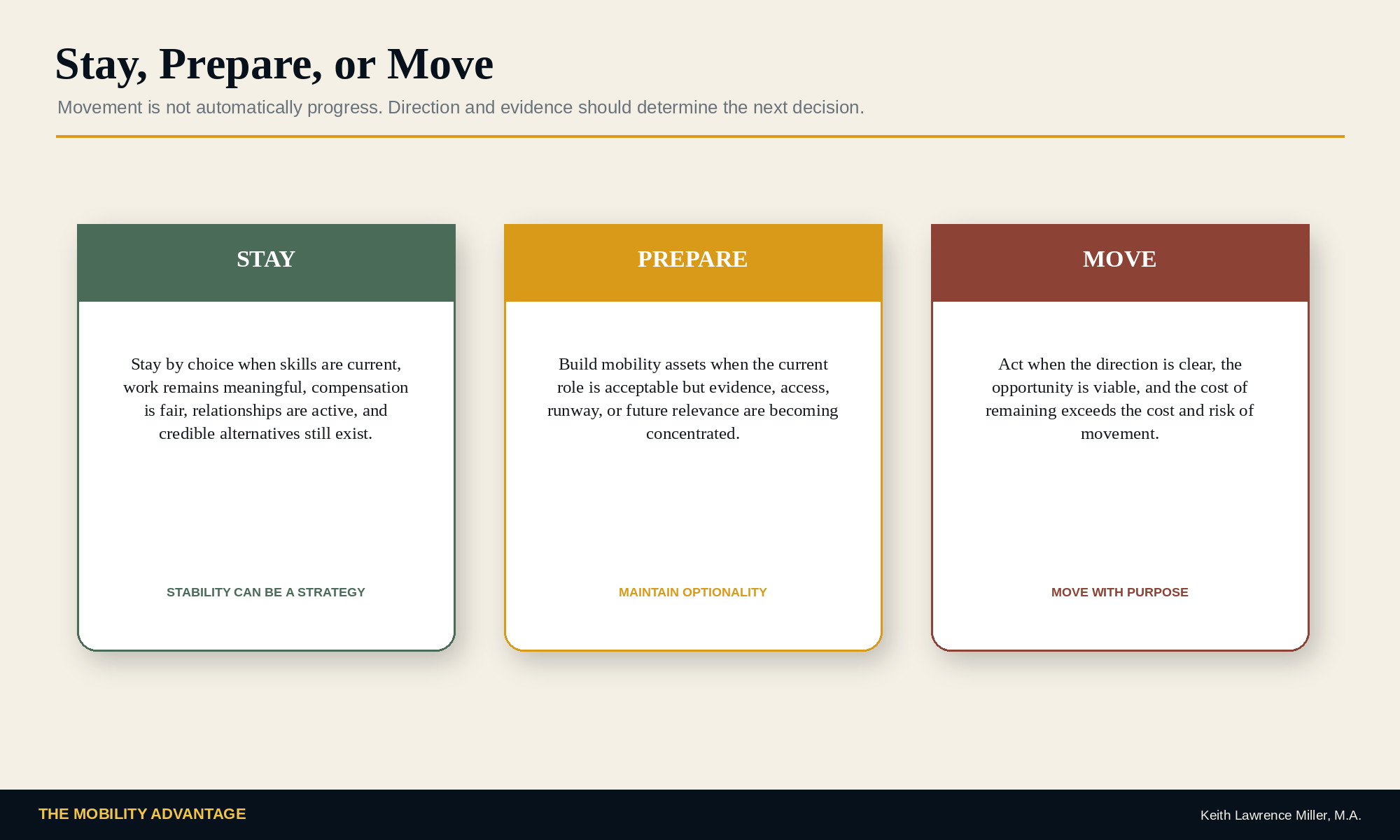
Stay, Prepare, or Move
Movement is not automatically progress.
A professional may choose to stay when stability is healthy and alternatives remain credible.
They may prepare when the current role remains acceptable but skills, evidence, access, runway, or market relevance are becoming concentrated.
They may move when the direction is clear, the opportunity is viable, and the cost of remaining exceeds the cost and risk of transition.
Stage Seven: Movement — Movement Is More Than Getting the Offer
Movement occurs when the transition actually happens.
A new role. Promotion. Career pivot. Business launch. Consulting practice. Geographic move. New profession. Expanded portfolio.
Movement creates its own risks.
A person may enter a role without adequate onboarding. They may discover that the new environment values different evidence. They may lose the relationships that previously supported performance. They may need to rebuild credibility.
Movement therefore begins another conversion cycle.
Reinvention Without Erasing Yourself
Career reinvention is often framed as starting over.
That is usually too crude.
A professional changing direction already carries judgment, patterns recognized over years, transferable skills, relationships, industry knowledge, leadership experience, and evidence.
The task is to determine what travels.
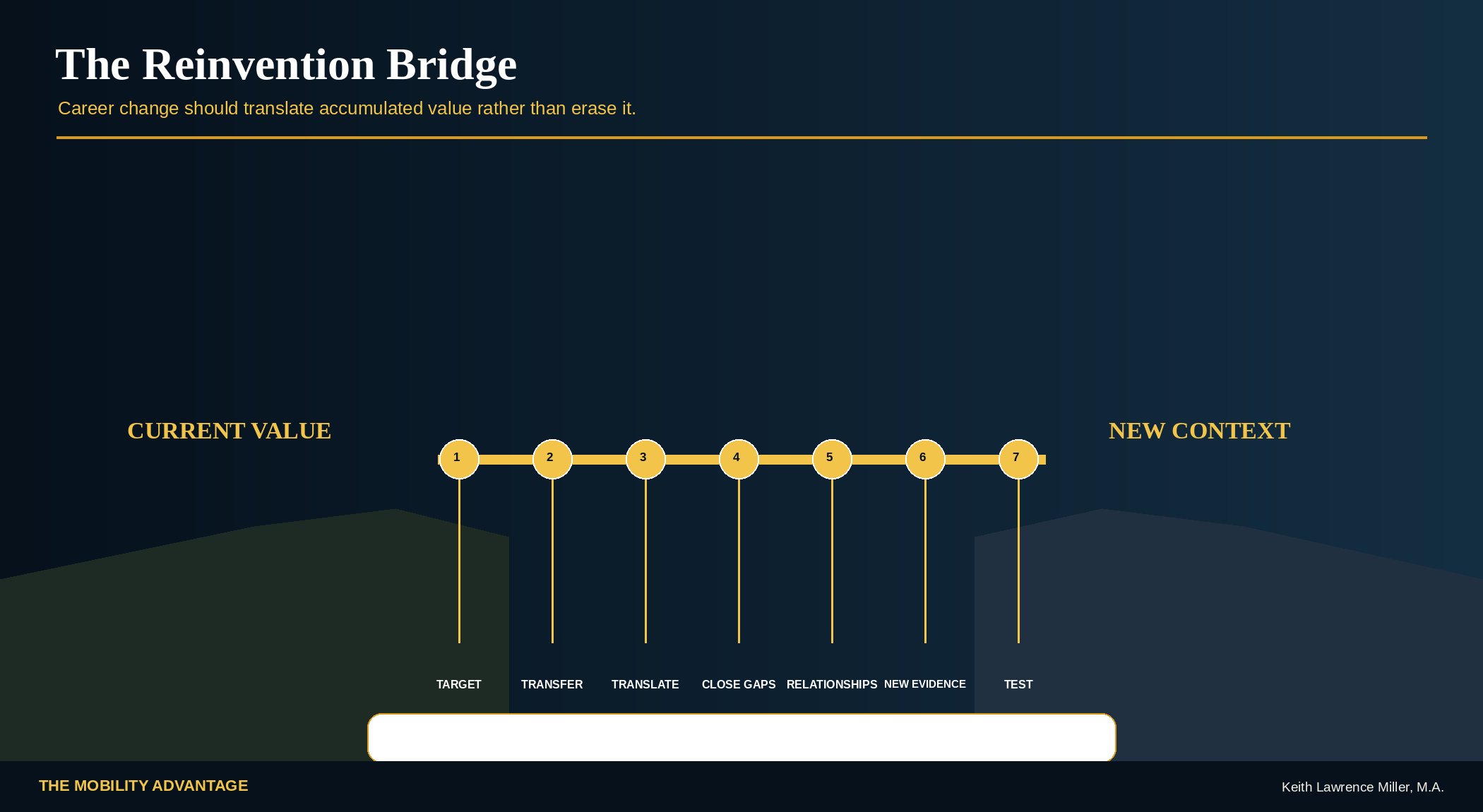
The book's Reinvention Bridge asks professionals to clarify the target, inventory transferable capability, translate prior evidence, close essential gaps, build target relationships, produce evidence in the new context, and test before committing fully.
Reinvention should preserve truth while creating relevance.
AI Changes Every Conversion Point Differently
Artificial intelligence does not affect careers through one universal mechanism.
At Capability, AI can accelerate learning and improve performance while making assisted performance look stronger than retained capability.
At Evidence, AI can help document accomplishments and create work samples while also producing polished claims that are difficult to verify.
At Recognition, automated screening can reveal skills hidden by titles or reproduce bias through weak proxies.
At Access, technology can connect professionals to more people and information while also creating low-trust contact.
At Opportunity, AI may create roles, alter task bundles, and change demand.
At Choice, AI can model scenarios while missing household consequences, values, identity, or context.
At Movement, AI can support onboarding and learning while overuse may remove guided practice through which expertise develops.
The better question is: How does AI alter this conversion point for this person, occupation, institution, and market?
Human Judgment Becomes More Valuable
When production gets cheaper, judgment can become more important.
Someone still needs to ask: Is this correct? Is it relevant? What is missing? What matters? What is the risk? What should happen next? Can this claim be defended? What does the evidence justify? Who is affected? Which tradeoff is acceptable?
AI fluency can increase mobility.
AI dependence can weaken it when the professional loses the ability to evaluate the work independently.
The durable asset is not simply the ability to generate. It is the ability to judge.
Career Education Is Larger Than Job Placement
Universities often measure career support through placement outcomes.
Placement matters.
Career education should go further.
A graduate may secure the first role and still lack professional evidence, negotiation skill, network development, labor-market understanding, career adaptability, mobility strategy, financial planning for transitions, and reinvention capability.
Career education should help people manage movement across decades.
Employers Also Have a Mobility Problem
The Career-Conversion Model can be applied organizationally.
Do employees possess the required capability? Can skills and outcomes be seen? Are evaluation standards consistent? Can employees reach developmental relationships and internal recruiters? Do meaningful opportunities actually exist? Can employees accept them without losing flexibility, benefits, or manager support? Do transitions succeed after movement?
The answers reveal where talent stalls.
Calling every failure a retention issue conceals useful information.
Mobility and Power
Career markets are not neutral.
Gatekeepers influence what evidence counts. Managers control developmental assignments. Recruiters influence access. Organizations define job requirements. Institutions confer credentials. Employers set compensation. Policies affect benefits and flexibility.
Professionals possess agency inside these systems. The systems also possess power over professionals.
A serious mobility framework needs both levels: individual action and institutional design.
Unequal Starting Lines Matter
People do not begin from equal positions.
Education, wealth, health, disability, geography, family responsibilities, professional networks, immigration status, transportation, housing, discrimination, and institutional reputation influence every conversion stage.
They do not eliminate agency. They alter the cost and likely return of different actions.
Conditions matter. Decisions still matter within those conditions.
The Career Mobility Index
The book includes a Career Mobility Index as a diagnostic framework.
Its purpose is reflection and structured analysis.
It should not be treated as a scientifically validated score unless future validation establishes reliability and predictive validity.
A stronger use combines self-ratings with actual work outcomes, responses from target markets, network range, internal application data, financial scenarios, observed transitions, and feedback from informed people.
The purpose is to discover where mobility may be weak. It is not to rank human worth.
Diagnose the Arrow, Not Only the Asset
The Career-Conversion Model becomes especially useful when attention shifts to the arrows.
Two professionals may possess equal capability. Only one converts it into strong evidence.
Two professionals may have equally strong evidence. Only one receives recognition.
Two recognized professionals may have very different access.
Two people may receive similar opportunities. Only one can afford to accept.
The diagnostic question becomes: Where is value being lost between stages?
Another degree will not necessarily solve an access problem. More networking will not solve missing capability. A better résumé will not create market demand. Confidence coaching will not solve an immigration restriction.
Precision reduces wasted effort and unnecessary self-blame.
Build a Career That Can Move
The final chapters convert mobility into maintenance.
Career resilience is easier to build before disruption.
A durable career operating system reviews capability, evidence, recognition, relationships, access, opportunity, choice, identity, and direction.
The goal is not permanent job hunting. It is preventive maintenance.
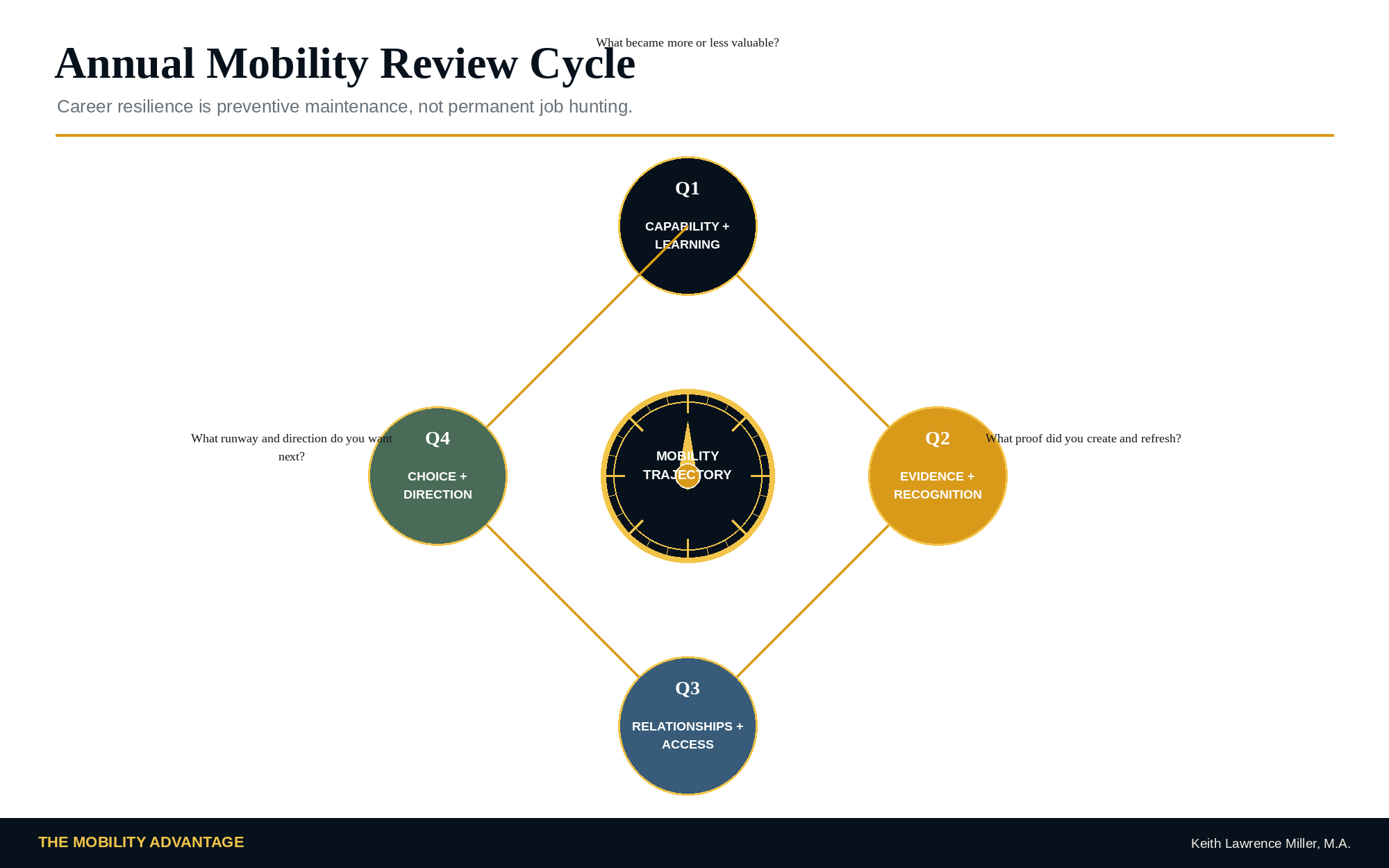
The Annual Mobility Review
Once a year, ask:
What became more valuable? What became less valuable? Which evidence did I create? Which relationships deepened? Which opportunity systems became accessible? What changed in technology and labor demand? What would happen if current employment ended? Which direction is worth preparing for?
Compare the answers with the previous year.
Mobility is a trajectory.
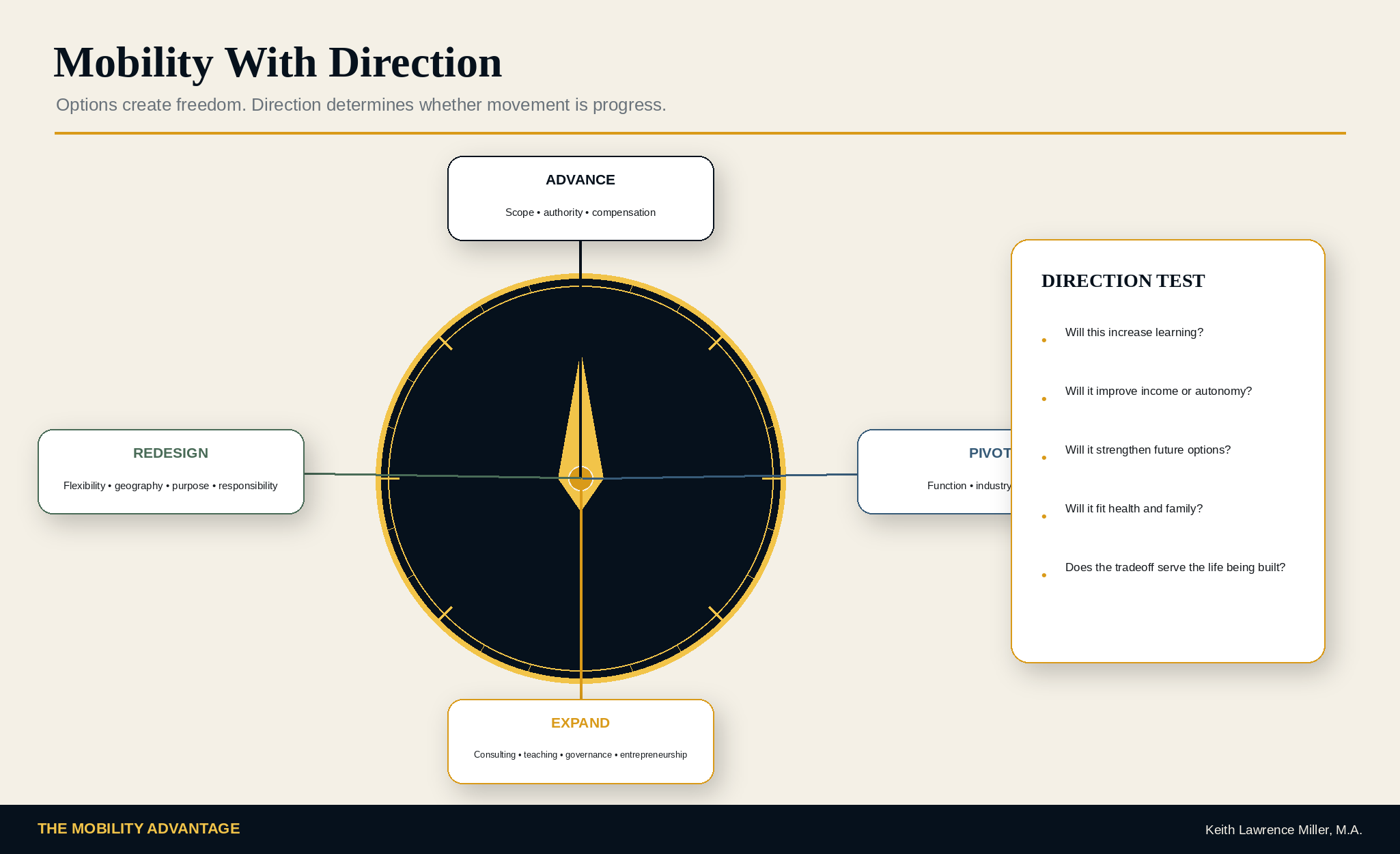
Four Mobility Decisions
Advance: seek greater scope, authority, compensation, or influence.
Pivot: transfer capability into a different function, industry, or market.
Expand: add consulting, teaching, writing, governance, entrepreneurship, or another source of professional value.
Redesign: change the role work plays in life through flexibility, geography, purpose, reduced responsibility, or another structure.
A career can combine these decisions.
The important question is which mobility assets each choice should build.
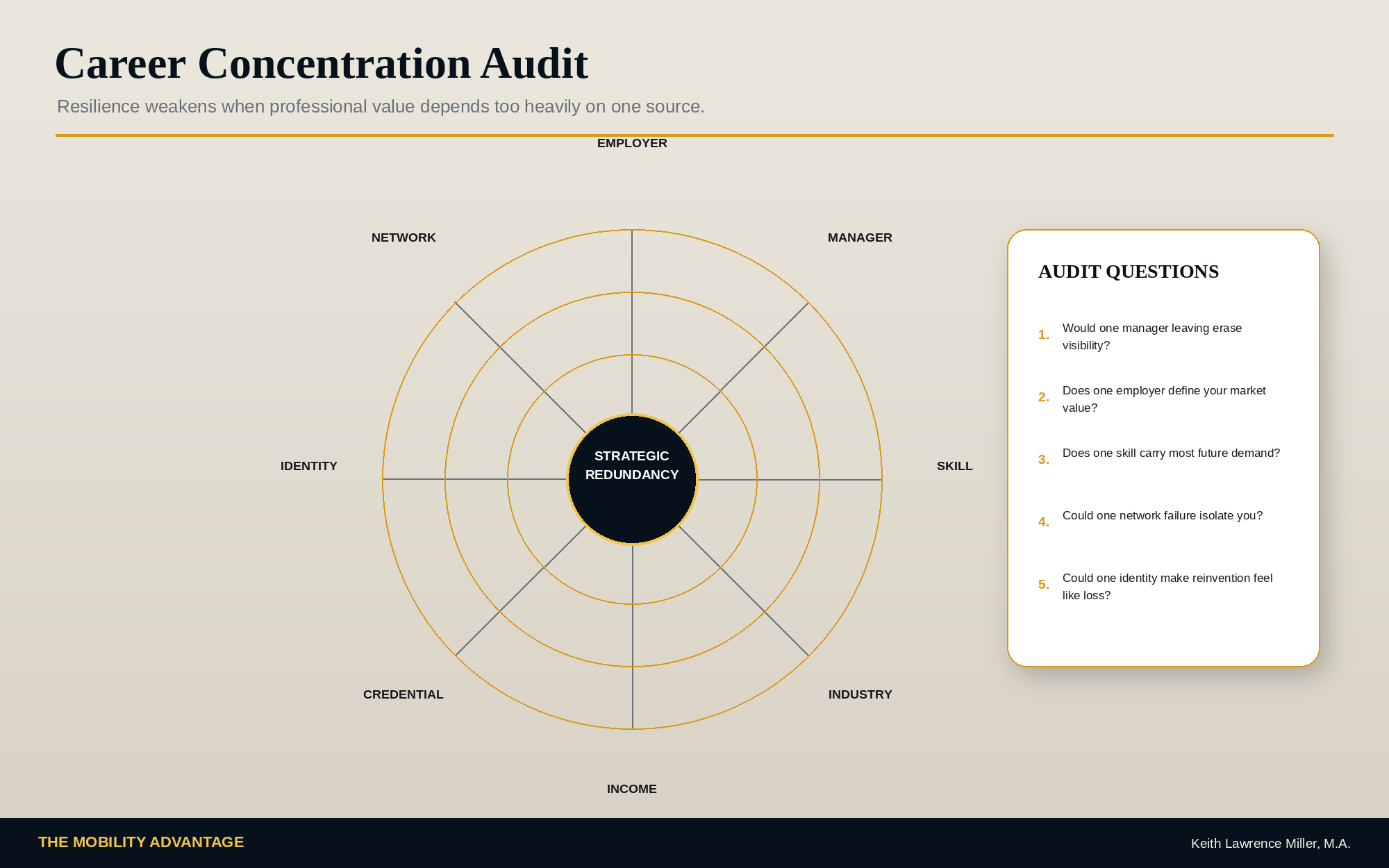
Career Concentration Creates Risk
Careers can become concentrated around one employer, manager, industry, income source, credential, professional identity, network, or technology.
Total diversification is neither possible nor desirable. Depth requires commitment.
The goal is strategic redundancy.
More than one person understands your value. More than one skill connects to demand. More than one relationship can provide information. More than one plausible path could protect essential income or benefits.
The Professional Evidence Bank
Keep a running record of meaningful professional evidence: outcomes, projects, metrics, testimonials, decisions, presentations, credentials, work samples, and publications.
The evidence bank reduces the need to reconstruct your career under pressure.
The Relationship Portfolio
Relationships should also be viewed as a portfolio.
Internal relationships, external peers, former colleagues, mentors, sponsors, recruiters, clients, professional associations, alumni, industry contacts, and community connections.
A portfolio does not mean treating people transactionally.
It means recognizing that careers develop through relationships and avoiding total dependence on one narrow network.
The Institutional Mobility Scorecard
Organizations can examine their own mobility systems.
Are skills visible? Are opportunities accessible? Do managers release talent? Are developmental assignments distributed fairly? Are evaluation standards clear? Do employees trust internal applications? Can people explore options without retaliation? Do AI tools widen access or reinforce existing patterns? Which groups stall at which conversion point?
Internal mobility becomes easier to improve when the bottleneck is named.
Mobility Is Not the Final Goal
Options are valuable.
More options are not automatically a better life.
Mobility can become its own form of endless optimization.
Another promotion. Another credential. Another network. Another move. Another income stream.
Eventually the question changes.
What is all this mobility for?
Learning? Income? Autonomy? Contribution? Family? Health? Authority? Purpose? Time?
The Career-Conversion Model ends with Movement.
The larger career question ends with Direction.
Direction Determines Whether Movement Is Progress
A professional can move upward and lose something important: health, family time, meaning, autonomy, learning, future flexibility.
A prestigious role can narrow future options. A lateral move can increase them. A lower-paying transition can create long-term growth. Remaining in place can be the strongest strategic choice.
Movement is not automatically advancement.
Direction decides what counts.
Healthy Stability Is a Mobility Outcome
A stable career can be excellent.
Healthy stability includes current capability, meaningful work, fair compensation, strong relationships, visible evidence, and credible alternatives.
The professional stays because staying serves the life they want.
The difference is choice.
Build Optionality Before You Need It
Career crises compress time.
A layoff creates urgency. A toxic workplace consumes energy. A health issue changes priorities. A restructuring closes doors.
That is a difficult time to begin documenting accomplishments, rebuilding relationships, updating skills, or creating financial runway.
Mobility works better when maintained before the crisis.
Keep skills current. Preserve evidence. Maintain relationships. Understand the market. Know your financial range. Review your direction. Build the system before you urgently need the exit.
Who Should Read The Mobility Advantage?
The book is designed for experienced professionals, executives and senior leaders, career changers, early-career professionals, managers, HR and talent leaders, career coaches and advisers, universities and career centers, and workforce or public-sector leaders.
It is especially useful for people whose capability is not producing equivalent choice or opportunity and for institutions trying to understand why qualified talent stalls.
The Mobility Advantage
A career becomes more resilient when professional value is not confined to one title, one manager, one employer, or one version of the future.
Capability matters. So does whether that capability can travel.
Evidence matters. So does whether anyone recognizes it.
Relationships matter. So does whether they reach systems where opportunity exists.
Opportunity matters. So does whether the person can realistically choose it.
Movement matters. So does the direction of the life being built.
The goal is not permanent motion.
The goal is the capacity to move with purpose when circumstances change.
The Career-Conversion Model, Career Mobility Index, and related original tools are integrative frameworks developed by Keith Lawrence Miller from established research traditions and practice-based observation. They are not presented as independently psychometrically validated instruments. This book provides general educational information and does not guarantee employment, promotion, compensation, business success, career satisfaction, or another career outcome. Readers should obtain qualified legal, financial, tax, immigration, medical, psychological, employment, or other professional guidance where individual circumstances require it. Labor-market conditions, laws, regulations, technology, contracts, benefits, and hiring practices can change. AI output can be inaccurate, biased, outdated, incomplete, or fabricated. Consequential AI-generated recommendations require appropriate human review.