Full book feature
Develop the Judgment to Make the Senior HR Decision
A senior HR executive rarely receives a clean problem.
The chief executive wants speed. The business leader wants flexibility. The employee wants fairness. Legal risk may be emerging. The facts may be incomplete. A policy may point in one direction while business pressure points in another. Someone powerful may already have decided what they want HR to say.
That is where senior HR judgment begins.
The defining question is rarely: Do you know an HR rule?
The more difficult question is: Can you identify which fact controls the decision, determine what must happen first, protect the organization’s duties, preserve legitimate ownership, and choose a response that remains sound after the immediate pressure passes?
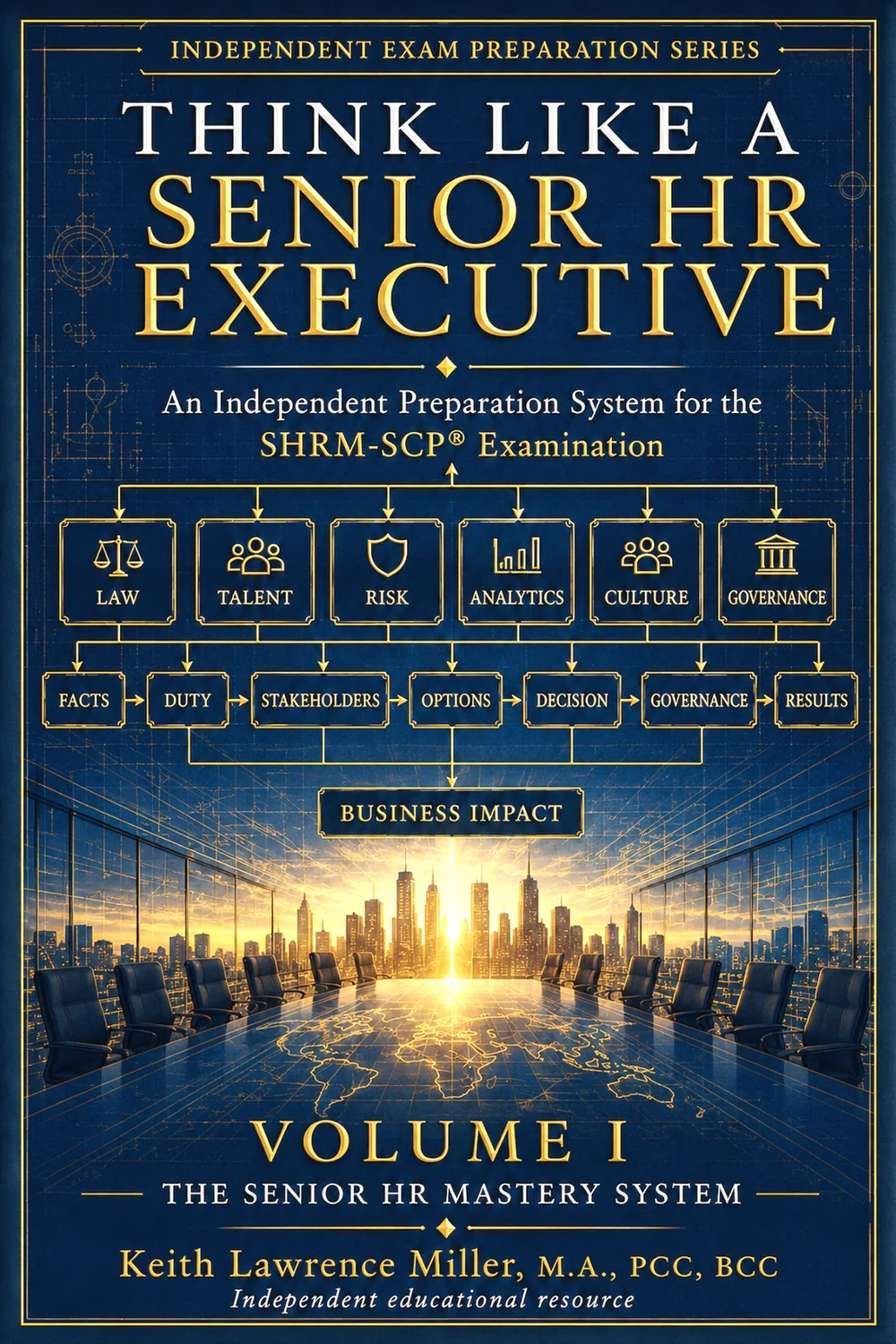
That is the central problem addressed by Think Like a Senior HR Executive — Volume I.
The book was developed as an independent preparation system for professionals working toward senior-level HR mastery, including readers preparing for the SHRM-SCP® examination.
Its deeper purpose extends beyond examination preparation.
It teaches a repeatable method for reasoning through ambiguity at executive altitude.
The examination becomes a proving ground. The professional objective is stronger judgment.
Senior HR Work Is a Judgment Discipline
Technical knowledge matters.
Employment law matters. Compensation matters. Benefits matter. Talent acquisition matters. Labor relations matter. Analytics matter. Technology matters.
Knowing these domains establishes the professional floor.
Senior HR leadership requires something more.
A senior leader needs to determine what problem is actually occurring, which issue is controlling, which facts are still missing, what obligation must be protected immediately, who should be engaged first, whether the visible incident is evidence of a larger system failure, who owns the final decision, when HR should advise, when HR should intervene, and when the matter should escalate.
Those are judgment questions.
The Three-Mastery System
The book's foundational architecture is the Three-Mastery System.
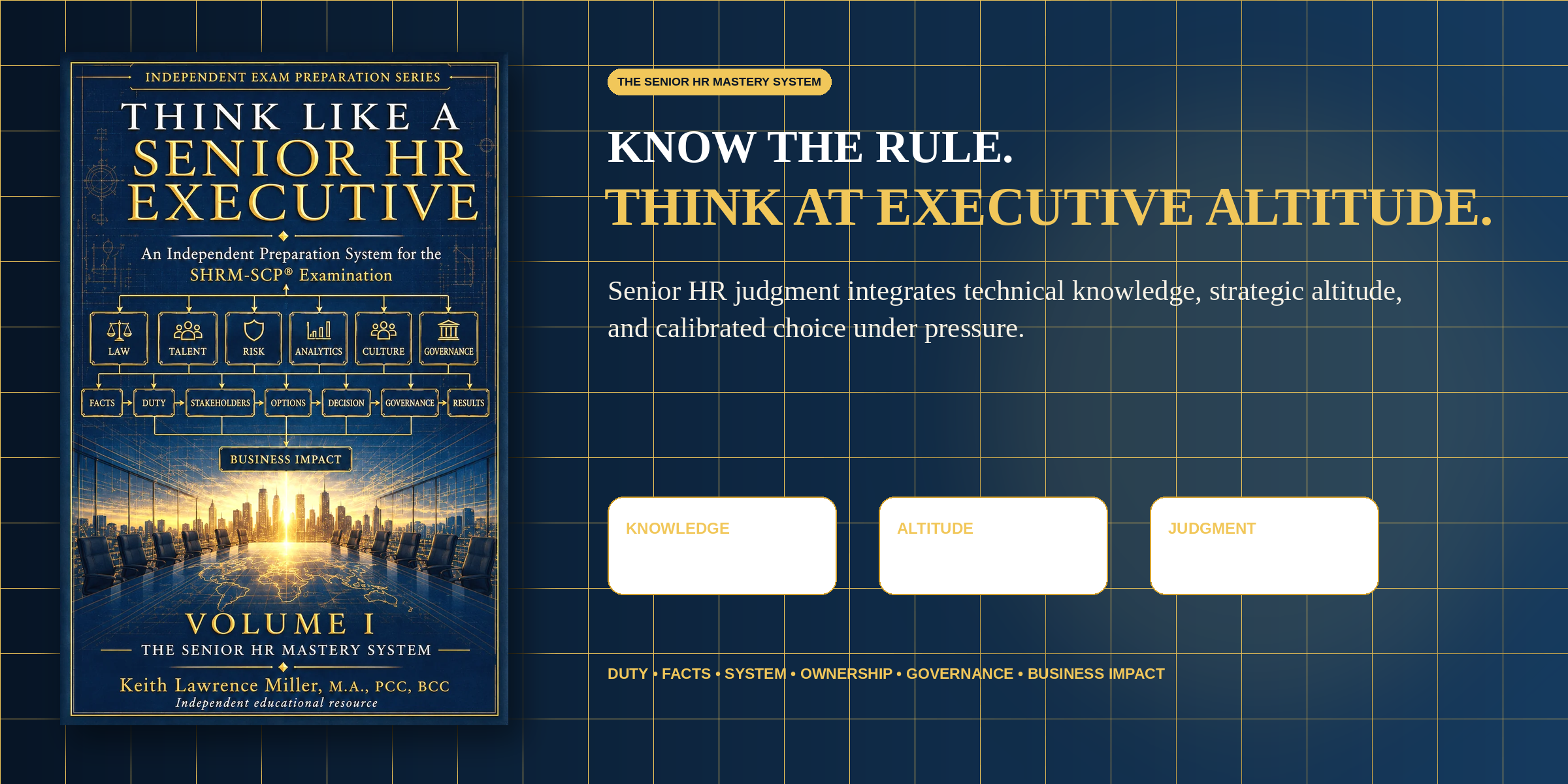
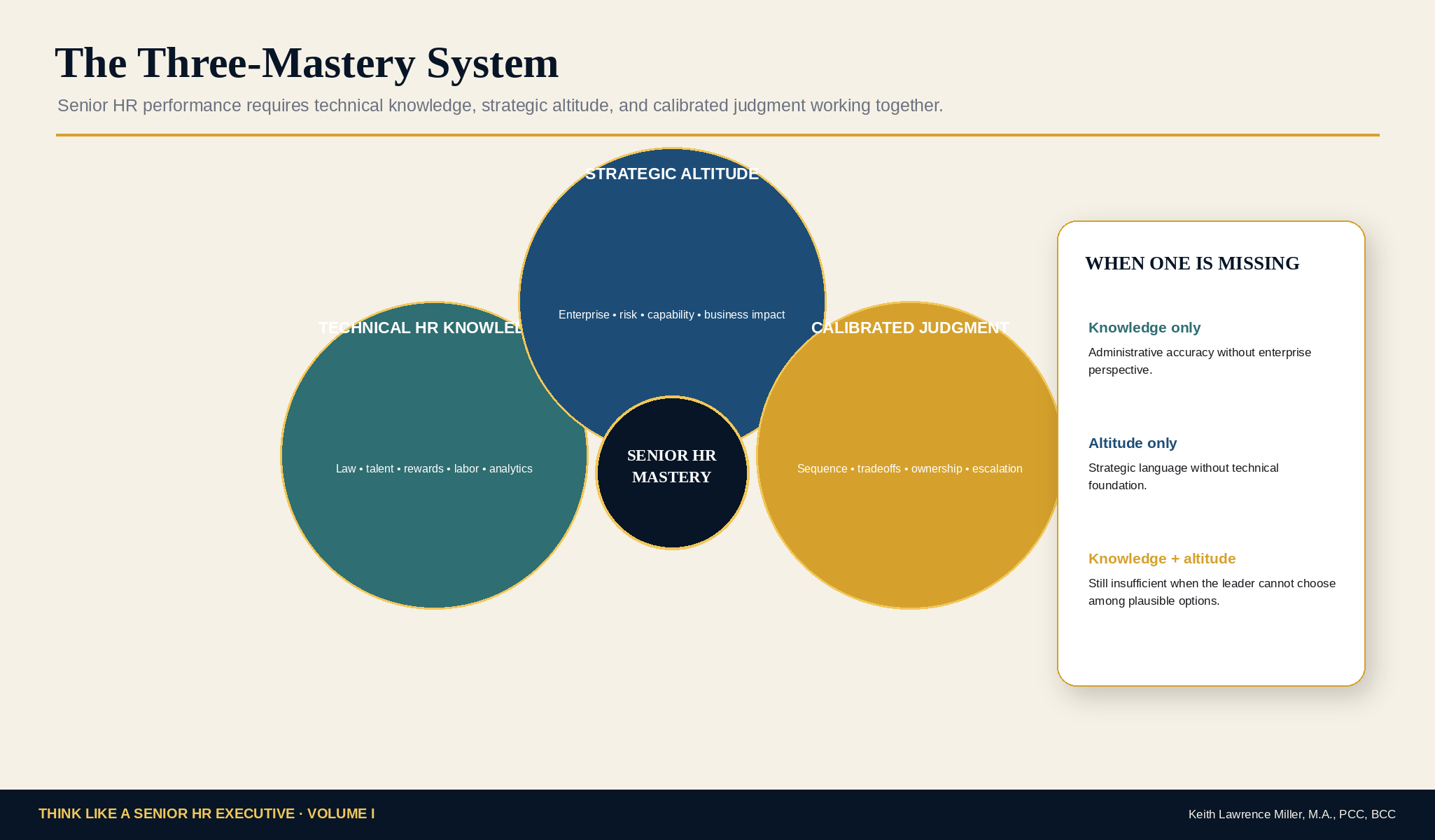
Senior HR performance requires three forms of mastery working together.
Technical HR Knowledge
The leader must know the substance: law, talent, rewards, employee relations, workforce planning, technology, analytics, organizational systems, definitions, procedures, and frameworks.
Strategic Altitude
The leader must operate at the level of the enterprise. Senior HR responses should connect people decisions to strategy, risk, operating capacity, customer impact, cost, speed, workforce capability, governance, culture, and long-term consequences.
Calibrated Judgment
The leader must choose among plausible responses based on evidence, sequence, authority, consequence, and organizational context.
Knowledge without altitude becomes administration. Altitude without knowledge becomes unsupported strategy. Knowledge and altitude without judgment still leave the leader unable to choose.
Judgment Is Structured Choice
Senior judgment is not instinct alone.
It can be disciplined.
The book teaches readers to make the reasoning visible: What is the issue? What is the controlling duty? What facts are known? What facts are assumptions? Who is closest to the issue? Is direct engagement appropriate? Is the problem isolated or systemic? Who actually owns the decision? What would justify escalation?
This structure protects leaders from urgency, hierarchy, empathy used at the wrong stage, fear of conflict, overreliance on technical legality, unnecessary escalation, and impressive but irrelevant recommendations.
The Decision Ladder
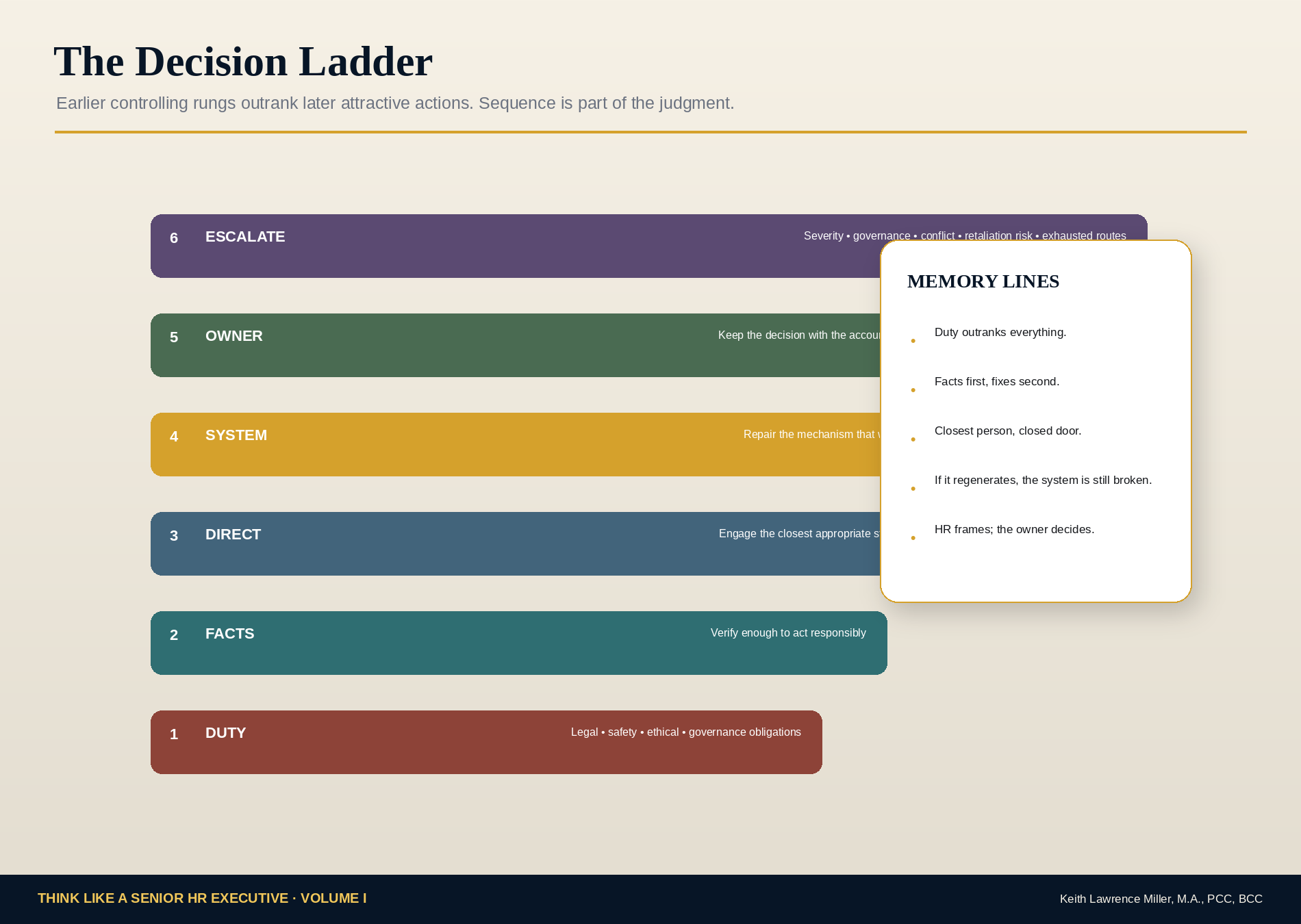
One of the central frameworks in Volume I is the six-rung Decision Ladder:
Duty → Facts → Direct → System → Owner → Escalate
The ladder is a priority system. It asks what should control the sequence.
Rung One: Duty
Legal, safety, ethical, and governance duties come first.
A powerful executive's preference does not cancel a harassment obligation. Revenue does not erase a safety issue. Relationship preservation does not excuse retaliation. Speed does not justify ignoring a required process.
The senior leader first asks: Is there a controlling duty that must be protected before anything else happens?
Rung Two: Facts
Once the duty is protected, determine whether the organization knows enough to act responsibly.
Facts are not a bureaucratic delay. They determine whether action is proportionate and defensible.
Facts first, fixes second.
Rung Three: Direct Engagement
When circumstances permit, the strongest first conversation is usually with the closest appropriate stakeholder.
Direct engagement can clarify facts, preserve dignity, expose assumptions, and keep decision ownership where it belongs.
Immediate bypass or escalation may be necessary when severity, retaliation risk, conflict, legal duty, safety, or governance requires it.
Rung Four: System
The senior HR leader asks whether the visible incident will regenerate.
If another employee entered the same system tomorrow, would the problem happen again?
A recurring issue may point toward policy, incentives, training, manager capability, workload, technology, decision rights, organizational design, role clarity, or governance.
Senior altitude looks for the mechanism that reproduces the outcome.
Rung Five: Owner
HR has influence and specialist knowledge. That does not mean HR owns every business decision.
The senior leader distinguishes among who advises, who safeguards, who recommends, who approves, who executes, and who remains accountable.
Within legal and ethical boundaries, legitimate business ownership should remain visible.
Rung Six: Escalate
Escalation belongs where severity, governance, conflict, retaliation risk, impartiality, or exhausted direct routes require it.
Escalating too early can destroy ownership and trust. Escalating too late can violate duty.
Sequence Is Part of the Answer
A correct second action can be a poor first action.
Coaching may be useful, but not before required fact-finding. Culture improvement may matter, but not before a specific legal right is protected. External expertise may eventually help, but not as a substitute for ownership.
Senior judgment asks: What belongs first?
The Five-Lens Weighing System
The Decision Ladder establishes sequence.
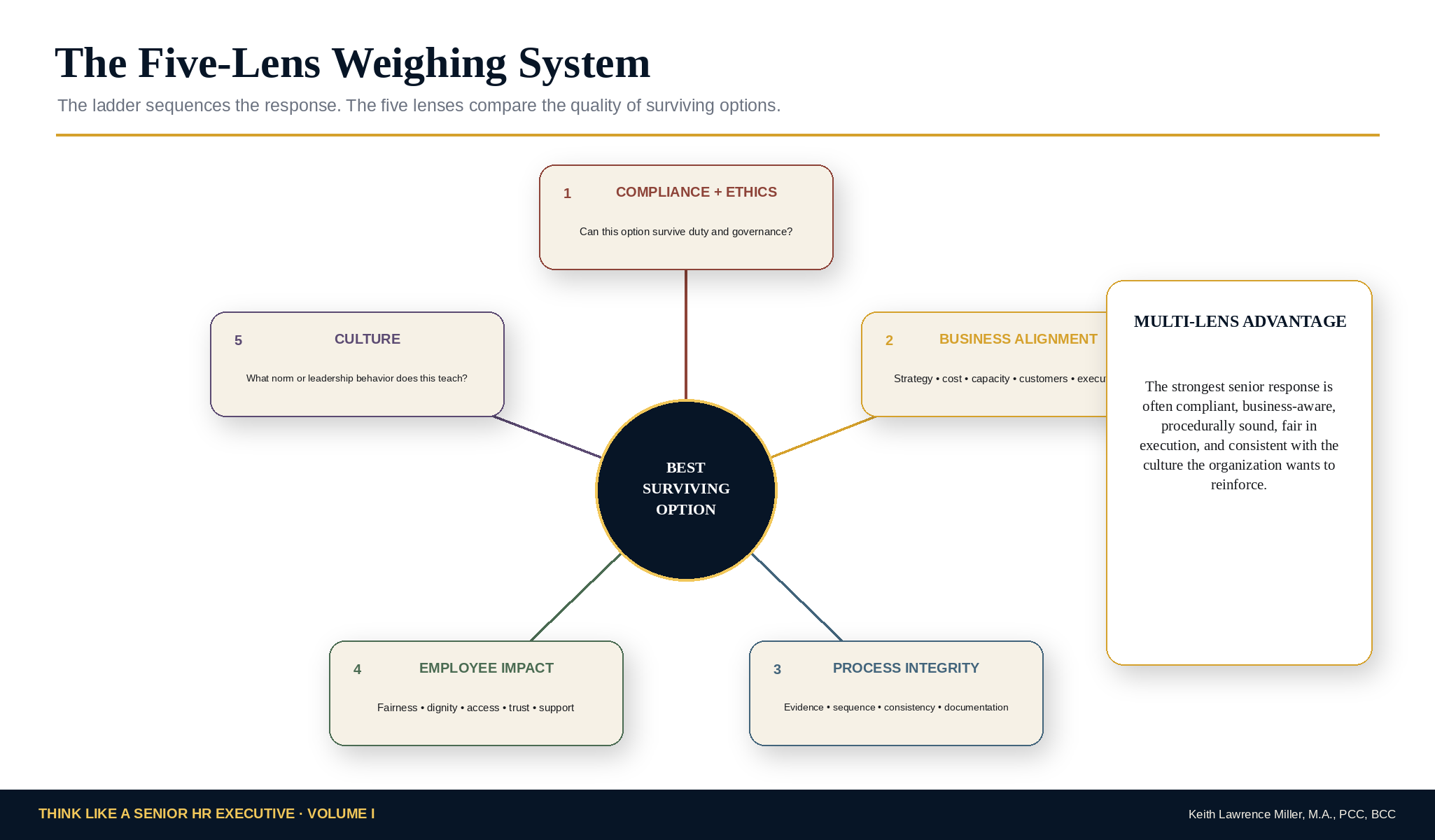
The Five-Lens Weighing System evaluates the quality of surviving choices:
Compliance and Ethics
Business Alignment
Process Integrity
Employee Impact
Culture
Lens One: Compliance and Ethics
Does the option leave a legal, safety, ethical, or governance obligation unresolved? Does it preserve appropriate confidentiality? Does it manage conflicts? Does it protect fair process?
An option that fails a controlling duty can often be eliminated immediately.
Lens Two: Business Alignment
What does the decision do to cost, capacity, customers, speed, execution, critical skills, continuity, risk, productivity, and strategy?
Calling something strategic is insufficient. The leader should be able to explain the business consequence.
Lens Three: Process Integrity
Is the response evidence-based, properly sequenced, documented, consistent, governed, and repeatable?
A strong process should remain defensible when people, leaders, or political circumstances change.
Lens Four: Employee Impact
What will the decision do to fairness, dignity, trust, access, support, and retention?
The employee lens does not erase controlling duties. It influences how those duties are carried out.
Lens Five: Culture
Every visible decision teaches.
What behavior does the action reward? What does it tolerate? What does it signal about leadership?
Culture is created through repeated visible choices.
Strong Answers Solve More Than One Problem
The strongest senior response often performs well across several lenses at the same time.
It is defensible, business-aware, procedurally sound, fair in execution, and consistent with desired organizational norms.
Find the Real Problem
Senior HR cases often present a visible request that conceals a different organizational problem.
“We need to terminate this employee” may conceal weak documentation. “Employees need resilience training” may conceal unsustainable workload. “We need more recruiters” may conceal pay, employer reputation, process, or unrealistic requirements.
Strong HR reasoning separates the request from the problem.
Do Not Solve the Surface Story
The visible event is sometimes only a symptom.
A repeated attendance issue may involve policy design. Turnover may originate in manager behavior. Hiring delay may reflect approval architecture. Conflict may actually be a role-clarity problem.
Solving the surface story may create temporary relief while preserving the cause.
Senior HR Altitude
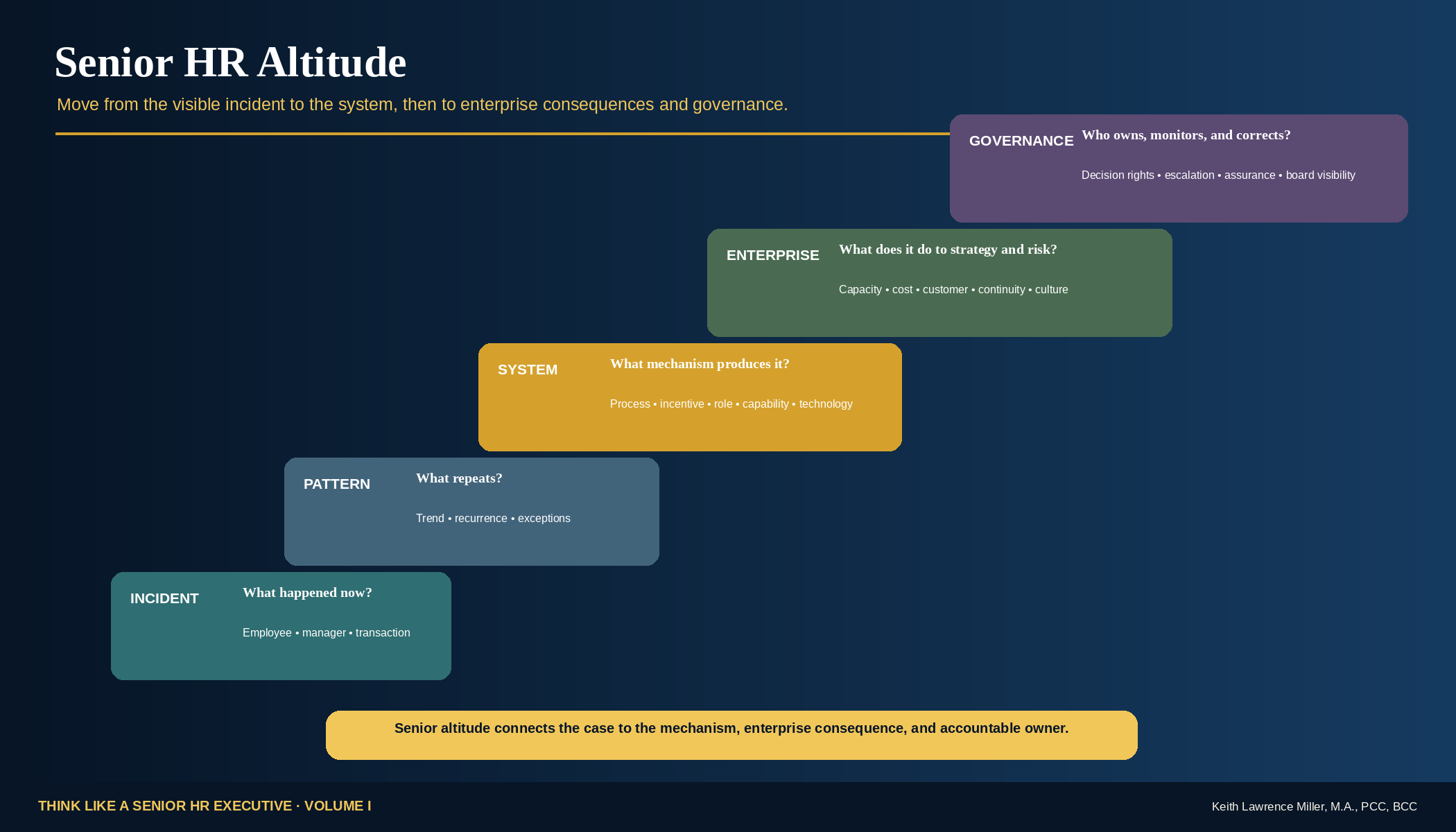
Senior HR judgment moves from the incident to the pattern, from the pattern to the system, from the system to enterprise consequence, and from enterprise consequence to governance.
The individual case still matters. Senior altitude connects it to what the organization must change, own, monitor, and learn.
Wrong Answers Often Sound Reasonable
Senior-level distractors are rarely absurd.
They often contain a legitimate idea at the wrong time, scope, or level.
Coaching can be useful but cannot replace fact-finding. Employee voice matters but cannot delay immediate safety action. Confidentiality matters but cannot erase investigation duty. External expertise can help but can also become a way to avoid leadership.
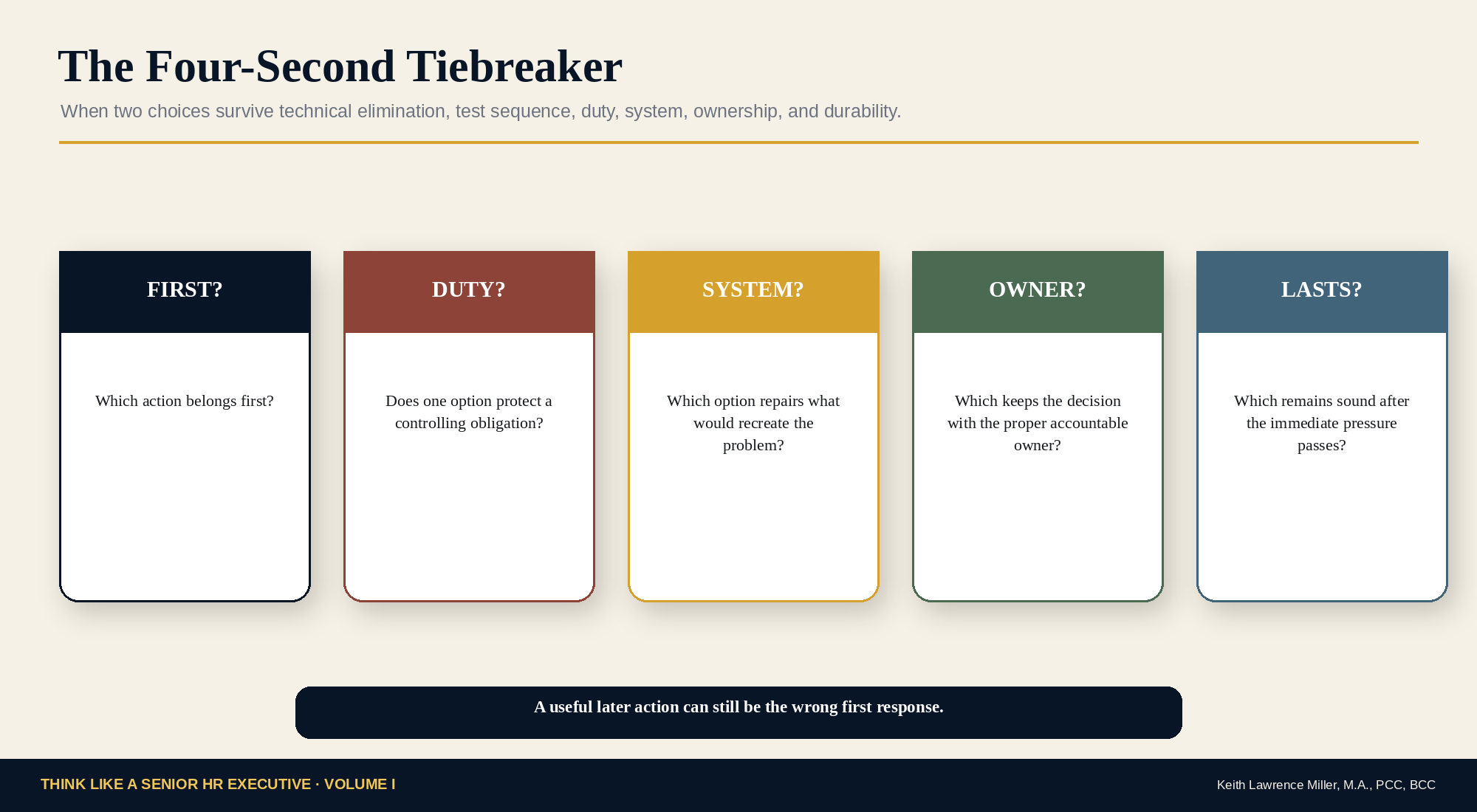
The Four-Second Tiebreaker
When two options remain plausible, the book introduces a compressed test:
First?
Duty?
System?
Owner?
Lasts?
Which action belongs first? Which protects the controlling duty? Which repairs the system? Which preserves proper ownership? Which remains sound over time?
The tiebreaker does not replace technical knowledge. It helps discriminate between technically plausible survivors.
The Coach, Consultant, and Psychologist Mind May Need Recalibration
Experienced professionals often arrive with useful strengths.
Coaches may naturally value dialogue. Consultants may reach quickly for structured interventions. Psychology practitioners may look for underlying behavioral explanations.
Those instincts can be valuable and can also create predictable errors when used before the senior HR sequence is clear.
Dialogue cannot replace a controlling duty. Assessment cannot substitute for an investigation. Consulting cannot replace ownership. Psychological explanation does not eliminate accountability.
The Eight Behaviors of Senior HR Leaders
Volume I applies the reasoning architecture across eight behavioral areas: Leadership & Navigation, Ethical Practice, Inclusive Mindset, Relationship Management, Communication, Business Acumen, Consultation, and Analytical Aptitude.
Leadership and Navigation
Senior leadership is direction plus mobilization.
The leader needs to understand the formal organization and the informal one: authority, influence, history, coalitions, trust, gatekeepers, resistance, and decision rights.
Leadership at this level means translating enterprise direction into a credible workforce agenda and governing implementation through accountable execution.
Ethical Practice
Ethical practice requires more than personal integrity.
Conflicts need disclosure. Information needs appropriate protection. Standards need consistent application. Pressure from powerful stakeholders must not create separate rules.
Ethics becomes governance.
Inclusive Mindset
Inclusion at senior altitude involves systems.
Who receives access? Whose evidence is recognized? Who is heard? Where do barriers operate? Which policies produce uneven consequences?
Relationship Management
Senior HR leaders work through trust, negotiation, influence, conflict, and repair.
Many conflicts that appear personal are actually structural: role ambiguity, competing incentives, decision rights, workload, dependencies, or process design.
Strong relationship management does not prioritize surface harmony over a controlling legal, safety, or ethical obligation.
Communication
Senior communication changes with the audience.
The CEO needs the enterprise issue. The CFO needs economics. The COO needs operational implications. The board needs material risk and governance. Employees need clarity, dignity, and credible explanation.
Business Acumen
HR earns executive credibility when people decisions connect visibly to enterprise outcomes.
Margin. Capacity. Customer experience. Risk. Productivity. Speed. Talent scarcity. Capital allocation. Execution.
Consultation
Consultation is disciplined problem solving.
Clarify the issue. Gather evidence. Test assumptions. Define options. Recognize constraints. Recommend. Preserve ownership. Measure results.
Analytical Aptitude
Data does not make a recommendation objective automatically.
The leader still needs to ask what is being measured, whether the operational definition is sound, what comparison is appropriate, what is missing, whether the relationship is causal, and how uncertainty should affect the decision.
HR Strategy Begins With the Enterprise
A company can operate many HR programs and still lack an HR strategy.
Strategy begins with enterprise direction: growth, automation, acquisition, cost pressure, digital transformation, geographic expansion, or market exit.
The HR calendar follows the strategy.
The ALIGN Strategy Test
Volume I uses the ALIGN Strategy Test to evaluate HR initiatives before they enter the portfolio.
The initiative should be anchored in a specific enterprise objective, strengthen relevant workforce capability, carry a credible investment logic, include governance, and define proof.
An initiative should exist because the enterprise requires something from the workforce. Trendiness is not enough.
Talent Acquisition Is a Business System
Recruiting is broader than applicant volume or time to fill.
Senior leaders ask which capability is being acquired, why the role is difficult to fill, whether requirements are realistic, what labor supply looks like, what vacancy costs, how employer reputation affects conversion, and where the process loses qualified people.
Engagement and Retention Require Diagnosis
Low engagement does not have one cause. Turnover does not have one cause.
Survey results need to connect to manager behavior, work design, pay, career opportunity, trust, burnout, recognition, schedule, leadership credibility, job fit, and market alternatives.
Learning and Development Must Build Capability
Training attendance is activity.
Capability is the objective.
What behavior or performance should change? What practice opportunity exists? What does the manager need to reinforce? How will transfer be supported? How will capability be demonstrated?
Career Architecture and Talent Mobility
Organizations lose capability when employees cannot see how to move.
Career architecture clarifies roles, levels, skill expectations, progression, adjacent pathways, readiness, development, and internal mobility.
Total Rewards Is a Portfolio of Consequences
Compensation decisions influence attraction, retention, internal equity, external competitiveness, behavior, cost, risk, and culture.
The senior HR executive understands both employee experience and financial architecture.
Benefits Strategy Requires Business and Human Judgment
Benefits are expensive and are also part of workforce security and employee choice.
The senior leader evaluates cost, utilization, workforce demographics, competitiveness, access, legal requirements, employee impact, and sustainability.
The HR Operating Model Matters
How HR is organized affects what HR can accomplish.
Business partners, shared services, centers of expertise, centralized structures, federated structures, technology, case management, service catalogs, and decision rights should be designed around the work.
Senior leaders diagnose the service and decision problem before redesigning the entire function.
Organizational Effectiveness Is System Work
Performance problems often sit above the individual level: structure, decision rights, incentives, span of control, workflow, information, capabilities, and culture.
Change Leadership Requires More Than Announcement
A technically sound change can fail because the organization was misread, stakeholders were engaged too late, the future state was vague, resistance was treated as disobedience, decision rights were unclear, or implementation lacked governance.
Workforce Planning Connects Strategy to Capacity
Workforce planning asks what talent the organization will need before shortage becomes operational failure.
Demand, supply, critical roles, scarce skills, automation, productivity, geography, succession, build-versus-buy decisions, contingent work, reskilling, and scenario planning all matter.
Performance Management Is a System
Performance problems can involve expectations, capability, motivation, resources, manager skill, measurement, feedback, incentives, work design, or conduct.
Senior HR distinguishes performance from misconduct, development from discipline, and individual cases from recurring design failures.
Employee Relations Requires Neutral Process
Complaints, investigations, retaliation risk, manager conduct, and policy application require disciplined intake and inquiry.
Protect people. Preserve evidence. Use appropriate impartiality. Separate allegations from conclusions. Document. Reach proportionate decisions. Repair systemic failures where they exist.
Labor Relations Requires Institutional Awareness
Collective representation changes decision rights, communication, bargaining obligations, and implementation.
Senior HR leaders need to know where management authority exists, where bargaining obligations apply, how labor relationships affect execution, and when specialized legal guidance is required.
Technology Management Is Governance
Automation can route cases, generate documents, support employee service, assist recruiting, analyze workforce patterns, and retrieve knowledge.
Artificial intelligence increases those capabilities and also raises questions about purpose, data, validity, impact, ownership, transparency, privacy, monitoring, exception handling, and human review.
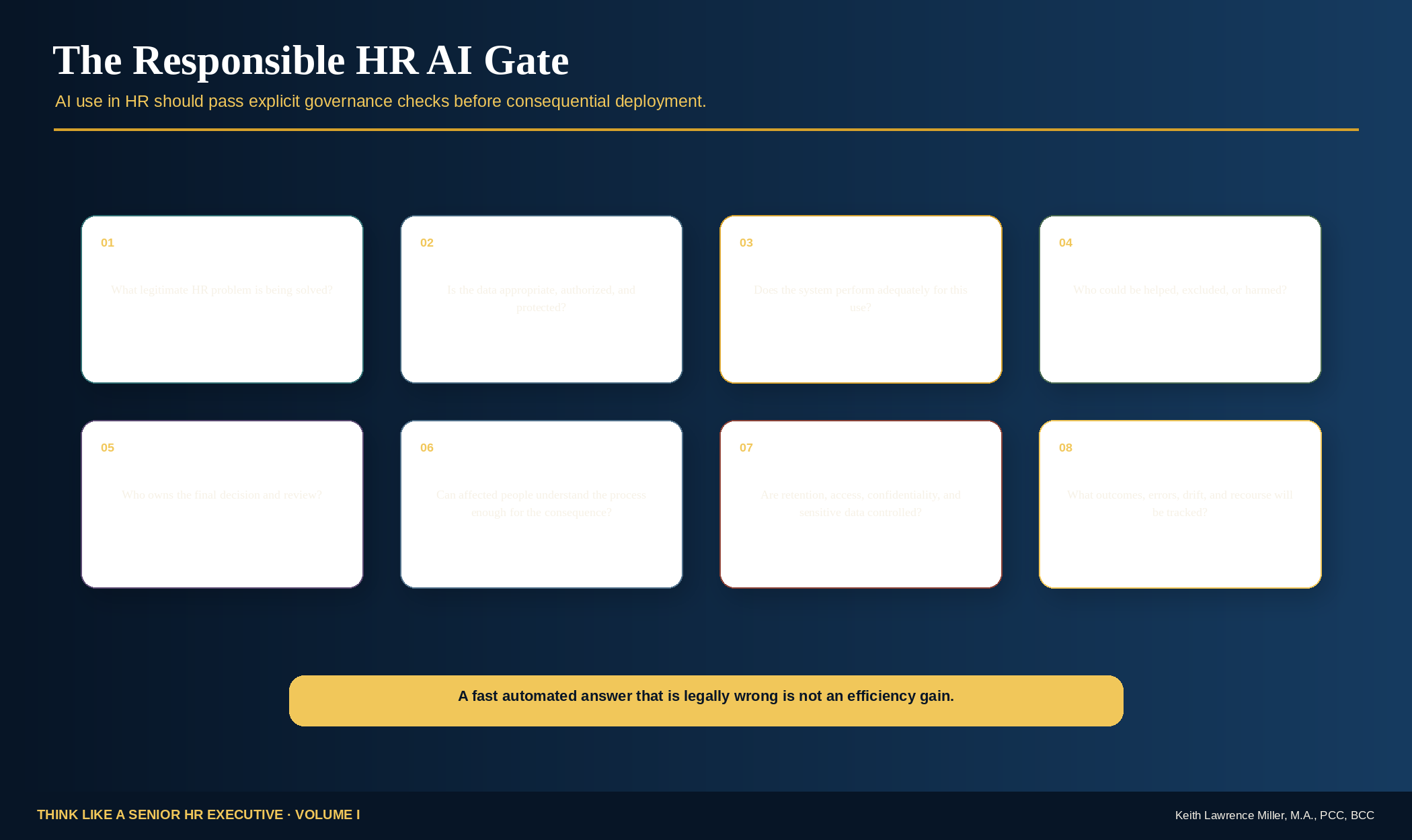
The Responsible HR AI Gate
The Responsible HR AI Gate brings these questions into a single governance discipline:
Purpose. Data. Validity. Impact. Ownership. Transparency. Privacy. Monitoring.
An automated answer that is fast and legally wrong is not an efficiency improvement.
AI Does Not Remove HR Accountability
An AI system may generate a recommendation.
Someone still needs to determine whether the source is authoritative, whether the analysis is valid, whether the result could disadvantage a group, whether protected information is involved, whether the output is explainable enough for the decision, who owns the final action, whether affected people can obtain review, and how outcomes will be monitored.
Risk Management Begins Before the Crisis
Senior HR risk includes continuity, safety, reputation, critical capability, leadership succession, labor stability, data, technology, investigations, benefits, and third-party exposure.
Risk becomes governable when responsibility is visible.
Human Capital Governance Reaches the Boardroom
Boards may need visibility into leadership succession, culture risk, human capital capability, executive compensation, workforce disruption, material misconduct, labor exposure, transformation, and technology risk.
The CHRO's role includes translating workforce information into governance language without overstating certainty.
Employment Law Creates the Boundary Conditions
The legal section helps readers recognize controlling obligations and sequence decisions appropriately.
The book addresses major issue families including discrimination, retaliation, disability, leave, accommodation, wage and hour, harassment, employer liability, restructuring, and reductions in force.
The recurring discipline remains the same: identify the duty, verify the facts, preserve fair process, keep status from distorting the standard, document, assign ownership, and escalate when appropriate.
Law Should Shape the Sequence Without Becoming the Entire Strategy
A technically legal answer may still be strategically weak.
It may damage trust, create inconsistent precedent, ignore business consequences, produce unnecessary turnover, or leave a broken process intact.
The Five-Lens System helps move from minimum legality toward stronger organizational judgment.
The Question Laboratory Teaches Construction, Not Memorization
The book turns the reasoning system back onto the examination itself.
How are knowledge questions built? How are situational judgment questions built? Why do two answers sometimes appear plausible? What fact changes the answer? What does “first” demand? What does “most effective” demand?
The Twelve SJI Scenario Families
Senior scenarios often test recurring tensions: duty versus convenience, facts versus premature action, direct engagement versus unnecessary escalation, individual event versus system failure, HR influence versus business ownership, speed versus process integrity, empathy versus accountability, and technical legality versus broader organizational quality.
Multi-Episode Executive Cases Build Integration
Real executive problems evolve.
New evidence appears. Stakeholders change positions. A decision that was appropriate initially may need adjustment.
Multi-episode cases develop continuity of reasoning.
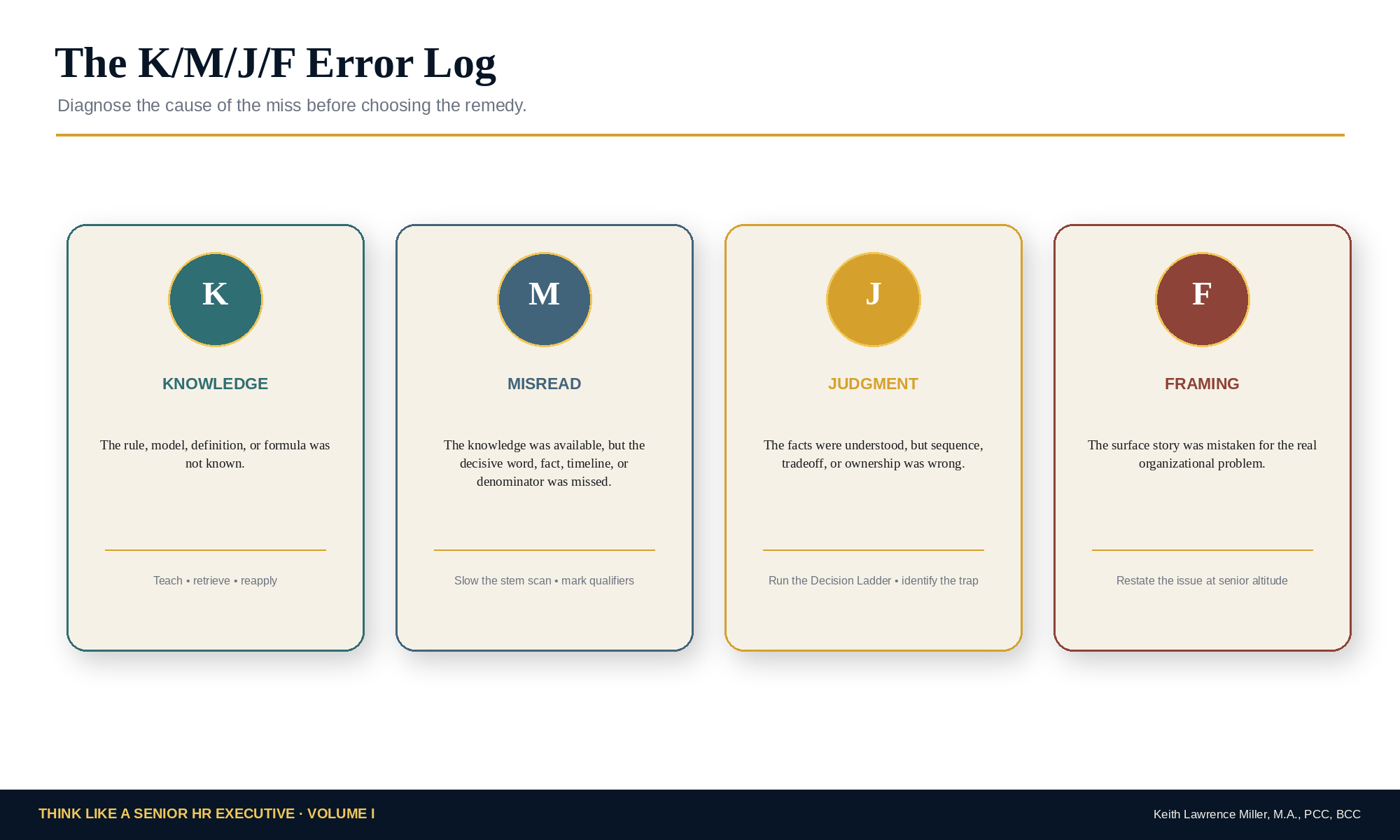
The K/M/J/F Error Log
A missed question does not automatically mean the learner needs more content review.
K — Knowledge: the rule or model was not known.
M — Misread: the learner knew the material but missed a decisive word, qualifier, timeline, or fact.
J — Judgment: the knowledge was available, but sequence or choice was wrong.
F — Framing: the visible story was mistaken for the real organizational problem.
Studying more law will not necessarily correct a framing error.
Confidence Calibration
The learner tags answers as Sure, Leaning, or Guessing and compares confidence with accuracy.
A high-confidence error deserves special attention because it can reveal a false rule, durable misconception, or unreliable decision pattern.
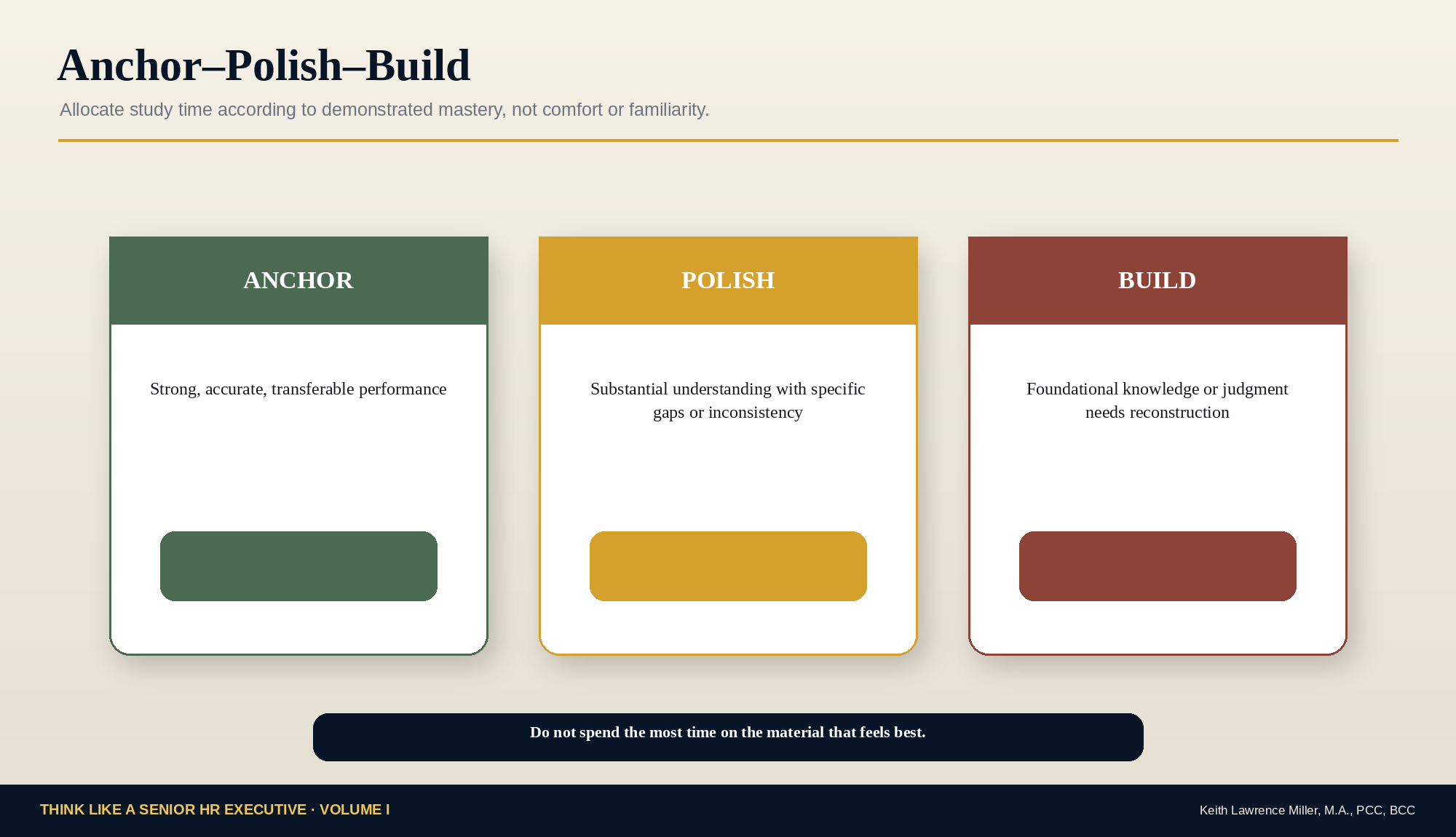
Anchor, Polish, or Build
Study time should follow evidence.
Anchor: the domain is genuinely strong and requires lighter maintenance.
Polish: substantial understanding exists, but specific gaps remain.
Build: foundational knowledge or judgment requires substantive reconstruction.
Retrieval Beats Familiarity
Reading repeatedly can create the feeling of mastery.
The stronger test is retrieval.
Can you explain the framework without the page open? Can you apply it to a new case? Can you distinguish neighboring concepts? Can you teach the reasoning aloud? Can you reconstruct the Decision Ladder under time pressure?
The Executive Translation Method
Volume I eventually asks whether the knowledge can guide an actual executive conversation.
The Executive Translation Method converts HR analysis into seven moves:
Issue. Consequence. Evidence. Options. Recommendation. Owner. Measure.
That sequence turns study into professional language.
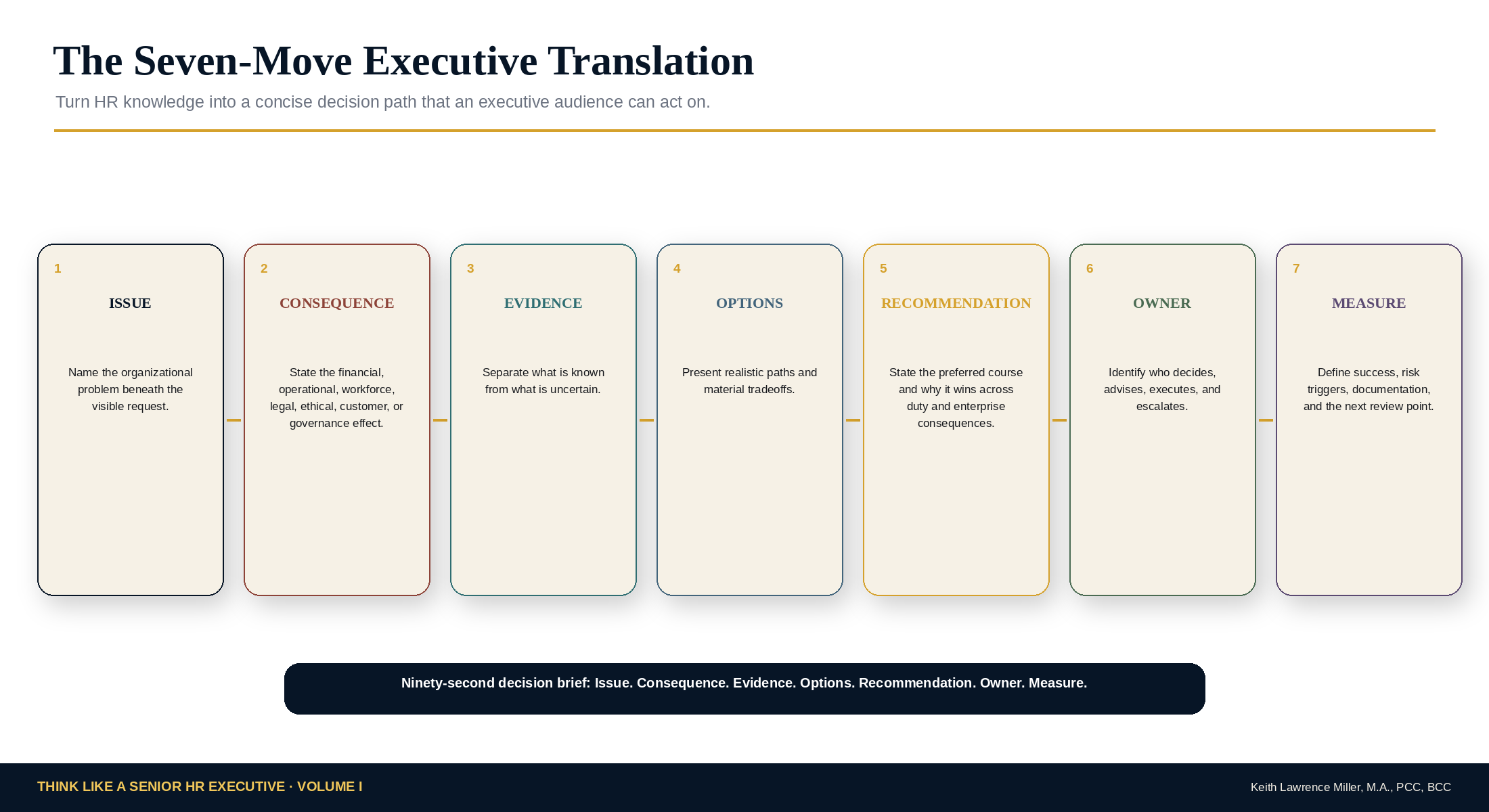
The Ninety-Second Decision Brief
Senior executives rarely want a lecture before learning what decision is required.
A concise executive brief can follow seven sentences: issue, consequence, evidence, options, recommendation, ownership, and measure.
The executive can expand where questions require it.
Different Executives Need Different Translations
The underlying truth should remain stable. The emphasis changes.
A CEO asks what enterprise problem is being solved and what is recommended. A CFO asks about cost, avoided loss, investment logic, and sensitivity. A COO asks about process, capacity, controls, service levels, and implementation risk. A board asks about material risk, governance, oversight, assurance, and escalation thresholds.
The Exam Is a Proving Ground
Technical recall matters. Timing matters. Question construction matters. Confidence calibration matters. Situational judgment matters.
The larger value is professional.
Can the reader identify the hidden issue, protect duty, gather the right facts, engage the right stakeholder, repair the system, preserve ownership, and translate the recommendation into credible business language?
The 12-Week Master Plan
Readers with sufficient preparation time can build mastery progressively through diagnostic work, deep content blocks, situational judgment practice, retrieval, teach-backs, confidence calibration, mixed review, practice examinations, and final integration.
The 8-Week Accelerated Plan
A shorter timeline requires stronger prioritization. Anchor domains receive maintenance. Polish domains receive targeted correction. Build domains receive deep work.
The 14-Day Final Review
The final two weeks are for consolidation: fresh practice, targeted retrieval, high-confidence error correction, mixed scenarios, formula and law refresh, pacing, and logistics.
The Final Readiness Decision
Readiness is more than a single practice score.
The learner should examine performance across practice sets, domain weakness, confidence calibration, high-confidence errors, situational judgment quality, timing, retention, and ability to recover after difficult questions.
Exam-Day Execution Is Operational Discipline
Preparation can still be undermined by poor pacing, overinvestment in one ambiguous item, changing answers without evidence, failure to recover after a difficult question, or ignoring logistics.
Exam day is the point when preparation must be allowed to perform.
Volume I and Volume II Serve Different Purposes
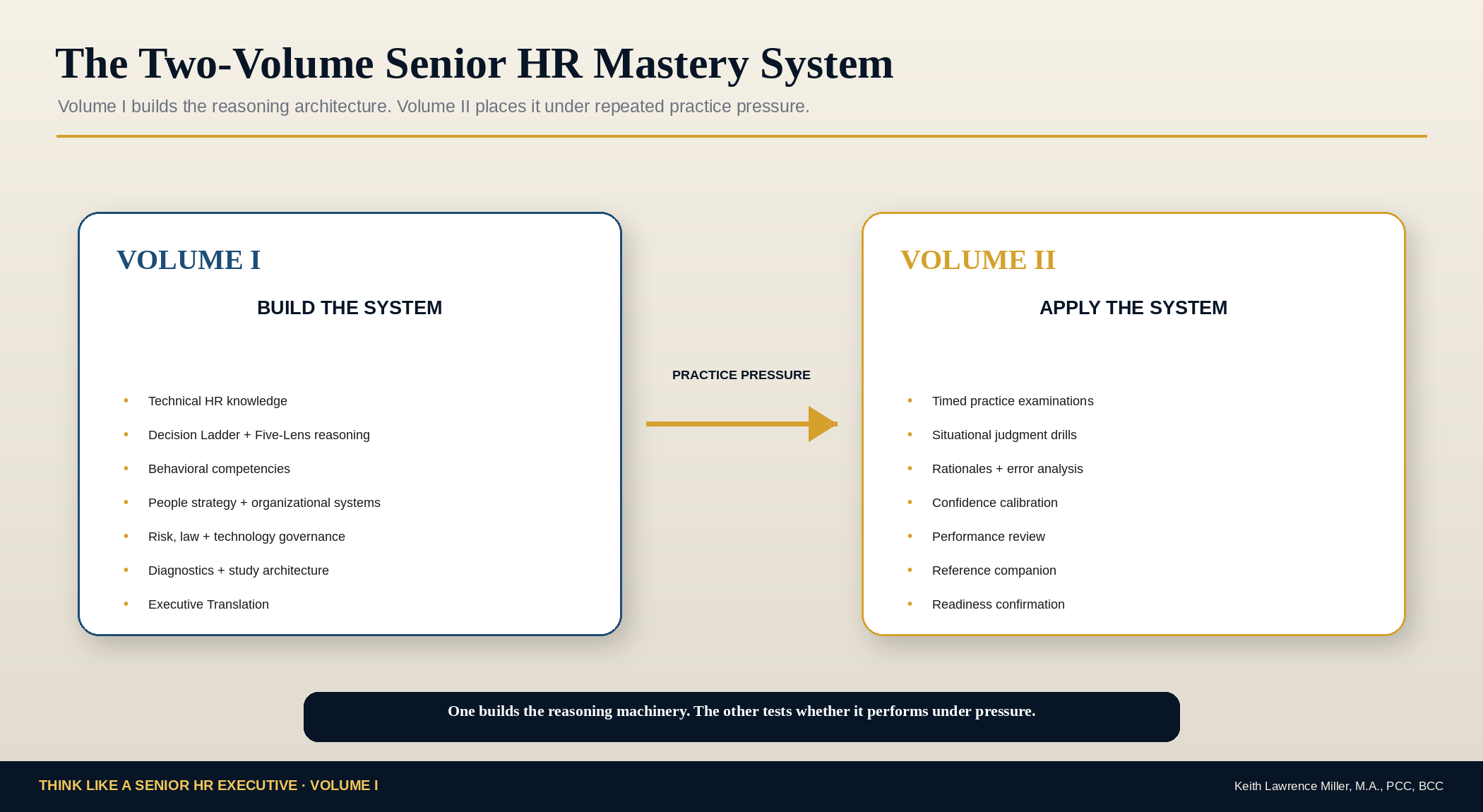
Volume I builds the system: knowledge architecture, judgment frameworks, behavioral competencies, functional HR content, question logic, diagnostic methods, and study process.
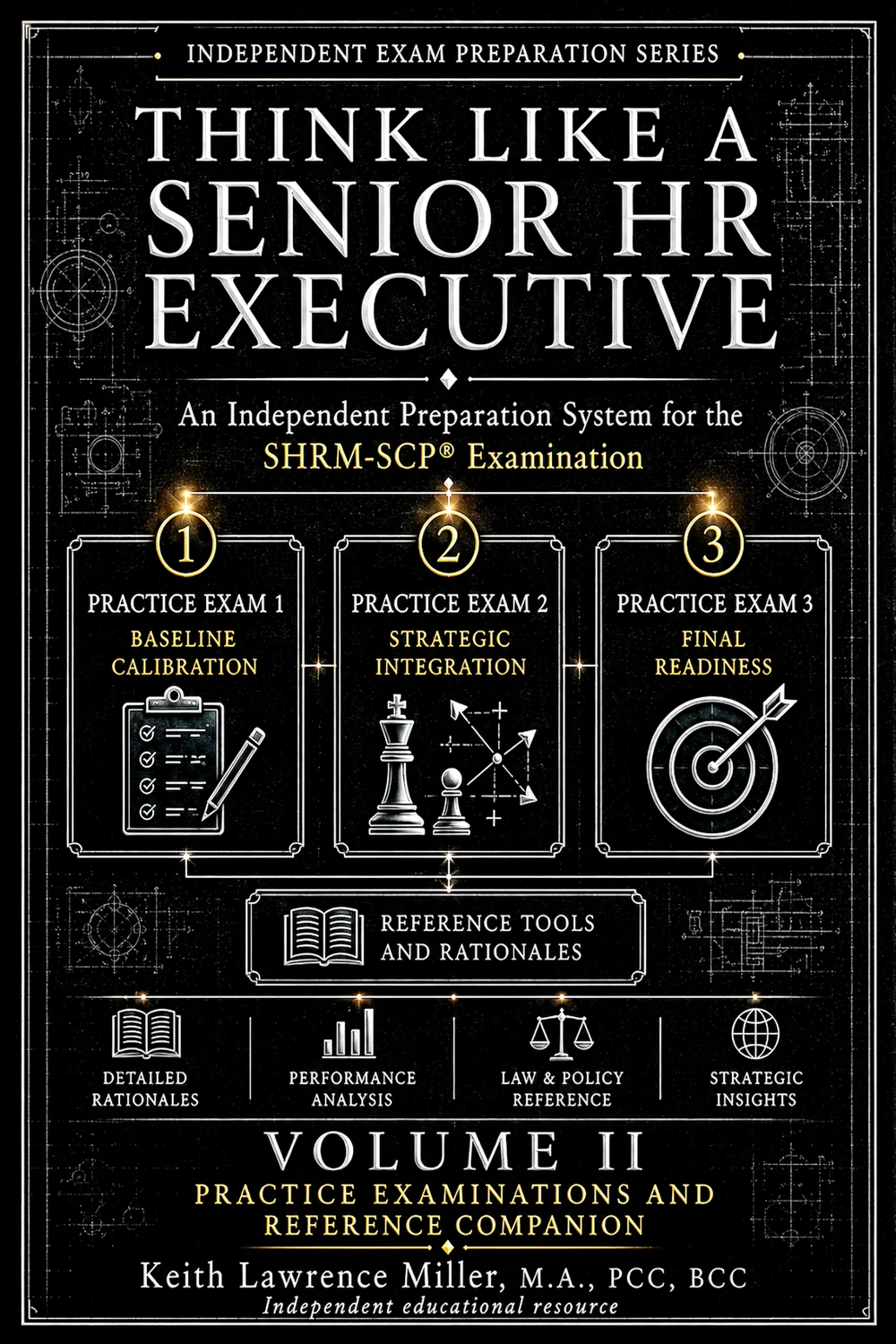
Volume II is the Practice Examinations and Reference Companion. It extends the system through applied scenarios, practice questions, rationales, performance analysis, and reference material.
One builds the reasoning machinery. The other places that machinery under repeated pressure.
Who Should Read Think Like a Senior HR Executive — Volume I?
The book is designed for SHRM-SCP® candidates, senior HR leaders, HR business partners, HR directors and vice presidents, career changers entering senior HR, coaches and organizational practitioners, talent and organizational leaders, and business executives who partner closely with HR.
Think Like the Senior Executive
Senior HR leadership does not mean having the most policies memorized.
It means knowing when the policy controls, when evidence is insufficient, when direct engagement is appropriate, when the issue belongs at system level, when HR should influence, when another executive still owns the decision, when escalation is mandatory, and when a technically legal action is still organizationally weak.
The strongest senior HR executive does more than answer the immediate question.
They protect the duty. Clarify the facts. Engage the right people. Repair the system. Preserve legitimate ownership. Escalate with discipline. Evaluate the decision across compliance, business, process, employee, and culture consequences. Then translate the recommendation into language the enterprise can act on.
That is senior HR judgment.
This publication is an independently prepared educational resource. It is not endorsed by, sponsored by, or affiliated with the Society for Human Resource Management (SHRM) or Prometric. SHRM, SHRM-CP, SHRM-SCP, SHRM BASK, and related names and marks are the property of their respective owners and are referenced descriptively to identify the professional framework and examination context addressed by the book. All practice questions, cases, frameworks, explanations, and rationales are original educational material. The publication does not reproduce, reconstruct, solicit, or disclose confidential live examination content, and performance on its materials does not guarantee a certification result.
Employment law, regulatory standards, benefits limits, technology rules, and certification policies can change. Federal law is discussed for educational purposes and may be supplemented or altered by state, local, industry, contractual, or international requirements. Official SHRM materials remain the controlling authority for current certification competencies, eligibility, testing policies, timing, and examination composition. This publication does not provide legal, tax, benefits, or investment advice. Readers should verify current requirements and obtain appropriately qualified advice for decisions involving specific facts.