Full book feature
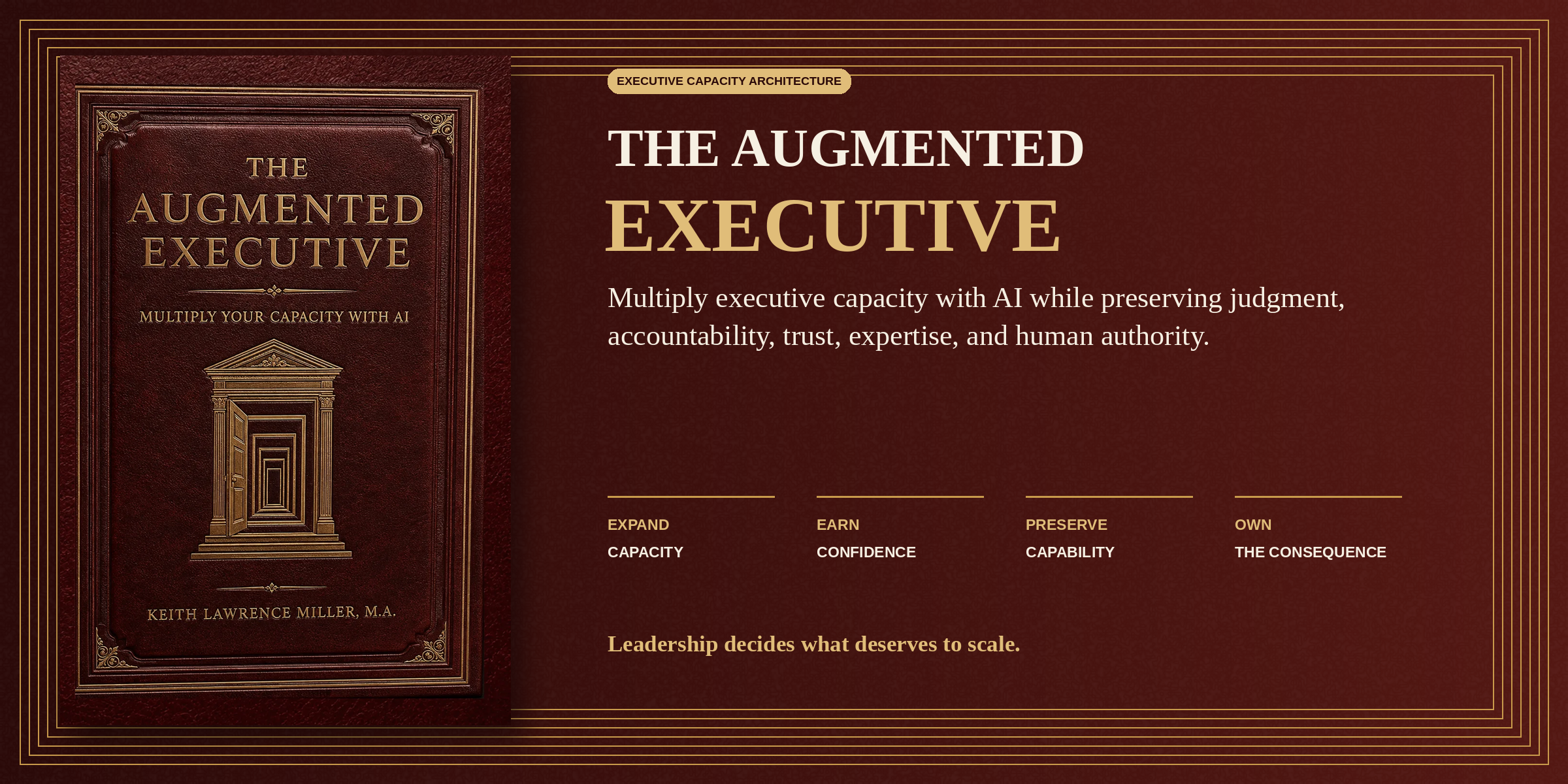
Expand Capacity. Earn Confidence. Preserve Capability. Own the Consequence.
Artificial intelligence can help an executive produce more analysis, more research, more alternatives, more drafts, more monitoring, and more preparation than one person could previously create in the same amount of time.
That is an extraordinary change in executive capacity.
It is also an incomplete description of leadership.
The central question is no longer simply whether AI can produce useful work.
The executive question is: Can the organization turn that potential into useful, trustworthy, resilient capacity without weakening judgment, accountability, expertise, relationships, or its ability to recover when the system fails?
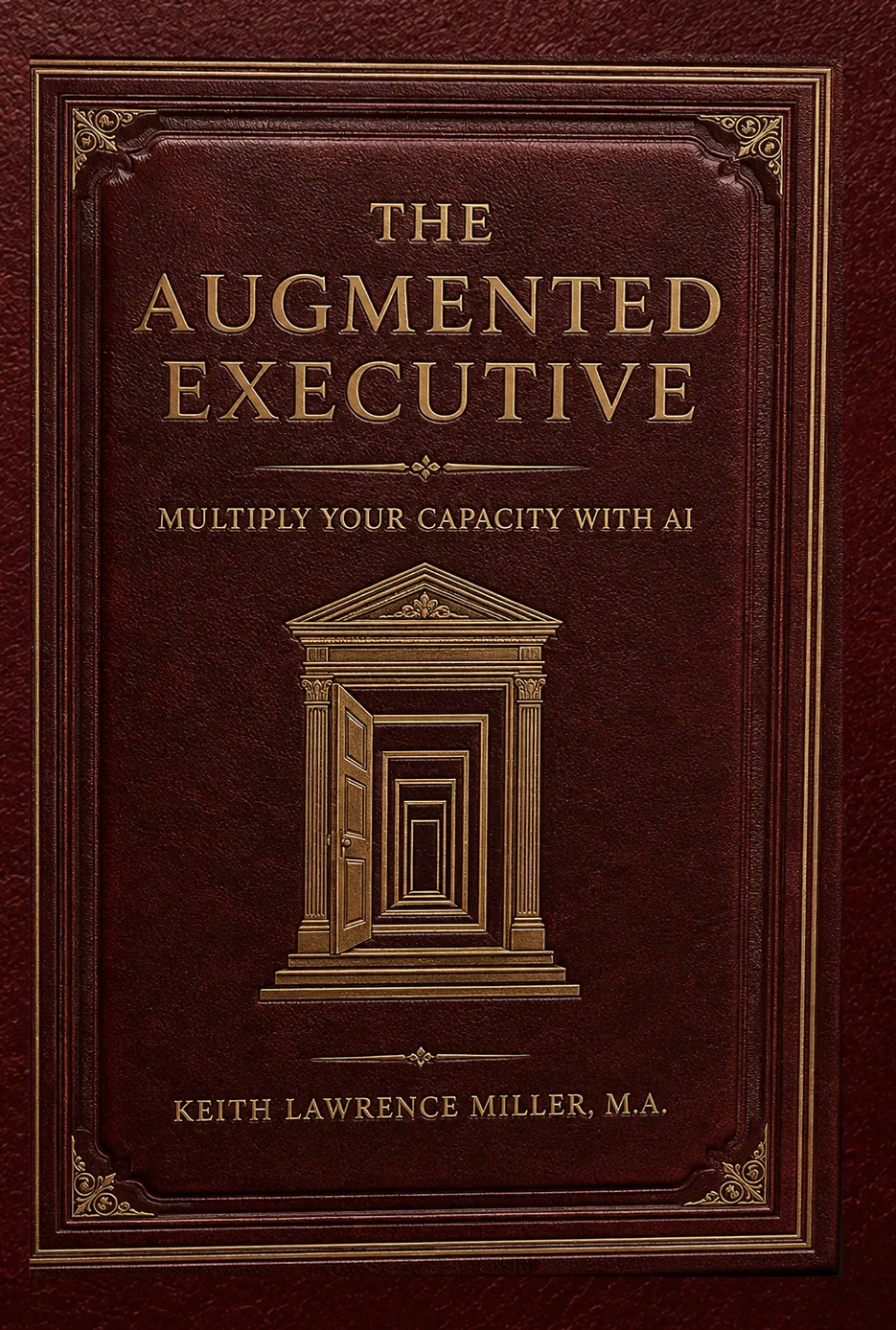
That is the problem at the center of The Augmented Executive.
The book treats artificial intelligence as part of an executive operating system.
AI can accelerate cognitive work. Leadership still determines what work matters, which information governs it, who may act, what evidence is required, how outputs are reviewed, what happens when the system is wrong, and who remains responsible for the consequence.
The executive of the AI era therefore has a larger design problem.
More capability must be turned into better capacity. More capacity must earn confidence. Greater dependence must be balanced by retained human capability. And authority must remain legible.
The Capacity Question
AI makes generation cheaper.
An executive can produce ten strategic alternatives where there was previously time for three. A research team can summarize hundreds of documents faster. A manager can prepare a presentation, memo, scenario analysis, competitive brief, meeting agenda, stakeholder map, and communication draft within the same working session.
That looks like capacity.
Sometimes it is.
Sometimes it is simply more output.
Those two things should not be confused.
A generated briefing has little organizational value if nobody can determine whether the underlying evidence is reliable. A faster recommendation does not improve leadership if the decision-maker cannot explain its assumptions. A workflow does not become scalable merely because one executive knows how to operate it.
The real test is whether the work can become accepted, useful, repeatable, explainable, governable, and resilient.
The Executive Is Already a System
Senior leadership has never been the work of one mind.
Every consequential executive decision already depends on a surrounding system: people, reports, meetings, analysts, advisers, databases, financial models, customer information, policies, institutional memory, legal guidance, subject-matter experts, operational feedback, informal relationships, and authority.
The executive receives information from that system and acts through it.
AI becomes another component in the system.
That means the first leadership question should rarely be: Where can I insert AI?
A better starting point is: What system produces this decision or outcome today?
Map the work first. What outcome matters? Who receives it? Which information is authoritative? Who contributes expertise? Where does challenge enter? Who approves? What can be reversed? What happens when something goes wrong?
Only then does the role of artificial intelligence become clear.
Personal Leverage Is Different From Organizational Capacity
A skilled executive can learn to use AI extremely well. That may create personal leverage.
The executive researches faster, writes faster, prepares faster, sees more alternatives, and processes more information.
That advantage is valuable. It does not automatically become an organizational capability.
Organizational capacity exists when the work can be repeated responsibly by authorized people using governed context, defined processes, appropriate evidence, clear handoffs, explicit decision rights, measurable outcomes, and viable recovery routes.
A clever interaction with an AI model may disappear when the executive leaves. A governed workflow can remain.
What Becomes Scarce When Generation Gets Cheap?
Every productivity technology relocates constraints.
When generating information becomes easier, other resources become more valuable: attention, review, judgment, verification, context, expertise, coordination, decision authority, and implementation capacity.
The executive can create fifty options. Someone still has to determine which options deserve attention.
A model can generate a ten-page market analysis. Someone still has to know whether the sources are appropriate.
AI can produce hundreds of outputs. Human review capacity may remain almost unchanged.
Generation can scale faster than responsible attention.
The bottleneck moves. The leader needs to find it.
The Capacity Multiplier
The strongest AI use cases increase useful work without creating equal or greater downstream burden.
Organizations often measure prompts, drafts, generated documents, licenses, users, messages, or hours supposedly saved.
Those are activity measures.
A stronger capacity question is: How much accepted work did the system create relative to the total scarce human effort required to produce, verify, approve, and use it?
If an AI system creates a report in five minutes and three specialists need two hours to verify it, the five-minute production time is not the whole productivity story.
Measure the complete workflow.
The Jagged Frontier
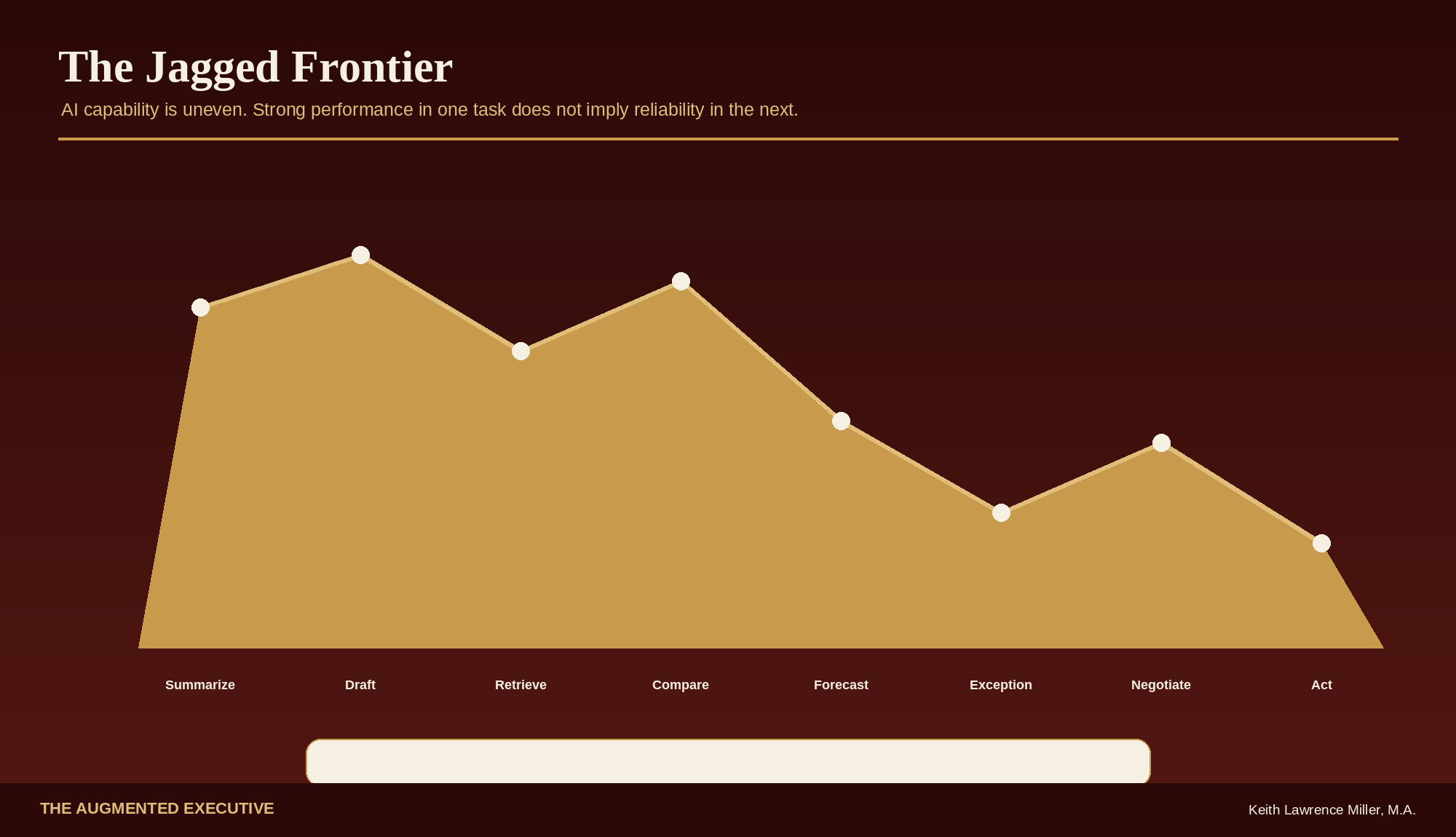
AI capability is uneven.
A system may perform impressively on one task and fail surprisingly on another that appears similar.
That creates a jagged performance frontier.
Executives should resist classifying a model simply as “good” or “bad.”
The useful question is: Where does this workflow perform reliably, and where does reliability break down?
Capability therefore needs boundaries.
The mature executive learns where the system works, where human expertise adds value, where review must increase, and where automation should stop.
Measure What Matters
Faster output can be valuable. It can also become a distraction.
The ultimate measure sits downstream.
Did the recipient receive something useful? Did the decision improve? Did implementation move? Did customers benefit? Did risk decrease? Did quality hold? Did employees gain useful capacity? Did review burden increase? Did expertise weaken?
Where did the saved time go?
Time saved by automation is not automatically converted into strategic value. Executives should decide where recovered attention will go.
The Executive Capacity Architecture
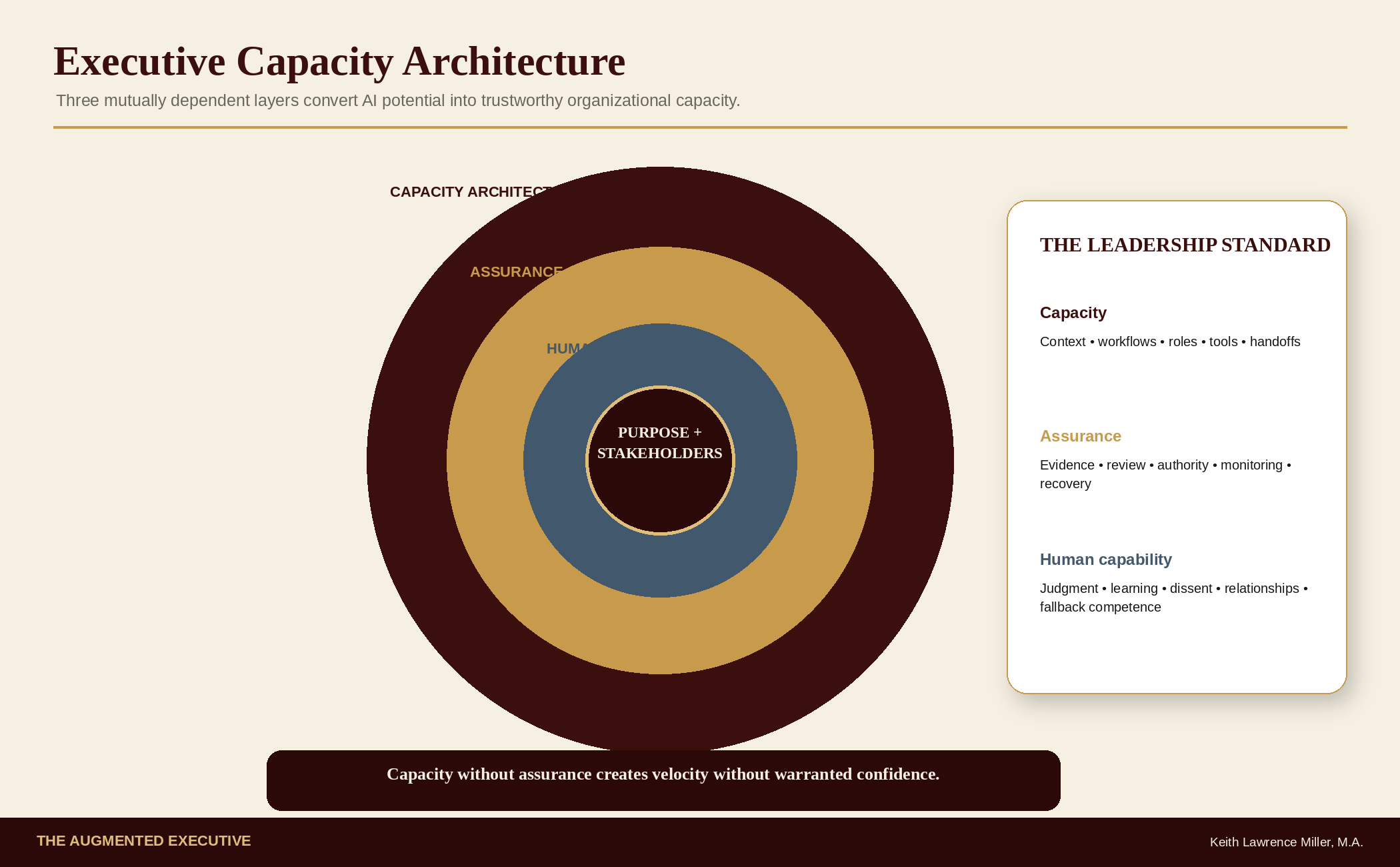
The central operating model in The Augmented Executive is the Executive Capacity Architecture.
It contains three mutually dependent layers:
Capacity Architecture
Assurance Architecture
Human Capability Architecture
Together they answer three questions:
What useful work can the system perform?
Why should anyone rely on the result?
What must people continue to know, practice, and own?
All three matter.
Capacity Architecture
Capacity architecture is the machinery that allows useful work to happen.
It includes governed context, defined workflows, role-based AI assistance, tool access, structured inputs, acceptance criteria, and handoffs.
The question is: What can this system accomplish, with what information, toward what purpose?
Without this layer, organizations often have impressive demonstrations that never become repeatable work.
Assurance Architecture
Assurance architecture creates the basis for justified confidence.
It includes evidence, source traceability, verification, competent review, uncertainty handling, decision rights, monitoring, audit records, escalation, fallbacks, and recovery.
The question becomes: Why is this result trustworthy enough for this level of consequence?
Without assurance, speed becomes exposure.
Human Capability Architecture
Human capability architecture preserves the organization's capacity to think and recover.
It includes judgment, expertise, learning, dissent, relationships, moral responsibility, fallback competence, and deliberate practice.
The question becomes: What must people continue to know, practice, and own?
Without this layer, a system can perform impressively while making the organization increasingly dependent on capabilities it no longer possesses.
Five Movements in Executive Capability
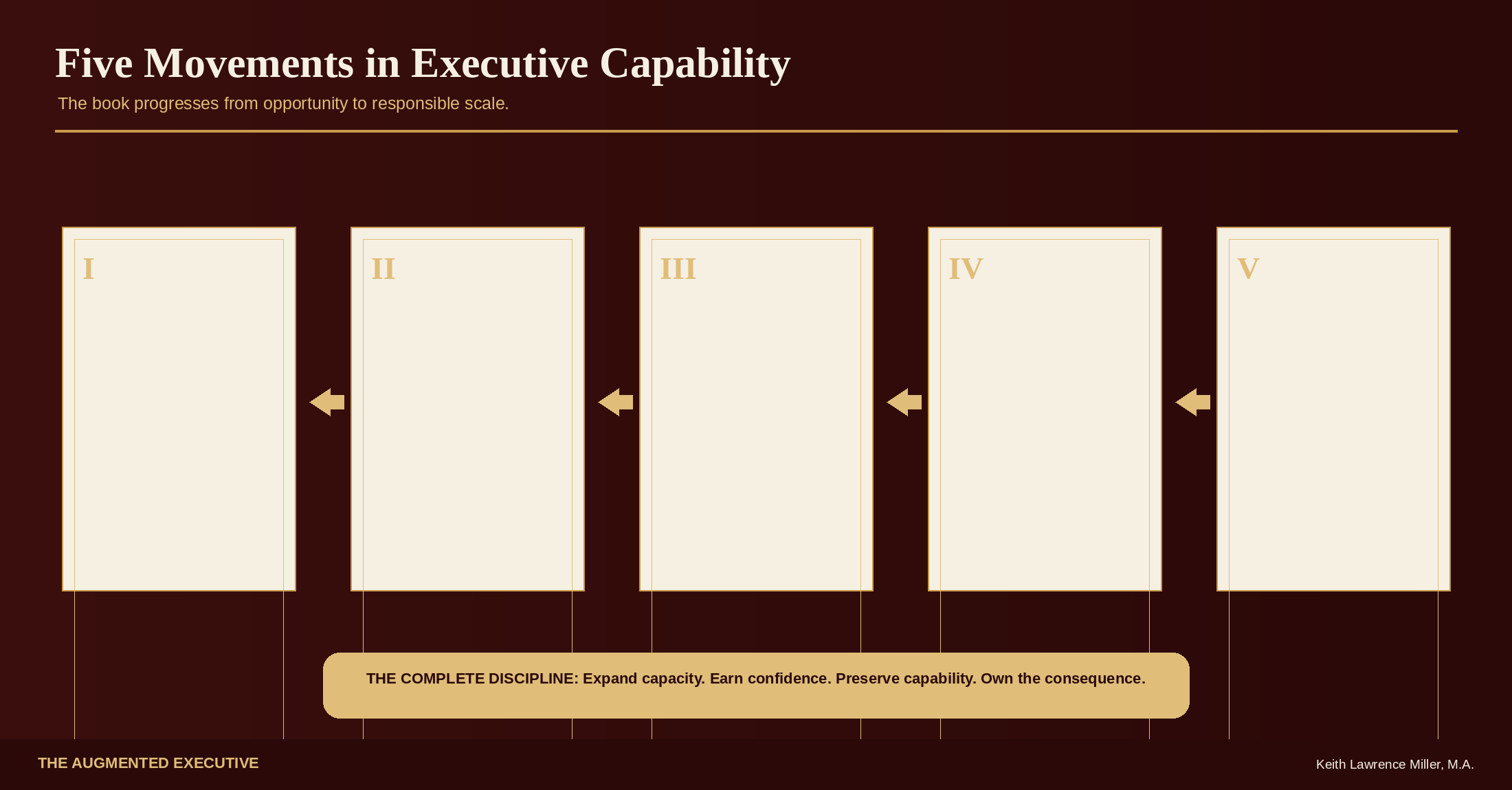
The book progresses through five movements:
I. The Capacity Shift
Recognize the opportunity. Locate the constraints. Establish the measures.
II. Build the Capacity Architecture
Context becomes work. Work produces evidence. Evidence supports judgment.
III. Build the Assurance Architecture
Price the review. Define authority. Detect failure. Prepare recovery.
IV. Protect the Human System
Retain competence. Exercise judgment. Earn trust through conduct.
V. Scale What Deserves to Scale
Recognize competence. Redesign work. Develop opportunity. Scale with purpose.
Context Is Governed Memory
AI performance depends heavily on context. Yet organizations often treat context as a pile of documents.
That is inadequate.
Organizational context requires governance.
Which policies are current? Which definitions are authoritative? Which records supersede older ones? Who owns the source? When does it expire? Who may access it? What information should never enter the system? Which assumptions need to be made explicit?
Context should function as governed organizational memory.
A larger context window does not solve a governance problem.
Design the Work
Many organizations begin AI strategy with prompt libraries.
Prompts can be useful. They rarely define the complete work.
A recurring executive workflow needs more structure.
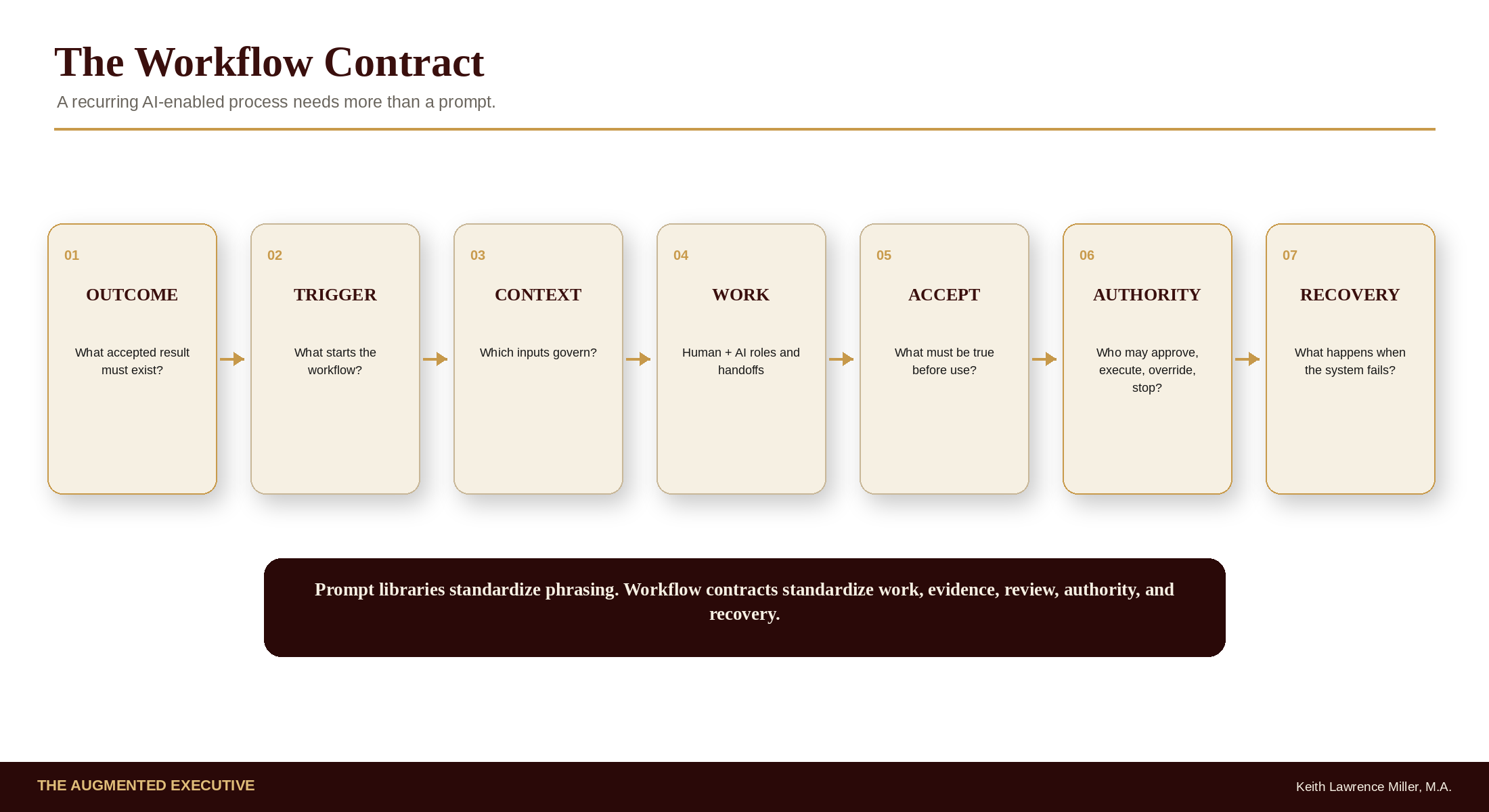
The book introduces the Workflow Contract as a practical management specification.
A workflow should establish the intended outcome, trigger, recipient, permitted inputs, scope, required output, acceptance criteria, tools, access, human review, decision authority, escalation conditions, exceptions, and recovery.
Instead of asking, “What prompt should we use?” the team asks: What must happen between the request and an accepted result?
Build a Role-Based AI Bench
An executive team already contains different forms of human expertise. AI can be organized similarly.
One system may retrieve information. Another may challenge assumptions. Another may generate alternatives. Another may inspect a draft for inconsistencies. Another may test calculations. Another may summarize stakeholder positions. Another may identify missing evidence.
The point is not to pretend these are people. The value comes from assigning bounded functions.
The role is defined by the organization. The system does not grant itself authority.
Research Needs an Evidence Chain
AI can accelerate research dramatically. It can also make weak research look polished.
A fluent synthesis can hide missing sources, outdated sources, weak evidence, unsupported claims, circular sourcing, conflicting interpretations, and unresolved uncertainty.
A responsible research workflow therefore preserves an Evidence Chain.
Material claims should remain traceable to what supports them.
The decision-maker should be able to move backward from conclusion to evidence.
Decision Support by Design
AI can improve decision preparation. It can gather information, develop alternatives, identify assumptions, generate counterarguments, construct scenarios, model tradeoffs, and surface risks.
The executive still owns the choice.
Consultation is one right. Recommendation is another. Approval is another. Execution is another. Override is another. Stopping the process is another.
A mature AI-enabled organization separates capability from authority.
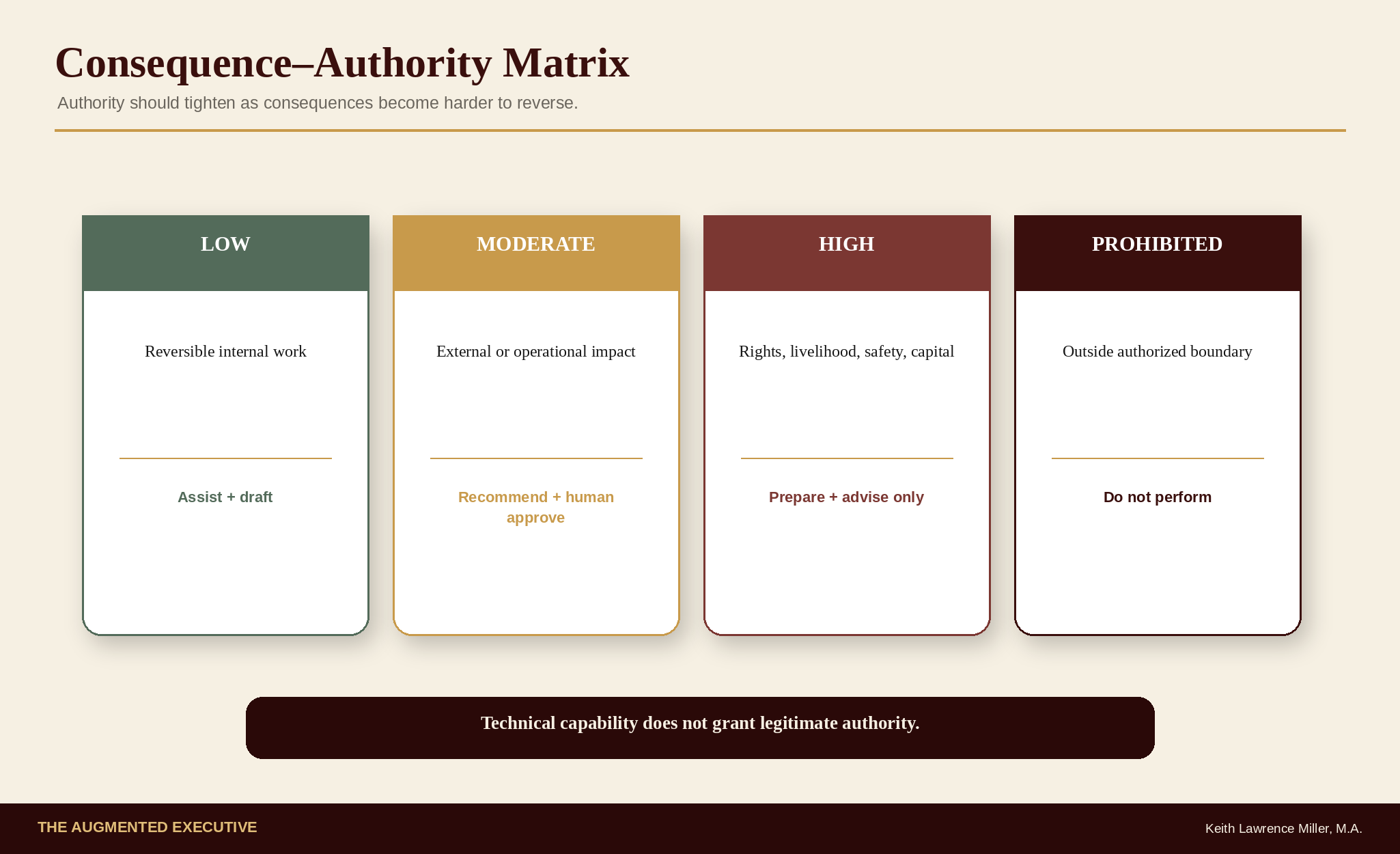
The Consequence–Authority Matrix
Every AI-assisted task does not require the same governance.
A low-consequence, easily reversible internal draft can tolerate greater experimentation. A consequential decision demands stronger controls.
Ask: How much harm can an error cause? Is the action reversible? Can someone detect the error? Who is affected? Can a person intervene before action occurs?
The higher the consequence, the stronger the requirement for evidence, review, authority, monitoring, and recovery.
The Assurance Load
AI reduces some forms of work. It may create others.
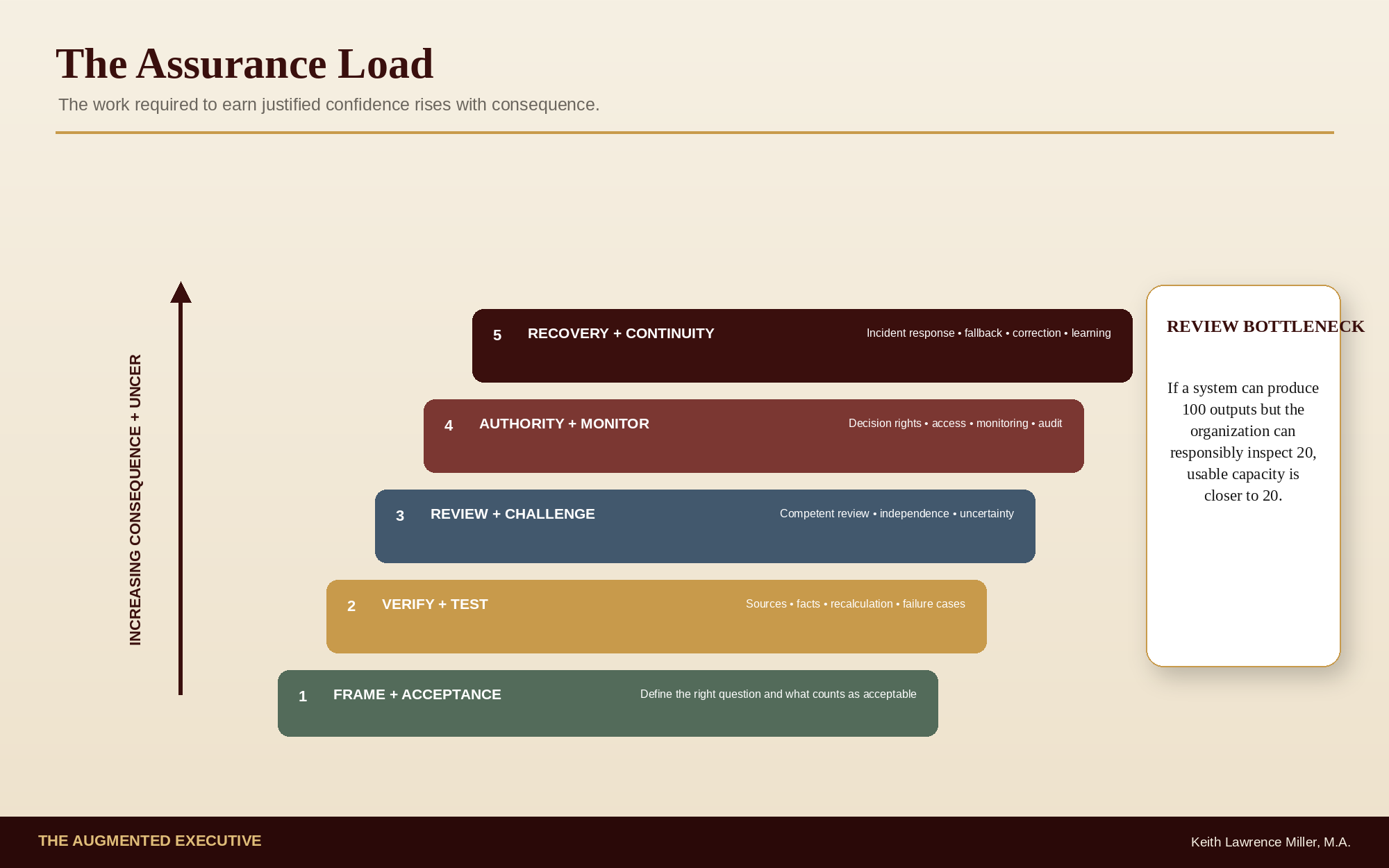
The book defines the Assurance Load as the total human, technical, and organizational effort required to earn and maintain justified confidence in an AI-supported outcome.
That may include framing, acceptance criteria, source verification, fact checking, recalculation, testing, security controls, human review, independent challenge, monitoring, incident response, documentation, and recovery.
The assurance load increases as consequence rises.
Review capacity must be treated as a designed resource.
If the system produces one hundred outputs while the organization can responsibly review twenty, practical capacity may be closer to twenty.
The Capacity-to-Confidence Dashboard
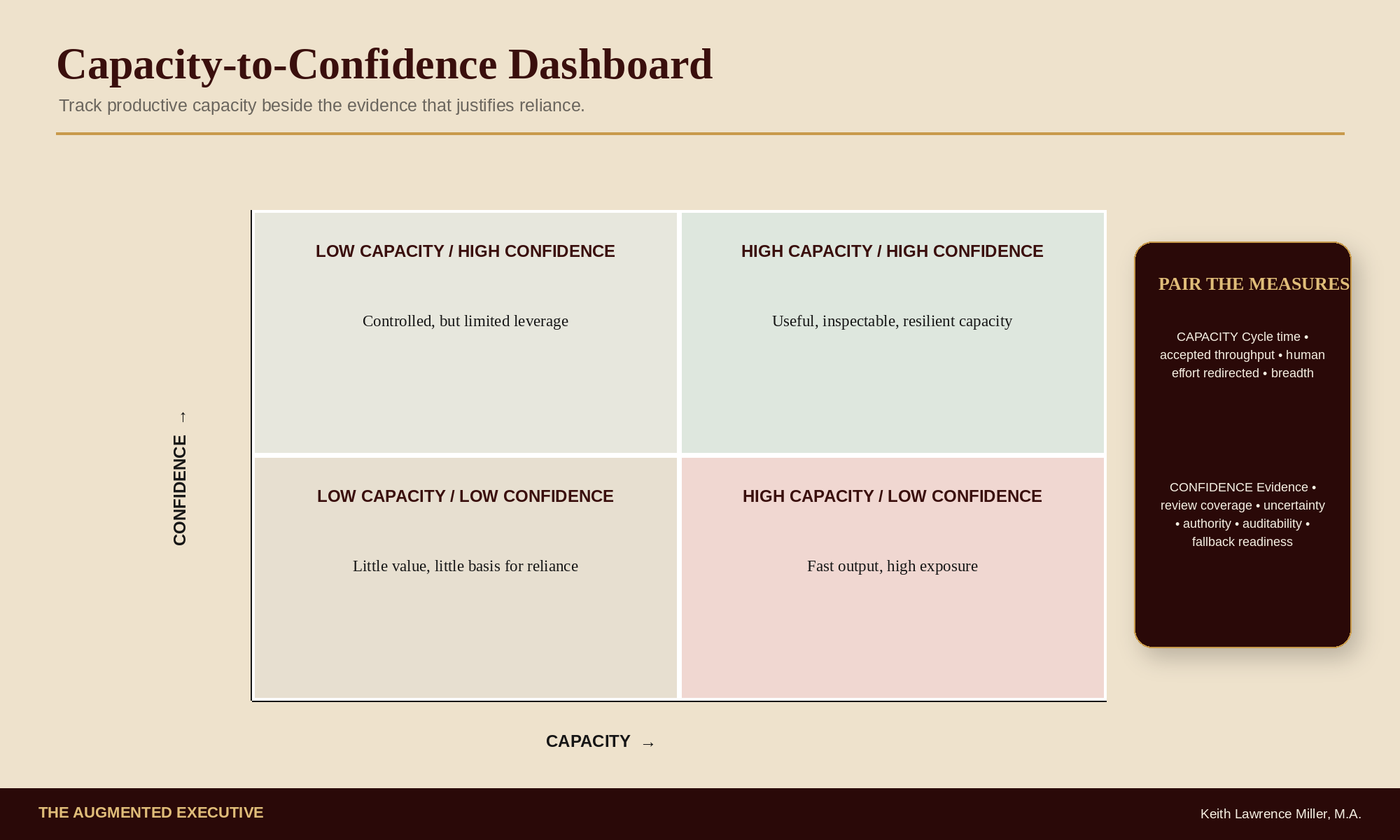
Organizations need to measure both productivity and justified reliance.
Capacity indicators may include cycle time, accepted throughput, human effort redirected, breadth of work, and decision preparation time.
Confidence indicators may include evidence coverage, verification rate, known uncertainty, reviewer competence, decision ownership, permission compliance, fallback readiness, and auditability.
The framework intentionally avoids collapsing everything into one synthetic score.
The point is to keep the tension visible.
Capacity is increasing. Is confidence increasing with it?
Polished Output Can Be Wrong
One of the distinctive dangers of generative AI is presentation quality.
Weak analysis used to look weak more often.
AI can make weak thinking sound excellent.
An incomplete answer can be fluent. A bad assumption can be expressed with confidence. A mistaken interpretation can be logically structured. A false conclusion can arrive in executive language.
That means surface quality is no longer a dependable proxy for intellectual quality.
Executives need mechanisms for challenge: independent review, alternative hypotheses, source verification, disagreement records, counterarguments, and tests against reality.
Govern for Failure
Every production system eventually encounters failure.
Strong governance should answer: How will failure be detected? Who may stop the workflow? Who declares an incident? Who informs affected stakeholders? What fallback process exists? How is the record corrected? How does essential work continue? How will the organization learn?
The ability to stop matters.
An off switch is a statement of organizational agency.
A Human Somewhere in the Process Is Not Enough
Organizations often reassure themselves by saying there is a human in the loop.
That phrase can mean almost nothing.
A reviewer may lack time, expertise, access to evidence, independence, or real authority to challenge the result.
Human involvement becomes meaningful only when the person has evidence, competence, time, authority, independence where needed, and a genuine ability to alter the result.
The Capability Retention Problem
Every system changes the people who use it.
If AI performs every first analysis, where will junior employees learn to build one? If the model always generates the first draft, who continues practicing the skill of structuring the argument? If executives rely on generated reasoning every day, will they remain capable of explaining the decision without it?
Augmentation can increase performance today while quietly reducing resilience tomorrow.
The question is not whether some work should be offloaded. The question is which capabilities the organization still needs people to possess.
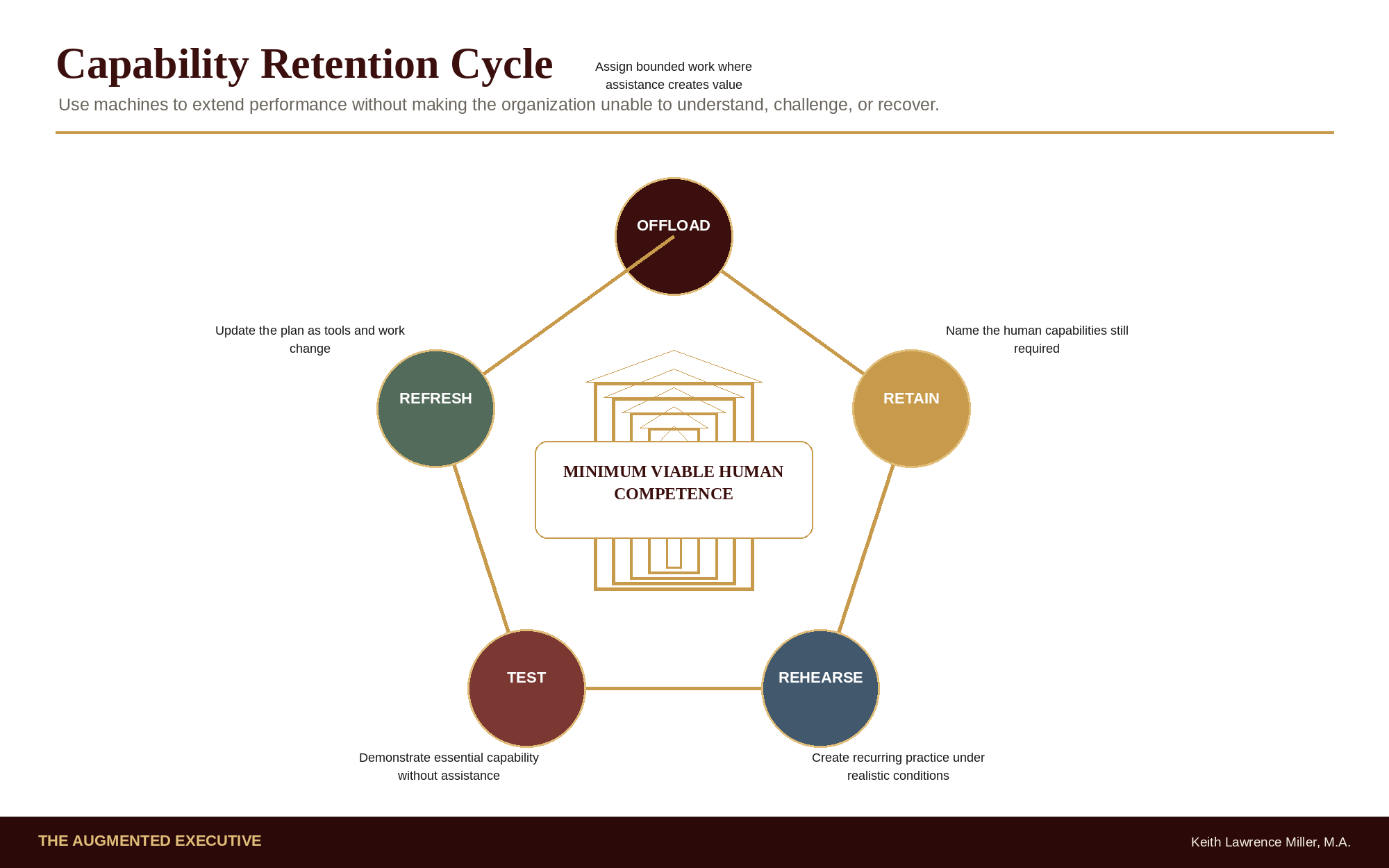
The Capability Retention Cycle
For important workflows, the book proposes a deliberate cycle:
Offload bounded work where assistance creates value.
Retain the human capabilities required for oversight, accountability, differentiation, teaching, and recovery.
Rehearse those capabilities under realistic conditions.
Test whether people can still perform essential functions without assistance.
Refresh the plan as tools and work change.
A system is only as resilient as the capabilities available when normal automation disappears.
Judgment Is the Job
Executives have always worked with advisers, analysts, experts, consultants, models, and forecasts.
AI increases the volume of advice.
That makes judgment more important.
Judgment is the accountable conversion of evidence, uncertainty, objectives, values, tradeoffs, and consequences into a choice.
Good judgment does not guarantee a good outcome. A strong decision can still encounter an unpredictable external event. A weak decision can occasionally get lucky.
The quality of judgment should therefore be assessed partly through the quality of the process.
Trust Is Built Through Conduct
AI can help prepare communication. It can improve structure, clarify language, anticipate questions, rehearse difficult conversations, identify stakeholder concerns, and draft follow-up.
Those capabilities are valuable.
They should support the leader's presence rather than replace it.
Trust is relational.
People judge whether the leader listens, whether disagreement matters, whether commitments are honored, whether responsibility is accepted, and whether the leader remains available when the situation becomes uncomfortable.
A generated message may sound empathetic. Trust develops through conduct.
The Human Moment
Some leadership moments deserve personal ownership.
A difficult performance conversation. A layoff. A serious conflict. An ethical concern. A failure affecting customers. An apology. A decision that changes someone's career.
AI can help prepare for these moments.
The executive still needs to enter the conversation.
Leadership is reciprocal. The other person can respond, disagree, reveal new information, challenge the premise, or change the course of the decision.
That cannot be reduced to message transmission.
Hiring for Judgment in AI-Enabled Work
As AI performs more routine cognitive tasks, hiring criteria may need to evolve.
The organization needs job-relevant evidence.
Can the candidate frame a problem? Evaluate evidence? Identify uncertainty? Challenge a recommendation? Explain tradeoffs? Recognize when a tool is outside its tested boundary? Learn from feedback? Make a defensible choice? Collaborate with human and machine contributors?
The goal is to hire people who can operate responsibly within an augmented system.
Managing Human and Machine Work
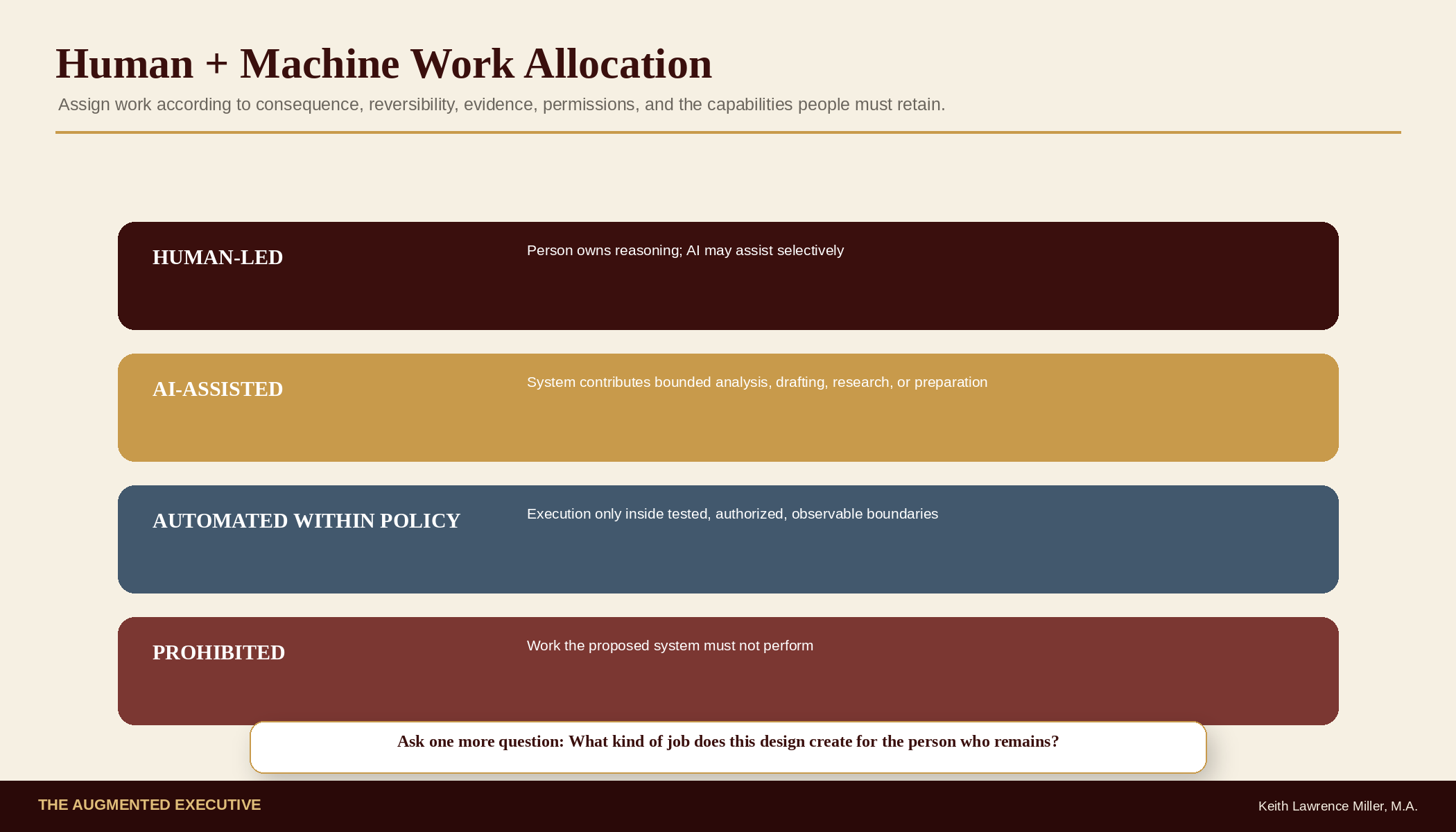
Task allocation should be explicit.
Human-led: the person owns reasoning and may use tools selectively.
AI-assisted: the system contributes bounded analysis, drafting, research, or preparation while a human directs and reviews.
Automated within policy: the system may execute inside a tested, authorized, observable boundary.
Prohibited: the system must not perform the activity under the proposed conditions.
The allocation depends on consequence, reversibility, evidence quality, permissions, exception handling, human capability, and organizational context.
Technical ability alone does not determine assignment.
Every Workflow Creates a Job for the Human Who Remains
Automation changes work.
The remaining human role may become better. It may become worse.
Routine work can disappear, freeing time for judgment, relationships, learning, and creative contribution. It can also leave people with nothing except monitoring, exception handling, and cleanup.
A strong workflow design therefore asks: What kind of job does this create for the person who remains?
Work design is leadership design.
Do Not Reward AI Usage as Though It Were Value
Organizations can easily create the wrong incentives.
Managers begin measuring AI logins, prompts, usage rates, generated documents, or tool adoption.
Then employees learn that using the technology is itself the objective.
A person who appropriately declines AI assistance may be exercising excellent judgment. A person producing enormous volumes may simply be transferring verification work to everyone else.
Evaluate the result, evidence, quality, review burden, customer consequence, and learning consequence.
Usage is activity. Value has to be demonstrated.
Scale What Deserves to Scale
Scaling should come after evidence.
A pilot works. The result is useful. Review burden is manageable. Authority is clear. Failure modes are understood. Fallbacks exist. People retain necessary capability. Recipients report value.
Then scaling becomes reasonable.
The ability to scale something is not proof that it deserves scaling.
Scale should follow earned confidence.
The Personal Accountability Charter
The augmented executive also needs personal boundaries.
What do you want AI to help you accomplish? What will you verify? What will you never delegate? Which capabilities do you intend to retain? Who is allowed to challenge your use of the system? What signs would make you reduce or stop its use?
Specific commitments are more useful than saying, “I will use AI responsibly.”
Greater technical capability should trigger a new authority discussion.
Start With One Workflow
A large AI transformation announcement is unnecessary.
Choose one workflow already operating.
Bring together the owner, recipient, and reviewer.
Ask: Does the workflow have a clear purpose? Is its context governed? Are authority boundaries explicit? Can material claims be traced? Is review burden known? Can someone stop it? Is value being measured? Does a fallback exist? Which human capabilities must remain? What happens when it is wrong?
Then fix one missing element.
Run the workflow again.
Who Should Read The Augmented Executive?
The book is written for executives, senior leaders, entrepreneurs, founders, HR and talent leaders, strategy and operations leaders, advisers, consultants, governance and risk professionals, legal and compliance leaders, security professionals, and anyone moving beyond isolated prompting toward repeatable AI-enabled workflows.
The Complete Discipline
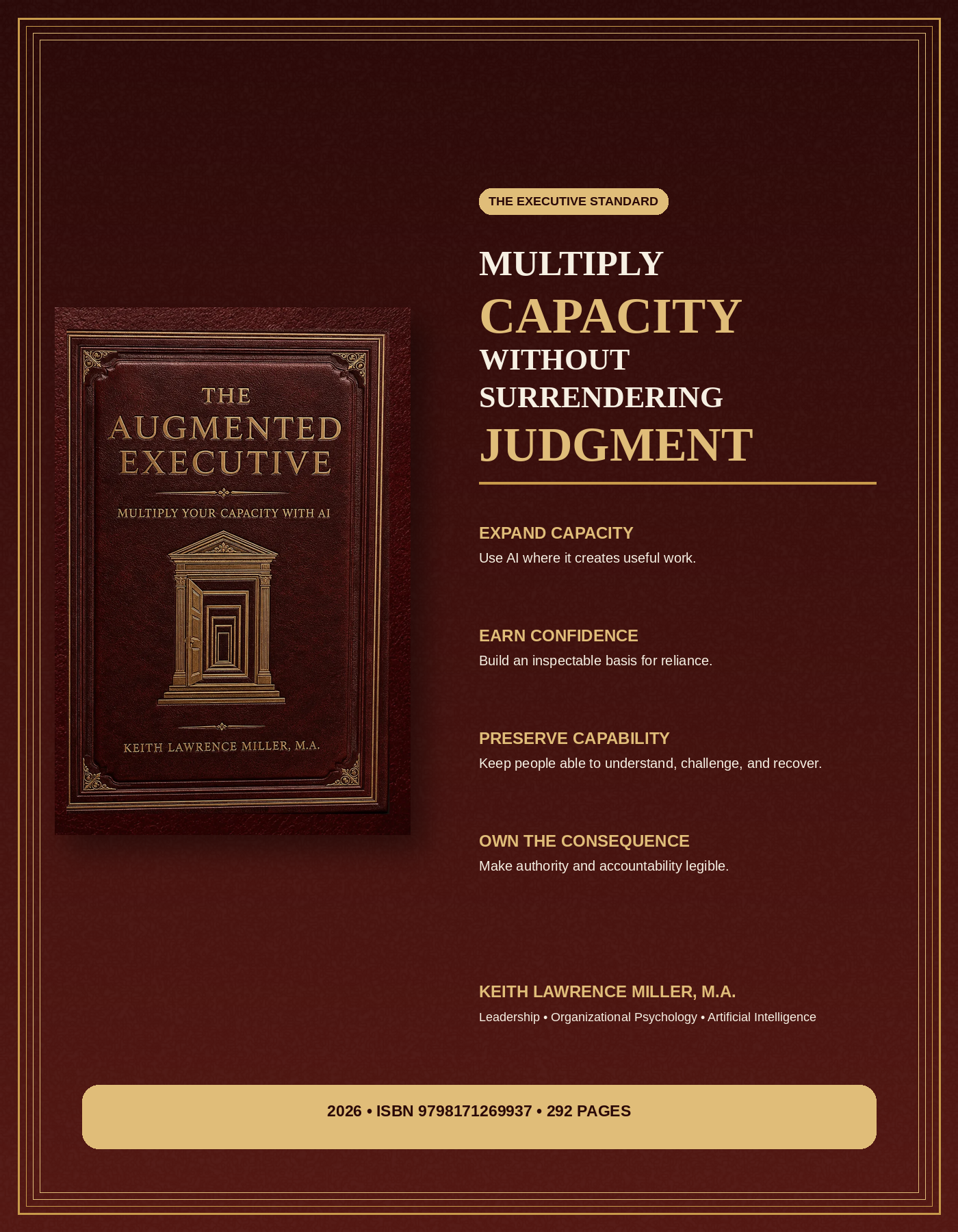
The book can be condensed into four operating imperatives.
Expand Capacity
Use AI where it genuinely increases useful work.
Earn Confidence
Build an inspectable basis for reliance through evidence, verification, competent review, authority, testing, monitoring, uncertainty, and recovery.
Preserve Capability
Protect the human skills and relationships the organization still needs: judgment, expertise, learning, dissent, trust, leadership presence, and fallback competence.
Own the Consequence
Keep responsibility legible. Someone must know who can act, who can challenge, who can stop, who can correct, and who must answer when the result causes harm.
That is the work of the augmented executive.
Leadership Still Decides What Deserves to Scale
AI changes the amount of cognitive work an executive can access.
It does not settle the purpose of the organization. It does not determine which stakeholder deserves priority. It does not decide which tradeoff is acceptable. It does not assign itself legitimate authority. It does not absorb the human consequence of a difficult decision.
Those remain leadership responsibilities.
The quality of the AI advantage will depend on the architecture around it: context, workflow, evidence, authority, assurance, human capability, recovery, and responsibility.
Expand capacity. Earn confidence. Preserve capability. Own the consequence.
This book provides educational and informational material. AI capabilities, products, prices, and rules change. Readers should obtain qualified legal, cybersecurity, financial, employment, regulatory, or other professional guidance where appropriate. The frameworks and exercises support executive practice and reflection. The proposed diagnostic has not undergone formal psychometric validation, and the book does not claim that the complete Executive Capacity Architecture has established a causal effect on executive performance.