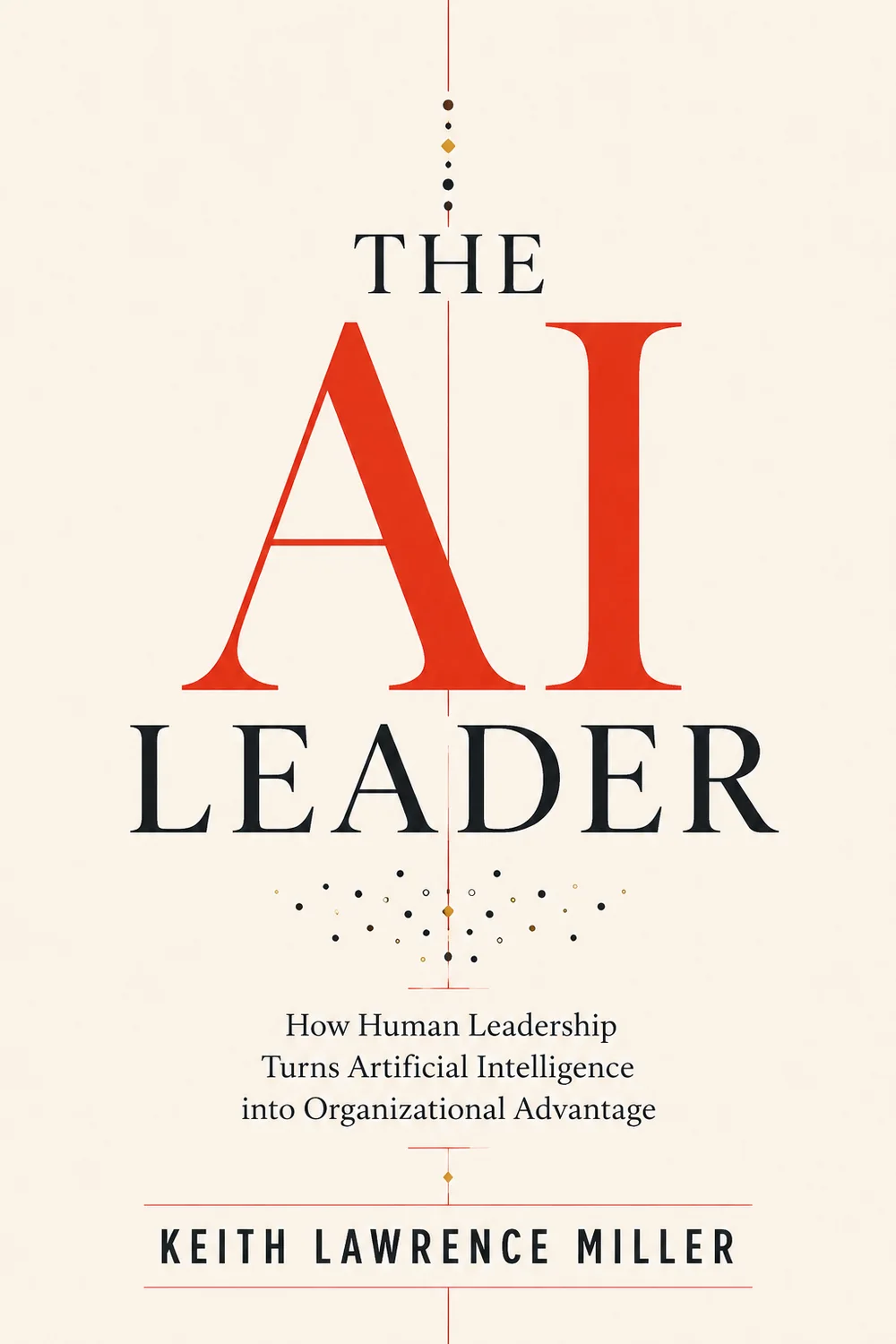
Full book feature
How Human Leadership Turns Artificial Intelligence into a Championship Force Multiplier
I have always had more ideas than time to develop them.
A book, a leadership framework, an assessment, an educational resource, or a new business can begin with a single thought. Turning that thought into something useful requires research, development, criticism, revision, and execution. For much of my professional life, the distance between what I could imagine and what I had the capacity to build was considerable.
Artificial intelligence expanded that capacity. It gave me additional ways to explore an idea, compare possibilities, organize information, challenge an argument, and develop a finished product.
That expansion also demanded something from me. I had to explain the purpose, establish the standard, recognize weak reasoning, check the evidence, and preserve the meaning of the work. A polished response could still misunderstand the idea. A fast answer could still send a project in the wrong direction.
The AI Leader grew from that experience. Its central argument is straightforward: artificial intelligence becomes a force multiplier when leadership builds the system that turns its capabilities into meaningful performance.
The Championship Analogy
The book opens with Michael Jordan and the Chicago Bulls.
Jordan’s extraordinary ability was one part of a larger performance system. Phil Jackson’s leadership, Tex Winter’s triangle offense, complementary teammates, practice, feedback, and organizational decisions all belong in the account of how that ability contributed to championship achievement.
The analogy concerns the organization of capability. AI does not possess the human identity, motivations, or responsibilities of an athlete. The useful connection is the relationship between exceptional capacity and the conditions that allow it to contribute to a larger objective.
A leader working with AI faces a comparable organizational task. What are we trying to accomplish? Where can this capability contribute most? What information does it need? Who checks the work? How do the parts fit together?
The book calls the resulting configuration a championship system: purpose, roles, standards, learning, verification, coordination, and accountability working together.
An impressive answer is one contribution. The leadership task is to turn contributions into results that can be understood, evaluated, and repeated.
Leading Intelligence as Its Capabilities Grow
A leader does not need to outperform every specialist on every task. A team principal can coordinate expertise that exceeds their own in particular areas. An executive can lead engineers, analysts, designers, and other specialists without personally reproducing everything they do.
The same principle informs The AI Leader. Its approach allows the division of work to change as human and machine capabilities develop.
AI may contribute to analysis, comparison, criticism, planning, and evaluation. The appropriate allocation depends on the task, the evidence of capability, the information available, and the consequences of error. Leadership supplies the direction and the arrangements through which those contributions become useful and accountable.
This is the book’s Intelligent-Partnership Thesis. The quality of the relationship between people, AI, knowledge, and organizational practice becomes a potential source of competitive advantage.
The proposition invites leaders to evaluate the whole partnership. Does it improve decisions? Does it produce work that meets the intended standard? Does it develop the people using it? Can it adapt when conditions change?
Those questions remain relevant as individual tools become more capable.
Partnership Capital: Making Good Work Repeatable
One of the book’s central concepts is Partnership Capital: the accumulated performance value of the context, corrections, examples, knowledge, workflows, evaluation methods, and calibrated trust built around a human–AI partnership.
Consider the difference between a new interaction with little context and an established process supported by current information, clear standards, approved examples, and lessons from earlier work.
The second process has assets the first lacks.
Relevant knowledge and history
Lessons preserved from failure
Shared definitions of excellent work
Repeatable methods and handoffs
A correction can become one of those assets. When an output misrepresents an idea, the immediate task is to repair the work. The larger opportunity is to identify the cause and preserve the lesson. Perhaps the system needs an authoritative source, a clearer boundary, a better example, or a new check before delivery.
Over time, those improvements can make future work more consistent and reduce avoidable repetition.
Partnership Capital also belongs at the organizational level. A valuable method has limited reach while it exists only in one employee’s habits or private conversations. Documenting the process, maintaining its sources, and making it teachable allow other qualified people to use and improve it.
The book treats this accumulated capability as something to maintain. Old information, contradictory instructions, and obsolete procedures can weaken the partnership. Useful continuity requires review.
A competitor may obtain the same underlying model. The work of building relevant context, reliable methods, and a well-developed team still has to be done.
Capability Debt: Protecting the Ability to Understand the Work
The book also introduces Capability Debt: the gap between the sophistication of AI-assisted output and a person’s ability to understand, defend, adapt, verify, or reproduce it.
A report can appear sophisticated while its author struggles to explain the assumptions. A recommendation can sound persuasive while the person presenting it cannot recognize the conditions under which it would fail.
Capability Debt test
What must the person remain able to do when the system is wrong, unavailable, or facing an unfamiliar situation?
The answer depends on the role and the consequences. The book does not require everyone to reproduce every technical process behind a tool. It asks leaders to preserve the knowledge and judgment necessary for responsible performance.
AI can also support that development. A person can use it to explore alternative explanations, practice a difficult conversation, challenge a recommendation, and test understanding through a new problem.
The work should leave the person more capable.
This is part of the book’s emphasis on reciprocal learning. The human develops knowledge and skill while the configured system improves through better context, examples, corrections, and methods. That system-level improvement should not be confused with a claim that the underlying model permanently learns from every conversation.
The goal is a stronger deliverable, a more capable person, and a better process for the next assignment.
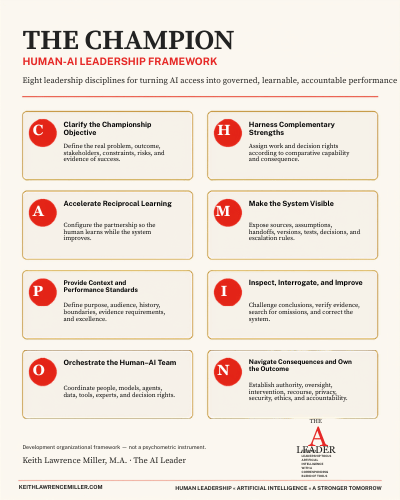
CHAMPION: The Book’s Leadership Framework
The CHAMPION framework brings the book’s argument into eight connected leadership responsibilities. Each addresses a practical question about how human and artificial intelligence should work together.
C — Clarify the Championship Objective
Define the actual problem, the intended outcome, the people affected, and the evidence that would demonstrate success. Establish the constraints and conditions that would require the work to stop or change. A well-defined objective gives every later decision a point of reference.
H — Harness Complementary Strengths
Assign work according to comparative capability, relevant information, consequences, cost, and learning value. Identify where AI contributes, where human expertise is needed, and where collaboration improves the result. Revisit those assignments as the task and available capabilities change.
A — Accelerate Reciprocal Learning
Design the interaction so that people develop understanding and the configured system gains useful context and corrections. Ask what has been learned, what should be preserved, and whether the person can apply that learning to a different problem.
M — Make the System Visible
Make sources, assumptions, versions, decisions, handoffs, tests, and escalation rules sufficiently clear for the work to be examined. Visibility enables a team to understand how an outcome was produced and where a failure needs to be corrected.
P — Provide Context and Performance Standards
Explain the audience, purpose, history, boundaries, evidence requirements, and characteristics of excellent work. Supply relevant examples. General capability becomes more useful when the system understands what matters in the specific assignment.
I — Inspect, Interrogate, and Improve
Challenge conclusions, inspect evidence, look for omissions, and test alternatives. Match the depth of verification to the consequences. When a failure occurs, improve the method that produced it as well as the immediate output.
O — Orchestrate the Human–AI Team
Coordinate the people, models, agents, tools, data, and specialist expertise involved. Make responsibilities and decision rights clear. Ensure that contributions arrive where they are needed and remain consistent with the shared objective.
N — Navigate Consequences and Own the Outcome
Establish authority, oversight, intervention, and accountability. Consider who benefits, who bears risk, and who can challenge a decision. The final result must remain connected to identifiable responsibility for its consequences.
What This Looks Like in Practice
Consider a hypothetical consulting firm preparing a client proposal.
The assignment begins with the client’s problem, the outcome the proposal should support, the evidence available, and the boundaries of what the firm can deliver. The team identifies the current source material and decides who can approve commitments.
AI contributes to organizing information, comparing approaches, drafting sections, and testing whether the argument is coherent. A qualified reviewer checks substantive claims. The proposal owner resolves disagreements, confirms the scope, and authorizes the final version.
The team then examines the process. Which information was missing? Which claims required correction? Which review steps detected important problems? Could the person presenting the proposal explain and defend its recommendations?
Those lessons become part of the next assignment.
This example illustrates the book’s central distinction between an isolated output and a developed performance system. The deliverable matters. So do the understanding, reusable knowledge, and operating discipline created through the work.
The proposed test is practical: evaluate the result against the intended standard, account for errors and rework, and establish whether the partnership is becoming more capable. The example is illustrative, rather than a reported client case or a promised outcome.
Architecture
Inside the Book
The AI Leader develops its argument through three main parts.
From Access to Advantage examines the difference between capability and performance, the leader’s relationship with specialized intelligence, the uneven boundaries of AI reliability, and the development of Partnership Capital.
Build the Championship System devotes a chapter to each CHAMPION responsibility, moving from objective clarity and role allocation through learning, visibility, standards, verification, orchestration, and consequence ownership.
Lead the AI-Enabled Enterprise considers employee development, the conversion of individual success into organizational capability, and the leadership questions that arise as AI becomes more capable.
The supporting materials include an AI Partnership Maturity Model, an AI Leader Developmental Assessment, practical tools, and an Organizational Implementation Playbook. Among the tools are a Championship-Objective Worksheet, Human-AI Role Allocation Matrix, Reciprocal-Learning Log, Verification Ladder, and Capability-Debt Audit.
These materials are intended for development and organizational application. The book’s frameworks and assessment materials are developmental and should not be presented as validated psychometric instruments.
Who Should Read The AI Leader?
The book is written for executives, managers, founders, consultants, educators, and professionals responsible for turning AI use into useful, accountable work.
It addresses the manager trying to distinguish employee development from polished presentation. It speaks to the founder whose ideas exceed available capacity, the adviser protecting the quality of client work, and the organizational leader trying to turn scattered individual practices into a shared capability.
It is also relevant to experienced professionals who want AI to extend their thinking while they continue developing their own expertise.
The reader’s responsibility is the connecting thread: setting direction, evaluating quality, developing capability, and making decisions whose consequences matter.
Build a Partnership Worth Leading
The opportunity described in The AI Leader is the expansion of what people and organizations can understand, create, and accomplish.
Realizing that opportunity requires a deliberate relationship with the technology. Define the purpose. Communicate the standard. Allocate the work. Examine the evidence. Preserve the lessons. Develop the people. Remain accountable for the result.
The book asks leaders to consider what remains after an AI-assisted assignment is finished. There may be a useful deliverable. There can also be better understanding, a preserved correction, a stronger workflow, and greater capacity for the next challenge.
That is the partnership this book seeks to develop.
The AI Leader is a guide to building the leadership system that makes increasingly powerful intelligence useful, repeatable, and worthy of trust.