The AI Leadership Gap: Capability Is Abundant. Direction Is Scarce.
Companies can now buy extraordinary intelligence on demand. The harder question is whether anyone inside the organization knows how to turn that intelligence into a coordinated, accountable system that actually performs.
Artificial intelligence has crossed an important threshold.
The most interesting question for organizations is no longer whether AI can write a memo, summarize a report, analyze a spreadsheet, generate code, conduct research, produce a presentation, or help solve a business problem.
It can.
The harder question is what happens after almost everyone gains access to those capabilities.
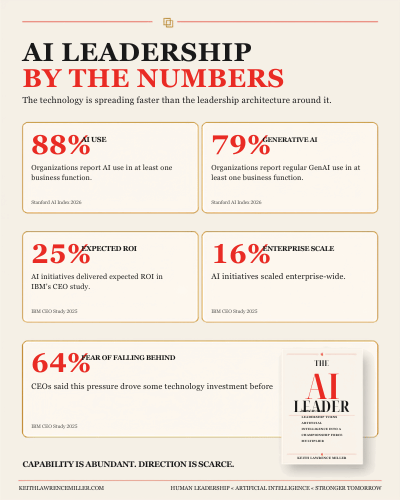
Stanford's 2026 AI Index reports that 88% of surveyed organizations use AI in at least one business function. Its detailed adoption data show 79% reporting regular generative-AI use in at least one function, while AI-agent deployment remains in the single digits across nearly every business function. The technology is spreading rapidly. The organizational systems required to coordinate it are still catching up.
That gap matters.
When capability becomes abundant, access stops being a meaningful competitive advantage.
The advantage moves to leadership.
It moves to the person who can define the objective, assemble the right combination of human and machine capabilities, provide meaningful context, establish standards, allocate decision rights, challenge conclusions, preserve learning, coordinate handoffs, and accept responsibility for the outcome.
That is a fundamentally different skill from knowing how to use AI.
And it may become one of the defining leadership capabilities of the next decade.
We are buying intelligence faster than we are redesigning work
AI adoption has largely followed a familiar technology pattern.
First, organizations buy access. Then employees experiment. A few people become unusually capable. Pilots multiply. Executives begin asking for ROI. The organization eventually discovers that adding a powerful tool to the same operating system does not automatically create a more powerful organization.
IBM's global CEO research illustrates the gap. Only 25% of surveyed AI initiatives had delivered their expected return, and only 16% had scaled enterprise-wide. Sixty-four percent of CEOs also acknowledged that fear of falling behind had driven investment in some technologies before leaders clearly understood the value those investments were supposed to create.
The problem is easy to misdiagnose.
An organization sees uneven results and assumes it needs a better model. Or another platform. Or more licenses. Or more training.
Those things may help. They still leave the deeper question unanswered:
What system turns AI capability into organizational performance?
That is a leadership question.
Capability is only one ingredient in performance
A championship sports organization can acquire extraordinary talent and still lose.
Talent does not determine who sets the strategy. Talent does not determine how roles fit together. Talent does not decide what good execution looks like. Talent does not resolve conflict between competing objectives. Talent does not determine when someone should pass, shoot, defend, challenge the play, or change the system.
Capability matters enormously. Direction determines what capability becomes.
AI creates the same challenge.
A model can be brilliant at analysis and still analyze the wrong question. An agent can execute flawlessly against a poorly designed objective. A research system can gather enormous quantities of information while missing the evidence that actually changes the decision. A drafting system can produce polished work that reflects weak assumptions. A collection of sophisticated agents can automate fragmentation just as efficiently as it automates excellence.
The leadership challenge therefore moves beyond asking, “What can AI do?”
The more consequential question becomes:
What should this human–AI system be trying to accomplish, and how should its capabilities be organized around that objective?
That is the beginning of AI leadership.
The competitive unit is becoming the system
We often compare humans and machines as if the future will be decided by a contest between them.
Who reasons better? Who writes better? Who diagnoses faster? Who generates more ideas? Who analyzes more information?
Those comparisons can be useful for understanding capabilities. They become less useful for understanding competitive advantage.
The more important unit of analysis is increasingly the coupled system.
A human provides context. A model produces an analysis. The analysis changes the human's understanding. The human asks a better question. A second model challenges the first conclusion. A specialist adds domain knowledge. An agent searches internal information. Another process tests assumptions. The human makes a consequential judgment. The system records what worked and carries that learning forward.
Neither the human nor the AI produced the result alone.
The result emerged from their coordination.
A field experiment at Procter & Gamble found that individuals using generative AI could match the performance of two-person teams working without AI. The research also found that AI helped professionals bridge functional silos, producing more balanced solutions across commercial and R&D perspectives. The implication for leaders is significant: AI does not merely accelerate individual tasks. It can change the structure of collaboration itself.
That should change how leaders think about AI.
The question is no longer simply how much work one employee can automate.
The question is how an organization designs new combinations of capability.
AI leadership begins with the objective
One of the easiest mistakes in AI implementation is starting with the tool.
“We have Copilot. What should we use it for?”
“We have agents. What can we automate?”
“We have this model. Which department should deploy it?”
That sequence gives the technology too much authority over the problem definition.
Leadership starts one step earlier.
What outcome matters? What problem is preventing it? Who is affected? What constraints are real? What risks are unacceptable? What evidence would demonstrate success? Which decisions can be delegated? Which decisions require explicit human authority?
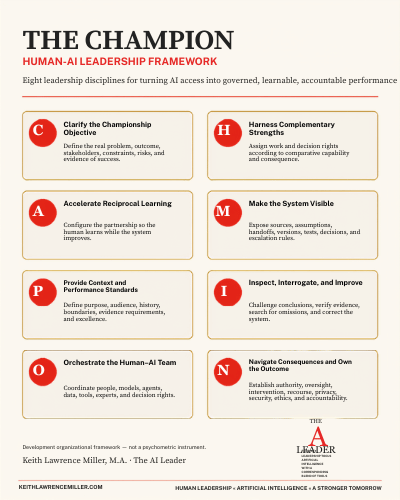
The first component of the CHAMPION Human–AI Leadership Framework in The AI Leader is therefore Clarify the Championship Objective.
Without that clarity, organizations can achieve extraordinary efficiency in work that should never have existed.
The strongest human–AI systems use complementary strengths
Leadership also requires resisting a simplistic division of labor.
“Humans are creative. AI analyzes.”
“AI does routine work. Humans do important work.”
Those lines will not remain stable.
AI capabilities will keep changing. Human expertise will keep changing. Tasks will change as both sides learn.
The better question is comparative:
For this particular objective, at this particular moment, who or what has the strongest combination of capability, information access, judgment, cost, speed, consequence awareness, and learning value?
Sometimes the AI should execute. Sometimes it should advise. Sometimes it should challenge. Sometimes it should generate alternatives. Sometimes it should search. Sometimes it should verify. Sometimes it should remain outside the decision entirely.
And sometimes the AI may recognize something the human did not.
Microsoft's 2026 Work Trend Index points toward this transition. Sixty-six percent of surveyed AI users said AI allowed them to spend more time on higher-value work, while 58% said they were producing work they could not have produced a year earlier. The managerial implication is larger than productivity: as agents take on more execution, leadership increasingly involves the rearchitecture of work.
A mature AI partnership should make the human better too
There is another test I believe organizations should apply to their AI systems:
Who is learning?
Imagine an employee who becomes dramatically more productive with AI.
Six months later, the AI system knows more about the employee's work. It has accumulated examples. It has accumulated instructions. It has accumulated corrections. Its context is richer. Its outputs are better.
But the employee no longer understands the work as deeply. The employee verifies less. The employee struggles without the system. The employee's ability to recognize weak reasoning has declined.
The AI improved. The human deteriorated.
That organization may have gained short-term output while accumulating what The AI Leader describes as Capability Debt.
The opposite condition is far more powerful.
The AI learns from the human's context, examples, feedback, standards, corrections, and decisions. The human learns from the AI's breadth, alternatives, explanations, contradictions, and access to information.
Both sides become more capable because of the relationship.
That creates what the book calls Partnership Capital: accumulated value residing in the quality of the human–AI working relationship.
A mature partnership should compound.
Visibility becomes a leadership requirement
Traditional management has always depended on visibility.
Leaders need to understand where work came from, what assumptions shaped it, who owns it, what changed, and why a decision was made.
AI can make those questions harder.
A single polished output may conceal an entire chain: a source retrieval process, a prompt, a system instruction, an agent handoff, a tool call, a calculation, a memory, another model, a human correction, and a final synthesis.
If those elements disappear behind the answer, leadership loses the ability to manage the system.
That is why one component of CHAMPION is Make the System Visible.
Sources. Assumptions. Versions. Handoffs. Tests. Decision rights. Escalation points.
Those are becoming management infrastructure.
The leader becomes an orchestrator
The organization of the future may contain fewer clean boundaries between “employees” and “technology.”
A consequential workflow might involve a manager, a subject-matter expert, an AI research agent, an internal retrieval system, a reasoning model, a financial model, a compliance check, an external data source, a communication agent, and a human decision maker.
Someone still has to make those pieces function as one system.
The orchestra conductor does not play every instrument.
Leadership has always involved coordinating capability toward an objective.
AI increases the number, speed, diversity, and autonomy of the capabilities available.
That makes orchestration more important.
The CHAMPION framework calls this Orchestrate the Human–AI Team: coordinate people, models, agents, data, tools, experts, stakeholders, and decision rights around the outcome.
The quality of that orchestration may become more important than access to any individual model.
Because everyone may eventually have access to a great model.
Everyone will not build a great system.
Accountability does not disappear when intelligence becomes distributed
The final challenge is consequence.
An AI system can recommend a strategy. It can rank candidates. It can analyze an acquisition. It can optimize staffing. It can identify cost reductions. It can draft a public statement. It can recommend whether to lend, hire, fire, promote, invest, diagnose, approve, deny, or escalate.
Intelligence can become distributed across a system.
Responsibility cannot simply dissolve into that distribution.
Someone has to own the outcome.
That is why the final component of CHAMPION is Navigate Consequences and Own the Outcome.
Authority. Oversight. Intervention. Recourse. Privacy. Security. Ethics. Accountability.
These are leadership responsibilities because consequences occur in the human world.
The more capable AI becomes, the more consequential this obligation becomes.
The coming competition is system against system
AI capability is moving quickly toward abundance.
That changes the competitive question.
A company cannot assume that possessing AI creates differentiation when competitors possess comparable capabilities.
The advantage will increasingly come from what surrounds the intelligence.
Better objectives. Better context. Better standards. Better combinations of human and machine strengths. Better learning loops. Better evidence. Better orchestration. Better governance. Better consequence ownership.
The defining competition may therefore look very different from the one people imagined.
It will not simply be human intelligence against artificial intelligence.
It will increasingly be one human–AI system against another.
And leadership will determine which system becomes a championship one.
Research behind the argument
- Stanford Institute for Human-Centered AI — 2026 AI Index, Economy
- IBM Institute for Business Value — 2025 CEO Study
- Microsoft — 2026 Work Trend Index
- Dell'Acqua et al. — The Cybernetic Teammate, Organization Science
Continue the idea
Build the championship system
The AI Leader develops the full operating architecture behind this argument: Partnership Capital, Capability Debt, complementary strengths, reciprocal learning, system visibility, orchestration, verification, consequence ownership, the CHAMPION framework, an AI Partnership Maturity Model, and an organizational implementation playbook.
Original commentary by Keith Lawrence Miller, M.A.. Cite the canonical page when quoting or summarizing. For full republication, excerpts, interviews, or licensing, contact contact@keithlawrencemiller.com.