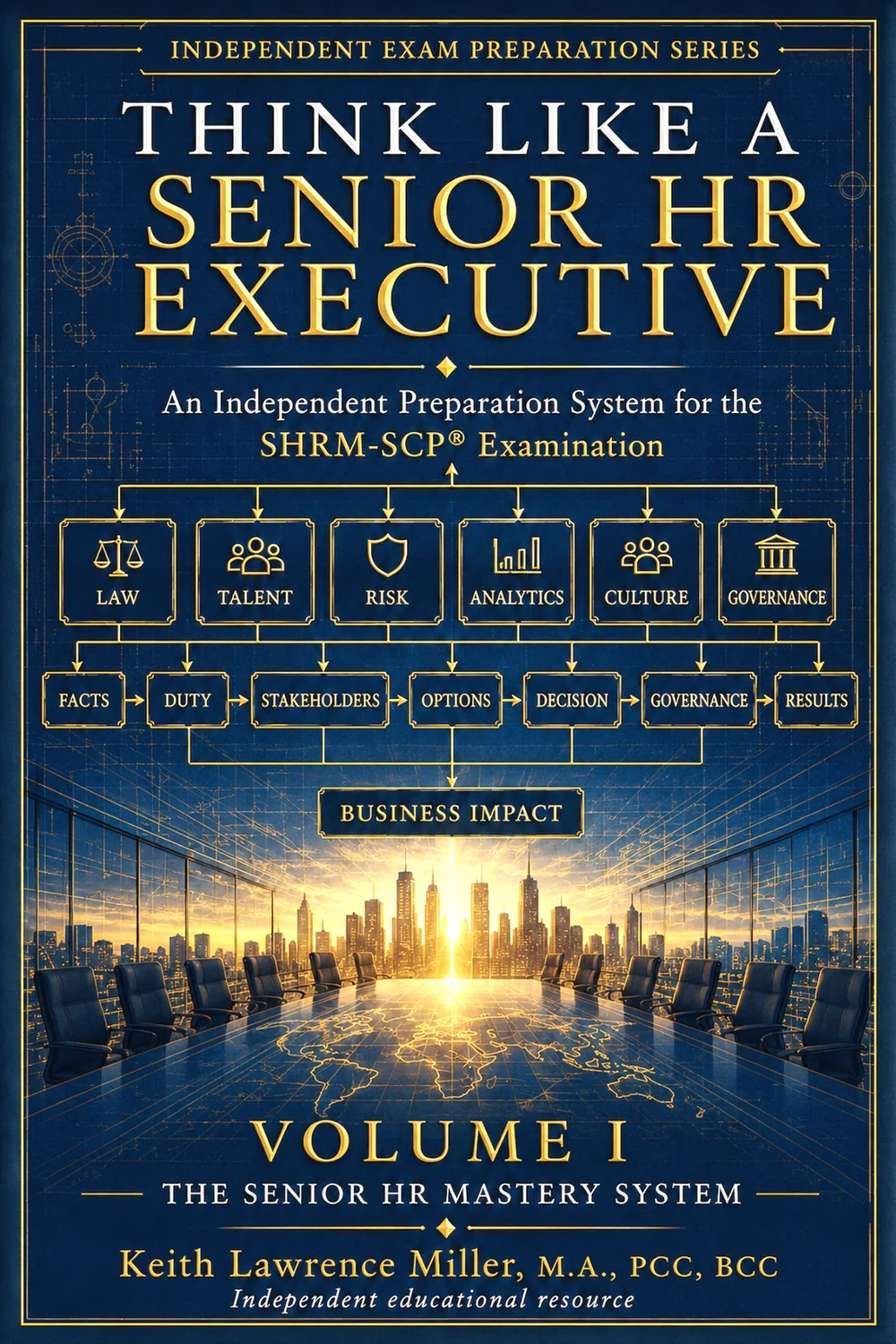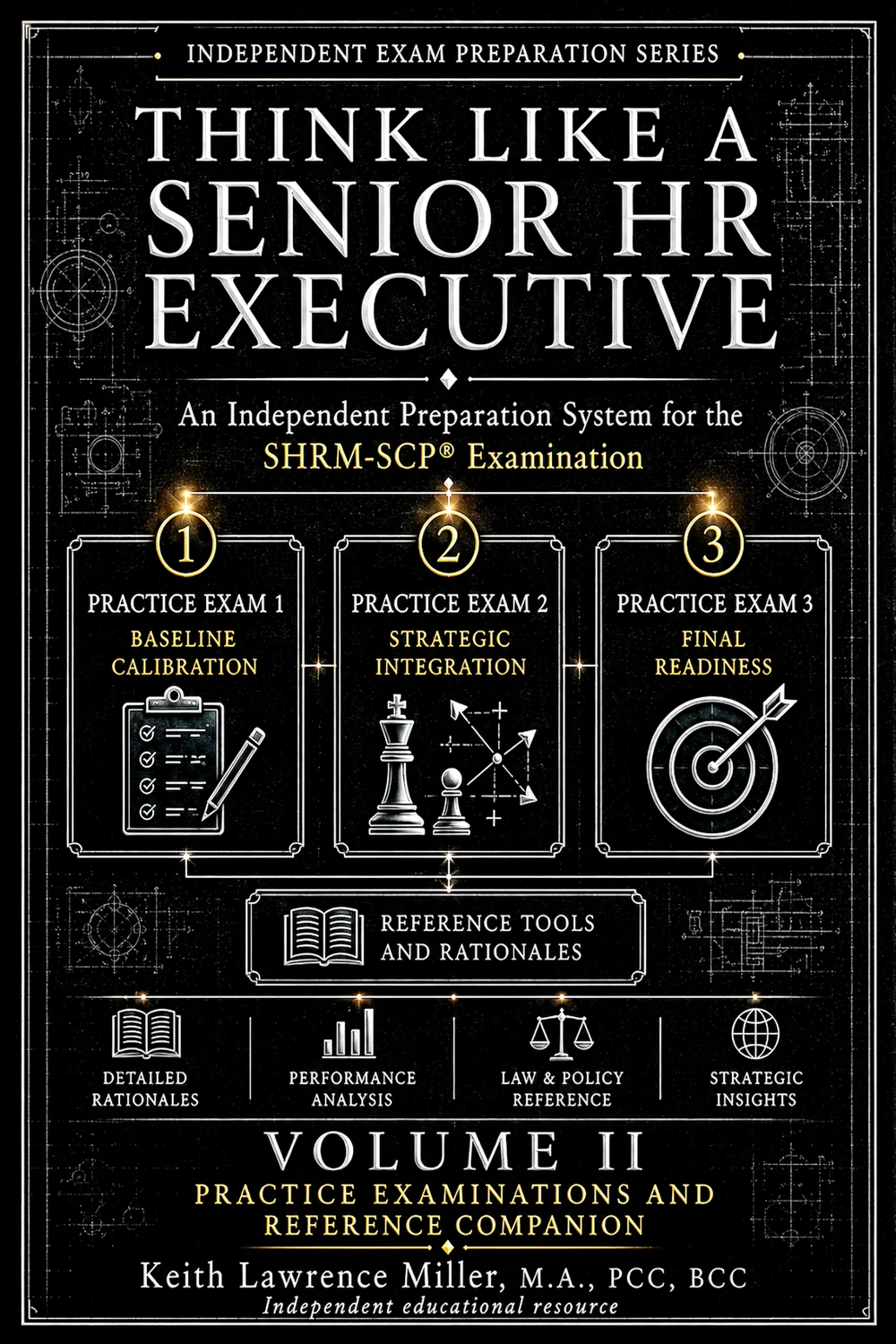
Full book feature
Practice the Decision Until the Reasoning Holds Under Pressure
Knowing a framework and using it under pressure are different capabilities.
A professional may know employment law, the Decision Ladder, the Five-Lens Weighing System, workforce planning, compensation, investigations, analytics, technology governance, and still face a timed scenario where several answers look reasonable.
The clock is moving. The question changes from What do you know? to Can you choose?
Think Like a Senior HR Executive — Volume II is designed around that shift. Volume I builds the reasoning architecture. Volume II puts that architecture under pressure through full simulations, detailed rationales, diagnostic error coding, confidence calibration, reference tools, and readiness evidence.
Volume I Builds the System. Volume II Tests Whether It Works.
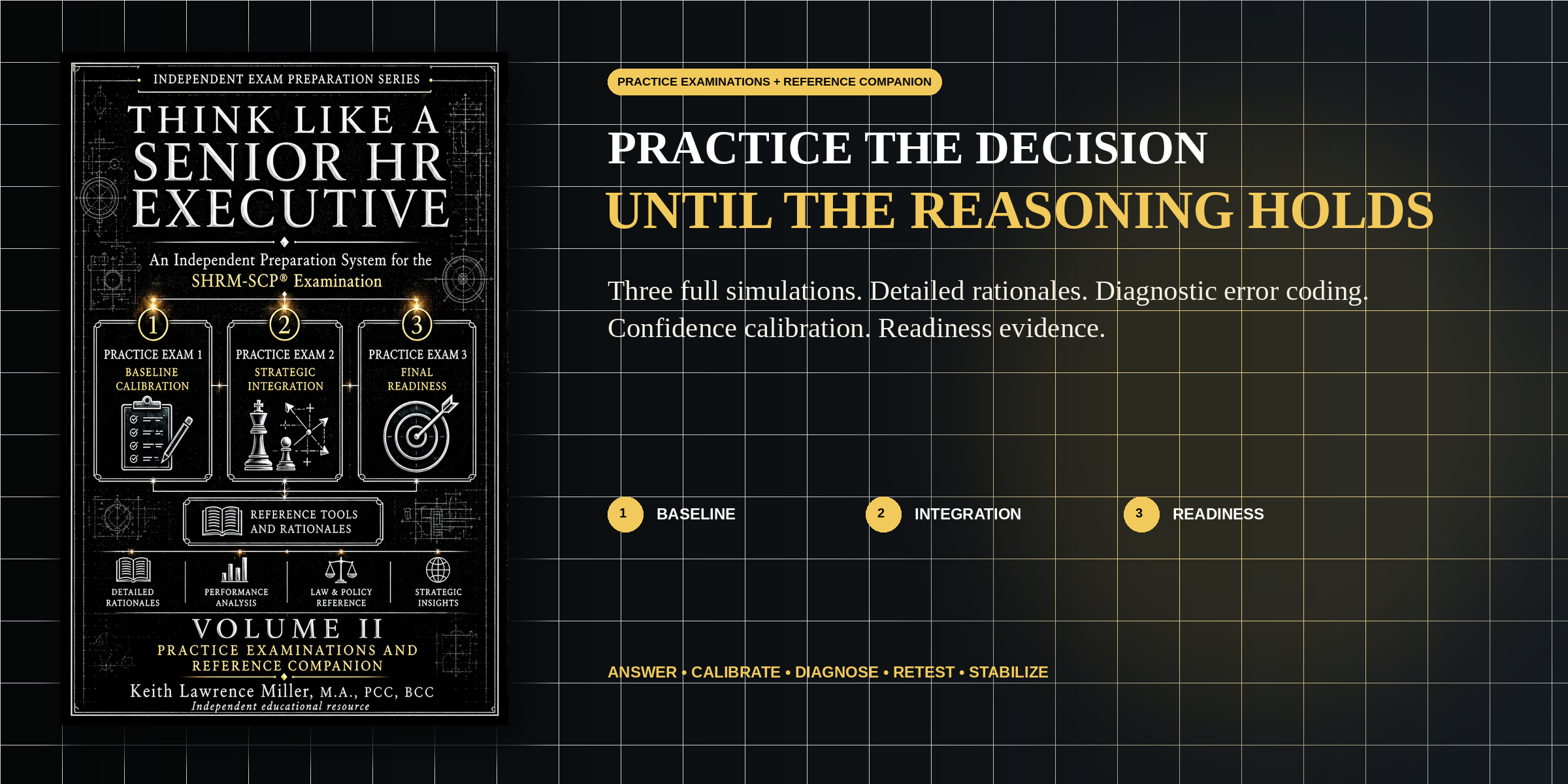
Volume I builds technical HR knowledge, strategic altitude, decision sequencing, the Decision Ladder, Five Lenses, senior-HR competencies, people strategy, organizational systems, law, risk, technology governance, error diagnosis, confidence calibration, and executive translation.
Volume II applies that architecture through questions, scenarios, time pressure, competing answers, rationales, error analysis, domain tracking, delayed retesting, reference tools, and readiness decisions.
One volume develops the reasoning machinery. The other asks whether the machinery continues to work when the answer is not obvious.
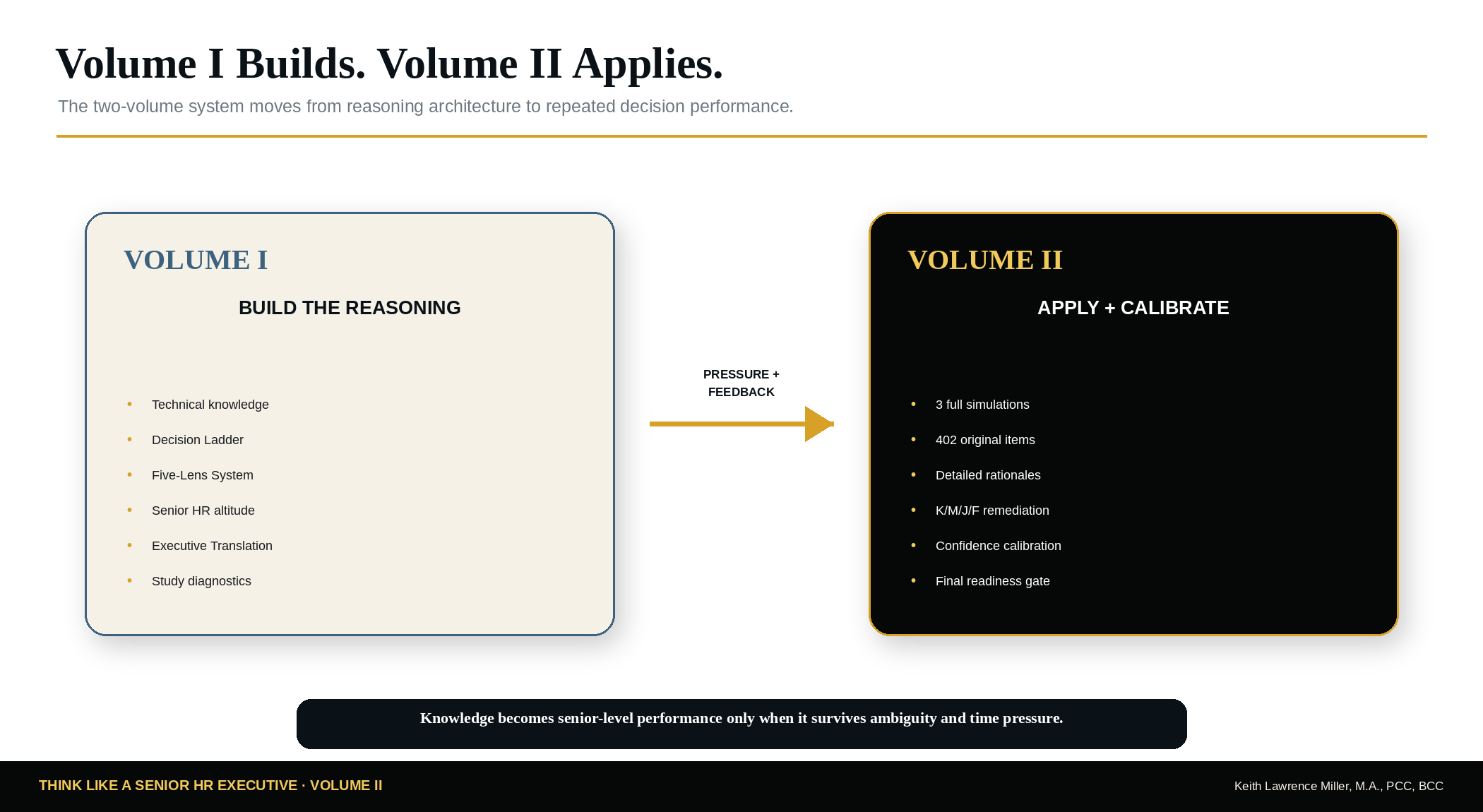
Practice Is Not the Same as Repetition
More questions do not automatically create better judgment. A candidate can answer hundreds of items and repeatedly choose empathy before duty, escalate too early, solve the surface story, overvalue a technically legal response, or move before facts support action.
Deliberate practice asks what failed: knowledge, reading, judgment, framing, or confidence calibration. Then it repairs the mechanism and tests the correction on something new.
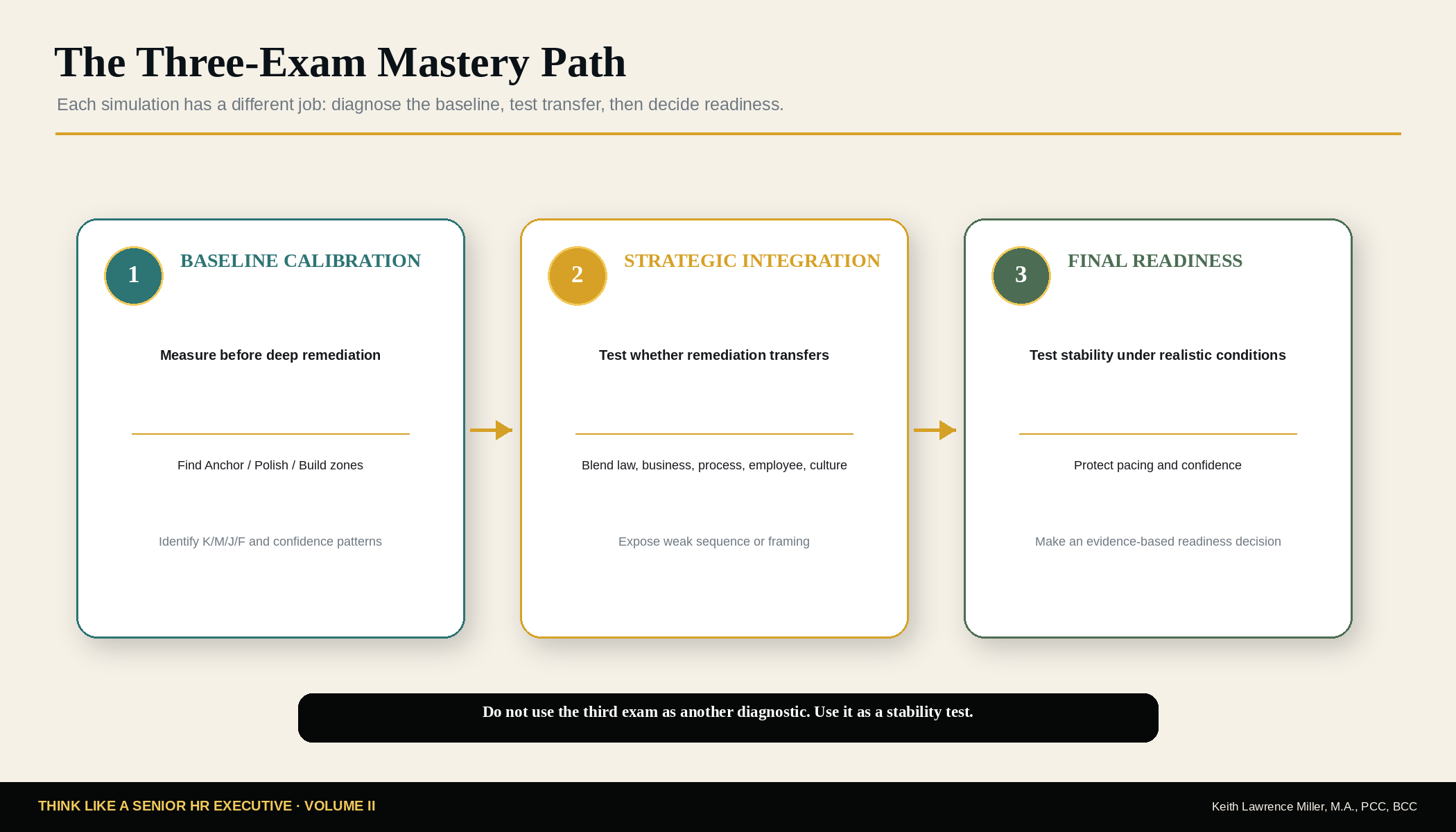
The Three-Exam Mastery Path
Practice Exam 1 — Baseline Calibration: measure performance before deep remediation.
Practice Exam 2 — Strategic Integration: test whether corrected Build zones transfer into integrated senior-HR scenarios.
Practice Exam 3 — Final Readiness: test stability, pacing, confidence, retrieval, and decision discipline under realistic constraints.
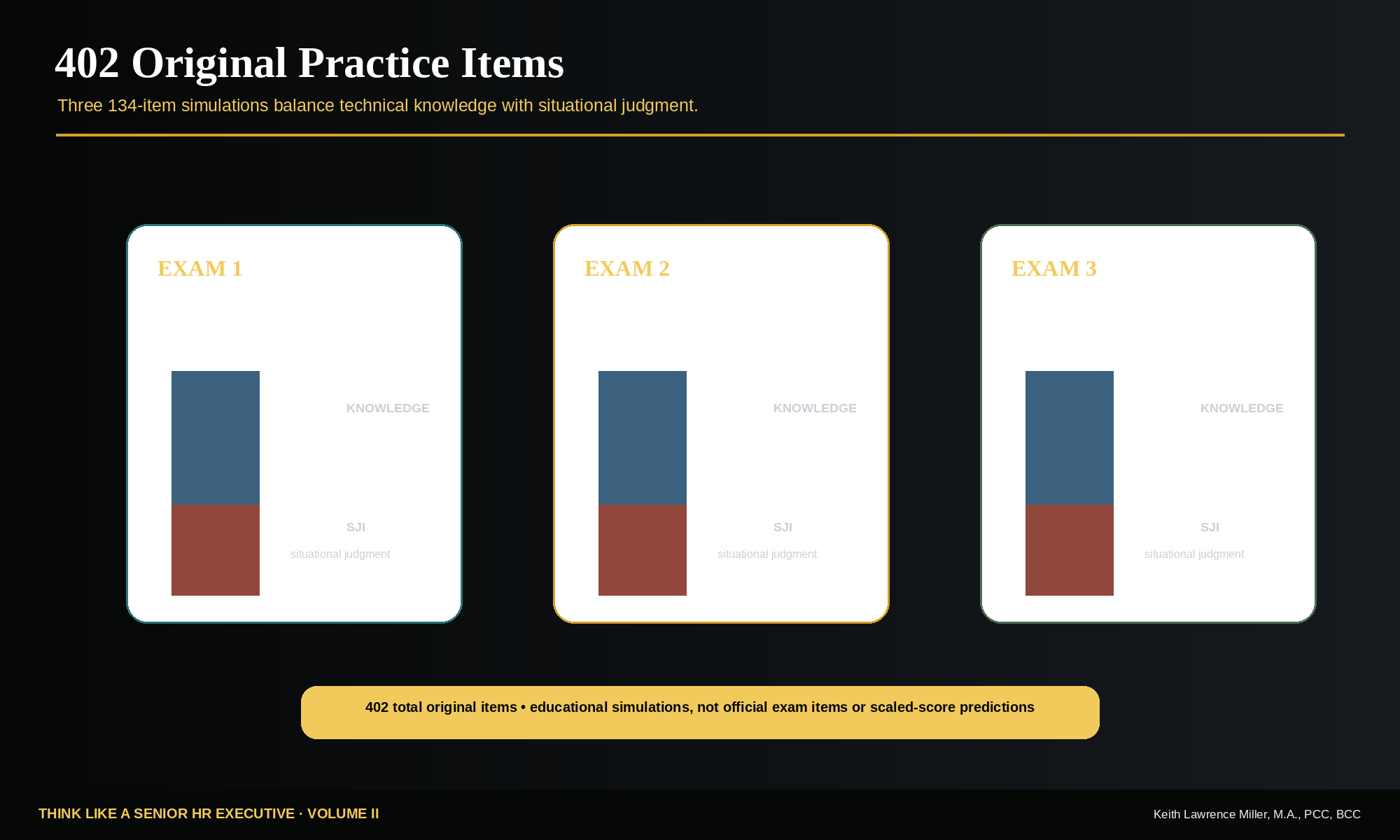
402 Original Practice Items
Each simulation contains 134 original items: 80 knowledge-oriented items and 54 situational-judgment items, arranged into two 67-item sections for internal simulation purposes. Across three examinations, Volume II contains 402 original practice items.
The simulated composition mirrors the public 2026 examination architecture for educational preparation. Internal scores and study zones are instructional tools, not official scaled-score predictions.
A Practice Test Should Produce More Than a Score
Volume II tracks raw accuracy, knowledge accuracy, SJI accuracy, Sure-answer accuracy, Leaning-answer accuracy, Guessing-answer accuracy, section completion, domain performance, the largest K/M/J/F cluster, and the lowest domain.
Two learners can produce the same total score and need completely different study plans.
Confidence Is Data
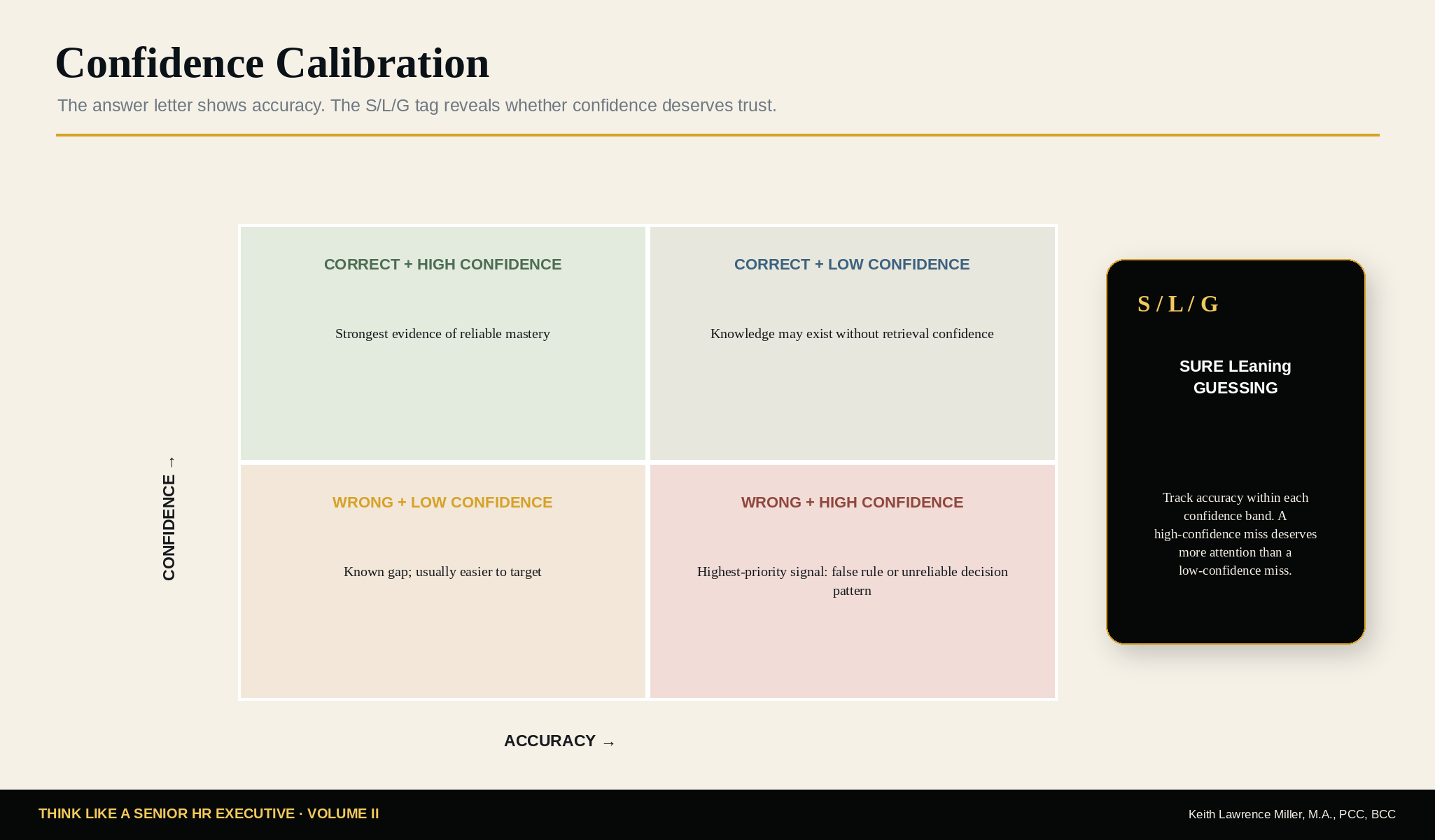
Each response can be tagged S — Sure, L — Leaning, or G — Guessing.
An incorrect Sure answer is more concerning than an incorrect Guess because it can reveal a false rule, durable misconception, or unreliable decision pattern. High-confidence errors are priority evidence.
The Rationales Explain Why the Best Answer Wins
The detailed rationales identify the domain, explain why the best answer wins, and show why the alternatives fail.
The candidate learns the structure of the distractor: too passive, premature escalation, half-right but wrong sequence, technically legal but organizationally weak, overcorrection, neighboring concept, wrong controlling fact, or surface-story framing.
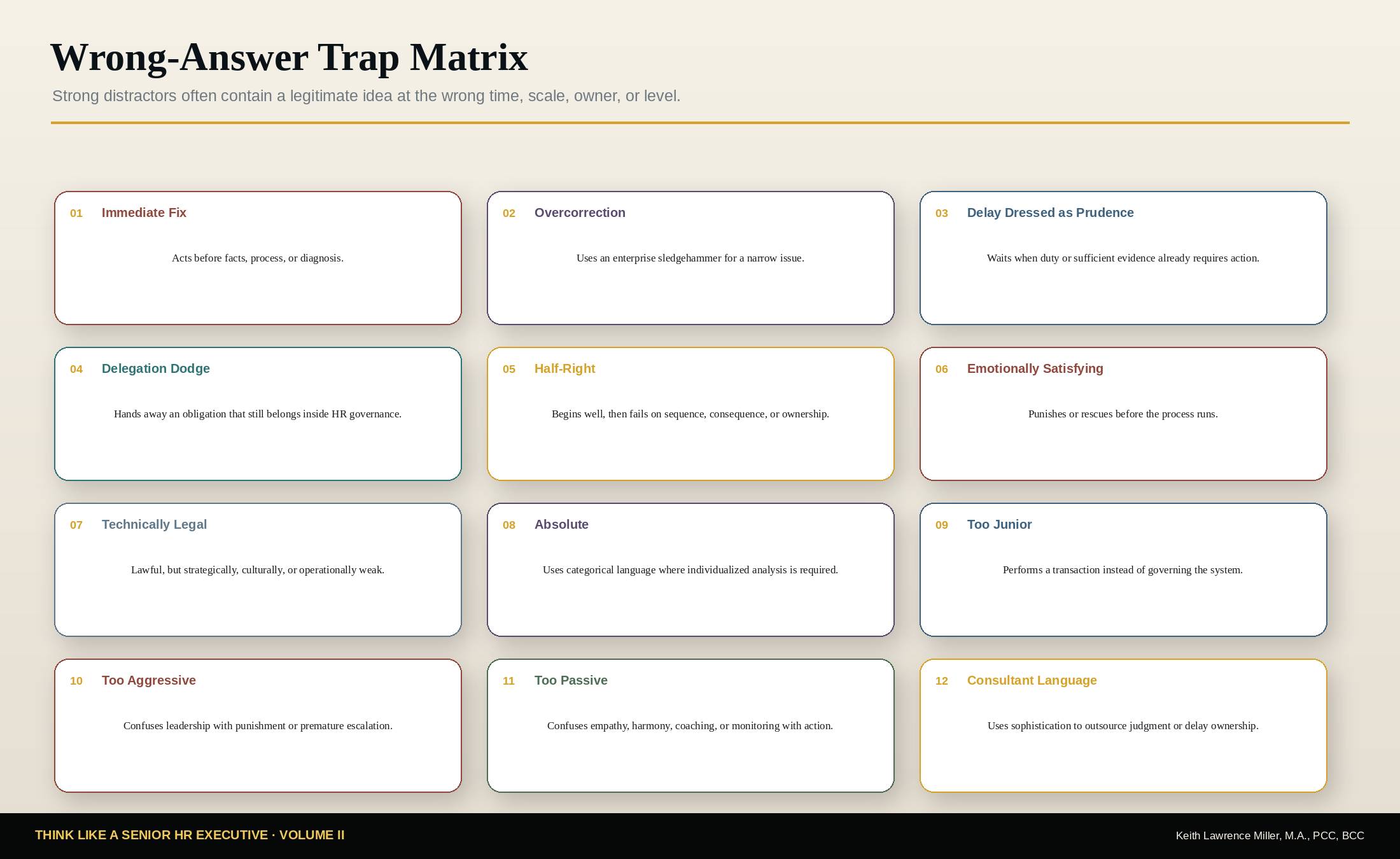
The Wrong-Answer Trap Matrix
Volume II makes recurring distractor families explicit: Immediate Fix, Overcorrection, Delay Dressed as Prudence, Delegation Dodge, Half-Right, Emotionally Satisfying, Technically Legal, Absolute, Too Junior, Too Aggressive, Too Passive, and Consultant Language.
A distractor becomes less powerful when its structure becomes recognizable.
Situational Judgment Is About Sequence
The senior question often includes several actions that might eventually be useful. The difficulty is identifying what belongs first.
The Decision Ladder remains active under timed practice: Duty → Facts → Direct → System → Owner → Escalate. Practice turns the sequence from something remembered into something used.
Trigger Words Matter
FIRST means sequence controls. BEST / MOST EFFECTIVE means compare viable survivors. Top performer can signal status-pressure bait. Repeated can signal a system problem. Policy permits warns that legality and wisdom may diverge. CEO directs introduces authority pressure. Immediately can signal action before facts. AI vendor says should activate purpose, data, validity, impact, ownership, privacy, transparency, and monitoring.
The Five Lenses Rank the Survivors
Once unsafe or badly sequenced options are eliminated, compare the surviving choices through Compliance and Ethics, Business Alignment, Process Integrity, Employee Impact, and Culture.
The Four-Second Tiebreaker
When two options remain plausible, ask: First? Duty? System? Owner? Lasts?
The test is short because the environment is timed. The deeper reasoning was built in Volume I; Volume II practices retrieval under pressure.
Knowledge Questions and Judgment Questions Require Different Reading
Knowledge-oriented questions generally target a defined concept, formula, legal distinction, model stage, term, measurement principle, or process.
Situational-judgment questions require issue recognition, fact discrimination, sequence, stakeholder analysis, system awareness, ownership, and tradeoffs. One often asks What is true? The other asks What should a senior HR leader do with what is true?
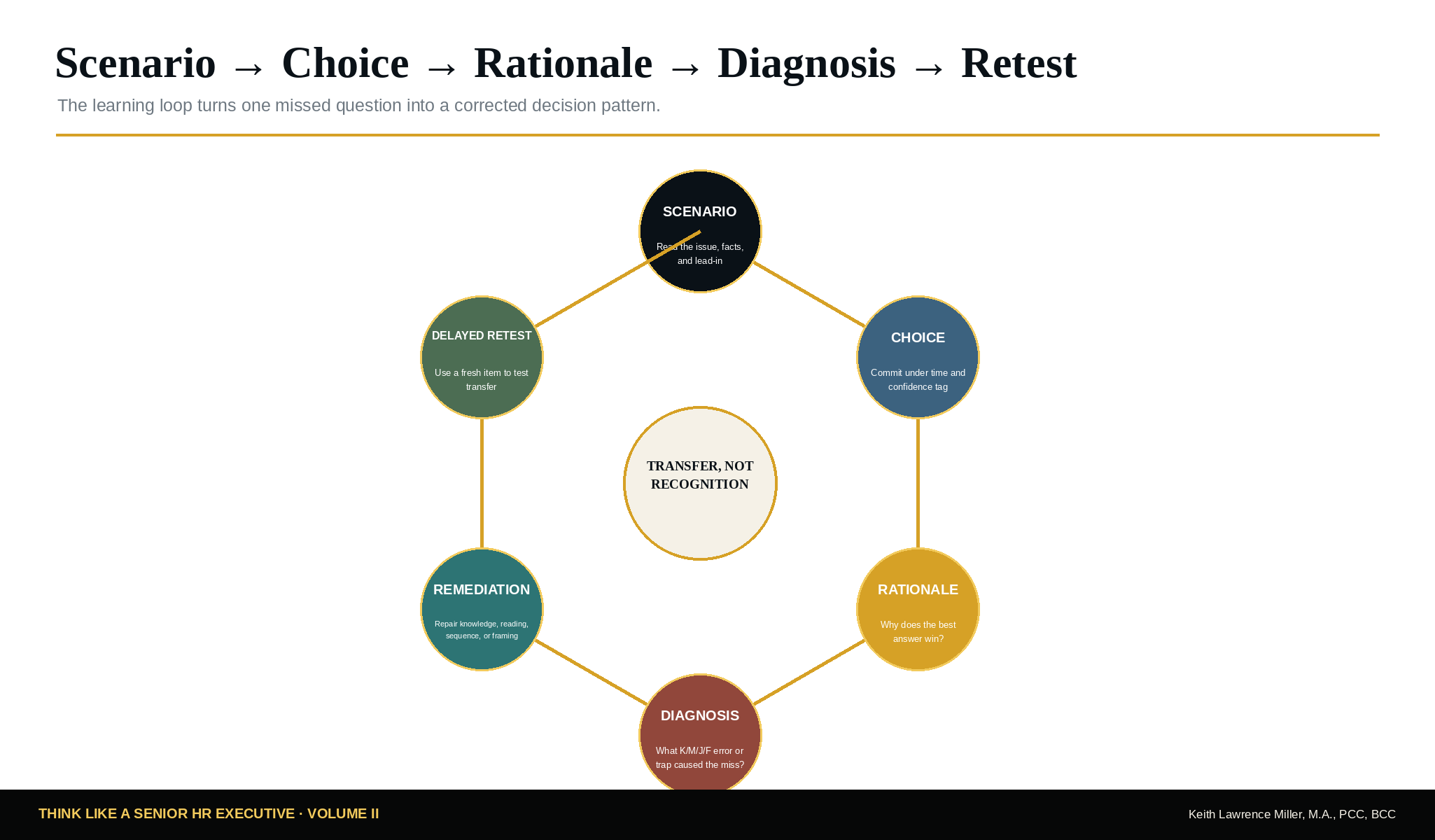
The Scenario Learning Loop
A missed item should enter a learning loop: Scenario → Choice → Rationale → Diagnosis → Remediation → Delayed Retest.
The objective is transfer, not immediate recognition.
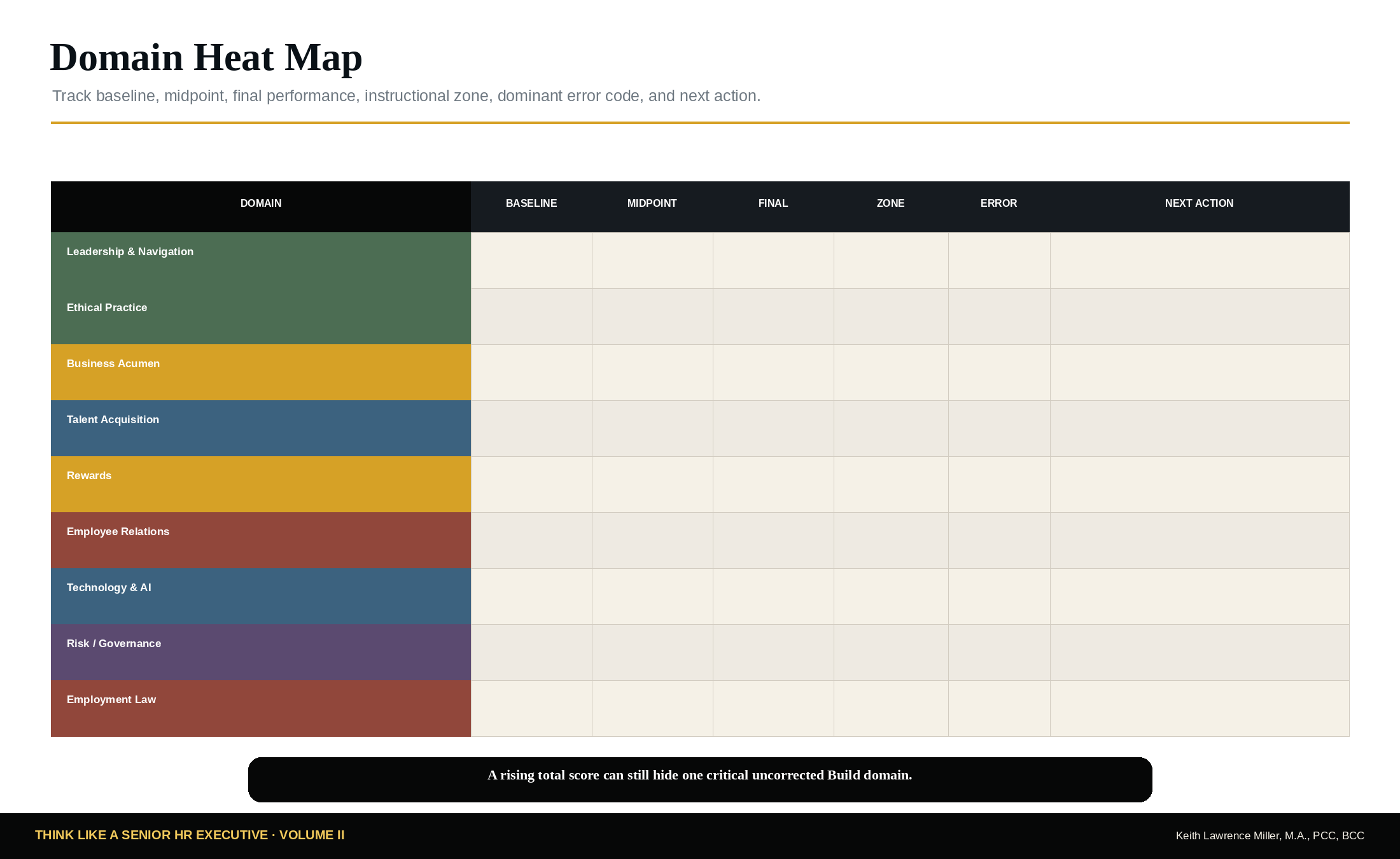
The Domain Heat Map Makes Weakness Visible
The Domain Heat Map tracks baseline, midpoint, final performance, instructional zone, dominant error code, and next action.
A rising total score can still hide one critical uncorrected Build domain.
Anchor, Polish, and Build Become Dynamic
The educational zones continue in Volume II: Anchor — approximately 85%+; Polish — approximately 65–84%; Build — below approximately 65%.
These are study-allocation zones, not official scaled-score predictions. Their purpose is to decide where the next hour of work should go.
Do Not Study Every Domain Equally
A domain at 92% does not need the same intervention as one at 52%. A candidate who misreads analytics items needs a different remedy from one who does not know the formula. Efficient study follows evidence.
The K/M/J/F Error Log Makes Remediation Specific
K — Knowledge: the definition, law, formula, model, or concept was missing.
M — Misread: the concept was known but a decisive word, denominator, timeline, jurisdiction, or fact was missed.
J — Judgment: the material was understood but the sequence, owner, action, or tradeoff was wrong.
F — Framing: the visible request was mistaken for the real organizational problem.
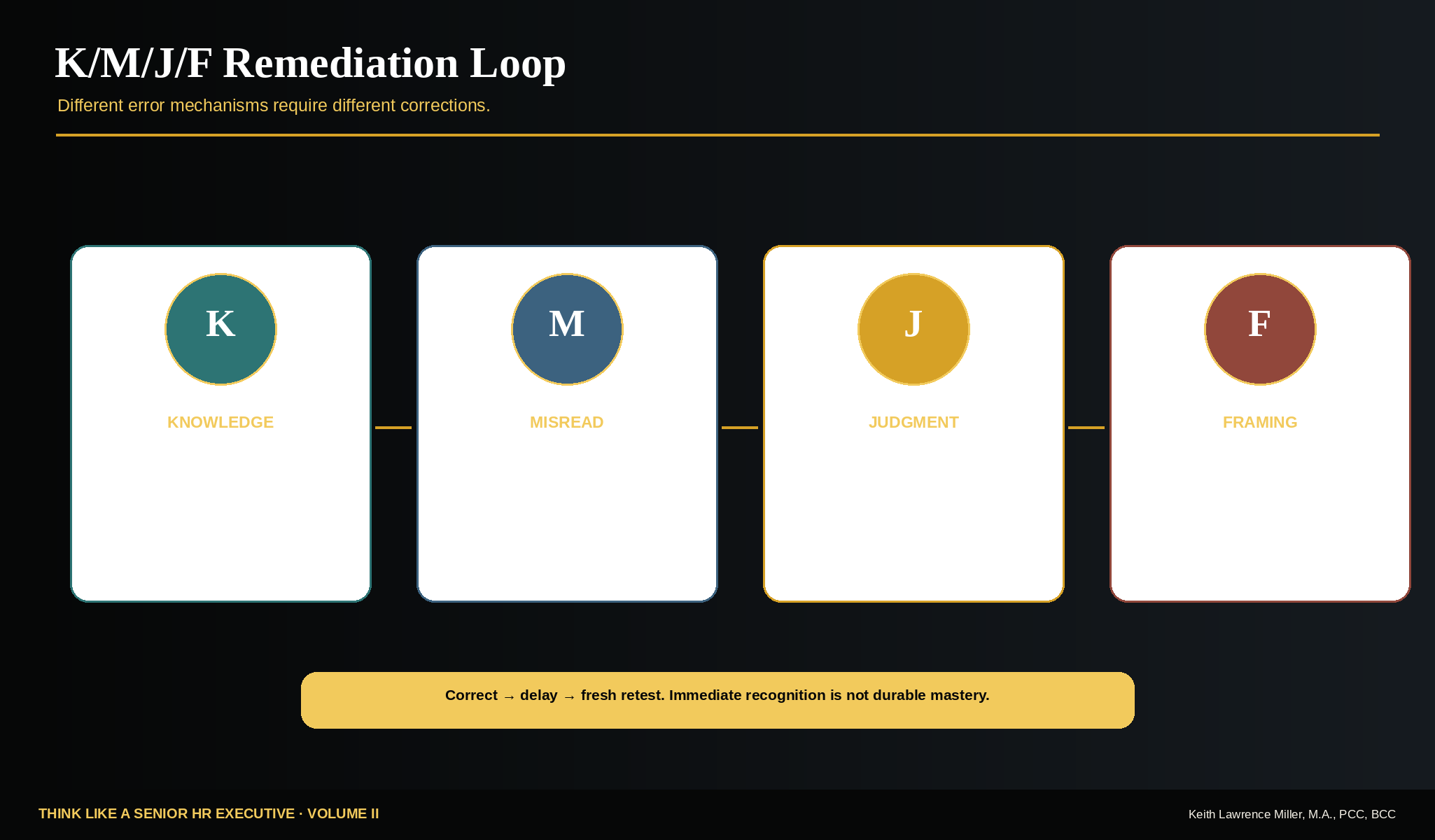
Immediate Recognition Is Not Durable Mastery
A learner who misses an item, reads the rationale, and immediately gets the same item right has demonstrated familiarity, not necessarily mastery.
The stronger test is a fresh delayed item with different names, industries, wording, answer order, and surface facts.
Practice Exam 2 Tests Transfer
After remediation, the second exam asks whether learning survives integration. Can legal knowledge operate inside a business scenario? Can analytics support a decision? Can employee impact remain visible without overriding duty? Can technology scenarios trigger governance rather than fascination?
Practice Exam 3 Tests Stability
Final readiness is stronger when performance is stable rather than dependent on one unusually strong attempt. The candidate should be able to maintain pacing, retrieve frameworks, avoid recurring traps, use confidence meaningfully, and recover from difficult items.
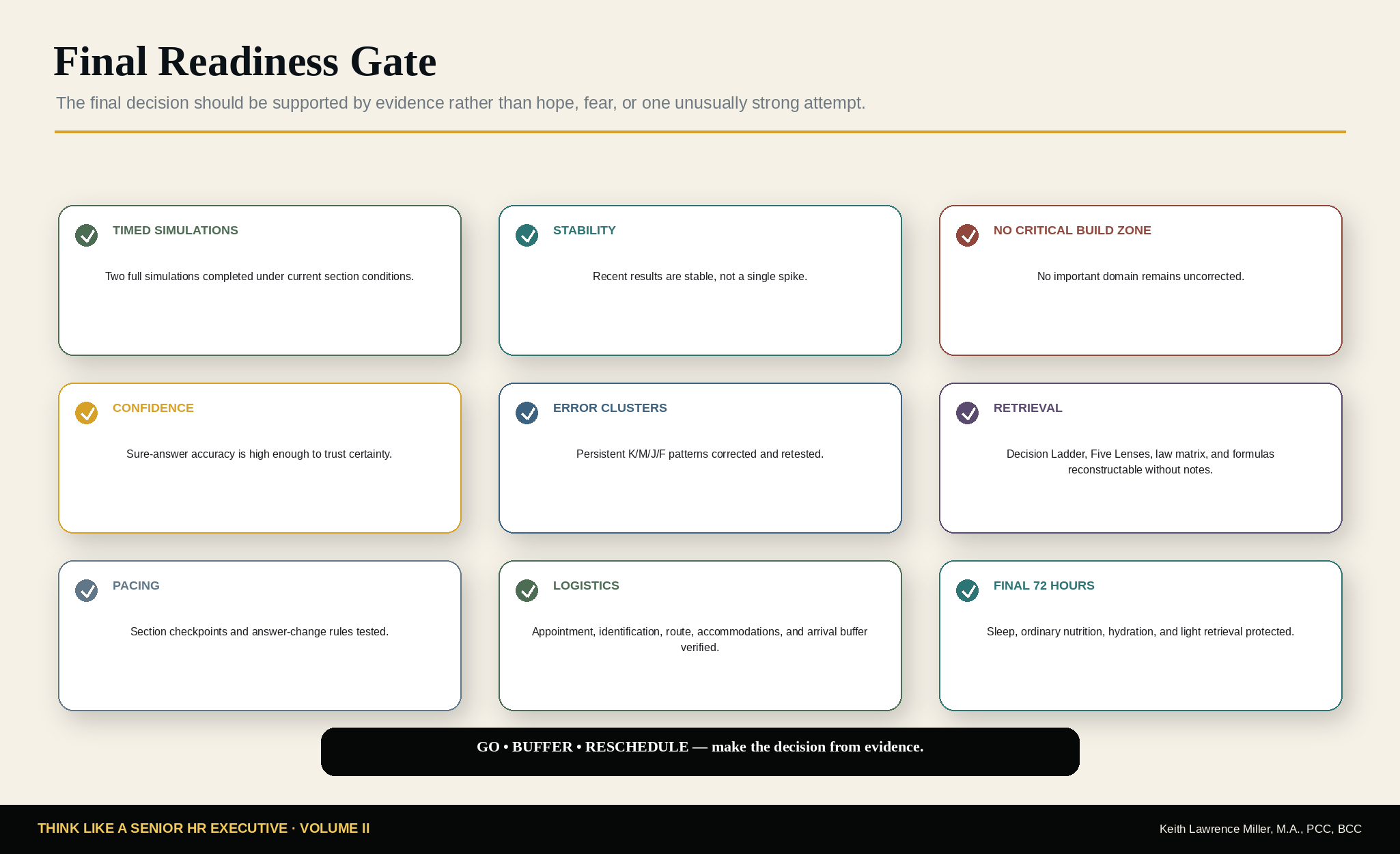
Readiness Is an Evidence Decision
The final decision should be supported by timed simulations, stable recent performance, no critical uncorrected Build domain, trustworthy Sure-answer accuracy, corrected error clusters, framework retrieval without notes, tested pacing rules, verified logistics, and protected final-day routines.
The final choice—go, buffer, or reschedule—should come from evidence rather than hope or fear.
Exam-Day Execution Is Part of Performance
Knowledge can be strong and execution poor. A candidate can lose time on one ambiguous item, change a correct answer from generalized anxiety, mishandle breaks, or let one difficult scenario disrupt the next ten.
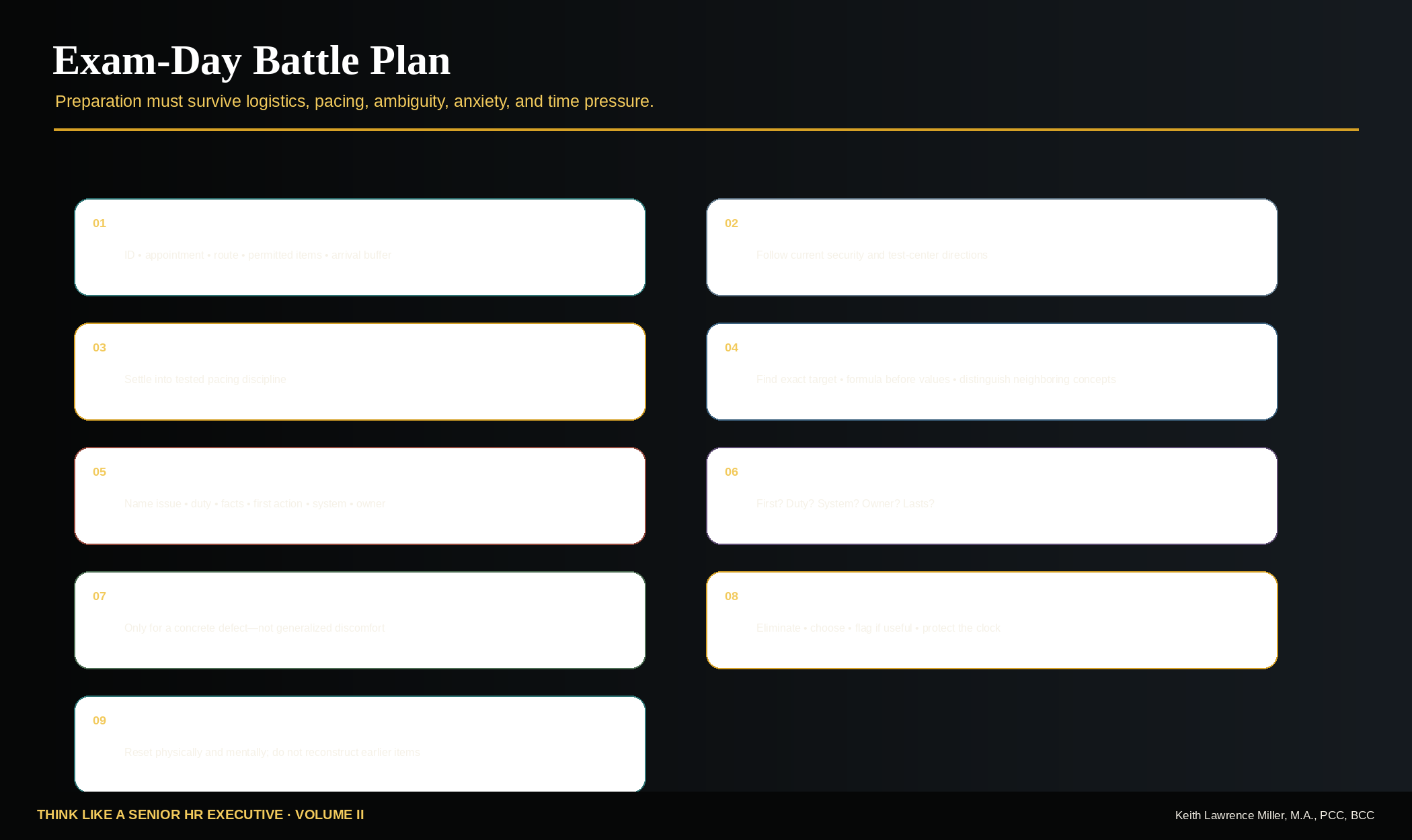
Volume II therefore includes an Exam-Day Battle Plan covering logistics, section starts, knowledge items, SJI items, two-answer ties, answer changes, difficult items, breaks, and final minutes.
Protect the Clock
One item should not consume the examination. Eliminate what you can, choose the best-supported answer, flag if appropriate, and continue. Timed practice teaches disciplined sufficiency.
The Reference Companion Makes Review Faster
The appendices include an Employment Law Matrix, HR Metrics Formula Sheet, Named Models at a Glance, one-page Decision Ladder and Five-Lens references, Wrong-Answer Trap Matrix, SJI Trigger Words and Stem Signals, Flashcard Master List, blank K/M/J/F Error Log, Confidence Calibration Tracker, Domain Heat Map, eight-week and twelve-week study calendars, fourteen-day final-review calendar, Final Readiness Checklist, Exam-Day Battle Plan, research and legal currency notes, and selected references.
Models Matter When You Know What They Are For
Knowing a framework name is not mastery. The important question is what type of problem it solves. Markov analysis supports internal-supply forecasting. Scenario planning prepares multiple futures. Build-buy-borrow-bot frames workforce supply choices. RACI clarifies implementation roles. Three Lines clarifies risk ownership and assurance. NIST AI RMF structures AI risk work. The Decision Ladder sequences action. Five Lenses rank viable choices.
AI Scenarios Require Governance, Not Enthusiasm
A vendor may promise predictive hiring or promotion recommendations. The senior response asks about legitimate purpose, data, validity, impact, ownership, transparency, privacy, monitoring, review, and recourse. Technology questions become governance questions.
The Reference Companion Keeps Legal Material in Perspective
Employment law matters greatly in senior HR preparation and can change. Agency positions, thresholds, state and local requirements, and specific facts matter. The professional discipline includes knowing when the rule must be reverified.
A Sample Scenario Shows the Difference
Suppose a leader wants to terminate a long-service employee immediately while the file contains satisfactory reviews and little prior feedback. A simplistic answer may cite at-will employment. A relational answer may prioritize empathy. An aggressive answer may push immediate termination.
The stronger senior response recognizes the documentation conflict, the need for a fair and defensible process, the business leader’s decision ownership within lawful boundaries, and the importance of correcting the process before a final action unless another urgent duty controls.
The Best Answer Often Protects Tomorrow Too
A strong response does more than resolve today’s case. It asks whether managers will document earlier, decision rights will become clearer, standards will be applied consistently, better evidence will exist, and governance will improve.
Practice Makes Professional Bias Visible
The HR generalist may overvalue established process. The business leader may overvalue speed. The coach may overselect conversation. The attorney may focus narrowly on defensibility. The consultant may prefer broad intervention. The analyst may wait for more data than the situation permits.
Practice scenarios reveal the pattern that needs calibration.
Confidence Calibration Builds Better Professionals
The confidence system has value beyond an examination. Calibrated leaders can distinguish strong evidence from provisional interpretation, state what remains unverified, and identify what would cause a change in course. That is more credible than false certainty.
The Goal Is Not Perfect Certainty
Senior HR work rarely offers complete information. The standard is disciplined judgment under uncertainty: enough evidence, correct duty, appropriate sequence, clear ownership, visible tradeoffs, reasonable monitoring, and a recovery route.
Preparation Should Become More Selective Over Time
Early study can be broad. Later study should narrow. The heat map identifies domains, K/M/J/F identifies mechanisms, confidence calibration exposes false mastery, Practice Exam 2 tests transfer, Practice Exam 3 tests stability, and final review reduces rather than expands the study universe.
More Study Is Not Always Better
Late-stage preparation can become compulsive. More resources can eventually reduce readiness. The final phase should protect retrieval, pacing, confidence, sleep, routine, logistics, and execution.
Volume II Is Also a Professional Reference
The compact matrices, formulas, frameworks, diagnostics, and decision models can support continued professional development after the examination. K/M/J/F can even be adapted to real decisions: was the miss caused by missing knowledge, a missed fact, weak judgment, or poor framing?
The Two-Volume System Creates a Learning Loop
Diagnose with Practice Exam 1. Classify Anchor, Polish, and Build areas. Study selectively with Volume I. Practice on fresh scenarios. Analyze with K/M/J/F and confidence calibration. Retest on delayed fresh items. Integrate with Practice Exam 2. Stabilize remaining weaknesses. Simulate with Practice Exam 3. Decide readiness from evidence. Execute using the exam-day plan.
Who Should Read Think Like a Senior HR Executive — Volume II?
The book is designed for SHRM-SCP® candidates, experienced HR professionals, HR business partners, HR directors and vice presidents, career changers entering senior HR, organizational and talent leaders, and independent learners who want diagnostic practice instead of passive rereading.
Practice the Decision
The best senior HR answers rarely come from memorizing a sentence. They come from a repeatable reasoning system.
Recognize the issue. Protect the duty. Read the facts carefully. Choose the correct sequence. Engage at the right level. See the system. Preserve ownership. Weigh the surviving choices. Recognize the distractor. Calibrate confidence. Translate the decision. Learn from the miss. Retest the principle.
Then do it again until the judgment becomes more stable.
Volume I asks: How should a senior HR executive think?
Volume II asks: Can you still think that way when the clock is running and several answers look right?
That is where practice becomes mastery.
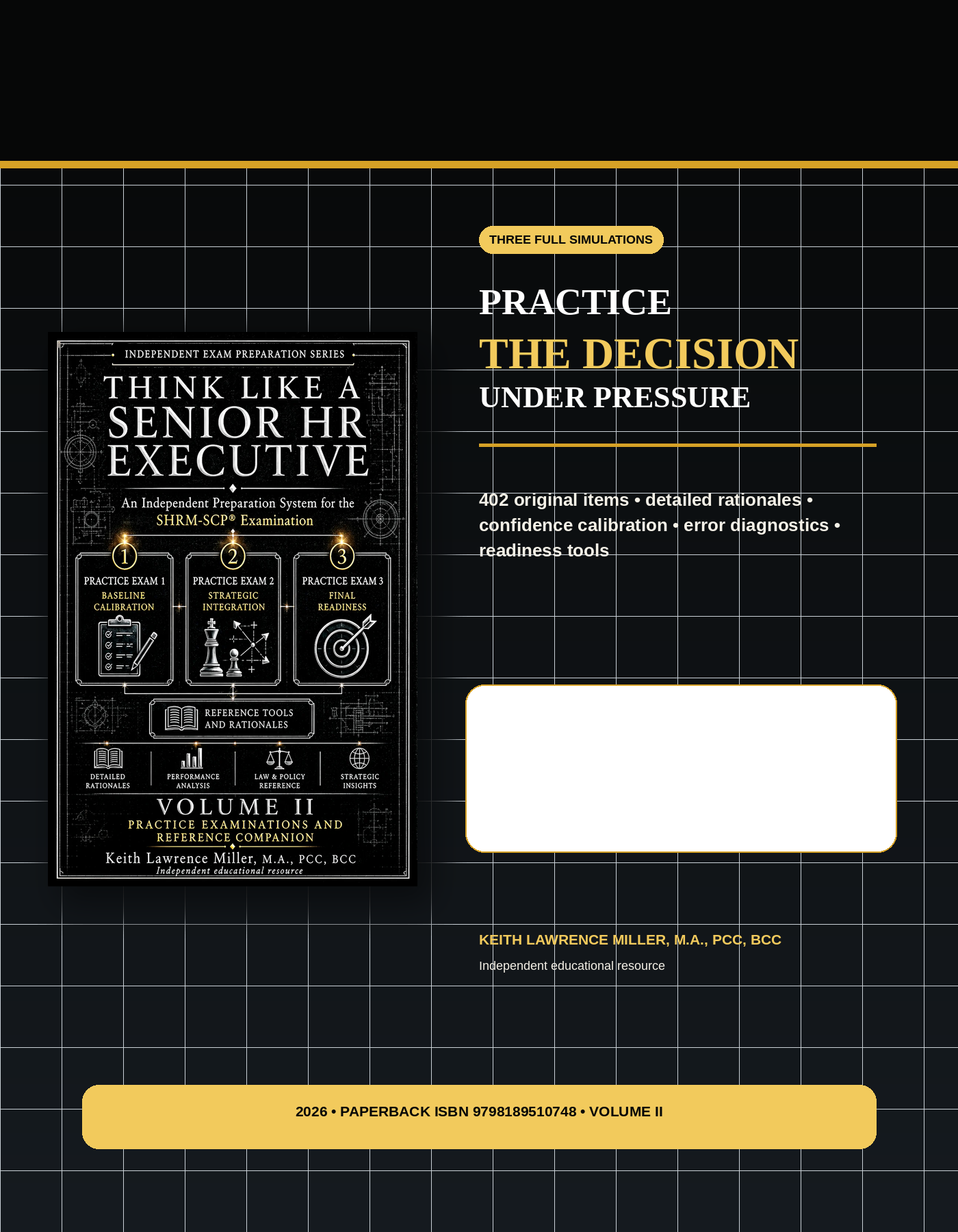
This publication is an independently prepared educational resource. It is not endorsed by, sponsored by, or affiliated with the Society for Human Resource Management (SHRM) or Prometric. SHRM, SHRM-CP, SHRM-SCP, SHRM BASK, and related names and marks are the property of their respective owners and are referenced descriptively to identify the professional framework and examination context addressed by the book.
All practice questions, simulations, scenarios, cases, explanations, and rationales are original educational material. The book does not reproduce, reconstruct, solicit, or disclose confidential live examination content. Internal scores, study zones, practice simulations, and readiness tools are educational devices and are not official scaled-score predictions. Performance on these materials does not guarantee a particular examination or certification result.
Employment law, agency positions, regulatory thresholds, benefits limits, technology rules, and certification policies can change. Federal law is discussed for educational purposes and may be supplemented or altered by state, local, industry, contractual, or international requirements. Official SHRM materials remain the controlling authority for current competencies, eligibility, testing policies, timing, and examination composition. The book is not legal, tax, benefits, or investment advice. Readers should verify current official requirements and obtain qualified professional guidance where specific facts require it.