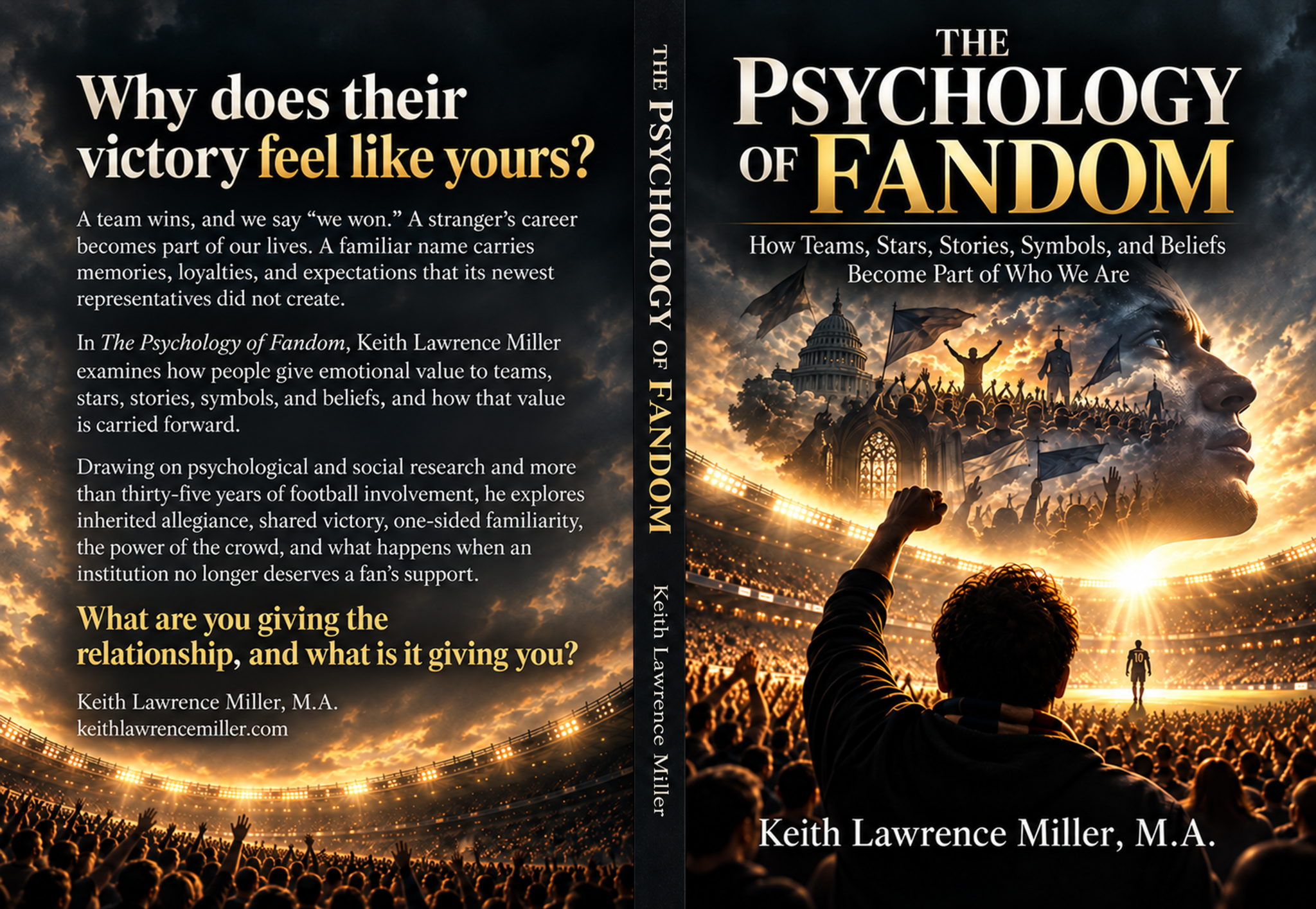
The Psychology of Fandom: What We Give, What We Receive, and What We Choose
By Keith Lawrence Miller, M.A.
I came to this subject through a relationship I had lived for more than thirty-five years. My father introduced me to football. I collected cards, memorized statistics, followed the players and strategy, watched the games and the hype, played fantasy football, and made betting part of my involvement. I knew the subject because I kept giving it attention.
Then I stopped watching. What I regarded as racism and disrespect toward the flag pulled back the curtain for me. The Giants’ treatment of Eli Manning compounded that dissatisfaction. I made a commitment to myself that I would never watch football again, and I turned more of my focus toward MMA.
Years later, I heard names of football players I did not know. Other people cared about those players. I had no history with them. The institution had continued, but I had stopped participating in the process through which its newer representatives became personally important to me.
That contrast opened a set of questions: Why do we invest in performers who do not know us? How does another person’s achievement become something we can share emotionally? What carries meaning from one generation of players to the next? And what are we supporting when we support the name?
My departure is part of this inquiry, not a verdict about every fan or every institution. My judgments about public events belong to me. The public record and the motives of the people involved are separate questions. I want to understand fandom without turning my experience into a universal rule.
The score is not the whole relationship
A score tells us who won. It does not tell us why one person experienced the result as an ordinary fact and another experienced it as a consequential moment. The difference may come from a player, a season, a parent, a place, a memory, or a story that has been followed over time.
That is why “we won” sounds natural among supporters. The player did the work. The fan did not enter the contest, earn the points, or produce the recorded result. Still, the fan can experience the team’s achievement through a relationship that has become part of the fan’s own life.
Psychologist Robert Cialdini and colleagues studied how college football supporters described teams after victories and defeats. Their work is often summarized as “basking in reflected glory.” The original findings are narrower: the researchers examined university students’ language and clothing in particular settings. Most participants used consistent pronoun patterns; among the smaller group whose language changed, “we” was more common after a win. The study gives us evidence about public association with success, not a complete account of every fan’s motive. [2.1]
My interest is in what the relationship lets a person do. A supporter can make another person’s achievement relevant to a shared identity without claiming to have performed it. The emotional pleasure is real; the athletic accomplishment belongs to the people who earned it.
What was handed down before we chose?
I describe myself as having been born into Giants fandom because my father was already a lifelong fan. I did not begin by comparing teams and selecting one from a neutral list. Football and the Giants arrived in my life through a relationship that already mattered. My own attachment grew through what I learned, watched, and remembered.
That path is not universal. A person can become a fan through friends, a particular performance, a place, a story, or a decision made much later. Research on sport socialization reports several influences; the studies examined particular samples and cannot establish one route for everyone. A qualitative study of 35 parents, for example, describes different ways parents and children shaped one another’s fandom. A separate study of 20 sport-fan parents examined children’s influence on parental identification. Those reports make room for variation; they do not prove a fixed family-transmission law. [4.1] [4.3] [4.4]
To name one part of that experience, I use the phrase inherited emotional value. A team or institution may already matter to people before a new player arrives. The new person can receive an audience, expectations, and a history he did not create. He may add to that history, change it, disappoint it, or leave before a strong personal bond forms.
“Inherited emotional value” is a descriptive term I developed for this book. It is not an established psychological law, and it does not mean that a fan’s attachment is automatic. The institution carries continuity; people supply the attention and meaning.
Stories turn outcomes into journeys
Two people can see the same contest, agree on the result, and leave with opposite feelings because they wanted different endings. A score records the outcome. A story gives someone a reason to care about who succeeds, who fails, and what the result appears to mean.
That structure reaches beyond sport. A viewer can follow a contestant on reality television, a fictional character, a musician, a racing driver, or a public figure. We may respond to perseverance, conflict, sacrifice, skill, vulnerability, or a turning point. Narrative research offers one way to understand how people become absorbed in stories, but applying those findings to any individual fan remains an interpretation rather than a direct diagnosis. [5.1]
Stories also invite judgment. A person becomes a hero or a villain in the account we are following. That role can be based on what we have seen, what we have been told, and what outcome we want. It can change as new information arrives. The story does not make the performer into a fictional character; it describes the frame through which the audience interprets public action.
Familiarity can exist on one side
I could tell you about players. They could not tell you about me. That asymmetry became clearer after I stopped watching football. I had spent years learning statistics, strategy, execution, and careers. The players’ performances occupied my attention. My life did not occupy theirs in a comparable way.
Communication researchers distinguish an immediate sense of interaction during media exposure from a continuing parasocial relationship that can persist beyond one viewing. The distinction helps us talk about one-sided familiarity without pretending the person on screen knows each viewer personally. It also helps keep the idea in proportion: a meta-analysis of 120 studies did not find a significant overall relationship between social deficiencies and parasocial relationships. That does not prove every media attachment is harmless; it does caution against treating fandom itself as evidence of a problem. [6.1] [6.3]
People around a performer may know one another, argue, organize, and build reciprocal friendships. A fan community can include real relationships even when the relationship to the athlete, actor, creator, or character is not mutual. Those are different connections. Both can matter.
Uncertainty gives attention somewhere to go
Anticipation begins before a result is known. We think about what might happen, discuss the possibilities, and watch the event unfold. A contest can remain compelling precisely because no one knows the outcome in advance.
Research on reward anticipation and suspense can help describe parts of that experience. One survey model involving Formula One spectators connected positive parasocial relationships with hope and suspense; it does not establish a universal causal effect. Neuroscience findings about reward prediction come from specific tasks and populations, not from a scan of every sports fan. These studies give us concepts, not permission to claim that all fandom works through one brain mechanism. [8.2] [8.4]
I also include my own betting history as testimony. I regarded the winnings as side income, but that self-report was not audited, and the account is not a financial claim or a promise about prediction. The book keeps the excitement of anticipation separate from evidence about gambling behavior and from my personal memories.
The crowd is part of the experience
A play does not change when people watch it together. The experience can. A shout, a song, a chant, or a shared silence lets people recognize one another’s response without first explaining the history behind it. The audience is not merely a background to the performance. It can become part of what the event means to the people present.
Small-group experiments on coordinated activity have found differences in later cooperation across particular conditions. They do not establish that every stadium, concert, or gathering produces the same effect, or that any response lasts beyond the measured setting. They give us a reason to examine synchronized attention and shared ritual carefully, not to promise a universal crowd effect. [9.3]
For some people the greatest return is the event. For others it is the friend beside them, the conversation afterward, the ritual of watching together, or the memory of a season that now belongs to a family. Those sources can overlap without being identical.
Symbols carry histories—and comparisons have limits
A team name, uniform, flag, car badge, or fictional character can come to represent more than its literal function. The meaning accumulates through repeated use, memory, and the people who treat the symbol as important. Research on possessions and brand relationships helps describe some consumer attachments, but a commercial product is not a person and does not know its owner. [11.2]
National symbols may hold political history and collective identity. Religion can involve belonging, inherited practice, sacred obligation, belief, and a relationship understood by practitioners as more than social identification. Some processes may look comparable from the outside; the meaning and purpose can be very different. A psychological account of symbols cannot settle theological questions or reduce religious commitment to fandom. [12.3] [13.2]
Comparison can clarify one feature of an attachment. It cannot erase the distinct history, authority, obligations, and meaning of the relationship being discussed.
When the institution no longer deserves your support
The emotional value of a name can make an institution feel like part of us. That continuity can be sustaining. It can also make criticism harder. We may defend a decision because the team has been ours for years, because a player once mattered to us, or because leaving would feel like abandoning people and memories that remain important.
My own football exit came after I judged conduct around the flag as racist and disrespectful. The Giants’ treatment of Eli Manning compounded my dissatisfaction. Those are my interpretations and judgments. Manning’s public statements and the Giants’ public explanations are documented separately in the source notes; they do not establish what every participant privately intended, and they do not require every reader to reach my conclusion. [12.1] [14.1] [14.2] [14.3]
There is a difference between explaining why an attachment formed and deciding whether it should continue. The first question looks at history. The second asks what the institution is doing now, what standards matter to us, and whether our ongoing attention still fits those standards.
Leaving does not erase the history
I made a commitment to myself that I would never watch football again. That was my choice. Years later, unfamiliar player names made visible how much the sport had changed while my own participation stopped. I turned more of my attention toward MMA; I am not claiming a particular schedule or a replacement attachment for every part of what I left.
Research on role exit and the de-escalation of fandom can help identify questions people may face when they step away. The studies do not establish one fixed sequence, a universal emotional response, or a requirement that former fans become opponents. Some people leave completely. Some reduce their involvement, change what they follow, or return later. The decision belongs to the person living the relationship. [15.2] [15.3]
What remains may be complicated: family memories, old knowledge, a team’s place in a person’s biography, relief, frustration, or no wish to revisit the subject. Leaving does not turn the past into a mistake. It changes what the present relationship asks of us.
What is the relationship giving you?
Pause over one attachment that has occupied your attention. Recall how it began. A person may have introduced it. A performance may have drawn you in. A story may have given you someone to root for. That beginning helps explain the relationship you have now.
Then consider what keeps it active. What do you watch, learn, discuss, create, defend, or buy? What do you receive through that participation—enjoyment, anticipation, knowledge, company, a valued memory, or an expression of something you believe? Be precise about where the return comes from. The performer may supply an experience. People around the performance may supply relationships. A familiar symbol may call a history to mind.
Look at the present exchange as carefully as the past. Does your involvement still provide what you value? Does it fit the responsibilities and relationships that also deserve your attention? Has something changed in the institution’s conduct or in your own reasons for following it?
You may find that the relationship continues to deserve its place. You may want a different scope of participation. You may decide to leave. Each answer depends on the relationship you actually live and the standards you choose to maintain. The history remains yours. The next invitation is something you can consider.
About the book
The Psychology of Fandom: How Teams, Stars, Stories, Symbols, and Beliefs Become Part of Who We Are examines sports and other forms of fandom through personal testimony, public records, psychological and social research, and interpretation. It considers shared victory, family and social transmission, heroes and narratives, one-sided familiarity, uncertainty, crowds, institutions, brands, national symbols, religion, institutional disappointment, role exit, and the exchange between attention and meaning.
The phrase inherited emotional value is the author’s descriptive concept, not an established psychological law. The manuscript distinguishes Keith’s personal experience and judgments from public records, research findings, and the book’s interpretations. It does not present the psychology of fandom as a clinical diagnosis of individual fans.
Keith Lawrence Miller, M.A. · Copyright © 2026 · ISBN 9798162143529 · Independently published
Selected source notes
These notes retain the manuscript’s chapter numbering. The cited research is limited to the samples, methods, and claims described in the studies. Personal accounts are Keith’s testimony; public records establish reported events and statements; the connections drawn in the article are interpretation. An interpretation is not silently presented as a research finding.
- [2.1] Shared language after wins. Cialdini, R. B., Borden, R. J., Thorne, A., Walker, M. R., Freeman, S., & Sloan, L. R. (1976). “Basking in reflected glory: Three (football) field studies.” Journal of Personality and Social Psychology, 34(3), 366–375. https://doi.org/10.1037/0022-3514.34.3.366. The study supports findings about public association with success in particular student settings; it does not establish a universal motive for all fans.
- [4.1] Fan socialization. Lenartowicz, M., & Organista, N. (2023). “Sports fans’ socialization, team identification and gendered differences between sport consumption.” Acta Gymnica, 53, e2023.007. https://doi.org/10.5507/ag.2023.007. Retrospective reports from 286 students at a sports-related Polish university; not observed childhood causation or a population-wide estimate.
- [4.3] Fandom and parenthood. Tinson, J., Sinclair, G., & Kolyperas, D. (2017). “Sport fandom and parenthood.” European Sport Management Quarterly, 17(3), 370–391. https://doi.org/10.1080/16184742.2017.1280068. Qualitative accounts from 35 parents; the manuscript does not claim a universal family pattern.
- [4.4] Children and parents’ fandom. Hyatt, C. G., Kerwin, S., Hoeber, L., & Sveinson, K. (2018). “The reverse socialization of sport fans: How children impact their parents’ sport fandom.” Journal of Sport Management, 32(6), 542–554. https://doi.org/10.1123/jsm.2017-0263. The study examined 20 sport-fan parents; it is not a universal proportion or independent interview with every participant described.
- [5.1] Narrative transportation. Green, M. C., & Brock, T. C. (2000). “The role of transportation in the persuasiveness of public narratives.” Journal of Personality and Social Psychology, 79(5), 701–721. https://doi.org/10.1037/0022-3514.79.5.701. The application to fandom is the author’s interpretation.
- [6.1] Parasocial concepts. Dibble, J. L., Hartmann, T., & Rosaen, S. F. (2016). “Parasocial interaction and parasocial relationship: Conceptual clarification and a critical assessment of measures.” Human Communication Research, 42(1), 21–44. https://doi.org/10.1111/hcre.12063.
- [6.3] Parasocial relationships and social deficiencies. Tukachinsky, R., Walter, N., & Saucier, C. J. (2020). “Antecedents and effects of parasocial relationships: A meta-analysis.” Journal of Communication, 70(6), 868–894. https://doi.org/10.1093/joc/jqaa034. The meta-analysis reported no significant overall relationship in its analysis; that does not prove no individual can experience harmful displacement.
- [8.2] Suspense in racing spectatorship. Hartmann, T., Stuke, D., & Daschmann, G. (2008). “Positive parasocial relationships with drivers affect suspense in racing sport spectators.” Journal of Media Psychology, 20(1), 24–34. https://doi.org/10.1027/1864-1105.20.1.24. A survey model, not a universal causal estimate.
- [8.4] Reward prediction. Schultz, W., Dayan, P., & Montague, P. R. (1997). “A neural substrate of prediction and reward.” Science, 275(5306), 1593–1599. https://doi.org/10.1126/science.275.5306.1593. The manuscript uses primate findings only for the general role of expectations in reward learning, not as evidence of a specific fan response.
- [9.3] Coordinated activity. Wiltermuth, S. S., & Heath, C. (2009). “Synchrony and cooperation.” Psychological Science, 20(1), 1–5. https://doi.org/10.1111/j.1467-9280.2008.02253.x. Small-group experiments do not establish a universal stadium effect or lasting behavioral change.
- [11.2] Possessions and the extended self. Belk, R. W. (1988). “Possessions and the extended self.” Journal of Consumer Research, 15(2), 139–168. https://doi.org/10.1086/209154. A conceptual account applied here to consumer symbols; it does not mean an object has personal awareness.
- [12.1] Author testimony about football and the flag. Keith’s judgment of racist conduct and flag disrespect, his response to anthem protests, more than thirty-five years of participation, and his departure are personal testimony. They establish his reported experience and moral judgment, not the motives of other people.
- [12.3] National symbols and imagined communities. Anderson, B. (1983). Imagined Communities: Reflections on the Origin and Spread of Nationalism. Verso. Publisher discussion. A historical and theoretical account, not an experimental estimate; the application to fandom is interpretive.
- [13.2] Religion, identity, and cultural variation. Ysseldyk, R., Matheson, K., & Anisman, H. (2010). “Religiosity as identity.” Personality and Social Psychology Review, 14(1), 60–71. https://doi.org/10.1177/1088868309349693; Saroglou, V. (2011). “Believing, bonding, behaving, and belonging.” Journal of Cross-Cultural Psychology, 42(8), 1320–1340. https://doi.org/10.1177/0022022111412267. Psychological descriptions do not adjudicate spiritual truth or establish a universal response in every tradition.
- [14.1] Author testimony about leaving. Keith’s football involvement, judgments about racism and flag disrespect, dissatisfaction about the treatment of Eli Manning, commitment to stop watching, and turn toward MMA are autobiographical testimony. No exact exit date or private motive is asserted.
- [14.2] Public record of the quarterback change. New York Giants (2017, November 28), “Geno Smith to start at quarterback on Sunday” and “Eli Manning talks to media about QB change.” These statements document the announced change and public explanations; they do not establish private motives.
- [14.3] Public statement by the Giants’ president. New York Giants (2017, November 29), “Giants President John Mara discusses QB change.” What respect required in the episode remains the author’s interpretation.
- [15.2] Role exit. Ebaugh, H. R. F. (1988). Becoming an Ex: The Process of Role Exit. University of Chicago Press. Publisher page. Interview-based sociology; application to fandom is interpretation, and a fixed sequence is not required.
- [15.3] De-escalation of fandom. Hyatt, C. G., & Foster, W. M. (2015). “Using identity work theory to understand the de-escalation of fandom: A study of former fans of National Hockey League teams.” Journal of Sport Management, 29(4), 443–460. https://doi.org/10.1123/jsm.2013-0327. Selected qualitative accounts, not prevalence or a universal causal sequence.
Related reading
The Psychology of Machiavelli · The Leadership Psychology of Bill Parcells · Recruiting Mastery