The Psychology of Machiavelli: How Human Behavior Became a Science of Power
What shaped the mind that learned to see power so clearly?
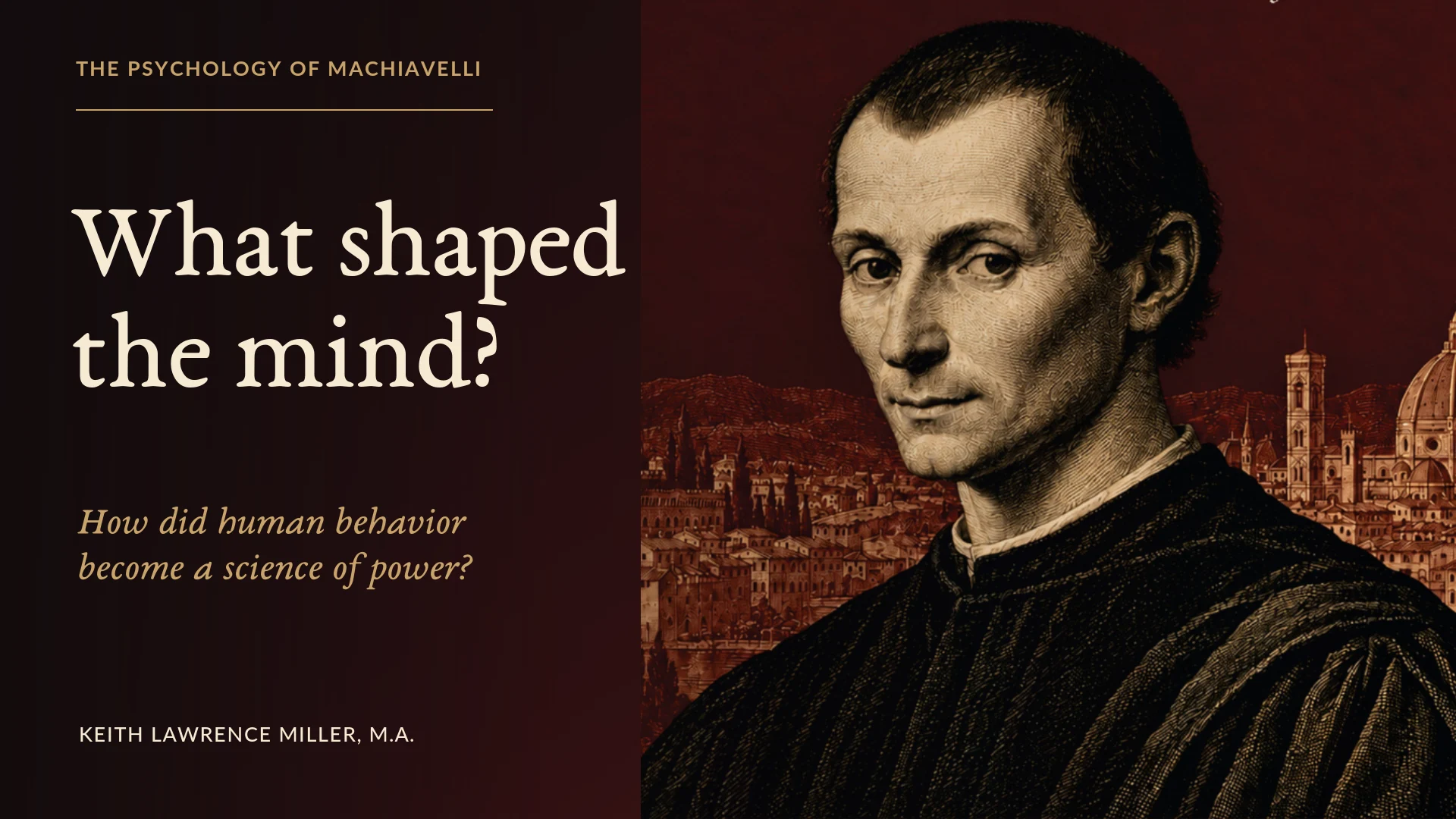
A person can be intelligent, capable, and right about what is happening, yet remain unable to change the outcome. Knowledge does not automatically become authority. Good intentions do not guarantee cooperation. A position that appears secure can disappear when the people and institutions supporting it change.
Niccolò Machiavelli examined these problems in the lives of others. He also encountered them in his own.
My work as an organizational psychology practitioner and executive coach concerns how people develop, exercise judgment, and act within organizations. In The Psychology of Machiavelli: How Human Behavior Became a Science of Power, I bring that perspective to a historical question: how did one person become so attentive to the relationship between human behavior and the conditions that give it force?
The book is an intellectual biography. It follows the formation of an observer, from family and education to diplomacy, military organization, political collapse, imprisonment, and the writing through which experience became an explanation of power.
At its center is a question larger than how to gain an advantage over another person: How does a human being learn to see other human beings this clearly? [1]
Before the reputation, there was a mind
Machiavelli is often encountered as an accusation before he is encountered as an author. His name suggests calculation, manipulation, and the pursuit of power without conscience. That reputation can decide what a reader expects before the first page is opened.
This book begins earlier.
It begins in a household where legal learning, books, written agreements, family obligations, and practical dependence existed together. His father, Bernardo, acquired access to Livy through the work of compiling an index. Books were not merely signs of cultivation. They were resources obtained, organized, borrowed, and used.
That environment matters to the inquiry. A person could possess learning without commanding an institution. A family could have property and still depend on arrangements with other people. A claim could be carefully written and still require recognition from someone with authority.
The early chapters examine these conditions alongside schooling, religious life, illness, and the protective actions of relatives. They ask what became available to the developing observer without pretending to recover every thought he had as a child.
The result is a developmental account rather than a legend of an already completed genius. Family supplied materials. Education supplied tools. What Machiavelli eventually made of them had to be learned through his own work. [2]
Florence gave observation consequences
Public service brought Machiavelli into situations where interpreting behavior was more than an intellectual exercise.
A government needed to know whether an ally would cooperate. An offer of soldiers raised questions about payment, command, readiness, and arrival. A persuasive explanation could fail because the person receiving it wanted something different. A promise could appear convincing and still not become an agreement.
The book follows Machiavelli at work within these problems. His diplomatic reports preserve expectations made before outcomes were known, competing explanations, and judgments that later events required him to revise.
Savonarola presents an observer's problem of belief and persuasion: how do a speaker's words change with political pressure, and how can fear, hope, and moral identity hold a following together?
Cesare Borgia presents problems of delegated authority, deception, public blame, and dependence. A ruler might overcome an immediate enemy without securing the larger relationships on which his survival rested.
The militia makes the inquiry practical in another way. Men had to be enrolled, supplied, trained, paid, and placed under command. Local attachments could obstruct public purposes. An order did not produce the resources required to carry it out.
Across these encounters, Machiavelli's attention moves between the person and the arrangement. Who wants what? What can that person actually command? What will others do in response? [3]
When the observer became the subject
The fall of the Florentine republic changed Machiavelli's own position within the forces he studied. Dismissal in 1512 was followed by restrictions, then arrest and torture in 1513. His knowledge survived the loss of his office. His authorized place in public work did not.
That difference gives the biography much of its human force.
A former secretary could still analyze affairs of state, but his competence could not require the new government to employ him. He could seek assistance, cultivate relationships, and offer his experience. Acceptance remained in other people's hands.
After release, he wrote that he would be more cautious and hoped the times would become less suspicious. He also sought work. Protection and participation belonged to the same continuing life.
The book does not make imprisonment the moment that created his entire understanding of human behavior. His earlier writings already show him examining persuasion, changing circumstances, and different actions that reach similar ends.
The observer existed before the prisoner. Political catastrophe changed his circumstances and the personal stakes of questions he had already learned to ask. Following that chronology makes his life more revealing, not less dramatic. [4]

Read this graphic as text
Family, education, public service, vulnerability, writing, and legacy form a developmental reading guide. Observation preceded imprisonment; the diagram does not make imprisonment the origin of the method. Source: the book’s opening inquiry and Parts I–III and VI.
Being good and being effective are different questions
One of the book's central arguments concerns the relationship between moral judgment and behavioral consequence.
An action can be morally objectionable and achieve its immediate purpose. An action can be admirable and fail to produce the result intended. Recognizing this does not require approving the objectionable act or abandoning the admirable purpose.
It requires continuing the inquiry.
Condemning deception does not explain how it obtains cooperation. Praising generosity does not establish who finances it or whether the giver can sustain it. Calling someone a good leader does not tell us whether the people, resources, and conditions needed for collective action are present.
Machiavelli's work becomes more demanding when we follow what happens after the first result. A ruler may acquire power without deserving glory. He may preserve himself while harming the community. A measure that secures obedience may create resentment that changes the next encounter.
The reader must therefore ask: effective for whom, toward what purpose, at whose expense, and for how long?
These questions do not replace moral responsibility with admiration for winning. They make it harder to mistake a successful act for a complete justification of that act. [5]

Read this graphic as text
Moral judgment asks: Is the action morally desirable? Behavioral consequence asks: Does it achieve its intended result? Understanding an action is not approving it. Source: Chapter 18, Morality and Outcome.
Fear, generosity, and the consequences that return
The book examines familiar words by following the relationships behind them.
Fear is not the same thing as hatred. A person may obey because punishment is credible while also wanting the authority removed. Immediate compliance does not reveal the whole relationship. A ruler who looks only for obedience may overlook the hostility his methods are producing.
Generosity also has more than one consequence. A benefit can win gratitude. Maintaining a reputation for giving can consume resources and impose burdens on people who receive little of the benefit. The action praised by one group can become the reason another group resents the giver.
Dependence complicates loyalty. Someone can appreciate assistance and become less free to refuse the person supplying it. A successful subordinate can increase an organization's capacity while becoming threatening to a superior who fears losing authority or recognition.
Fear of loss adds another force. People do not act only to acquire what they lack. They act to preserve what they already possess. An established holder of power may seek more because the existing position does not feel secure. The resulting effort at protection can make other people feel endangered and give them stronger reasons to resist.
In each case, a label is insufficient. The useful explanation follows the action into another person's response, then asks what that response makes possible next. [6]

Read this graphic as text
Purpose, action, response, and what follows. Who benefits? Who bears the cost? What happens next? This is a conceptual reading guide, not a numerical result or a new branded framework. Source: Preface, opening inquiry, and Chapter 30.
Why success can teach the wrong lesson
Past success can make a method difficult to question.
Machiavelli returns to the problem of people who prosper through a characteristic way of acting and continue to trust it after circumstances change. A cautious approach may serve one situation and fail in another. A bold initiative may work because of the particular interests and pressures surrounding it, not because boldness always wins.
The person sees the favorable result. The conditions that helped produce it may receive less attention.
This makes success an uncertain teacher. Experience can improve judgment, but it can also build confidence in a habit whose usefulness has expired. Repeating the action does not recreate the world in which it first succeeded.
The book follows this problem from Machiavelli's comparisons of contrasting styles to the question of institutional adaptation. A republic may draw on people with different capacities rather than require one individual to become capable of every response. Yet those capacities matter only when the institution can recognize and use them.
The question is not simply whether someone knows that change is needed. It is whether judgment, authority, and available means can come together to make a different course possible. [7]
An organizational psychologist before the discipline had a name
The book develops a clear argument: Machiavelli was an organizational psychologist before the discipline had a name and can be understood as its father through intellectual parentage.
The argument rests on what his work repeatedly does.
He examines selection and training, delegation and incentives, information and counsel, competing loyalties, group conflict, and the ability of institutions to endure. He asks how people become willing and able to act together, and why the intended result fails to appear when an essential condition is missing.
His practical organizational work matters here. Understanding that Florence needed a force of its own did not assemble one. Recruitment, command, equipment, records, exercise, and provision had to become a functioning arrangement. The gap between a sound intention and an operating institution was itself something to study.
Intellectual parentage concerns this sustained joining of behavioral observation, explanation, and practical organization. It does not claim that Machiavelli founded a modern psychology department or establish an uninterrupted line of professional training from Renaissance Florence to the present.
The larger foundation of the book remains the formation of his mind. The organizational psychology claim emerges from the life and work examined across the biography; it does not require every experience to be forced into a predetermined professional label. [8]
Machiavelli is not Machiavellianism
A modern psychological construct bearing an author's name is not a complete account of that author's life or thinking.
This book examines the difference between Niccolò Machiavelli, the cultural image attached to his name, and the later study of Machiavellianism. Treating them as identical can obscure his attention to public liberty, military preparation, institutions, and collective behavior.
His disturbing recommendations remain part of the record. A fuller reading does not require turning him into a harmless figure or pretending that deception is absent from his advice.
It requires reading beyond deception.
An explanation of how people can be manipulated does not establish everything about the observer's own personality. A recommendation addressed to a ruler is not a completed psychological questionnaire. A character in a comedy is not automatically the author's confession.
The biography returns to the person, the texts, and the situations that the available evidence can actually illuminate. [9]
The journey through the book
The book develops its inquiry across six parts and thirty-three chapters.

Read this graphic as text
Part I: The Making of a Mind, Chapters 1–4. Part II: The World Becomes a Human Laboratory, Chapters 5–12. Part III: When Power Turned on the Observer, Chapters 13–15. Part IV: The Psychology of Power, Chapters 16–25. Part V: From Observation to a Science of Power, Chapters 26–30. Part VI: The Mind He Left Behind, Chapters 31–33. Source: the manuscript contents.
The Making of a Mind begins with family, household learning, childhood conditions, and education. It establishes the materials available before public life made observation a professional responsibility.
The World Becomes a Human Laboratory follows Florence, Savonarola, diplomacy, foreign dependence, Borgia, and the militia. Human behavior becomes a problem to interpret while consequential events are still unfolding.
When Power Turned on the Observer examines the collapse of Machiavelli's institutional world, his expressed intention to exercise greater caution, and the reconstruction of his intellectual work after exclusion.
The Psychology of Power considers motives, fear of loss, morality and outcomes, rewards, reputation, cooperation, obedience, habit, and group conflict. Each subject is examined through the circumstances and responses that make it consequential.
From Observation to a Science of Power turns to The Prince, the Discourses, The Art of War, and the wider literary work. It asks how accumulated observation became arguments that another person could read, question, and use.
The Mind He Left Behind addresses Machiavellianism, the relationship to later disciplines, and what subsequent readers can be shown to have taken from his work. [10]
What a science of power means here
The subtitle describes a method of inquiry, not a promise of control.
Machiavelli compared cases, examined circumstances, questioned appearances, considered outcomes, and attempted to organize collective action. His knowledge came through records, books, correspondence, public responsibilities, and encounters with other people.
Calling that undertaking a science of power does not attribute modern laboratory experiments to him. It identifies an effort to make the operation of power explainable through human conduct rather than leave power as a word that explains itself.
The book follows that effort while keeping historical evidence separate from psychological interpretation. Where a letter records an intention, it is treated as an intention. Where the sources permit an explanation but cannot settle it, the explanation remains an argument rather than becoming an invented event.
The reader encounters a mind at work within limits. The value lies in the quality of its questions and explanations, not a claim that its conclusions were infallible. [11]
Read the man behind the name
The Psychology of Machiavelli is for readers interested in psychology, intellectual biography, history, leadership, and the organization of human life. It is also for anyone dissatisfied with an account of power that stops at a person's title, stated intentions, or reputation.
The book offers a way to examine what people seek, what they fear losing, how their position affects their choices, and why other people's responses can change the meaning of an apparent success.
Its invitation is not to imitate every strategy Machiavelli described. It is to understand the observer who made those strategies, their conditions, and their consequences available for examination.
Before his name became shorthand for manipulation, there was a person learning to observe. This book follows that person through the world that formed him and the ideas he left behind.
Begin with the mind behind the reputation.
View The Psychology of Machiavelli on Amazon
About the author
Keith Lawrence Miller, M.A., is an author, executive coach, and organizational psychology practitioner. He earned a Master of Arts in Organizational & Business Psychology and an Advanced Certificate in Collective Intelligence in Organizations from Teachers College, Columbia University. His work connects psychology, leadership, career strategy, education, and the relationship between human capability and institutional life. [12]
Source notes
This author essay draws on The Psychology of Machiavelli: How Human Behavior Became a Science of Power by Keith Lawrence Miller. Historical claims and psychological interpretations are developed with endnotes and source references in the book.
[1] Preface and opening inquiry. [2] Chapters 1–4. [3] Chapters 5–12. [4] Chapters 13–15. [5] Chapter 18. [6] Chapters 16–23. [7] Chapters 12 and 24. [8] Chapter 32. [9] Chapter 31. [10] Contents and the six part introductions. [11] A Note on Method and Language; Chapter 30. [12] About the Author.
Published 2026-10-14. Last updated 2026-10-14. For attribution and republication guidance, use the newsroom story desk.
Read the mind behind the reputation.
Explore The Psychology of Machiavelli by Keith Lawrence Miller, M.A.