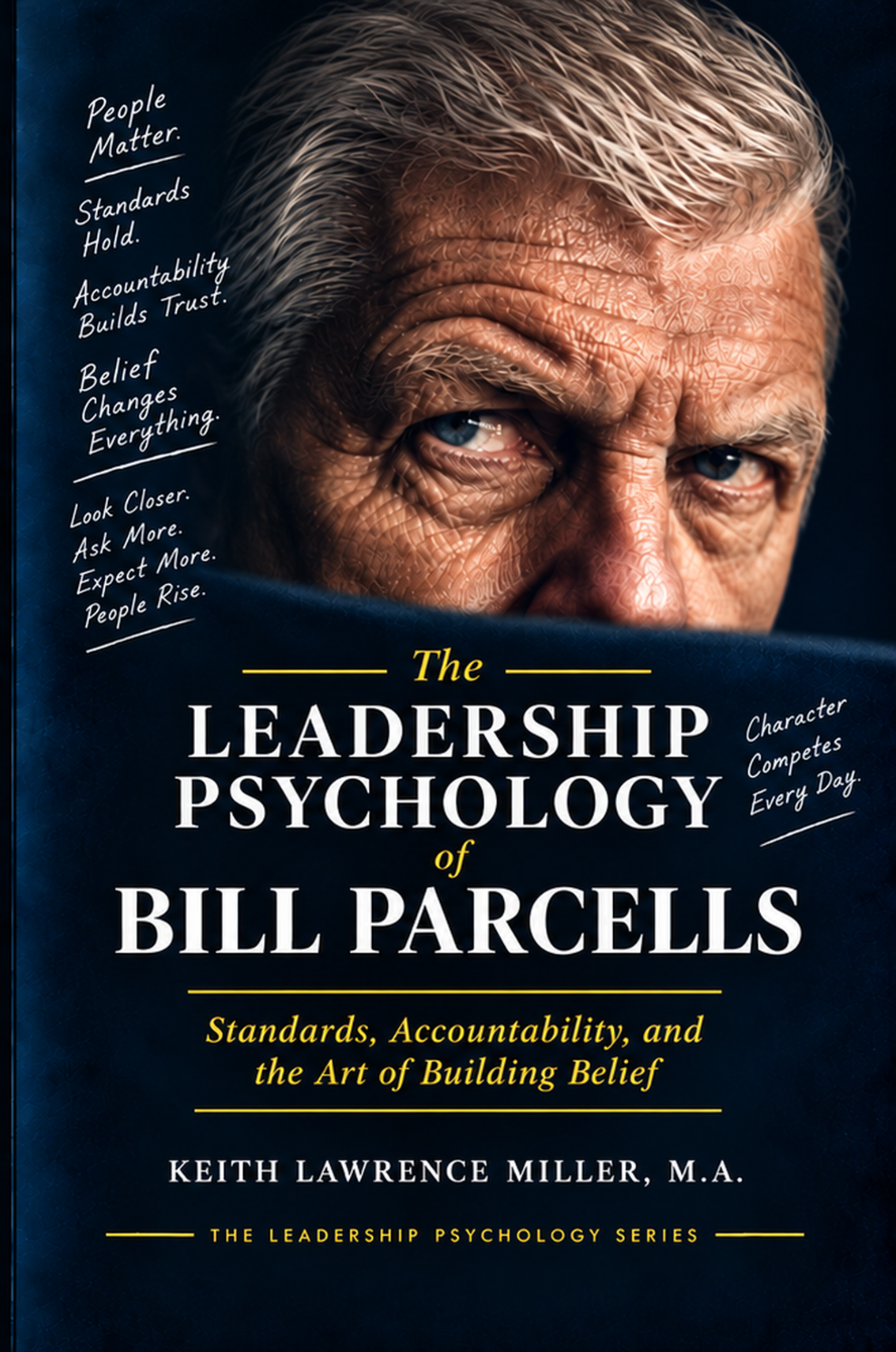
The Leadership Psychology of Bill Parcells: What I Learned About Standards, Accountability, and Building Belief
By Keith Lawrence Miller, M.A.
My interest in Bill Parcells began before I had the language to call it leadership.
It began with my father.
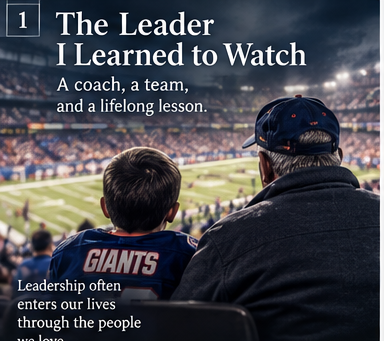
My father had followed the New York Giants since the late 1940s. By the time I was old enough to understand football, the team was already part of the rhythm of his life. I was competitive and naturally inclined to choose my own side, so I initially rooted against his Giants. I picked Joe Montana and the San Francisco 49ers before their championship following the 1984 season. The next year, I told my father that the Chicago Bears would win the Super Bowl. They did.
Meanwhile, I continued watching every Giants game beside him.
Something changed as I watched the team change.
During the 1984 and 1985 seasons, the Giants were becoming more disciplined, more connected, and increasingly difficult to knock away from their plan. By 1986, I told my father I was finally joining him. I would root for the Giants, and I believed they were going to win the Super Bowl.
They did.
The Giants won Super Bowl XXI, and I became a lifelong Giants fan. More importantly, a football season became part of the relationship I shared with my father. The championship remains meaningful to me because we experienced it together.
Lawrence Taylor immediately showed me what extraordinary individual performance looked like. Parcells made me pay attention to something broader: the preparation, assignments, standards, role clarity, coordination, and collective effort surrounding the star.
I did not know the terminology then. I was a child watching leadership become visible through football.
Years later, after studying organizational psychology, coaching leaders, working with teams, raising a family, and thinking more seriously about how people develop, I returned to those experiences with different questions.
What exactly had I admired?
Which parts of Parcells's leadership were transferable beyond professional football?
Which depended on the conditions of the NFL?
When did intensity serve development?
When could the same intensity become damaging?
Why did some people appear to respond extraordinarily well to his demands?
How did standards become believable?
And how could I separate admiration for a leader from the temptation to defend everything associated with him?
Those questions became The Leadership Psychology of Bill Parcells.
The book is an independent work of leadership analysis and personal reflection. It claims no endorsement from Parcells, the NFL, or any team discussed, and it explicitly avoids clinical diagnosis or invented access to private deliberations. Historical evidence, participant recollections, psychological research, personal interpretation, and hypothetical teaching applications are kept distinct throughout the book.
That discipline matters because the leadership lesson I ultimately carried forward was more demanding than simply telling people to be tough.
Admiration Becomes Useful Only After It Survives Examination
It is easy to study a successful leader backward.
Once we know that Parcells won championships, transformed struggling teams, developed accomplished assistants, and became one of the most recognizable coaches of his era, earlier decisions begin to look inevitable.
They were not.
After Parcells's first season as Giants head coach, the team was 3-12-1 and his future was uncertain. Later accounts indicate that general manager George Young considered replacing him. The championships that would eventually strengthen Parcells's authority did not yet exist.
That case changed how I think about leadership evaluation.
A poor result can expose bad judgment.
It can also arrive while a leader is correcting an underlying system whose improvement has not yet reached the final outcome.
Patience can protect development.
It can also protect failure.
The serious question is therefore neither “Did the leader fail?” nor “Should we believe in the leader?”
The question is:
What did the failure reveal, what will change, and what evidence should appear next if the explanation is correct?
That converts patience from faith into a monitored investment.
The leader should be able to identify what the first result exposed, what falls within their control, what corrective action follows from the diagnosis, and when the organization will review the evidence again.
Later success should update our judgment.
It should not rewrite the uncertainty that existed when the decision had to be made.
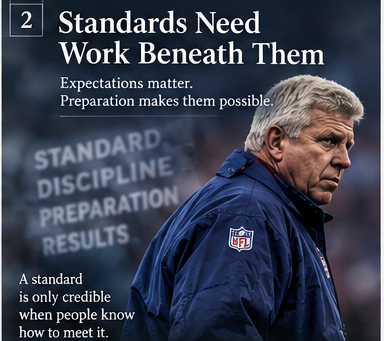
A Standard Has to Describe the Work
Parcells is strongly associated with standards and accountability. Those ideas sound simple until a leader has to apply them to real people under changing conditions.
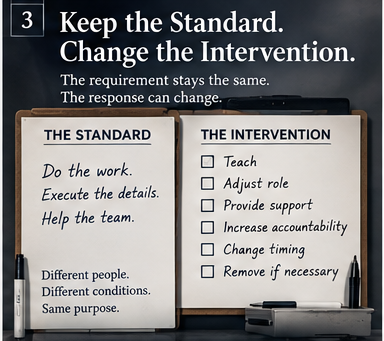
One of the most important conclusions I reached while writing the book is that a standard and an intervention are different things.
The standard answers:
What does the work require?
The intervention answers:
What should this leader do now, with this person, under these conditions?
Those questions should never be confused.
Two people can miss the same requirement for completely different reasons. One may never have been properly taught the task. Another may have demonstrated the capability repeatedly and stopped doing what was agreed. A third may lack a necessary resource. Someone else may understand the work but be operating under conflicting priorities.
Identical failure does not establish identical cause.
That means identical treatment can produce the appearance of consistency while ignoring reality.
The book describes this as keeping the standard while changing the intervention. A strong leader should be able to preserve a legitimate requirement while changing instruction, support, timing, role design, consequences, or decision authority when the conditions justify it.
Consistency should exist at the level of purpose and reasoning.
It should not require a leader to repeat one favorite method regardless of evidence.
Toughness Without Diagnosis Is Just a Style
Leadership discussions often become arguments about personality.
Be tougher.
Be more supportive.
Be decisive.
Give people space.
Push harder.
Listen more.
Every one of those recommendations may be appropriate in some circumstances.
None tells us whether it is appropriate now.
Parcells interested me because his public image was intensely demanding, yet the closer historical record repeatedly shows decisions that resist a simple theory of relentless pressure.
In 1990, for example, the Giants canceled planned joint practices with New England after holdouts and injuries left the team insufficiently prepared for the exercise they had intended to conduct. A superficial reading might say a hard-driving coach should always welcome more practice.
The more useful interpretation is that preparation is valuable only when the activity serves the purpose of preparation. Completing an exercise merely because it was scheduled can produce activity without useful development.
That leads to a principle I find important in business as well:
Commitment belongs to the objective before it belongs to the original plan.
There are times when persistence reflects discipline.
There are also times when continuing protects a bad design because admitting that circumstances changed feels like weakness.
A leader should know the difference.
Accountability Begins With an Accurate Diagnosis
Accountability is often presented as something leaders impose after failure.
I think it should begin earlier.
The leader is accountable for understanding the problem well enough to direct pressure toward something that can actually change.
If a person lacks instruction, greater pressure does not supply instruction.
If a team lacks decision authority, greater motivation does not create authority.
If the work is badly designed, exhortation can turn a leadership failure into an employee character judgment.
If someone has clearly demonstrated capability and repeatedly violates an understood responsibility without a relevant constraint, direct accountability becomes much more defensible.
That distinction is what makes demanding leadership credible.
The standard governs the leader too.
Before judging another person's response, the leader should know what was requested, whether the expectation was understood, what resources and authority were available, whether the person had demonstrated the capability before, and what changed.
Only then does intensity have a legitimate target.
Belief Needs Work Under It
Parcells also shaped the way I think about belief.
Leadership language is filled with encouragement.
Believe in yourself.
Believe in the team.
Believe we can win.
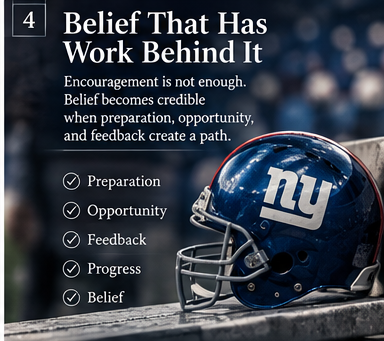
Those messages can matter, but confidence becomes cheap when it has no relationship to preparation.
One of the book's chapters is called Belief That Has Work Behind It because that is the kind of belief I came to admire.
A leader's confidence should give someone a credible next step.
The person needs to understand the standard, receive preparation connected to it, possess a realistic opportunity to perform, and receive feedback that helps determine whether progress is actually occurring.
Otherwise, encouragement can become a burden.
The leader announces belief while someone else pays the cost of an impossible assignment.
Parcells's former players have publicly described the experience of being pushed toward capacities they believed he saw in them. The book treats those recollections as participant accounts rather than proof of a universal causal effect, but they reveal an important meaning those players attached to the relationship: someone expected more and connected that expectation to work.
That distinction matters to me.
I have always been interested in helping people experience an accomplishment they can legitimately claim.
In athletics, I was above average in many sports and strong in several, yet exceptional speed was never the gift that settled competition in my favor. I learned to invest in preparation, decisions, positioning, rapport, practical coaching, and finding ways for teammates with fewer obvious physical advantages to contribute meaningfully.
I wanted them to recognize that the victory belonged partly to them.
That is what belief should do.
It should make contribution possible.
The Star Does Not Explain the Team
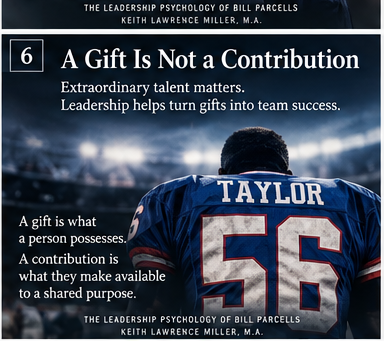
Lawrence Taylor was impossible to ignore.
His athletic ability and competitive force attracted attention immediately.
Parcells taught me to look at everyone around him.
A team does not become exceptional because one person is extraordinary. Someone maintains an assignment that prevents a breakdown. Someone coordinates a handoff. Someone prepares an opponent look during practice. Someone absorbs responsibility that never appears in the highlight.
The person who finishes the visible play may depend on several people who made the play possible without touching the final moment.
That became a powerful leadership lesson for me.
A gift is something a person possesses.
A contribution is what that person makes available to a shared purpose.
Leadership helps convert gifts into contributions.
The distinction changed what I valued in teammates and later what I valued professionally. People who are less impressive individually can become indispensable when their capabilities are correctly positioned inside a system.
A roster tells us who is available.
The work of the team determines what those people can accomplish together.
Leadership Also Travels Upward
Leadership literature often places the leader at the top of every causal sentence.
The coach developed the player.
The manager created the culture.
The executive built the team.
Real relationships are more complicated.
Parcells's public description of Curtis Martin is one of the cases I found most instructive because Parcells placed himself among the people Martin had influenced.
That reverses the normal direction of the story.
Formal authority remained with the coach.
Learning did not.
Someone lower in the hierarchy could raise the standard of the person above him.
That idea deserves much more attention in organizations.
A leader can define expectations while an employee reveals a better way to work.
A manager can hold final accountability while a specialist has superior knowledge.
A new colleague can expose an assumption that everyone else has stopped questioning.
The mature leader does not absorb every improvement into their own reputation.
Credit should travel toward the person who made the contribution.
The organization learns more effectively when it knows where useful knowledge actually came from.

Fairness Does Not Require Identical Treatment
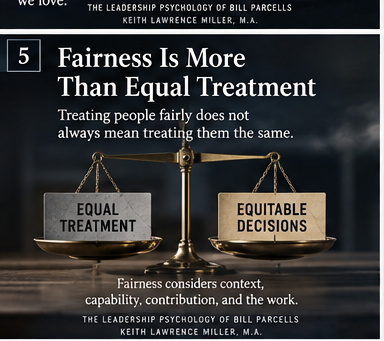
Parcells publicly articulated a distinction that became another major theme in the book: fair treatment does not always mean identical treatment.
That principle can easily become an excuse for favoritism, so it deserves scrutiny.
Different treatment becomes defensible when the relevant conditions are genuinely different and the reason connects to the work.
A novice may require more instruction than an expert.
A person returning from injury may require a different readiness assessment from someone returning from a contract dispute.
A high performer may receive an assignment requiring capabilities others have not demonstrated.
Those differences can be legitimate.
Fame, personal preference, friendship, convenience, or revenue can also influence a leader while being disguised as judgment.
That is why discretion needs explanation, boundaries, review, and a correction path.
The book draws on organizational-justice research to separate fairness into different questions: Was the outcome defensible? Was the procedure sound? Was the person treated with dignity? Was the explanation truthful and adequate?
A leader who says, “I treat everyone fairly, although I do not treat everyone the same,” therefore takes on a demanding obligation.
The differences should survive inspection.
Preparation Gives People a Chance Under Pressure
One reason Parcells made such a strong impression on me was the relationship I perceived between preparation and performance.
Pressure does not create preparation.
It reveals what preparation made available.
The 1990 NFC Championship Game provides one of the clearest examples in the manuscript.
Late in the game against San Francisco, the Giants faced fourth-and-two. Gary Reasons recognized an alignment the team had prepared to exploit. Parcells had given him conditional authority to call a fake punt if the condition appeared. Reasons saw it, called the play, took the direct snap, and ran thirty yards.
The result was memorable.
The decision architecture is more useful.
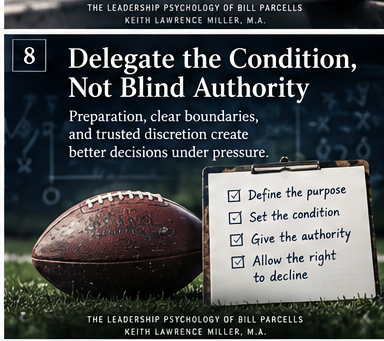
The leader established the purpose and boundary.
The person closest to the changing condition had immediate information.
Preparation allowed him to interpret what he saw.
And genuine discretion required that declining the opportunity remain a legitimate choice if the condition was absent.
That is a much more sophisticated form of delegation than telling someone to “use your judgment.”
Judgment becomes usable when people know what they are trying to protect, which evidence matters, what they may decide, what they may not decide, and when the decision returns to another authority.
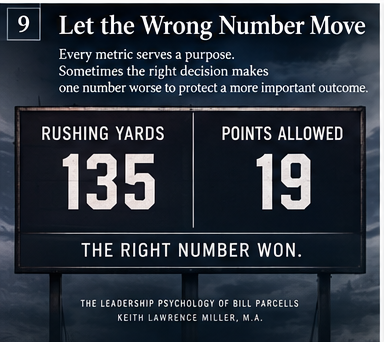
Sometimes the Wrong Number Has to Move
Super Bowl XXV produced another leadership lesson I find useful far beyond football.
The Giants had built part of their defensive identity around stopping the run. Against Buffalo, however, Bill Belichick's defensive plan was willing to tolerate more rushing yards in order to reduce opportunities for Buffalo's dangerous passing attack.
Thurman Thomas ultimately rushed for 135 yards.
Buffalo scored nineteen points.
The Giants won 20-19.
The lesson is not that worsening a metric is inherently wise.
It is that every measure serves a purpose.
Organizations eventually get into trouble when a proxy becomes more important than the reason it was created.
A department protects its response-time number while customers remain unresolved.
A sales team protects volume while creating unprofitable work.
A recruiting function protects time-to-fill while sacrificing candidate quality.
A leader protects attendance even when attendance no longer produces useful collaboration.
A metric can improve while the system deteriorates.
Leaders therefore have to understand when a local number should remain firm and when the larger objective requires a disciplined tradeoff.
A Result Cannot Justify Every Method
This was one of the most important places where my admiration became more demanding.
Parcells led in a competitive environment where pressure, public correction, scarce roles, physical risk, and intense evaluation were part of professional football.
That context matters.
It still does not mean that winning settles every question about method.
A team can perform after an intense intervention.
That proves the performance occurred.
It does not prove the intervention caused the performance, that a less costly method would have failed, or that every human consequence was justified.
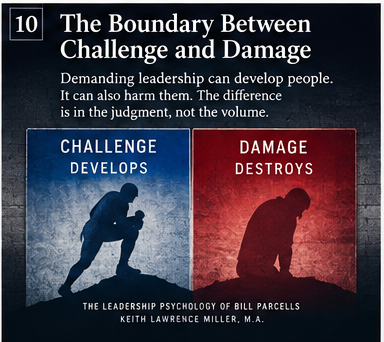
The book treats the boundary between challenge and damage seriously for that reason.
A demanding intervention should remain connected to the work. The person should understand the standard, the gap, the consequence, and what happens next. Intensity that adds no useful information may express a leader's anger more clearly than it improves performance.
Dignity creates another boundary. Accountability can be severe and still remain specific. A consequential failure can justify removal from a role or another serious consequence. None of that requires turning a documented performance problem into a global judgment about someone's worth.
This is where studying Parcells through organizational psychology became more valuable than simply admiring the surface style.
The transferable lesson is rarely the yelling.
The transferable lesson is the judgment beneath the intervention.
Conflict Is Not Over Because the Leader Says It Is
The famous 1990 sideline confrontation between Parcells and Phil Simms became another important test.
Both men remembered the confrontation.
Their accounts differed regarding what triggered it and how quickly the tension subsided afterward.
Parcells remembered relatively rapid closure.
Simms remembered tension continuing through the following week.
The leadership lesson is significant.
The person with greater authority does not have exclusive standing to declare that a relationship has recovered.
Two people can return to productive work and still remember the cost of a conflict differently.
Repair should therefore be judged through more than the leader's intention.
Can the other person still speak?
Can they disagree?
Can they perform consequential work?
Did conduct change if something avoidable occurred?
Did correction reach the audience that heard an inaccurate public claim?
A championship later in the season does not reach backward and certify every interaction that preceded it.
That principle has enormous relevance in workplaces.
Results matter.
Relationships through which future information must travel matter too.
A Great Staff Should Add Capability, Not Decoration
Parcells's coaching staffs became another part of the story I wanted to understand.
The 1990 Giants staff included several assistants who had already been or would later become head coaches, including Tom Coughlin, Bill Belichick, Romeo Crennel, Ron Erhardt, Al Groh, Charlie Weis, and Ray Handley.
Their later careers are impressive.
They do not prove that Parcells created those careers.
That causal restraint improves the leadership lesson.
The important question is what a strong staff actually does while everyone is still in the room.
Does expertise have a meaningful domain?
Can specialists influence consequential decisions?
Can people disagree before the answer is fixed?
Does the principal integrate competing judgments rather than requiring everyone to imitate his first opinion?
Does credit identify who contributed?
A leader who hires talented people and then requires them to mirror the leader has purchased decoration.
A strong staff should add capability.
The Organization Should Become Less Dependent on the Leader
Leadership success creates an uncomfortable test.
What happens after the leader leaves?
A turnaround may look impressive while important knowledge, relationships, authority, and decision patterns remain concentrated in one person.
The organization becomes faster and more dependent at the same time.
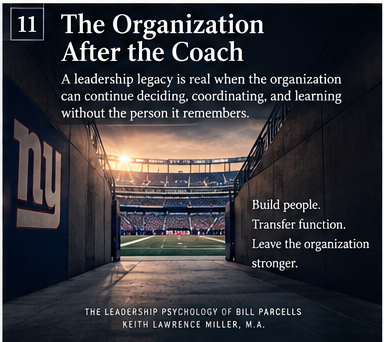
The book uses Parcells's later Miami experience to examine this question. After moving from an executive role to a consulting position while general manager Jeff Ireland received full football authority, Parcells later expressed the view that he had left unfinished work. The manuscript treats that as Parcells's retrospective self-assessment rather than proof of what caused later Dolphins performance.
The broader issue is succession.
Has the organization transferred the function?
Can other people identify the relevant signals?
Do they possess the relationships and information needed to act?
Has authority moved along with responsibility?
Can the group make a sound decision that differs from what the former leader might have preferred?
If every difficult question still returns to the predecessor, the title may have transferred while the work has not.
A leadership legacy becomes operational when the organization can continue deciding, coordinating, and learning without waiting for the person it remembers.
The Leadership Fit Review
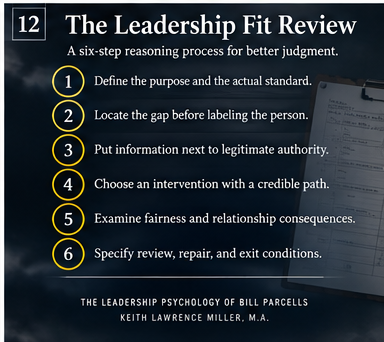
The book eventually converts these cases into an original six-step reasoning process called the Leadership Fit Review.
It is explicitly unvalidated. It produces no leadership score, does not predict human behavior, and does not replace legal, clinical, safety, labor, regulatory, technical, or other qualified professional judgment.
Its purpose is simpler: slow down leadership judgment enough that the reasoning can be examined.
The six steps are:
- Define the purpose and the actual standard.
What is the organization trying to protect or achieve?
- Locate the gap before labeling the person.
What actually failed, and what evidence identifies the cause?
- Put information next to legitimate authority.
Who knows what, and who is authorized to decide?
- Choose an intervention with a credible path.
Why should this response improve the identified condition?
- Examine fairness and relationship consequences.
Was the process defensible, the person treated with dignity, and the explanation adequate?
- Specify review, repair, and exit conditions.
What evidence will show whether the response worked, and what will cause the leader to change it?
The book's central instruction is to translate judgment rather than mannerisms. A leadership move should be copied only after the conditions that made it useful are understood.
That is where my thinking about Parcells ultimately landed.
I do not need to sound like him.
I need to understand what the intervention was trying to accomplish.
What I Carry Forward
I began the book with admiration.
I ended it with admiration subjected to harder questions.
Preparation remains one of the strongest lessons.
People deserve a credible way to meet the standard placed before them.
Accountability remains important.
Its usefulness depends on understanding what happened well enough to direct correction toward the actual problem.
Belief remains important.
It becomes credible when preparation, opportunity, evidence, and honest feedback give someone something meaningful to do with that belief.
Discipline remains important.
Its purpose should be development, execution, responsibility, or protection of the work rather than an outlet for the leader's frustration.
Fairness remains important.
It requires more intellectual work than treating everyone identically.
Rapport remains important because leaders need information from the people affected by their decisions.
And achievement remains important because accomplishing something difficult can become part of how people understand what they are capable of doing next.
The research did not erase what Parcells meant to me.
It made that influence more precise.
I still see Parcells as an extraordinary leader, while also making clear that admiration cannot substitute for historical evidence or justify every tactic.
That is the kind of admiration I want to preserve.
The mature response to a powerful example is neither imitation nor automatic defense.
It is translation.
Carry forward the seriousness of preparation.
Carry forward the expectation that people understand their responsibilities.
Carry forward belief that has real work beneath it.
Give people a meaningful opportunity to contribute.
Give credit accurately.
Hold leaders accountable for the effects of their methods.
Let context change the intervention.
And keep the people who actually performed the work inside the story.
Long before I could explain any of this, I learned the first version beside my father.
The 1986 Giants gave us a championship to share. Parcells's leadership entered my life through that relationship, which is why the lesson has always been larger than football.
That is what I once thought of as the gift of winning.
The more I studied leadership, the more demanding that idea became.
The leader's job is not merely to produce the result.
It is to help create the conditions in which people can prepare, contribute, improve, accept responsibility, and legitimately recognize that some part of the achievement belongs to them.
That is the leadership psychology of Bill Parcells that I carry forward.
About the Book
The Leadership Psychology of Bill Parcells: Standards, Accountability, and the Art of Building Belief is an independent work of leadership analysis and personal reflection in The Leadership Psychology Series, which examines how consequential leaders acquire authority, make decisions under pressure, shape institutions, and expose the limits of personal power.
The book combines documented football history, participant recollections, organizational-psychology research, Keith Lawrence Miller's personal experience watching the Giants with his father, and explicitly identified hypothetical applications. It examines standards, preparation, accountability, belief, fairness, reciprocal influence, staff design, conflict and repair, delegation, metrics, role changes, demanding leadership, succession, communication, institutional recognition, and the transfer of leadership principles beyond their original setting.
The psychological discussion concerns documented behavior, relationships, and organizations rather than clinical diagnosis. Original tools such as the Leadership Fit Review are presented as unvalidated reasoning aids rather than assessments or predictive instruments.
Keith Lawrence Miller, M.A. ISBN: 9798176626308 Imprint: Independently published