Full book feature
An Assessment Is a Snapshot, Not a Sentence
People are drawn to assessments because they promise something difficult to obtain: a clearer view of themselves.
Why do I react this way? Why do certain environments energize me while others exhaust me? Why do I plan carefully and still procrastinate? Why do I communicate well with some people and struggle with others? What motivates me? How do I respond to stress? What kind of leader am I becoming? Where am I growing? Where am I getting in my own way?
A well-designed assessment can help make those questions more concrete.
It can give language to a pattern. Reveal a tension. Highlight a blind spot. Create a baseline. Suggest a useful experiment. Open a conversation.
What it cannot do is reduce a human being to a number.
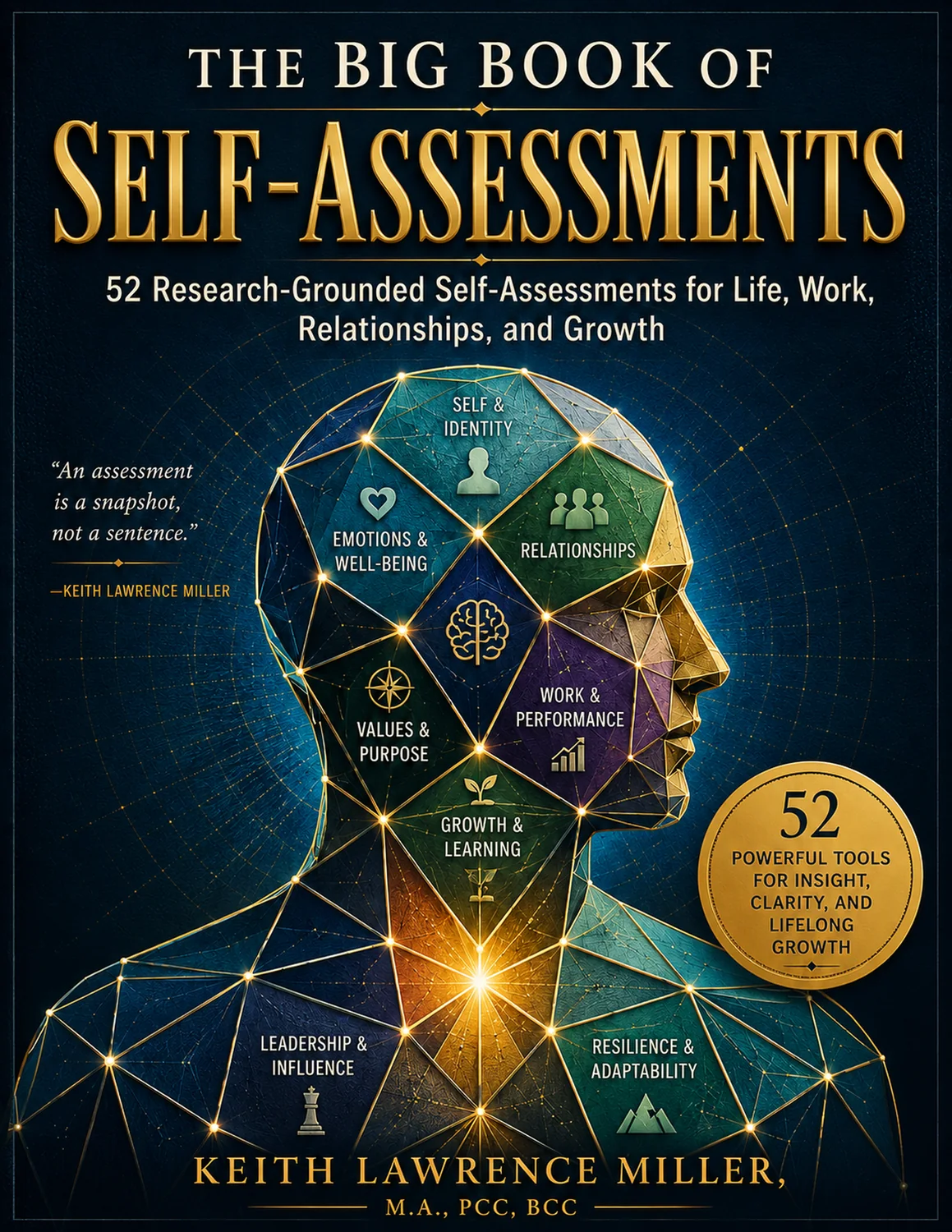
That distinction sits at the center of The Big Book of Self-Assessments.
The book contains 52 structured assessments across major areas of life and work, but its larger purpose is not to generate 52 labels.
Its purpose is to develop a more disciplined form of self-inquiry.
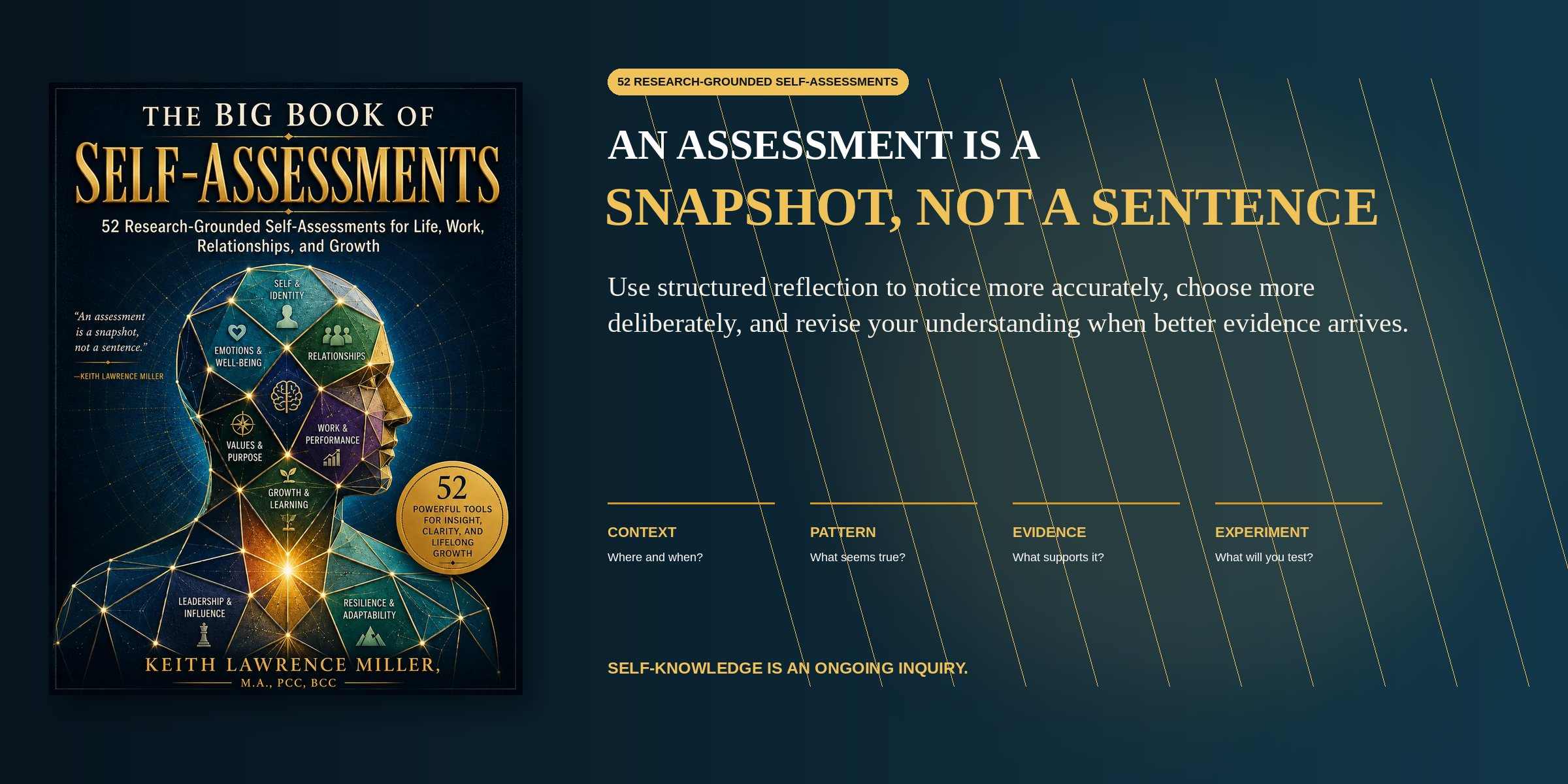
The governing principle is simple: An assessment is a snapshot, not a sentence.
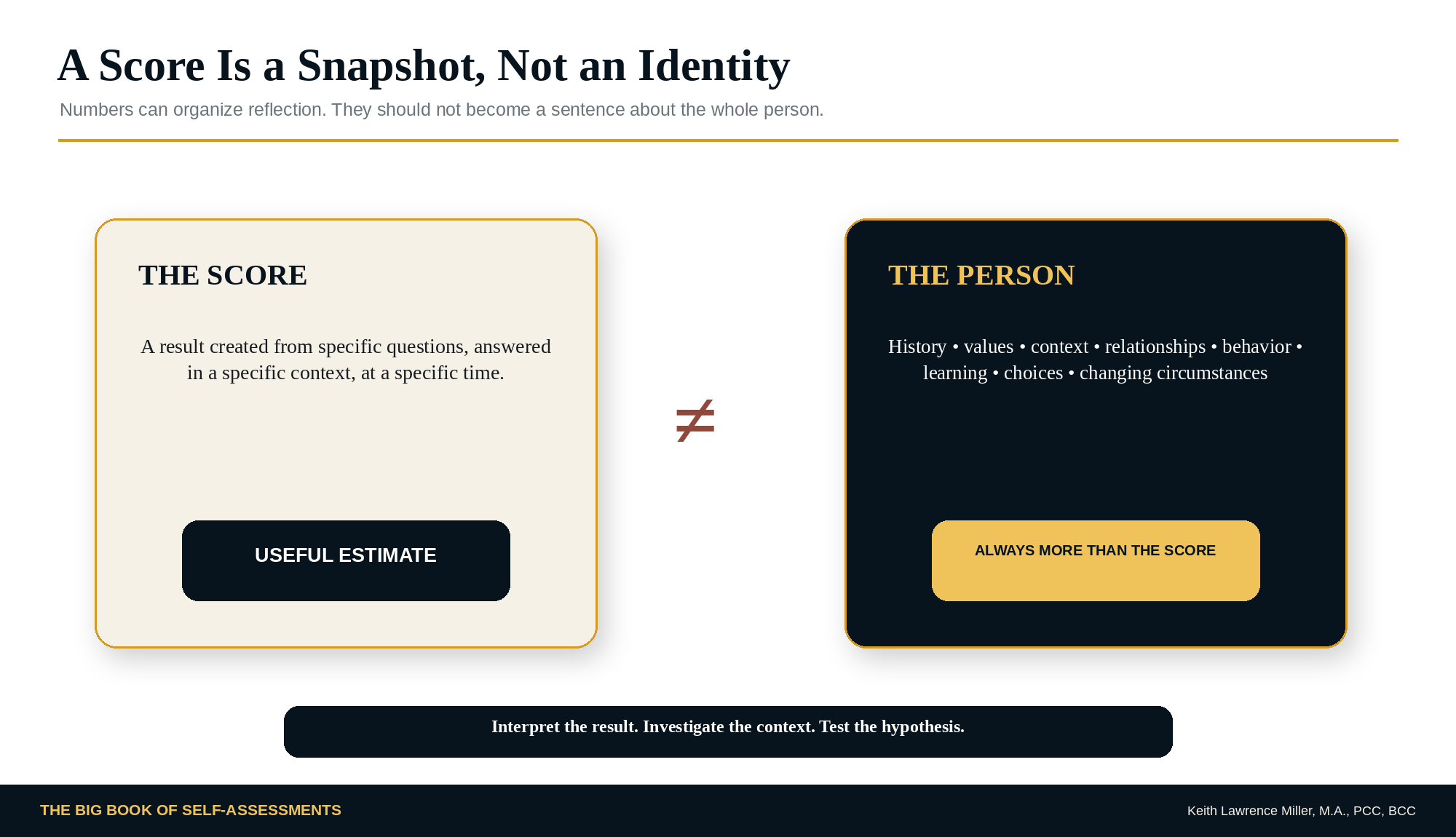
A Score Is an Estimate, Not an Identity
Every self-assessment begins with limitations.
A particular person answers a particular set of questions while thinking about a particular context and period of life.
That result may be useful. It is still incomplete.
Mood can affect responses. Recent events can affect responses. The role a person is thinking about matters. Behavior at work may differ from behavior at home. Standards change. People compare themselves with different reference groups. Memory is selective.
A responsible assessment therefore does not say: This score is who you are.
It asks: What might this result be telling us, in this context, at this point in time?
Different Constructs Change at Different Speeds
One reason assessment results are misunderstood is that people treat every measured pattern as equally permanent.
They are not.
Some assessments concern broad dispositions. These patterns may demonstrate meaningful stability while still changing across roles, relationships, cultures, health conditions, life stages, and experience.
Other assessments concern habits, skills, coping strategies, preferences, perceptions, current states, attention patterns, and work practices.
These may change more quickly.
A temporary period of exhaustion should not automatically become a personality conclusion. A preference should not be confused with an ability. A current habit should not be treated as destiny.
Trait, State, Skill, Preference, Value, Habit, and Perception Are Different
Trait: a relatively broad tendency that may demonstrate moderate stability while still varying across circumstances and development.
State: a more temporary condition influenced strongly by the current situation.
Skill: a learnable capacity demonstrated through performance and practice.
Preference: a pattern of liking or fit that may guide choices without determining competence.
Value: a priority used to judge what matters and what deserves pursuit.
Habit: a repeated behavior supported by cues, routines, rewards, and environment.
Perception: an interpretation of oneself, another person, or an environment.
These categories matter because the right developmental response depends on what has actually been assessed.
High Is Not Automatically Good
Assessment culture often treats higher scores as better.
Human behavior is more complicated.
More assertiveness can support leadership. Too much can become pressure. Persistence can support achievement. It can also become rigidity. Trust can support relationships. Poorly calibrated trust can create avoidable exposure. Conscientiousness can support quality. Extreme standards can contribute to perfectionistic delay.
The useful question is rarely: How can I maximize this score?
A stronger question is: How well does this pattern fit the demands, values, relationships, and consequences of the situation I am in?
Self-Perception Is Evidence, Not the Only Evidence
Self-assessment necessarily depends on self-report.
That information matters. Nobody else has direct access to every private intention, effort, emotion, or thought.
Yet self-report is incomplete.
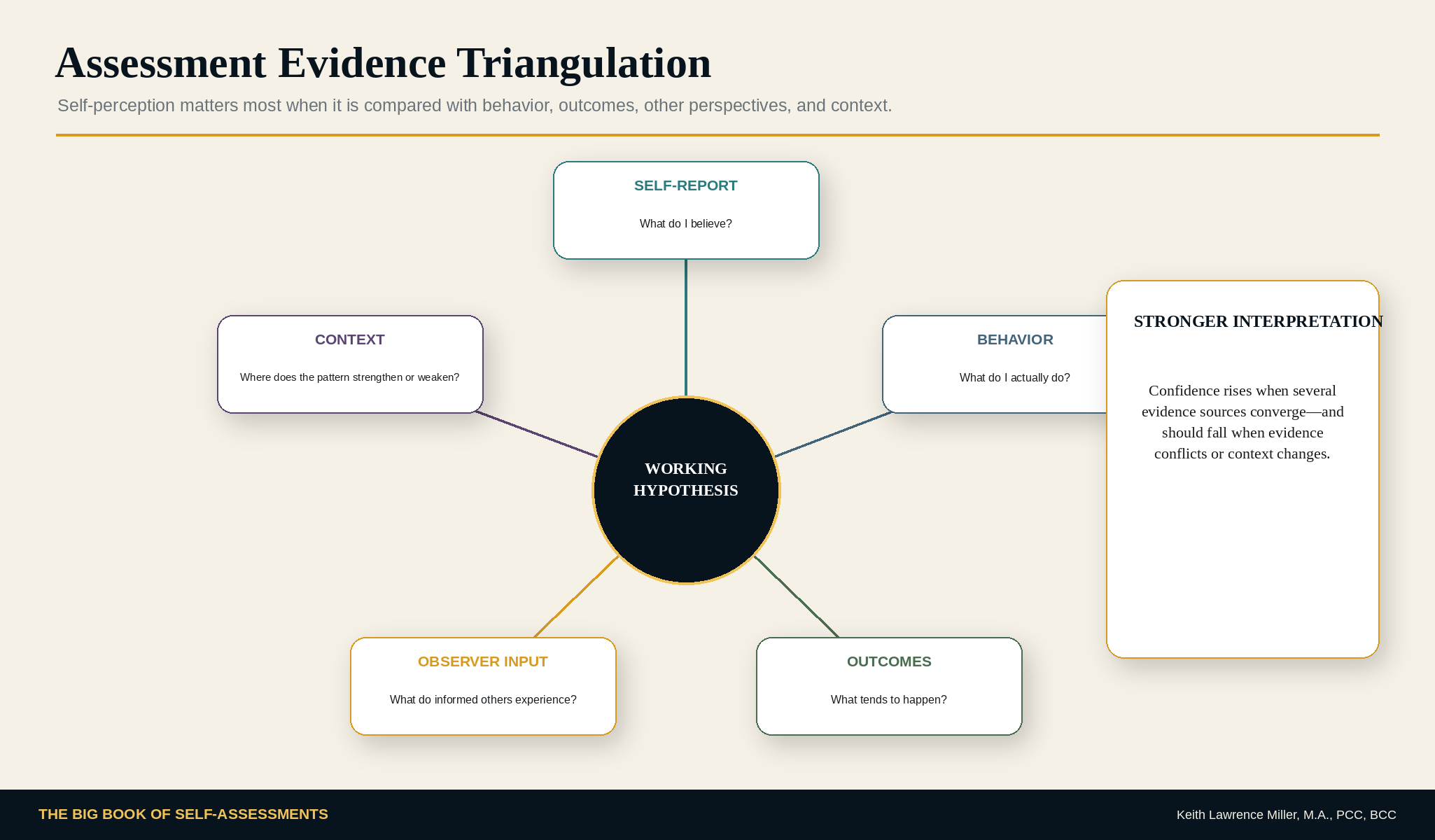
For that reason, the book encourages selected comparisons among several evidence sources: self-report, behavioral evidence, outcome evidence, observer evidence, and contextual evidence.
A single score becomes more useful when placed beside real life.
Contradictions Are Information
Human beings are full of apparent contradictions.
A person may show high empathy and weak boundaries. Strong conscientiousness and chronic procrastination. Confidence and weak verification habits. Social warmth and discomfort with public disagreement. Curiosity and poor follow-through. High trust and low calibration.
Those are not necessarily assessment failures.
They may be the most interesting findings.
The contradiction asks: Under what conditions does each pattern emerge? Does one strength create a cost somewhere else? Are two priorities competing? Is the environment activating one tendency more strongly?
Do Not Build a Hidden Personality Type From Several Scores
One danger of taking many assessments is the temptation to combine them into a grand label.
The book explicitly resists that move.
Scores from different chapters are not automatically comparable. They may use different constructs, numbers of items, response anchors, timeframes, and evidence bases.
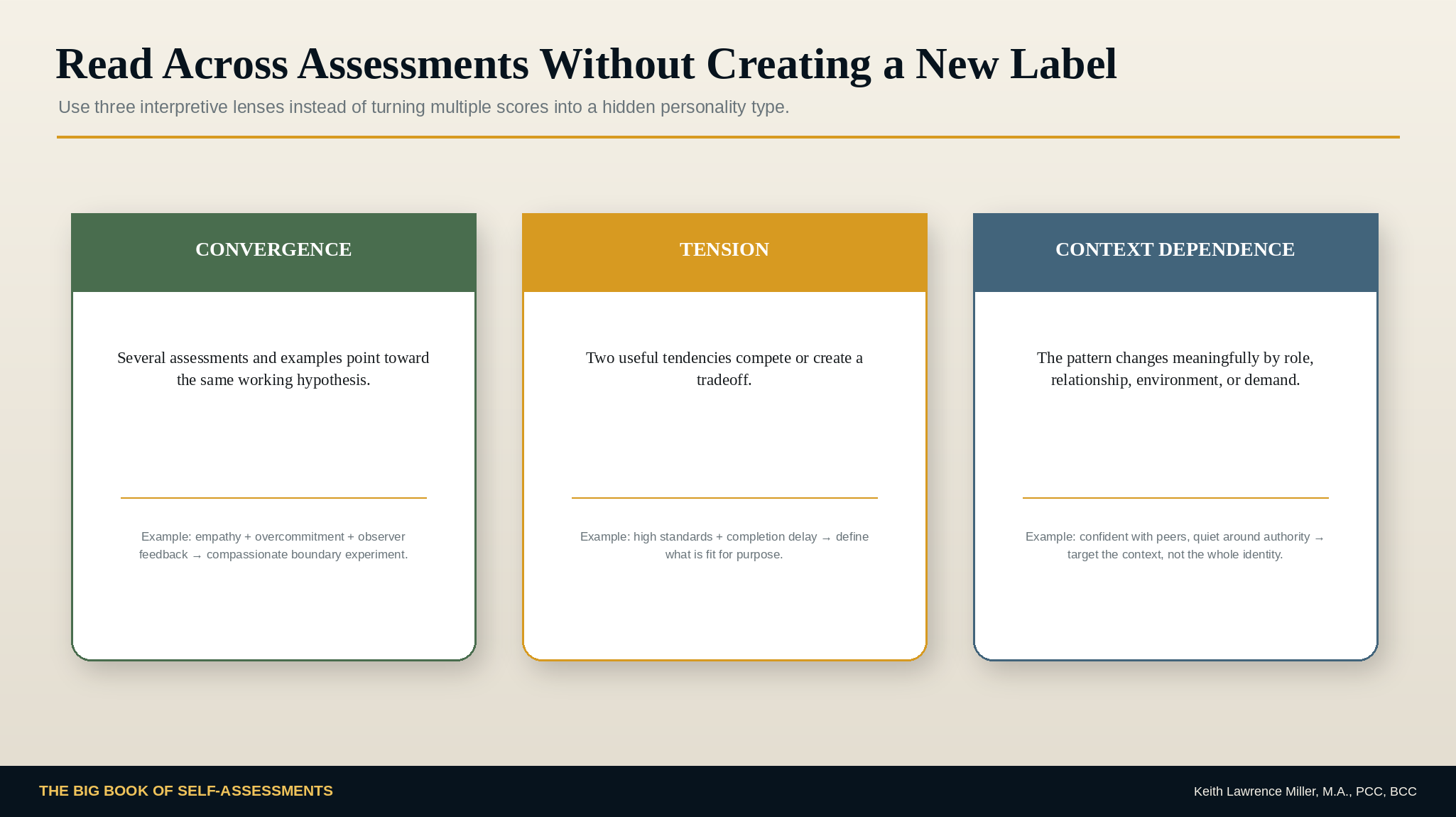
When several assessments point in the same direction, call it a working hypothesis.
When they disagree, investigate the context.
The Seven Domains of Self-Knowledge
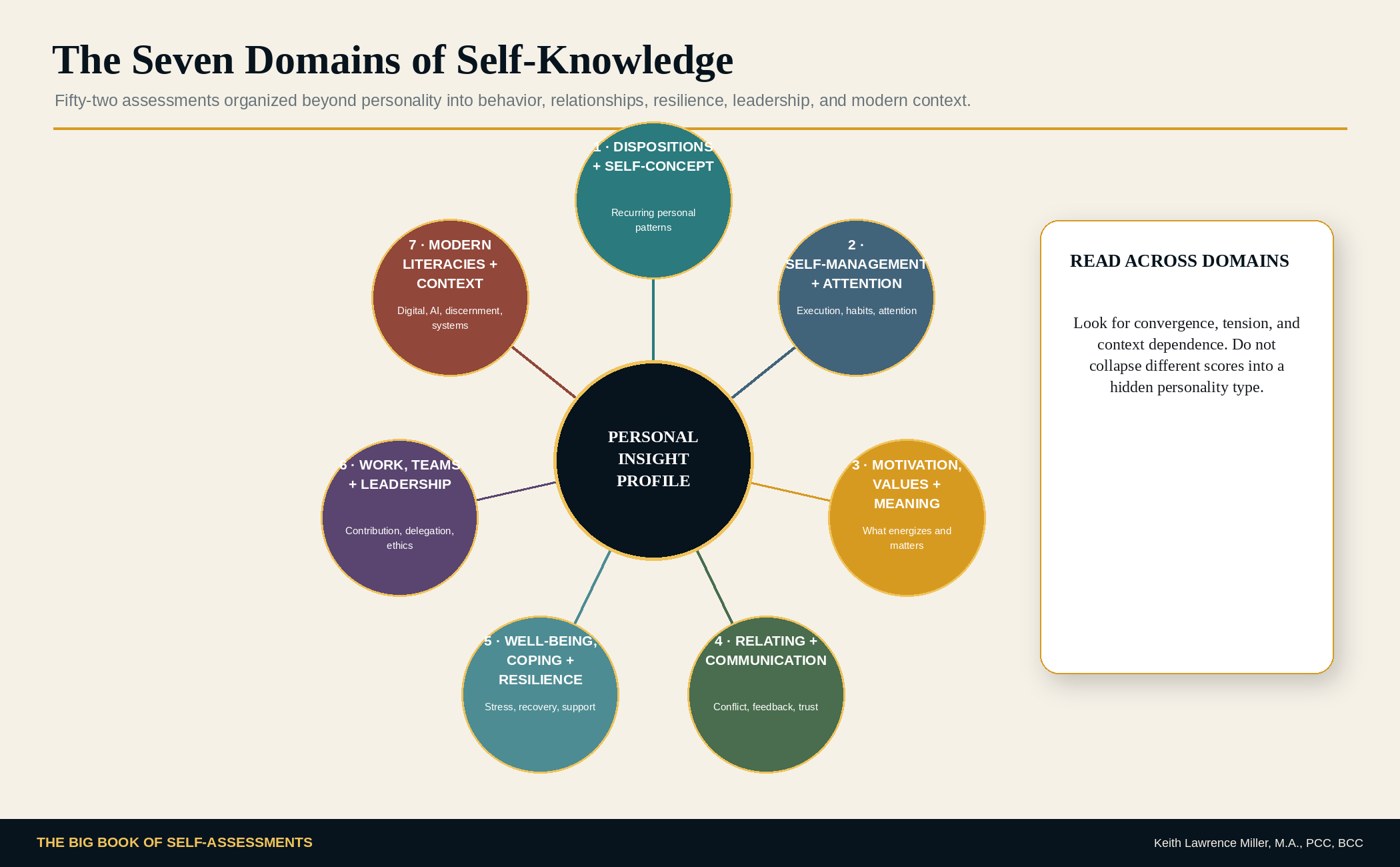
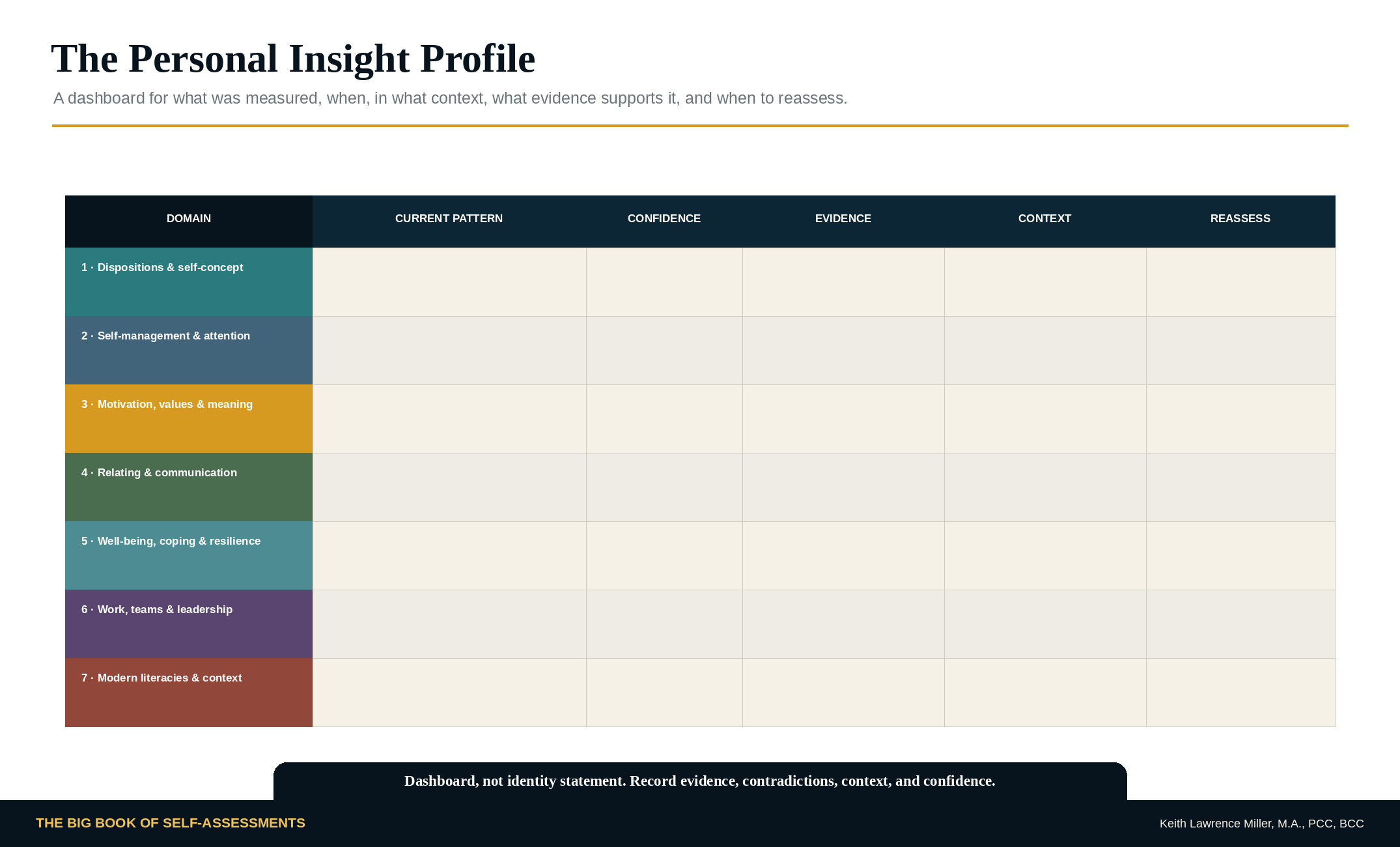
The 52 assessments are organized across seven broad developmental domains.
The structure matters because self-knowledge is larger than personality.
Domain One: Dispositions and Self-Concept
Whole-person patterns, social energy, assertiveness, compassion and candor, organization, dependability, emotional recovery, curiosity, humility, fairness, and self-concept clarity.
Domain Two: Self-Management and Attention
Self-control, impulse management, planning, goal execution, procrastination, habits, attention, decision style, and reset or re-engagement.
Domain Three: Motivation, Values, and Meaning
Motivation, values alignment, purpose, autonomy, competence, relatedness, growth beliefs, learning orientation, career adaptability, and work preferences.
Domain Four: Relating and Communication
Communication, conflict, feedback, boundaries, attachment-related tendencies, empathy, perspective-taking, trust, voice, and interpersonal safety.
Domain Five: Well-Being, Coping, and Resilience
Stress appraisal, burnout-risk indicators, coping, self-compassion, optimism, hope, gratitude, sleep, restoration, and social support.
Domain Six: Work, Teams, and Leadership
Team contribution, leadership tendencies, delegation, ownership, ambiguity, change, ethics, inclusion, and intercultural agility.
Domain Seven: Modern Literacies and Context
Digital habit hygiene, AI literacy and readiness, information discernment, and systems-thinking orientation.
Domain One: Dispositions and Self-Concept
The first domain explores broad personal patterns and how people understand themselves.
The goal is not to choose an ideal personality. It is to understand recurring patterns more accurately.
Domain Two: Self-Management and Attention
Knowing what you value is different from managing behavior consistently.
This domain moves closer to daily execution and asks what actually happens when goals meet attention, habits, environment, emotional friction, and competing demands.
Specificity creates more useful change than character judgments such as “I am lazy” or “I have no discipline.”
Domain Three: Motivation, Values, and Meaning
Performance improves when people understand what drives them.
A motivation problem may sometimes be an alignment problem.
Values become most useful when priorities compete and the person has to make a real tradeoff.
Domain Four: Relating and Communication
Relationships are shaped by more than warmth or social skill.
Can you disagree without becoming destructive? Can you receive feedback without collapsing or attacking? Can you set a limit without excessive guilt? Do you trust too quickly, too slowly, or proportionately?
Relationship competence becomes clearer when the assessment reaches beyond whether someone is simply “good with people.”
Domain Five: Well-Being, Coping, and Resilience
Human performance does not occur separately from human well-being.
The assessments in this domain are educational tools. They are not clinical diagnostic instruments.
A reflective questionnaire can help someone notice a pattern. It cannot diagnose a medical, psychiatric, or psychological condition.
Domain Six: Work, Teams, and Leadership
This section recognizes that professional effectiveness is relational and contextual.
Leadership is not one fixed personality profile.
Different circumstances require different behaviors: direction, coaching, listening, decisiveness, restraint, delegation, ethical judgment, ambiguity tolerance, inclusion, and intercultural agility.
Domain Seven: Modern Literacies and Context
Modern self-management occurs inside rapidly changing information and technology environments.
Digital habits shape attention. AI literacy requires judgment. Information discernment requires verification habits. Systems thinking asks what produces patterns rather than merely reacting to individual events.
The SNAPSHOT Development Cycle
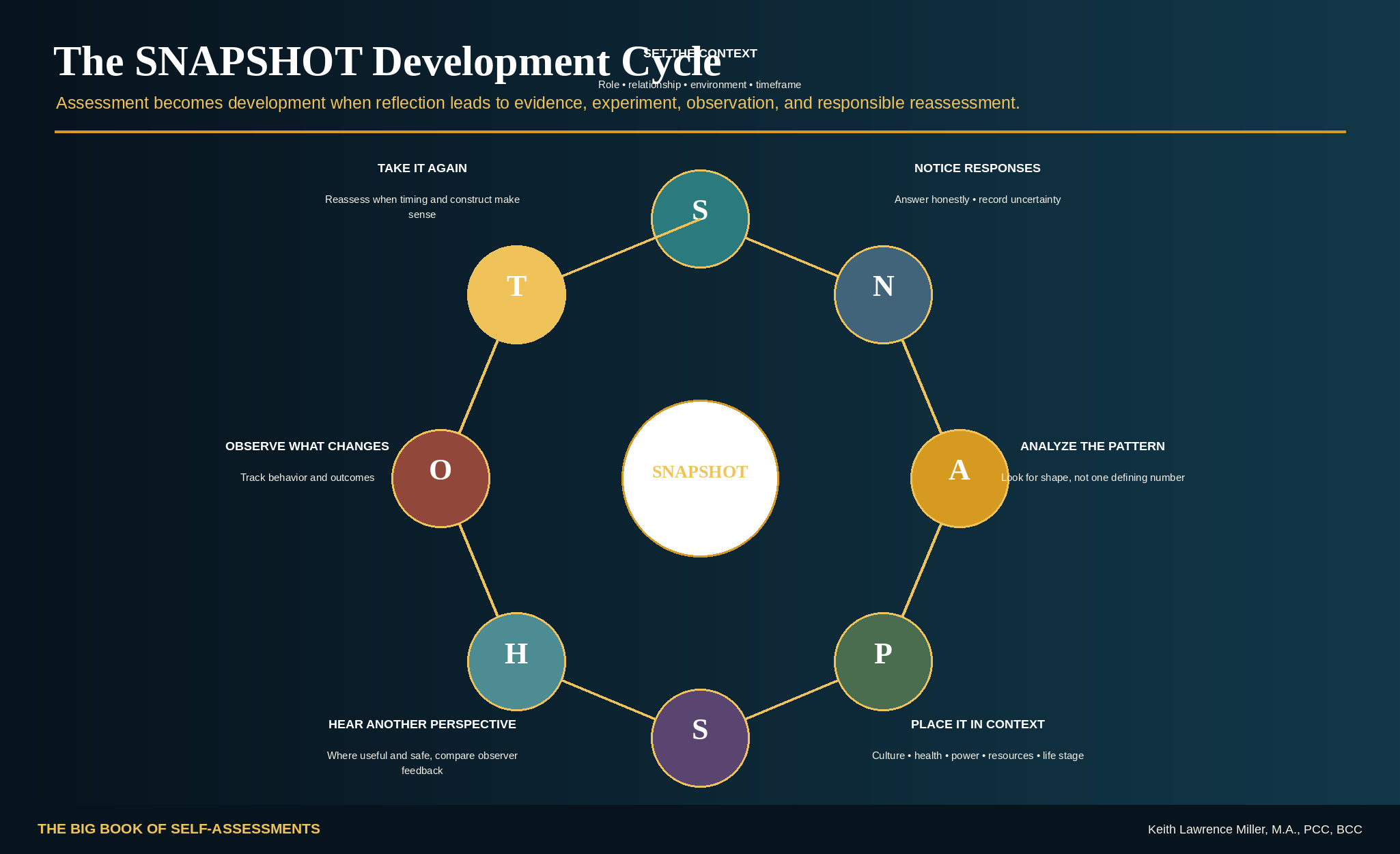
The book's organizing method for turning assessment into development is the SNAPSHOT Development Cycle.
S — Set the Context. Choose the role, relationship, environment, and timeframe you are considering.
N — Notice Your Responses. Answer honestly and record uncertainty rather than forcing certainty.
A — Analyze the Pattern. Calculate dimensions transparently and look for shape rather than one defining number.
P — Place It in Context. Consider culture, power, health, life stage, resources, demands, relationships, recent events, and environment.
S — Select an Experiment. Choose one small behavioral or environmental change.
H — Hear Another Perspective. Where appropriate and safe, compare self-perception with respectful observer feedback.
O — Observe What Changes. Track behavior and outcomes.
T — Take It Again. Reassess when the construct and interval make reassessment meaningful.
The SNAPSHOT cycle is an organizing method for development. It is not presented as a validated psychological theory.
Assessment Should Lead to Experiment, Not Label
A result becomes useful when it changes the quality of a question or decision.
Suppose someone notices a procrastination pattern.
The next step should not necessarily be: “I am a procrastinator.”
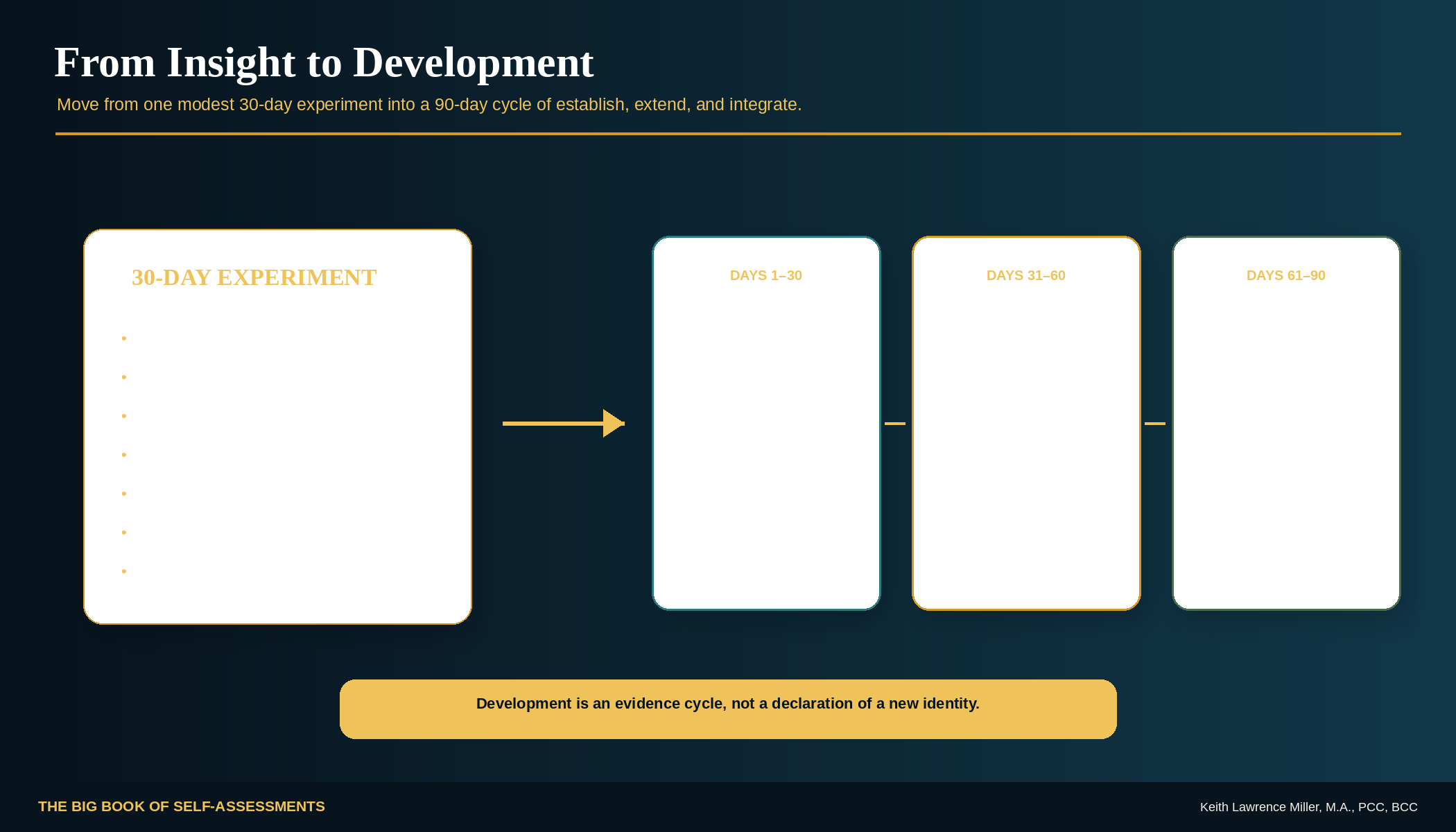
A better next step may be a 30-day experiment that changes the starting action, removes one distraction, sets a visible completion standard, and tracks whether initiation improves.
Assessment becomes development when it produces a testable next step.
Small Experiments Are More Informative Than Grand Declarations
People often react to insight with oversized plans.
The book encourages smaller experiments: change one cue, test one behavior, ask for one support, alter one meeting practice, set one boundary, try one attention strategy, or change one environmental condition.
Small experiments create evidence.
The 30-Day Experiment Canvas
The book includes a structured 30-day experiment process.
Identify the behavior to test, baseline, weekly actions, environmental support, accountability, likely obstacles, adaptations, leading indicators, outcome indicators, and review date.
Then decide: continue, revise, stop, or escalate for additional support.
The 90-Day Development Plan
Some patterns require longer practice.
Days 1–30: Establish. Run the smallest useful experiment and improve the environment.
Days 31–60: Extend. Repeat the behavior in a second context or at a greater level of difficulty.
Days 61–90: Integrate. Decide what should become routine, what needs revision, what requires additional support, and what should stop.
Compare Perspectives Carefully
Observer feedback can be extremely useful.
It can also be misused.
Another person's perspective is not absolute truth. Their observations are influenced by role, relationship, expectations, situations, and bias.
The purpose of comparison is to notice the gap.
Use Context Before Interpretation
A pattern can change by setting.
Someone may be highly assertive with peers and quiet around authority. Highly organized at work and disorganized at home. Socially confident in familiar environments and withdrawn in unfamiliar groups. Calm in routine situations and reactive under sleep deprivation.
These differences do not necessarily mean one answer is false.
They can reveal contextual activation.
The Personal Insight Profile
After working through relevant assessments, the book introduces the Personal Insight Profile.
The profile is a dashboard. It is not a final identity statement.
For each developmental domain, it records what was assessed, the context and date, a result summary, confidence in the interpretation, evidence, contradictory evidence, contextual influences, reassessment timing, and development priority.
This preserves something important: interpretation can change.
Look for Convergence
Several assessments may point toward the same developmental hypothesis.
A person scores highly on empathy, reports difficulty setting limits, describes chronic overcommitment, and receives observer feedback that they take on too much.
Those findings converge.
The development question becomes clearer.
Look for Tension
Some useful tendencies can compete: high standards and fast execution, empathy and boundaries, trust and verification, curiosity and completion, stability and exploration, candor and diplomacy.
A mature developmental profile does not eliminate every tension.
It helps the person manage tradeoffs more deliberately.
Look for Context Dependence
A person may communicate confidently with direct reports and cautiously with senior executives.
They may lead change effectively in technical situations and struggle when identity or politics are involved.
The pattern changes by context.
Development can target the context rather than treating the entire person as deficient.
Choose No More Than Three Priorities
Fifty-two assessments can generate many insights.
Trying to develop everything at once is usually a poor strategy.
What matters most now? What behavior would create meaningful benefit? Which issue is connected to an important goal? Which pattern creates the greatest recurring cost? Where would a modest change create leverage?
Development needs focus.
Reassessment Should Fit the Construct
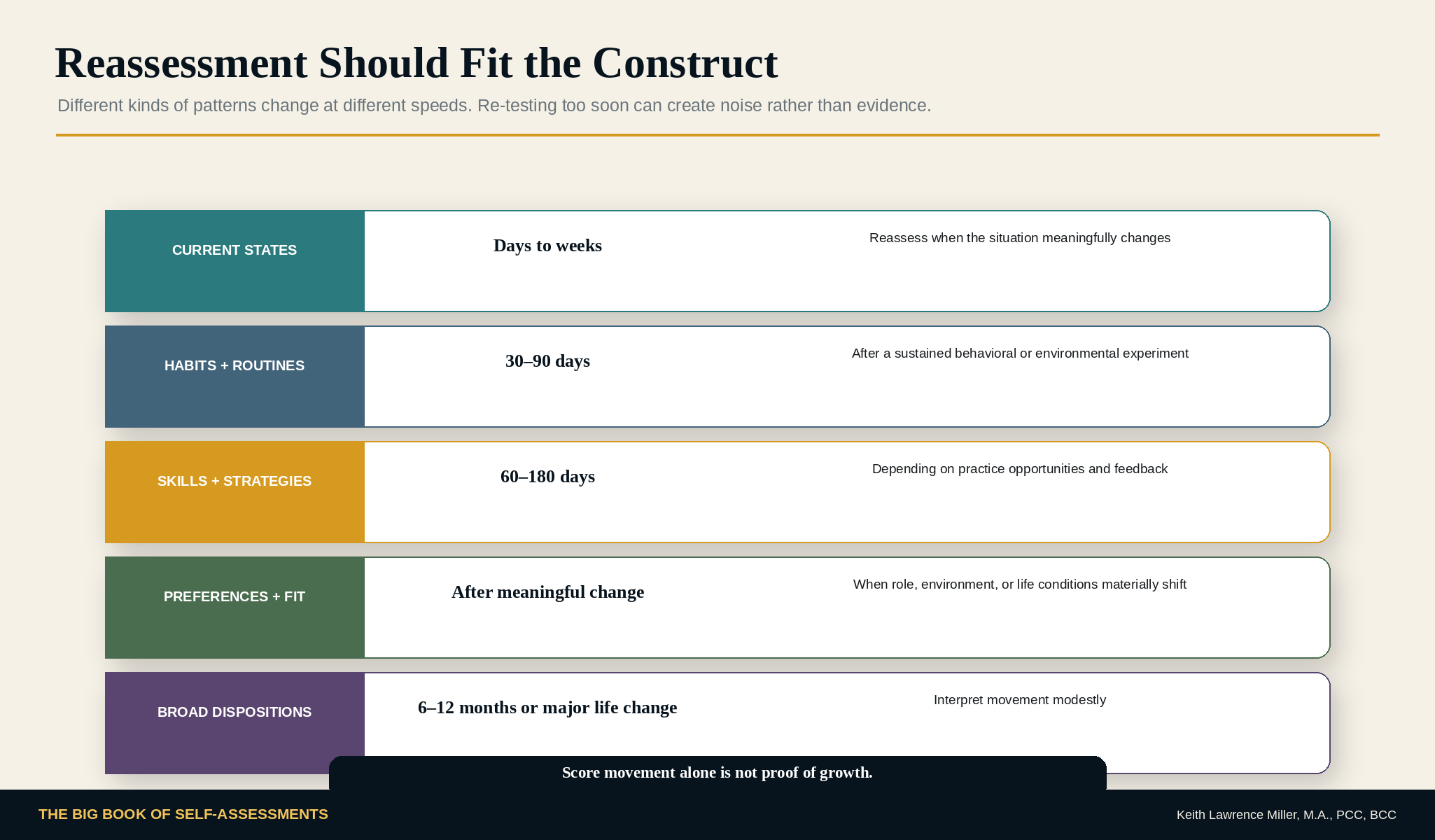
A temporary state may reasonably change within days or weeks.
A habit may deserve reassessment after 30 to 90 days of sustained experimentation.
A skill may require months of practice.
Preferences may shift after significant role or environmental change.
Broad dispositions should generally be interpreted more modestly and revisited over longer periods or after meaningful life changes.
Taking the same test repeatedly until the preferred score appears is not development.
Score Movement Is Not Proof of Growth
A score can change for many reasons: actual development, different circumstances, different standards, mood, recent events, practice effects, greater self-awareness, response-style changes, or measurement error.
Growth becomes more credible when score movement is accompanied by other evidence.
Behavior changed. Outcomes changed. Other people noticed something different. The person responds more effectively in situations that previously created difficulty.
The Change Narrative
The book encourages readers to document change rather than merely compare numbers.
Record the original context, new context, score or profile movement, behavioral evidence, outcome evidence, observer evidence, changed circumstances, alternative explanations, current confidence, and the next decision.
Development is a story supported by evidence.
Self-Knowledge Should Increase Choice
The real purpose of self-assessment is not endless introspection.
It is greater choice.
You notice the pattern earlier. You understand the conditions. You recognize the tradeoff. You respond less automatically. You can choose another behavior, seek support, change an environment, clarify a value, repair a relationship, redesign a routine, or ask a better question.
Assessment Should Never Become a Weapon
Results should not be used to win arguments.
A self-assessment is not proof of character. It is not a diagnosis. It should not become leverage over another person.
Participation should remain voluntary.
These Assessments Are Not Hiring Tests
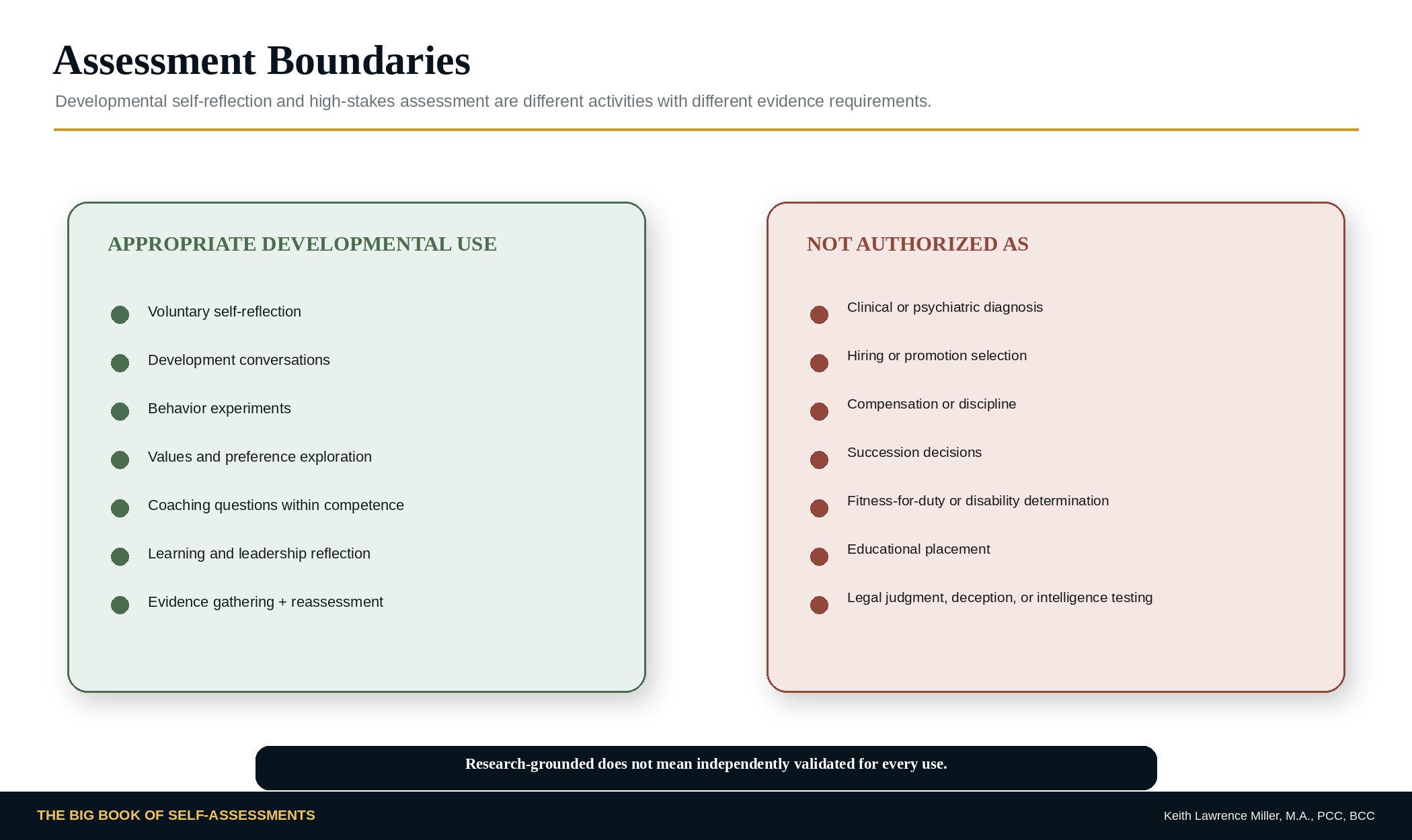
The assessments in this book were designed for voluntary education and development.
They are not authorized for hiring, promotion, compensation, discipline, succession decisions, fitness-for-duty determinations, disability decisions, educational placement, legal decision-making, deception detection, or intelligence testing.
A development instrument and a selection instrument require very different evidence and validation standards.
Developmental Assessments Are Not Clinical Diagnosis
The book discusses subjects such as stress, coping, burnout risk, attachment-related tendencies, emotional recovery, and well-being.
Those topics overlap with areas of psychological and health concern.
The assessments remain developmental.
They do not diagnose depression, anxiety disorders, trauma-related conditions, ADHD, personality disorders, or any psychiatric condition.
Privacy Matters
Assessment information can feel unusually personal.
A person should know who can see the results, where they will be stored, how long they will be retained, whether participation can be declined, and whether the result will affect employment or another consequential decision.
Development works best when people can reflect without fearing inappropriate use.
Coaches, Facilitators, and Educators Need Boundaries Too
Professionals may use reflective assessments to support conversations.
Responsible facilitation requires clarity: explain the purpose, preserve voluntary participation, avoid overinterpretation, do not imply diagnostic status, protect privacy, distinguish developmental content from validated instruments, refer when needs move beyond competence, encourage evidence outside the score, and focus on behavior and context.
The assessment should support judgment. It should never substitute for it.
Research-Grounded Does Not Mean Clinically Validated
The phrase research-grounded matters.
The constructs in the book draw from established psychological, organizational, leadership, learning, and human-development literature.
The specific assessments, item wording, scoring structures, interpretive language, exercises, worksheets, and SNAPSHOT Development Cycle are original developmental content unless otherwise identified.
A concept can be grounded in established research while a newly created measure still requires separate validation work before stronger claims can be made.
Responsible Assessment Requires Humility
A score can feel authoritative.
Numbers create psychological weight. A decimal point can make a result appear more precise than the underlying measurement deserves.
Responsible use requires restraint.
Ask: What does this result actually support? What does it not support? How stable is the construct? What context matters? What other evidence agrees? What evidence conflicts? What experiment would test the interpretation?
Humility makes assessment more useful.
Who Should Read The Big Book of Self-Assessments?
The book is designed for individuals, leaders, career professionals, coaches, HR and talent professionals, educators, teams, and general readers who want structured self-reflection without surrendering their identity to a test result.
Fifty-Two Assessments Are Not Fifty-Two Identities
You are not a procrastination score, leadership score, optimism score, empathy score, trust score, AI-readiness score, burnout-risk score, or communication score.
You are a person behaving inside contexts.
Some patterns are stable. Some change. Some are strengths in one situation and liabilities in another. Some reflect the environment as much as the person. Some deserve development. Some deserve acceptance. Some deserve professional support. Some simply deserve another look.
The value of assessment is not in replacing complexity. It is in making complexity easier to examine.
Self-Knowledge Is an Ongoing Inquiry
The closing principle of The Big Book of Self-Assessments captures the larger philosophy.
Self-knowledge is not a final classification.
It is an ongoing process of noticing, testing, comparing, listening, acting, observing, and revising.
The aim is not to become a score.
The aim is to notice more accurately, choose more deliberately, and revise your understanding when better evidence arrives.
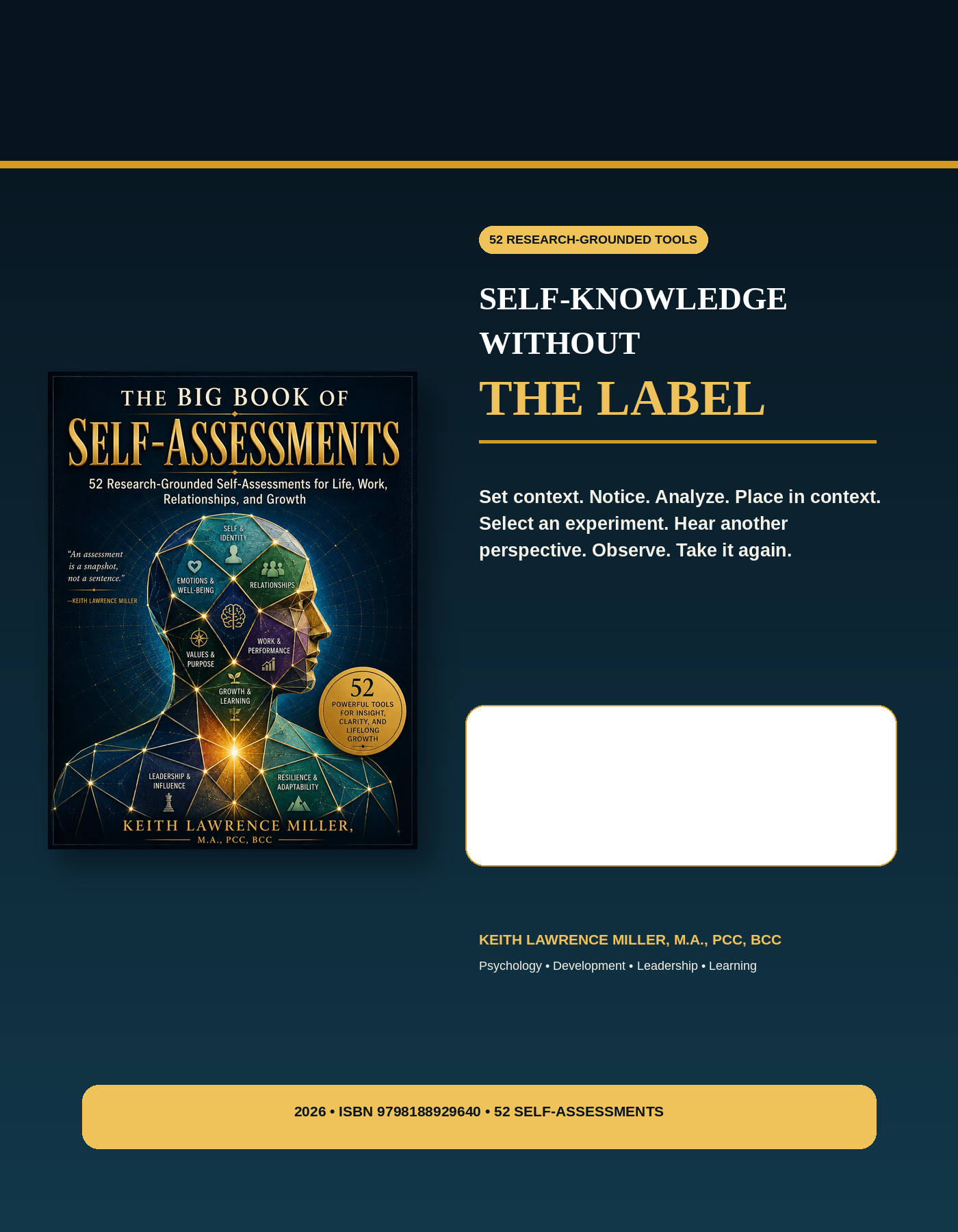
The assessments in this book are intended for voluntary educational reflection and personal development. This publication does not create a professional relationship, and no outcome is guaranteed. They are not clinical, medical, psychiatric, diagnostic, legal, intelligence, or employment-selection instruments. They are not authorized for hiring, promotion, compensation, discipline, succession, fitness-for-duty, disability determination, educational placement, legal decision-making, deception detection, or intelligence testing. The original developmental assessments and SNAPSHOT Development Cycle should not be represented as independently validated psychological instruments unless supporting validation evidence is established. Readers should seek appropriately qualified professional assistance when an issue involves health, safety, trauma, crisis, disability, legal rights, or other matters outside the scope of developmental self-reflection.