I need things done.
That sentence captures the reality of running a business more honestly than most speeches about artificial intelligence. Owners rarely suffer from a shortage of ideas. We suffer from fractured execution. A website needs to be repaired while a new service is being packaged. A payment path must be verified. A book manuscript needs to become a course. Three thousand former clients need to be reintroduced to a new offer. Research, writing, design, software, operations, and quality assurance all compete for the same finite attention.
For years, generative AI made individual outputs cheaper. It could draft an email, summarize a document, suggest a headline, or produce a block of code. The human being still carried the operating burden: moving context from one tool to another, remembering every constraint, checking every handoff, recovering from errors, and deciding what should happen next.
GPT-6 Astra arrives with a more consequential proposition. OpenAI describes it as its most capable model for complex reasoning, coding, computer use, research, and document creation. The company also says Astra is designed to carry out multistep workflows across code, browsers, and professional software while remaining coherent over longer tasks. Those are capability claims from OpenAI, rather than guarantees of a particular business result. They nevertheless point to a serious change in the economics of execution. Official GPT-6 Astra model page | Official Astra model guidance
The practical question is no longer how many paragraphs an AI can generate. The question is how much of a real objective it can carry from evidence to a verified deliverable.
Capacity finally begins to resemble a working environment
OpenAI publishes an API context window of 1,050,000 tokens and a maximum output of 128,000 tokens for GPT-6 Astra. The model accepts text and image input and produces text output. Through the Responses API, its supported tools include web search, file search, image generation, code interpretation, hosted shell work, patch application, skills, computer use, Model Context Protocol connections, and tool search. It also supports function calling, structured outputs, and streaming. Official GPT-6 Astra model specifications
Those numbers require careful interpretation. They are verified API specifications. They do not confirm that a ChatGPT Work account exposes the same context or output ceiling, and they do not tell an individual user how many plan credits a particular task will consume. OpenAI explicitly says features and usage depend on the plan, platform, region, rollout, and workspace settings. Official ChatGPT Work overview
Still, a context window of that scale has strategic meaning. A company can assemble an operating dossier containing brand standards, product architecture, prior decisions, customer research, policies, source files, site code, analytics exports, and examples of excellent work. Astra can reason across a much larger share of the real business context in one environment. The quality of the sources remains decisive. A million tokens of clutter can bury the truth as efficiently as a short, vague prompt.
The first leadership discipline, therefore, is context architecture: choosing the authoritative sources, removing obsolete instructions, naming conflicts, and telling the system which source controls when two files disagree.
The underused capabilities are managerial
The most valuable Astra features look less like magic and more like excellent management.
1. Give it an outcome to own
ChatGPT Work is designed around completed, reviewable results. It can gather information from approved files and plugins, use tools, create documents, presentations, spreadsheets, PDFs, visualizations, images, websites, and applications, and carry a workflow through to a result for human review. OpenAI recommends Work for substantial tasks with a clear outcome and reviewable deliverable. Get started with ChatGPT Work
This changes the prompt. "Give me ideas for a course" leaves the operating burden with the user. A stronger work order says: build the course architecture from the approved manuscripts; map learning objectives to modules; create the student workbook, facilitator guide, assessments, sales page copy, and launch checklist; cite every source; flag missing decisions; verify that all artifacts agree; stop before publication.
The difference is task ownership. Astra performs best when it can see the destination, the inputs, the authority it has, the boundaries it must respect, and the tests that define completion.
2. Manage the work while it is happening
Astra supports a more fluid relationship between direction and execution. In ChatGPT Work, a user can follow progress, answer questions, change direction, and approve important actions. OpenAI also documents mid-turn steering for Astra in the Responses API over a WebSocket connection. A developer can send a correction or new requirement while the response is running, preserve completed work, and continue from the updated instruction. The API version has specific technical requirements and does not prove that every interface implements the feature in the same way. Official mid-turn steering guide
This is an overlooked management skill. A capable leader does not restart a major initiative whenever a new fact appears. The leader preserves valid work, updates the constraint, and redirects the remaining effort. Astra is explicitly designed to accommodate that pattern.
3. Turn expertise into reusable skills
Skills package a repeatable workflow, instructions, templates, examples, and supporting resources. Plugins can combine those skills with connectors to services such as Google Drive, GitHub, Slack, email, calendars, customer systems, design tools, and other approved sources. OpenAI's guidance frames skills as a way to preserve the method behind recurring work and improve consistency. Official Skills and Plugins guide
This may become one of the most valuable forms of business intellectual property. A resume company can encode its document-development standards. A coaching practice can encode a session-preparation and follow-up method. A publisher can encode its manuscript, citation, accessibility, and production checks. A sales organization can encode account research, opportunity review, and proposal standards.
Prompts disappear into chat history. A tested skill becomes an operating asset.
4. Connect judgment to tools
Astra's tool support allows the model to move between analysis and action. It can search current information, inspect files, run code, work through supported browser or computer-use surfaces, create images, interact with connected systems through plugins, and produce finished files. Access and permissions govern what it can actually reach in a given session.
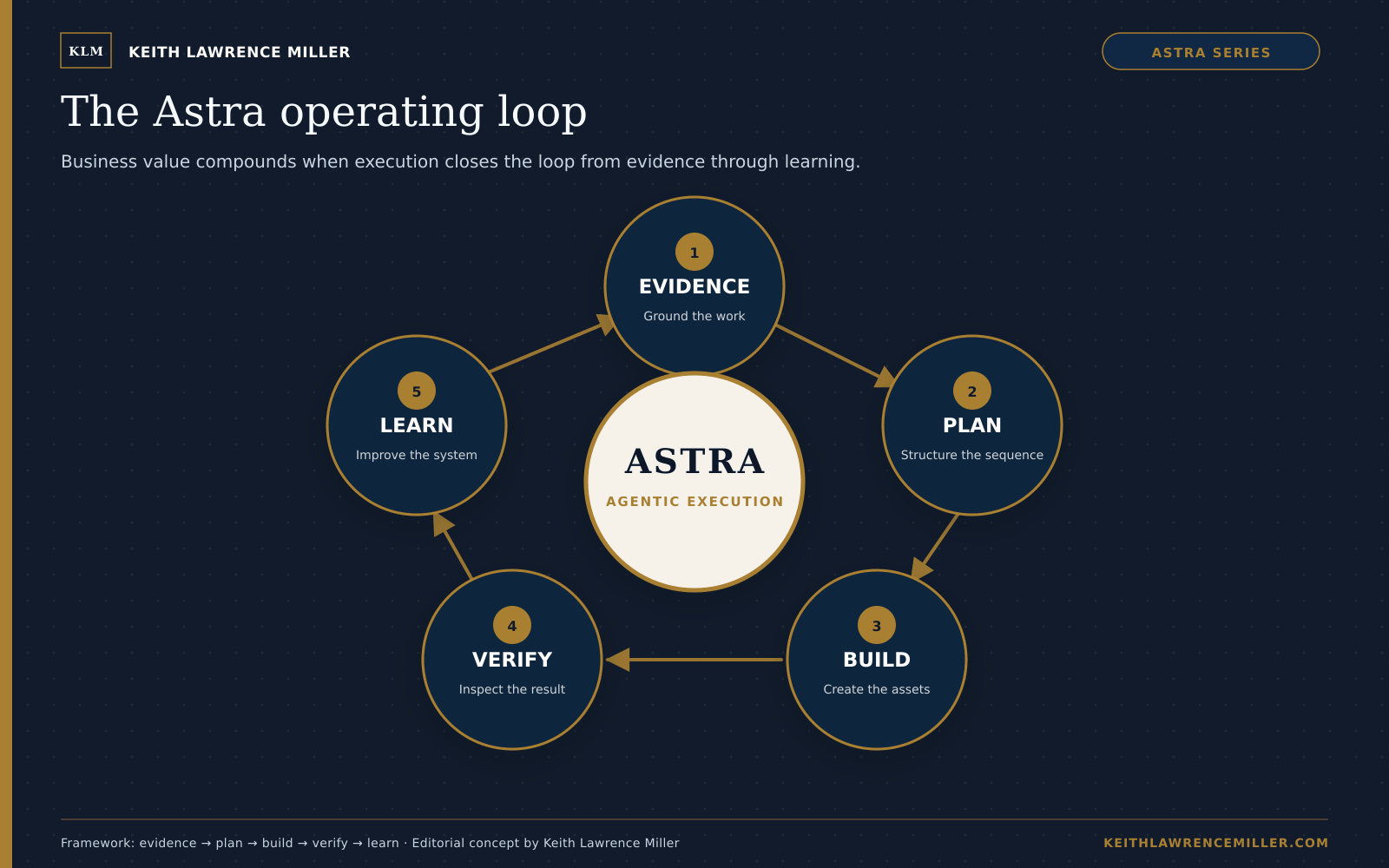
The business advantage comes from a closed loop: gather evidence, make a decision, execute the approved work, inspect the result, repair defects, and record what changed. Each tool should have a defined role. Installing a connector creates access; it does not prove that the workflow works correctly. Every unfamiliar or credit-consuming integration deserves a small proof-of-concept before it is trusted at scale.
5. Use long-running work for objectives that outlive one reply
OpenAI documents Goal mode for long-running work in the desktop app, Codex CLI, and IDE extension. A goal combines the objective with its completion criteria, and the user can pause, resume, steer, or ask for a status recap. Hosted work on the web can continue in the same ChatGPT Work thread with the outcome, constraints, and review criteria in the prompt. Official long-running work guide
This is well suited to migrations, platform builds, curriculum development, book production, data cleanup, research programs, and broad quality-assurance campaigns. The objective should be measurable. "Improve the site" creates endless interpretation. "Repair every broken checkout path, preserve existing content, run the defined test matrix, and return a page-by-page verification report" gives the system a finish line.
6. Convert reliable work into scheduled operations
Scheduled tasks can run in the background on a recurring schedule. On eligible plans, tasks can also start from supported Gmail, Slack, or GitHub events. They can use uploaded context, connected tools, plugins, and skills available to the task. OpenAI recommends testing the prompt manually and reviewing the first runs before relying on the automation. Official scheduled tasks guide
This opens practical business uses: a daily opportunity brief, a weekly site-health report, a customer follow-up queue, a content-performance review, a competitor watch, a pending-payment exception list, or a monthly executive dashboard. A stable workflow can move from occasional assistance to continuous operating capacity.
7. Build the interface around the insight
ChatGPT Sites can create, host, refine, and share websites, web applications, and games. OpenAI's current documentation says Sites can support persistent data, uploaded files, optional Sign in with ChatGPT, and built-in traffic analytics. Sites is in public beta, and plan-specific limits apply. Every deployment URL is described as a production deployment, so a private or saved version should be used for review before a public release. Official Sites documentation
The strategic opportunity reaches beyond publishing pages. A business can prototype a client dashboard, assessment experience, calculator, planning tool, searchable knowledge center, or interactive report. The interface becomes part of the answer.
8. Exploit the developer features that make workflows durable
Several of Astra's least discussed capabilities live in the API. Async tool calling allows the model to continue useful work while an application runs a developer-defined tool. Structured outputs can force results into a dependable schema. Function calling connects reasoning to approved actions. Prompt caching can reduce the cost of repeatedly sending a stable context prefix. Compaction and persisted reasoning help longer workflows manage continuity. Multi-agent orchestration can divide independent work across specialized agents. Astra can also change reasoning effort during a conversation through a configuration update while preserving the prompt prefix for caching. Official Astra model guidance
These are verified API capabilities. Their business value depends on an implementation that has been built, secured, tested, and measured. Access to Astra in ChatGPT does not establish API access, engineering readiness, or connector reliability.
Where the business value can compound
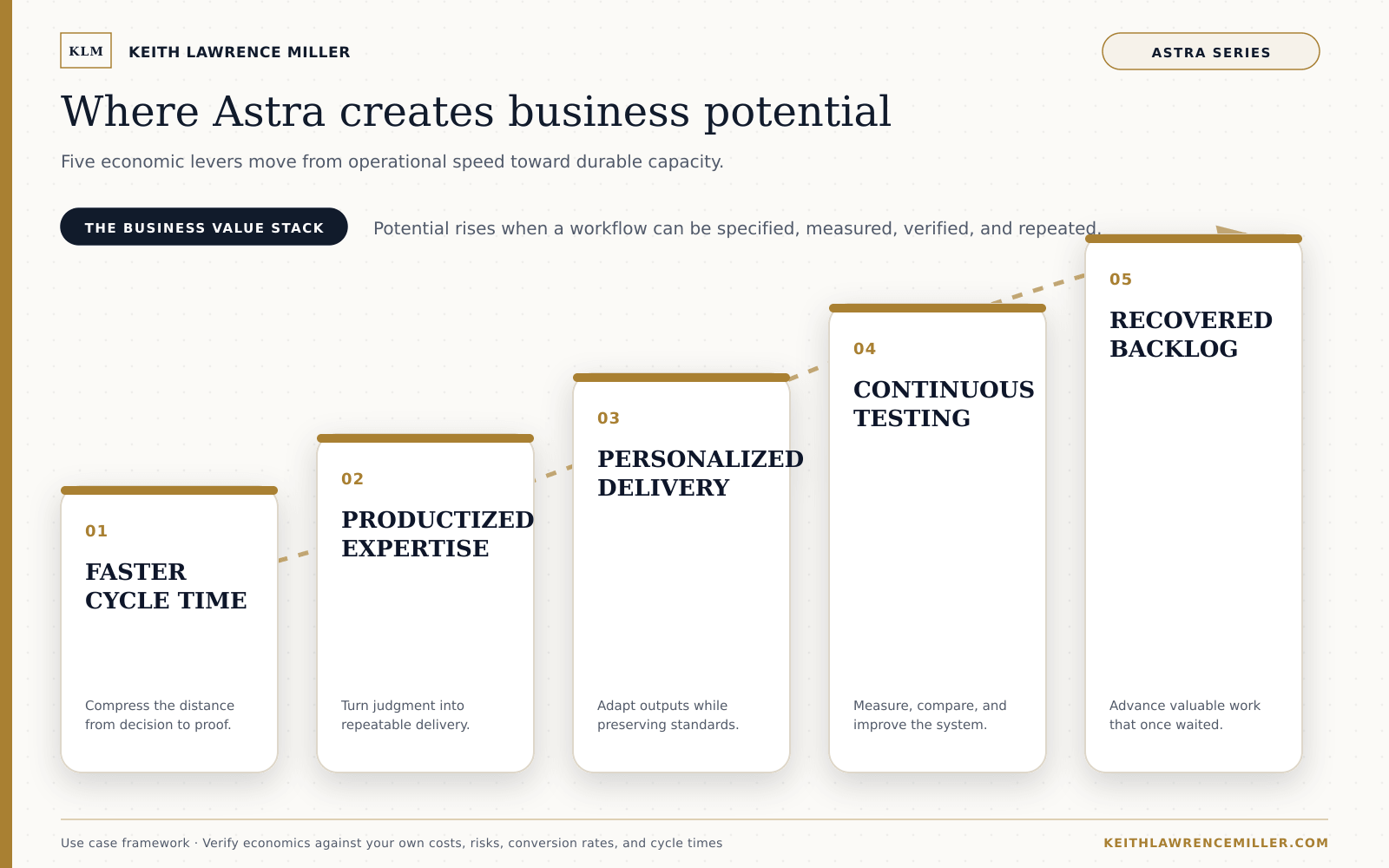
The first gain is cycle-time compression. Research, planning, drafting, production, and verification can occur in a more continuous loop. Fewer handoffs mean fewer opportunities for context loss.
The second gain is the productization of expert judgment. A founder's methods can be captured in source packs, examples, acceptance criteria, and reusable skills. The business becomes less dependent on the founder remembering and re-explaining every detail.
The third gain is responsible personalization. One authoritative body of knowledge can produce a role-specific executive brief, client workbook, manager guide, sales proposal, learning path, or career campaign while preserving the same standards. Personalization should stay anchored to verified facts and approved data.
The fourth gain is experimentation. Teams can produce multiple versions of a landing page, offer, curriculum, onboarding sequence, or dashboard and evaluate them against the same criteria. Faster creation matters only when the evaluation is equally disciplined.
The fifth gain is recovery of abandoned ambition. Every organization has valuable projects trapped behind limited time, fragmented vendors, outdated files, and repeated coordination failures. Astra creates a credible path to reopen some of that backlog, one bounded project at a time.
What this could mean for my own business portfolio
I see three immediate lanes of opportunity. These are strategic applications I intend to evaluate; they are not claims that every workflow is already implemented.
For Ivy League Coaching, Astra can help convert years of expertise into a deeper professional-intelligence system. Research, leadership frameworks, coaching materials, manager-development curricula, assessments, case studies, workbooks, proposals, and executive presentations can share one controlled knowledge base. A single enterprise question could produce a decision brief, a workshop, facilitator notes, participant tools, an implementation plan, and follow-up measurement materials. Human judgment remains essential wherever coaching, assessment interpretation, employment consequences, or confidential information is involved.
For MyTopMatch, the opportunity is to make career management continuous. A modern career campaign includes target-market research, job analysis, document strategy, networking, recruiter outreach, interview preparation, negotiation, follow-up, and pipeline management. Astra can support the reasoning and artifact production across that entire system. Any action involving a person's identity, application, message, or private data should remain permissioned and reviewable. No integration with a particular job board, employer system, or recruiter platform should be assumed until it is tested.
For KeithLawrenceMiller.com, Astra can support a much larger publishing and education engine. Books can become courses, teaching guides, articles, keynotes, podcasts, visual explainers, and interactive tools. A canonical source library can preserve the research, voice, citations, and product relationships across the entire body of work. The website can function as the public index of that intellectual ecosystem.
Across all three, the highest-value use may be orchestration: one verified research base producing distinct, audience-specific assets while every site, offer, and publication retains its own purpose.
Astra still requires an operating discipline
A powerful model can produce a polished error. It can act on an outdated file, inherit a contradictory instruction, misread the authority it has, or complete the wrong version of the task with impressive confidence. OpenAI itself advises users to verify important names, dates, numbers, quotes, claims, source currency, and every part of a generated file before sharing it. Official review guidance
Every serious business deployment should establish:
- A source hierarchy that names the controlling files and dates.
- Permission boundaries that state what the system may read, draft, change, send, purchase, publish, or delete.
- Evidence labels that distinguish VERIFIED, INFERRED, ESTIMATED, UNTESTED, and UNKNOWN.
- Acceptance criteria that can be checked before completion.
- Human approval gates for consequential external actions.
- A running decision log for long projects.
- A small proof-of-concept for unfamiliar tools, integrations, and paid workflows.
- A measurable business outcome such as time to completion, error rate, rework, conversion, client capacity, or revenue impact.
The standard should be proof, rather than polish.
A work order that brings out Astra's best
The following structure is more valuable than a clever one-line prompt:
You are responsible for delivering [business outcome].
Use these controlling sources: [files, systems, links, dates, and source priority].
You may [research, draft, edit, build, test, and save]. Stop before [sending, publishing, purchasing, deleting, or changing a live system] unless that action is explicitly authorized.
Deliver: [specific files, pages, analyses, or implemented results].
Acceptance criteria: [tests, measurements, content requirements, visual checks, and definition of done].
Label claims VERIFIED, INFERRED, ESTIMATED, UNTESTED, or UNKNOWN when the distinction matters. Cite current sources for time-sensitive facts.
Maintain a short decision log. Complete all authorized reversible work. Ask only for decisions that materially change the result. Verify the final output before handoff.
That prompt supplies a destination, a map, guardrails, and a finish line. It also turns the user's role into leadership: define the objective, provide the truth, establish authority, and judge the result.
The advantage belongs to people who can define the work
The arrival of Astra will produce a familiar wave of spectacle: benchmark charts, impossible demos, giant prompts, and claims that every company has changed overnight. Actual transformation will occur more quietly. It will appear in the organization that cuts a six-week handoff chain into a controlled workflow. It will appear in the expert who turns a lifetime of tacit knowledge into a repeatable service. It will appear in the entrepreneur who finally completes the platform, curriculum, publishing program, or client experience that remained stuck between vision and capacity.
AI spent years lowering the cost of words. Astra may lower the cost of coordinated ambition.
The business question is simple: What valuable work have you postponed because execution was too fragmented? Put that work on the table. Define done. Give Astra the right sources and boundaries. Then make it prove the result.
Author note
Keith Lawrence Miller, M.A., is an organizational and business psychology practitioner, executive coach, author, and founder of Ivy League Coaching and MyTopMatch. He writes about leadership, professional intelligence, careers, technology, and the systems that turn human potential into sustained performance.
Capability disclosure
The author received access to GPT-6 Astra in ChatGPT on September 5, 2026. Hands-on production testing is beginning. Product capabilities cited in this article are drawn from official OpenAI documentation reviewed on September 5, 2026. Business applications are the author's analysis and proposed use cases. Availability and limits can vary by account and environment.
The Astra series
One capability, three operating lenses.
Continue with the Professional Intelligence and career-system perspectives.
Read the Professional Intelligence thesis →Read the career-system thesis →