The Miracle of Santería: From Skepticism to a Life With Orisha
By Keith Lawrence Miller, M.A. (Ogun Oní)
For most of my early life, spirituality had almost no place in the way I understood the world.
I had never prayed. I did not know how to pray. I had never attended church in any meaningful way, and my knowledge of religion was superficial. I understood a few basic ideas about Christianity and Judaism, but religion itself seemed distant from my actual life. I viewed it largely as a human construction, a collection of beliefs and rules that people had created to explain the world or control behavior.
Spirituality seemed even less convincing.
It belonged, in my mind, to stories, superstition, and imagination.
That is important because The Miracle of Santería was not written by someone who grew up expecting supernatural experiences. My relationship with Santería began from skepticism. The transformation described in the book became meaningful precisely because it contradicted the way I had previously understood reality.
I did not begin by searching for a religion.
The door opened through my wife.

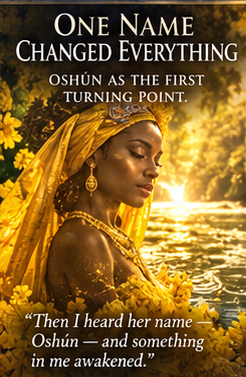
One Name Changed the Direction of My Life
Hazel had received a spiritual reading and came home describing the experience.
At the time, I barely understood what she meant by a reading. When she first told me, I wondered whether someone had literally been reading from a book. That was the level of my knowledge.
Then she said one word.
Oshún.
I had never studied Oshún. I had no theological framework for what the name meant. Yet the sound of it affected me immediately.
I stopped Hazel and wanted to know what she was talking about.
She explained that Oshún was associated with love and beauty, and something in me responded in a way I could not explain. The manuscript describes the experience as a strange recognition, almost as though I were hearing something unfamiliar and familiar at the same time. I had no evidence for the feeling and no prior knowledge that could explain it. I simply knew that I wanted to understand more.
That moment became the first opening.
It did not instantly turn me into a believer.
It made me curious enough to continue.
My First Spiritual Experience Happened During a Moment of Fear
Soon afterward, Hazel showed me how she understood the preparation of a spiritual candle.
Everything was new to me. Colors, herbs, oils, flowers, prayer, intention, and the idea that lighting a candle could become part of spiritual communication were completely outside my previous worldview.
I decided to try it.
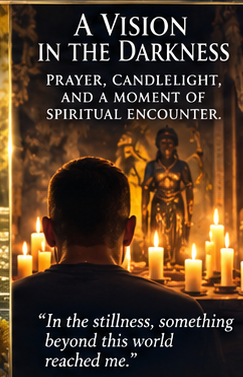
Several days into the candle burning, I was lying downstairs in the dark while my daughter Paris slept nearby. My mind was not occupied with theology. I was thinking about my life and my responsibilities as a father.
I was deeply worried about my daughter.
At that time, we were living in circumstances I did not want to become her future. I remember lying there thinking about how difficult parts of my own life had been and how desperately I wanted something different for her.
I began crying.
Then I experienced something I had never experienced before.
With my eyes closed, I perceived a female presence in my mind's eye. I experienced her as extraordinarily beautiful, powerful, dressed in gold, and surrounded by an overwhelming sense of presence. I later understood the figure as Oshún.
The most important part of recounting that experience is intellectual honesty.
I cannot prove to another person what occurred in that room.
I said essentially the same thing the following day when I described it to Hazel. I did not know whether I had dreamed, entered some unusual mental state, experienced something spiritual, or encountered something for which I had no vocabulary.
What I knew was that it affected me profoundly.
That distinction remains important to me today.
Faith does not require me to pretend that a personal spiritual experience is laboratory evidence.
It requires me to be truthful about what I experienced and what that experience came to mean in my life.
Curiosity Became Study
After that experience, I wanted answers.
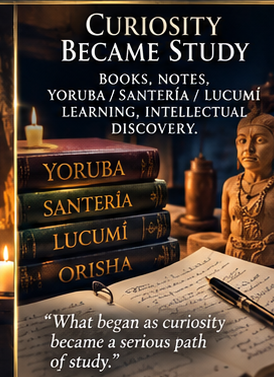
I began reading.
I studied Santería, also known as Lucumí, and learned about its development from Yoruba religious traditions carried into the Americas through the transatlantic slave trade. I learned how those traditions survived slavery, persecution, cultural displacement, and adaptation, particularly in Cuba and the broader Caribbean.
What first captured me spiritually eventually captured me intellectually as well.
This was a religious system with history, ritual structure, divination, sacred stories, priestly lineages, obligations, ceremonies, ethical expectations, ancestor reverence, and a complex relationship between human beings and Orisha.
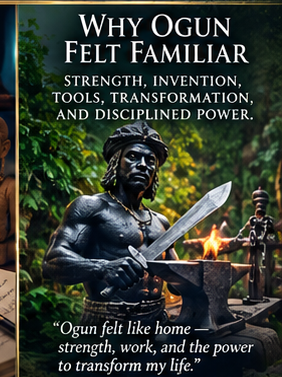
I became especially fascinated with Ogun.
The way Ogun was often described felt incomplete to me. He could easily be reduced to brute strength, iron, weapons, labor, and force. The more I studied, the more I saw another dimension: technology, invention, transformation, tools, civilization, perseverance, and the capacity to turn raw material into something useful.
That interpretation resonated with me deeply.
I understood what it meant to be viewed as rougher than you actually were.
I understood the value of strength.
I also understood that strength without intelligence is limited.
Ogun increasingly felt familiar.
Santería Forced Me to Learn Discernment Alongside Faith
My first Diloggún reading fascinated me.
It also taught me a lesson that would become central to my spiritual development: faith cannot eliminate discernment.
When I first met the woman who would become my godmother, I was completely uninitiated. I did not understand the structure of Lucumí well enough to evaluate everything I was hearing.
That made me vulnerable.
I could recognize that someone appeared spiritually gifted while still lacking the knowledge necessary to determine whether every interpretation, instruction, claim, or expense was justified.
That tension became important.
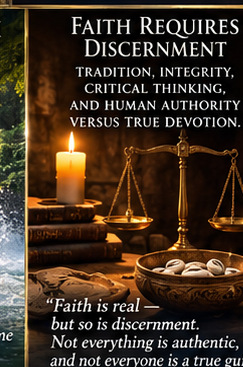
Religious authority does not automatically make every human decision correct.
A priest can possess knowledge and still have human weaknesses.
Tradition deserves respect, while human beings can still misuse authority.
Spiritual devotion and critical thought should not become enemies.
The book follows my journey as those distinctions became increasingly important.
The Miracle That Made the Book's Title Real for Me
One of the most significant experiences in the book occurred when I began preparing for Kariocha, the initiation through which I would be crowned to Ogun.
The financial requirement felt impossible.
I was told the ceremonial fee alone would be $28,000, with additional expenses pushing the total beyond $30,000.
At the time, I did not have even $500 available toward it.
The distance between my intention and my financial reality seemed enormous.
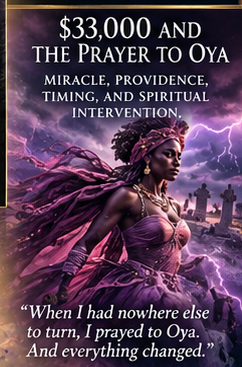
I was instructed to pray to Oya at my bóveda and explain what I needed.
I did.
About two weeks later, I received an unexpected letter from the Social Security Administration.
According to the letter, payments connected to my childhood had been underpaid because of an accounting error.
The amount owed to me was approximately $33,000.
It was almost exactly what I needed for the initiation.
Someone reading this story can interpret that event differently than I did.
They may call it coincidence, administrative timing, probability, or a strange convergence.
I experienced it as something more.
Both of my parents had already died. I had prayed to Oya, an Orisha deeply associated in the tradition with transformation and the cemetery, and money connected to my parents appeared through an unexpected correction at precisely the moment I believed I needed it.
That experience became one of the events through which the word miracle acquired personal meaning for me.
I do not need another person to use the same word.
The book explains why I do.
Crowning Changed My Understanding of Commitment
Kariocha was not simply another religious experience.
It represented a line in my life.
Before it, I had been exploring, learning, receiving, questioning, and developing relationships with Orisha.
The initiation required a different level of commitment.
Some elements of those ceremonies are private and should remain private. The book intentionally shares only selected portions of the experience because sacred knowledge does not become more authentic by exposing everything publicly.
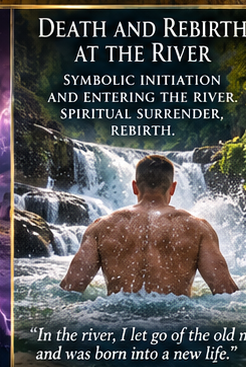
One of the portions I do describe occurred at the river.
My clothing was ritually removed as part of a symbolic death of the previous self. I entered the Iyawo period, the stage following crowning, as someone beginning a new religious life.
I experienced that moment intensely.
I had entered the ceremony carrying my previous history, identity, mistakes, hopes, and questions.
The symbolism forced me to confront the possibility that spiritual development requires more than adding beliefs to the person you already are.
Transformation can require surrender.
After returning from the river, I sat covered beneath a sheet in the sun and prayed to Ogun.
During that period, I experienced what I understood as a voice speaking clearly into my right ear.
The message was brief:
“I need my Oshún.”
When I reported it, the ceremony moved forward.
Again, this is testimony.
It is what I experienced.
The reader is free to decide what category they place that experience in.
For me, it became part of the relationship I understood myself to be forming with Ogun.
The River Taught Me Something About Identity
The symbolic death and rebirth of initiation affected me because it connected spirituality to identity in a way I had never experienced.
Modern life encourages us to think of identity as self-authored.
Initiatory traditions introduce a very different idea.
You submit yourself to obligations that existed before you.
You receive names, responsibilities, prohibitions, relationships, and expectations that you did not invent.
That can be deeply challenging for someone independent by nature.
It was challenging for me.
Yet the process taught me that freedom and obligation are not always opposites.
A meaningful commitment can narrow certain choices while deepening the life built inside those boundaries.
That became one of the enduring lessons of my relationship with Orisha.
My Ita Gave Me a Different Way to Think About Destiny
Following crowning, I received Ita, the life reading connected to the initiation.
I approached it with enormous anticipation.
In Lucumí, Ita is not casual advice. It can contain blessings, warnings, obligations, prohibitions, and guidance that becomes part of how the initiate understands the path ahead.
Several of the signs in my reading were meaningful to me.
The reading also showed me something about human mediation.
The Orisha may be sacred.
The people interpreting sacred communication remain human.
Language, hierarchy, ego, incomplete translation, institutional culture, personality, and power can all affect how a spiritual message reaches a person.
That realization became even more important later.
I came to believe deeply in Orisha while becoming less willing to confuse Orisha with every action performed in their name.
Those are different loyalties.
Faith Did Not Require Me to Surrender My Judgment
One of the most difficult parts of my journey involved eventually separating from my godmother.
This mattered because religious initiation creates profound relationships.
A godparent is expected to teach, guide, protect, and help develop the initiate.
Breaking such a relationship is therefore much more significant than simply ending a friendship.
The manuscript describes how I became increasingly troubled by restrictions on learning and by dynamics I observed within the ilé. After my crowning, I was told I would be unable to learn until after Iyaworaje, despite earlier expectations that initiation would open the path to greater knowledge.
I began to question whether these restrictions represented tradition or control.
That distinction became impossible for me to ignore.
Eventually, I chose to leave.
That decision taught me another important religious lesson.
Respect for elders is not the same as surrendering conscience.
Tradition is larger than any individual priest.
Devotion to Orisha does not require accepting every human authority unquestioningly.
A spiritual path that cannot survive sincere questions becomes too dependent on the people controlling access to it.
My faith survived the separation.
In many ways, it became more direct.
Iyaworaje Became a Year of Discipline
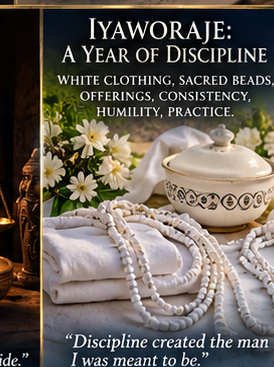
The year following crowning required sustained commitment.
Iyaworaje was not one dramatic ceremony.
It was daily practice, rules, restrictions, white clothing, behavioral discipline, offerings, study, humility, and attention to how I represented the Orisha whose crown I carried.
That year changed my understanding of sacrifice.
Sacrifice is easy to romanticize when it occurs once.
A year of repeated choices is different.
Character is shaped through repetition.
Religious identity becomes less about what someone claims to believe and more about what they continue doing after the emotional intensity of initiation has passed.
That principle applies far beyond religion.
A commitment becomes visible through behavior over time.
The Reading at the End of the Year Became Another Confirmation
After completing Iyaworaje, I arranged a Diloggún reading with Ocháni Lele, Stuart Myers.
The reading was conducted virtually, something that itself challenged conventional expectations within the tradition.
The sequence of throws recorded in the manuscript was unusual: 5-5, 6-6, 6-6, 5-5, 6-6.
Myers reacted strongly and told me that, in his interpretation, the Orisha were extraordinarily pleased with how I had completed the year.
He described the Iyaworaje as exceptionally well completed.
For me, the importance of the moment extended beyond the numbers.
The year had included isolation, disagreement, uncertainty, independent study, separation from religious authority, and repeated questions about whether I was following the right path.
The reading felt like confirmation that my relationship with Orisha had survived my conflict with human authority.
I understood that as an important distinction.
My faith did not belong to another person's approval.
Santería Changed the Way I Think About Miracles
Before this journey, the word miracle would have made me skeptical.
Today I use it differently.
A miracle, in the context of this book, does not require me to prove that every unexplained event violated natural law.
The word describes the moments in my life in which timing, spiritual experience, divination, relationship, transformation, and circumstance converged so powerfully that I could no longer understand my life in the same way I had before.
Some of those experiences were internal.
Some involved events I could document.
Some involved religious interpretations that another person may not share.
That is acceptable.
Faith becomes dishonest when it demands that personal conviction be presented as universal proof.
Skepticism becomes equally limiting when it assumes that anything outside current explanation must therefore be meaningless.
My own path eventually found room for both reverence and uncertainty.
I can say:
This happened to me. This is how I understood it. This is what changed afterward.
That is enough for a memoir of faith.
Santería Is Larger Than the Miracles I Experienced
The personal story is only one layer of the book.
Santería, or Lucumí, carries a much larger history.
It survived enslavement, displacement, suppression, cultural adaptation, and generations of misunderstanding. Its continued existence is itself a story of religious resilience.
The tradition cannot responsibly be reduced to sensational images of sacrifice, magic, curses, or divination.
It includes theology, ancestry, ritual obligation, character, community, music, prayer, divination, sacred stories, initiation, ethical responsibility, and relationships with Orisha developed over time.
That broader context is why the book includes explanatory chapters alongside memoir.
I wanted readers unfamiliar with Santería to understand enough of the tradition to see why these experiences mattered to me.
I also wanted to challenge the caricatures that had shaped public understanding of the religion for so long.
The Orisha Became Part of How I Understand My Life
When I look backward, one of the strangest aspects of my spiritual development is how distant this entire world once seemed.
I had never prayed.
I did not believe in religion.
I had almost no spiritual vocabulary.
Then one name caught my attention.
Oshún.
That curiosity led to study.
Study led to experience.
Experience led to initiation.
Initiation led to obligation.
Obligation led to conflict, independence, discipline, and eventually a spiritual identity I could never have imagined earlier in my life.
That progression is why The Miracle of Santería remains one of my most personal books.
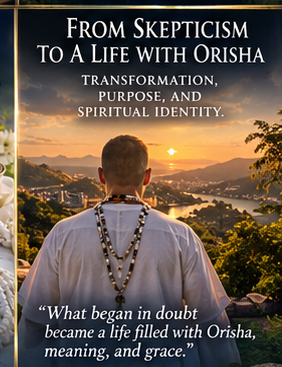
It records the transformation of someone who once saw spirituality as fantasy into someone whose relationship with Orisha became central to the way he understood his own life.
I did not arrive through blind belief.
I arrived through experience, doubt, study, mistakes, discernment, sacrifice, and repeated moments that I came to interpret as divine timing.
That is the miracle.
What the Book Ultimately Means to Me
The deepest transformation was not that I acquired a new religious label.
I learned a different relationship with uncertainty.
There are parts of life we can measure.
There are parts we can reason through.
There are parts we can document carefully.
And there are experiences whose meaning exceeds what we can conclusively prove.
I no longer feel compelled to collapse those categories into one.
My psychological education taught me to ask questions.
My spiritual life taught me that questions do not always destroy faith.
Sometimes they refine it.
Santería gave me a language for resilience, destiny, sacrifice, ancestry, transformation, character, and relationship with forces I understand as Orisha.
It also taught me that spiritual responsibility is lived through behavior.
You can receive sacred objects and still fail to develop character.
You can memorize prayers and still misuse authority.
You can hold religious titles and still fail the people who trust you.
The spiritual path means more when the person carrying it becomes more disciplined, more responsible, more discerning, more humble, and more capable of helping others.
That is the transformation I care about.
The miracles drew my attention.
The obligations changed my life.
And the relationship with Orisha gave those experiences a meaning I continue to carry.
The Miracle of Santería is ultimately the story of how a skeptic learned to recognize the sacred in his own life.
About the Book
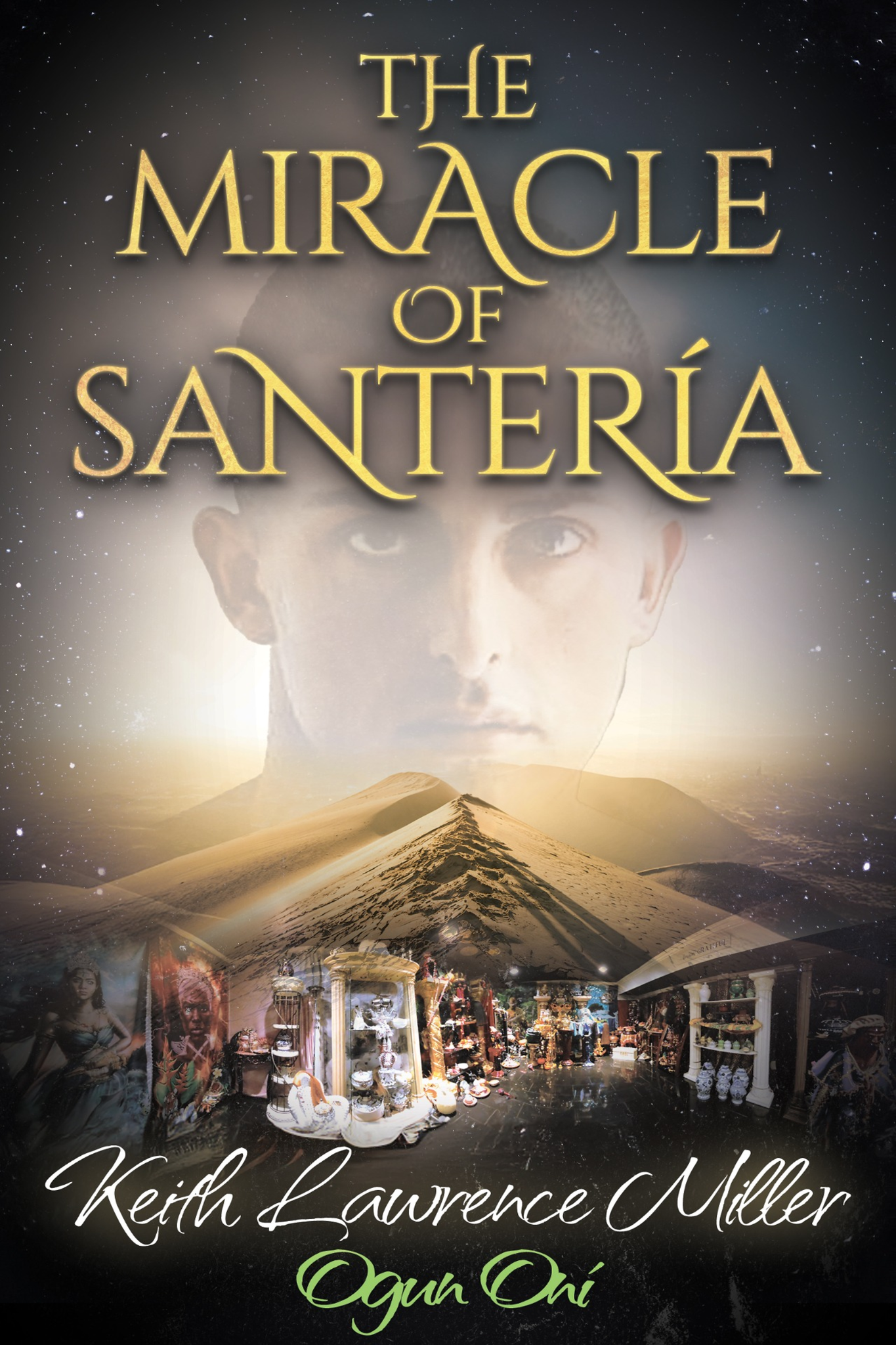
The Miracle of Santería: A True Story of Faith and Transformation is Keith Lawrence Miller's personal account of his journey from spiritual skepticism into Santería/Lucumí, his developing relationship with the Orisha, his initiation to Ogun, the discipline of Iyaworaje, and the experiences he came to interpret as divine guidance and miraculous timing.
The book combines memoir with introductory material about Santería's history, Orisha, divination, offerings, initiation, ancestor reverence, spiritual development, and religious practice. The narrative also examines discernment, religious authority, sacrifice, family, resilience, doubt, spiritual independence, and the distinction between devotion to Orisha and unquestioning loyalty to individual human authorities.
The work presents spiritual experiences as the author's testimony and interpretation. Readers may understand those experiences differently.
Keith Lawrence Miller (Ogun Oní) First Edition · January 2025 ISBN: 9798306842455