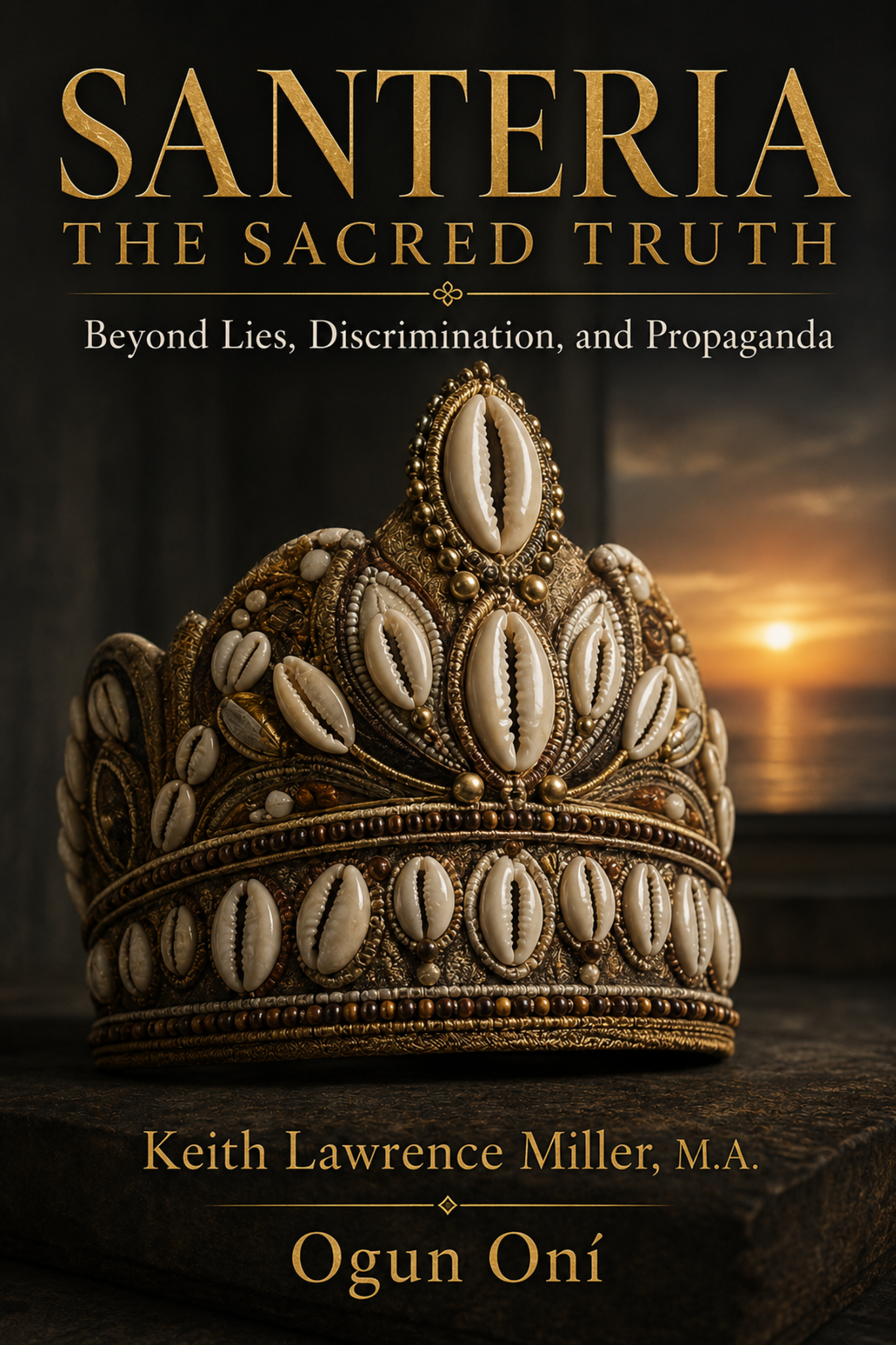
For years, Keith Lawrence Miller found it easier to keep part of his religious identity private than explain Santería to people who knew the religion primarily through stereotypes. Santería: The Sacred Truth is his attempt to change that public record without violating the sacred boundaries that deserve to remain protected.
A public-facing work confronting misconceptions, stereotypes, discrimination, and propaganda surrounding Santería while presenting its worldview with seriousness and respect.
Who it is for: Readers seeking public-facing religious literacy, practitioners organizing study, and people who want context without replacing lineage or qualified authority.
Key ideas
Questions and concepts carried through the work
Santería
Religious literacy
Discrimination
Public education
Author platform
Use the book as an entry point
The 2.0 site connects books to speaking, essays, frameworks, and adjacent titles rather than treating each publication as an isolated product.
Santería: The Sacred Truth: Why I Could No Longer Keep Orisha Hidden
By Keith Lawrence Miller, M.A. (Ogun Oní)
For years, it was easier to speak publicly about almost every part of my life except one of the most important.
I could talk about education, psychology, career development, business, leadership, family, writing, and professional achievement. Those subjects fit comfortably inside the categories people already understood. Santería required a different calculation.
How much should I say?
What will this person think after they hear the word?
Will they still see the same professional?
Will they assume something dangerous, irrational, primitive, or fraudulent before I have explained anything?
Will a sacred relationship that has brought discipline, protection, correction, identity, and meaning into my life suddenly be interpreted through a horror film, a hostile sermon, an internet rumor, or a stereotype created by someone who has never practiced the religion?
Remaining quiet was often easier.
The problem was what silence allowed other people to do in my absence.
When responsible practitioners remain invisible, the public story does not remain empty. Someone else fills it. A filmmaker can turn unfamiliar ritual into horror. A hostile religious speaker can describe Orisha through a theology created to reject them. A news story can place the word Santería beside crime or secrecy without explaining the religion itself. An unethical practitioner can become the example by which every priest and every house is judged.
Eventually I became unwilling to accept that arrangement.
Santería: The Sacred Truth grew from that decision.
I write from within the religion. My perspective has been shaped by sustained study, initiation, ceremonial life, service to Orisha, and experiences that changed the course of my life. The manuscript also places a responsibility on me because lived conviction cannot replace historical evidence, and personal testimony should never be disguised as scientific proof. The book therefore distinguishes documented history, legal authority, religious-studies scholarship, lineage teaching, practitioner testimony, and my own experience rather than collapsing them into one kind of claim.
That balance became the foundation of the book.
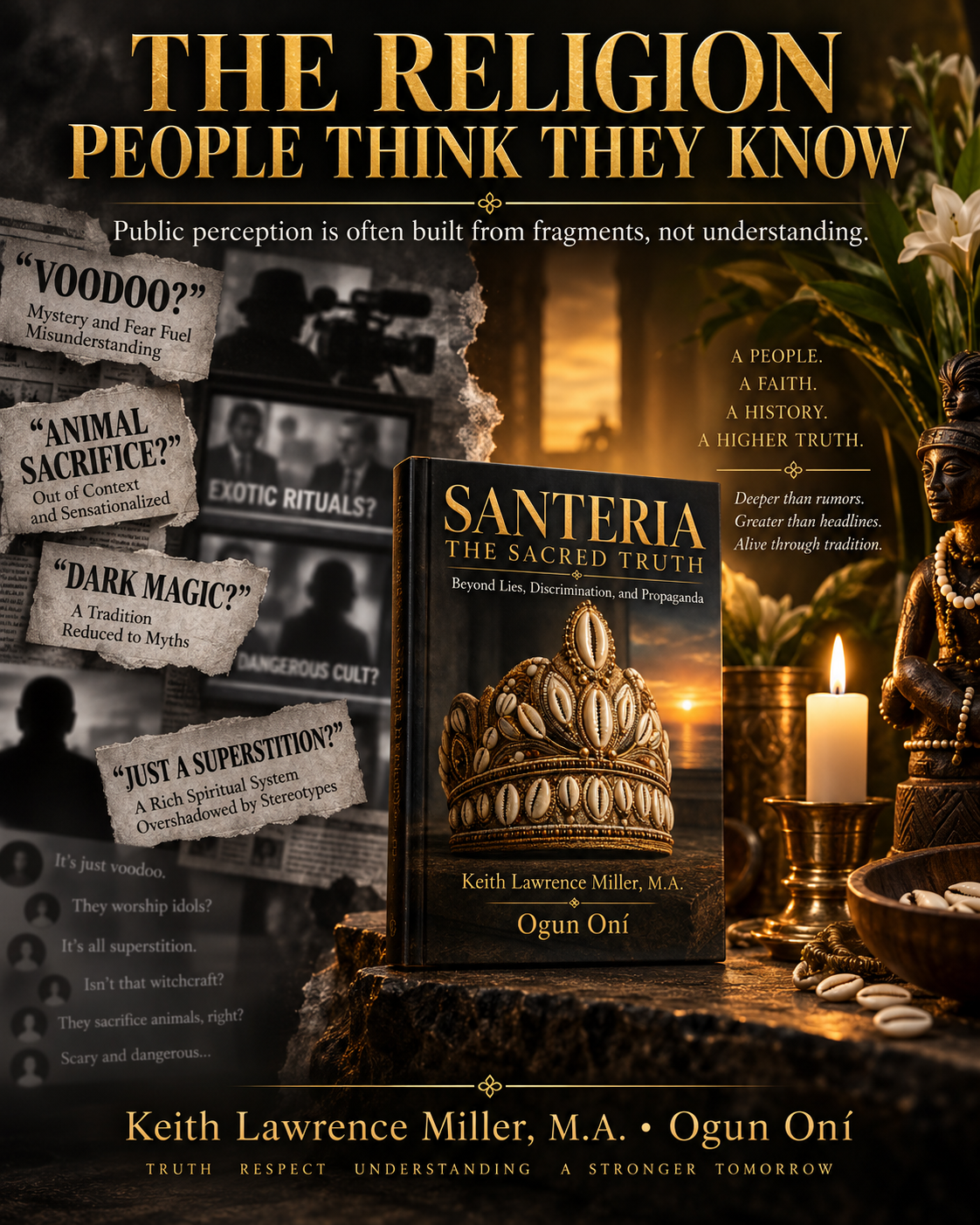
The Religion People Think They Know
Santería has an unusual public problem.
Many people recognize the name.
Far fewer can explain the religion.
Recognition often comes through a collection of disconnected images: beads, candles, blood, drums, saints, sacrifice, possession, secrecy, curses, or magic. The images are familiar enough to produce confidence even when the underlying knowledge is extremely limited.
That is one reason prejudice can become so durable.
People rarely describe a religion as misunderstood when they believe they already understand it.
A person who would hesitate before explaining the theology of an unfamiliar Christian denomination may feel completely comfortable defining Santería after seeing a movie scene or hearing a warning during childhood.
The problem extends beyond individual ignorance.
Schools decide which religions receive serious treatment.
Entertainment decides what images communicate danger quickly.
News organizations decide which events deserve attention.
Competing religious traditions sometimes describe Santería through their own theological categories.
Academic institutions have historically decided which African-derived practices counted as religion, folklore, magic, superstition, or culture.
The result is a public record in which the extraordinary depth of ordinary religious life has often been less visible than whatever appeared most sensational.
That is why the book refuses to begin with Santería defending itself.
The first responsibility is religious literacy.
Readers should encounter the religion as a coherent sacred world before being asked to judge its most controversial public images. The manuscript begins with divine source, Orisha, ancestors, destiny, character, sacred relationship, divination, initiation, oral transmission, responsibility, and community. Only after that foundation does the book turn directly toward the history of misrepresentation.
Orisha Cannot Be Reduced to a List of Services
One of the most persistent distortions comes from reducing Orisha to what people want from them.
Oshún becomes love.
Ogun becomes war.
Yemayá becomes motherhood.
Elegguá becomes roads.
Obatalá becomes peace.
Once the tradition is presented that way, the Orisha begin to resemble departments in a supernatural service company.
That is far removed from how I understand the religion.
Orisha are encountered as living sacred powers with identity, history, relationship, authority, obligations, character, and ways of correcting the people who approach them.
Ogun cannot be contained by iron or war. His sacred associations also reach labor, tools, technology, civilization, perseverance, transformation, and the disciplined use of force.
Oshún cannot be reduced to beauty or romance. Her roads carry dignity, diplomacy, fertility, appetite, prosperity, grief, sweetness, self-worth, and the responsibilities created by attraction and abundance.
Obatalá is more than white cloth or old age.
Yemayá is more than a maternal symbol.
Elegguá cannot be understood through one English word such as trickster.
Every reduction makes the Orisha easier to summarize while making the religion harder to understand.
That is precisely the problem this book tries to correct.
Santería Is a Religion of Relationship and Obligation
Another misconception treats Santería as a system people enter when they want something.
Money.
Love.
Protection.
Revenge.
A job.
A legal victory.
Healing.
Those desires may appear within real human religious life because practitioners are human beings with real needs.
They do not define the theology.
Relationship with Orisha involves gratitude, service, restraint, character, reciprocity, obligation, and the acceptance of responsibilities that can continue long after the original problem has passed.
That distinction has become important in my own understanding.
Orisha did not enter my life as an academic subject. I experienced them through what I understood as presence, intervention, correction, protection, demand, and change. Those experiences strengthened my conviction while also increasing my responsibility to communicate carefully. The stronger a testimony becomes personally, the more disciplined the public explanation should become.
A religion centered only on receiving would have little to say about character.
Santería has a great deal to say about character.
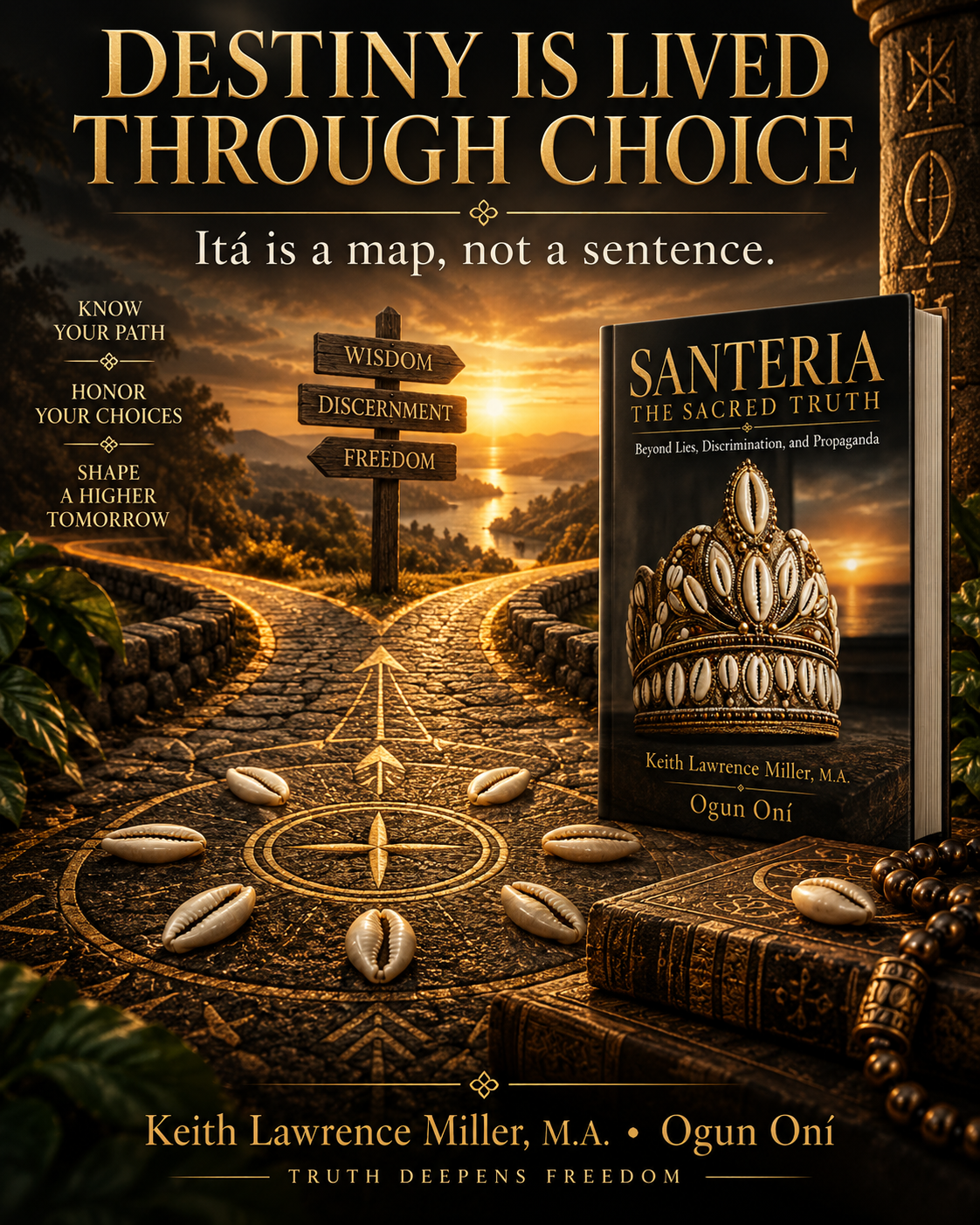
Destiny Is Lived Through Choice
The public sometimes encounters divination and immediately translates it into prediction.
What is going to happen?
Will I get the job?
Will this relationship work?
Will I become wealthy?
When will the problem end?
The deeper structure of Lucumí thought is more demanding.
Ori, Itá, Odú, Iré, Osogbo, character, warning, blessing, sacrifice, and choice form a system in which destiny is meaningful without becoming mechanical fatalism.
A warning matters because response remains possible.
A blessing brings responsibility because favorable conditions can be lost through conduct.
Strength can protect or destroy depending on how it is governed.
Opportunity can be wasted.
A difficult road can be altered by discipline, counsel, preparation, relationship, and behavior.
This is why one of the central ideas in the book is that Itá is a map, not a sentence.
The road matters.
So does the person walking it.
That is one of the aspects of Santería I find philosophically powerful because sacred guidance does not erase human responsibility.
It increases it.
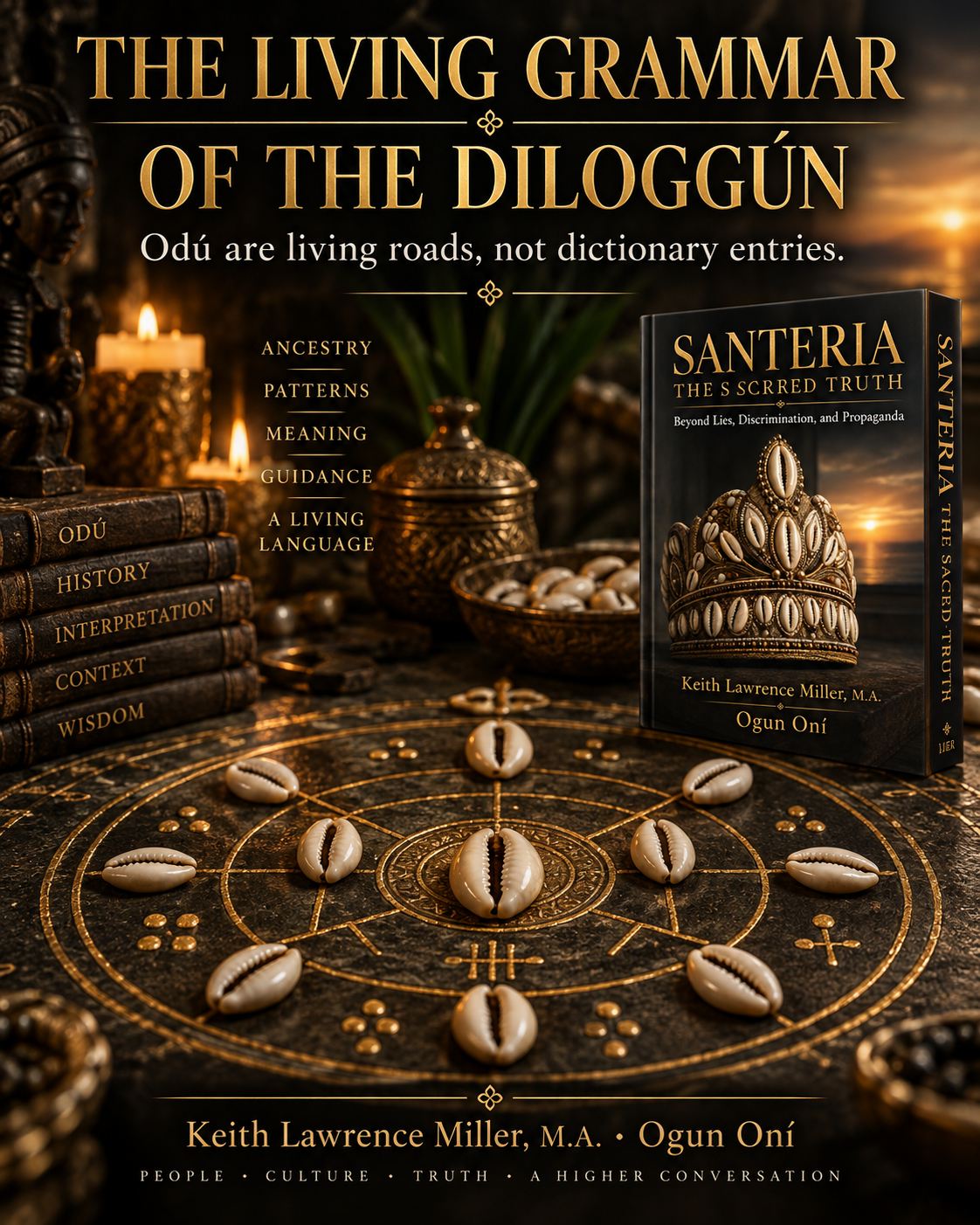
The Diloggún Is Far More Than Fortune-Telling
The same misunderstanding affects the Diloggún.
From outside the religion, cowrie-shell divination can be presented as a simple mechanism for forecasting events.
Inside the intellectual structure of the tradition, the oracle is considerably more complex.
Odú are not dictionary entries.
A shell pattern does not operate like a lookup table where one number equals one future event.
Odú carry stories, conditions, warnings, blessings, ethical demands, relationships, proverbs, consequences, and possible roads.
Patakís help make those structures intelligible through narrative.
They can show how pride destroys an opportunity, how appetite turns blessing into loss, how power becomes dangerous without restraint, how a gift can remain unrecognized, or how a person repeatedly creates the very condition they claim to want removed.
The oracle can speak about circumstances while simultaneously placing the person's character under examination.
That is why I describe the Diloggún as a living grammar.
Interpretation requires context, sequence, relationship, training, and responsibility.
Reading about it does not authorize someone to divine.
Knowing public information does not confer religious office.
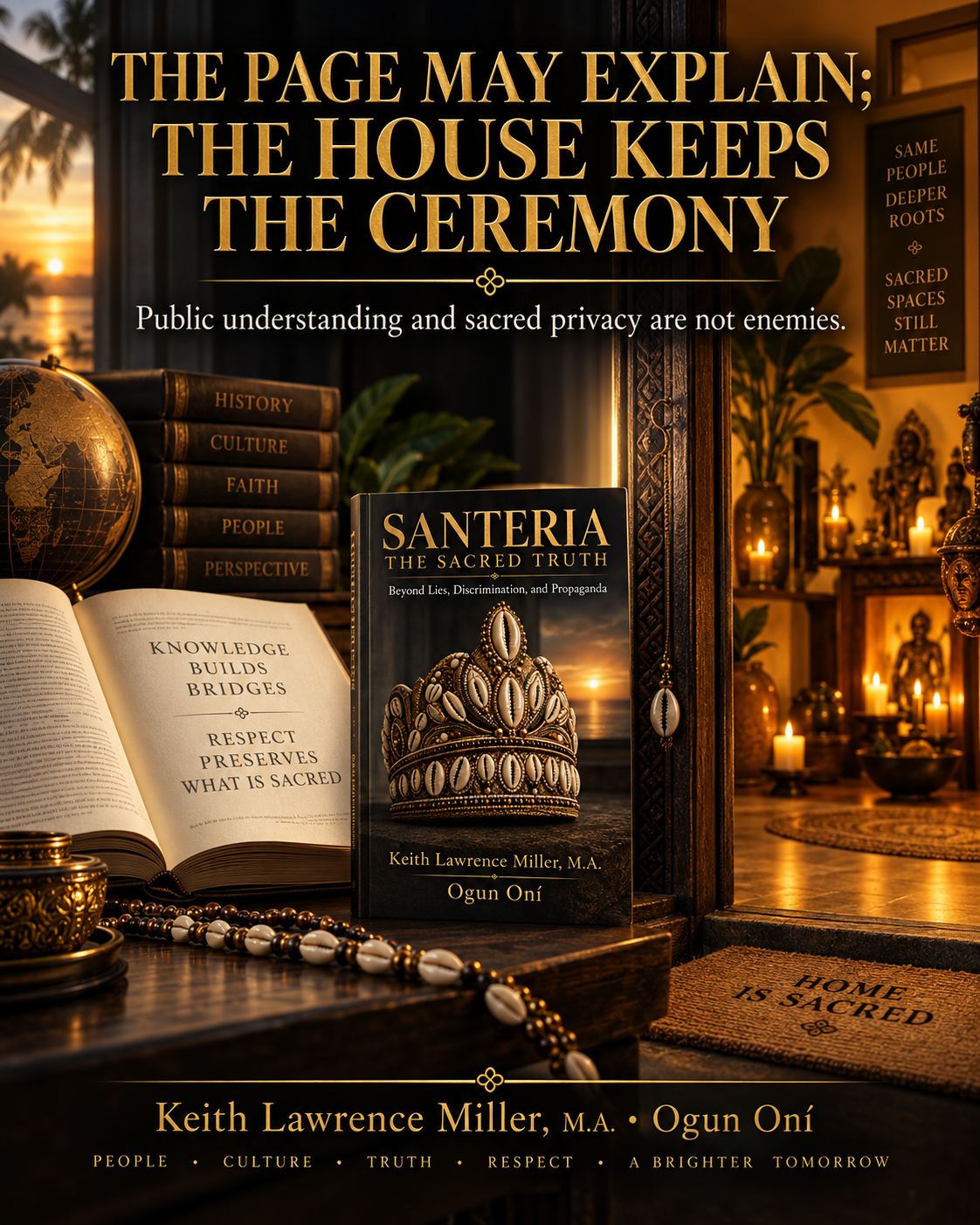
The Page May Explain; the House Keeps the Ceremony
This became one of the governing principles of the entire project.
The page may explain; the house keeps the ceremony.
Public education is necessary.
Exposure is something different.
A reader can learn why initiation matters without receiving an initiation sequence.
A reader can understand the religious meaning of offerings without being given protected procedure.
A reader can learn how the Diloggún functions intellectually without being authorized to cast or prescribe.
A reader can understand why sacred objects matter without being shown how they are prepared, consecrated, received, or worked.
The book therefore draws a deliberate line between public theology and consecrated knowledge.
That boundary does not weaken education.
It makes education responsible.
There are things a book should explain.
There are also things a book should have enough discipline to leave alone.
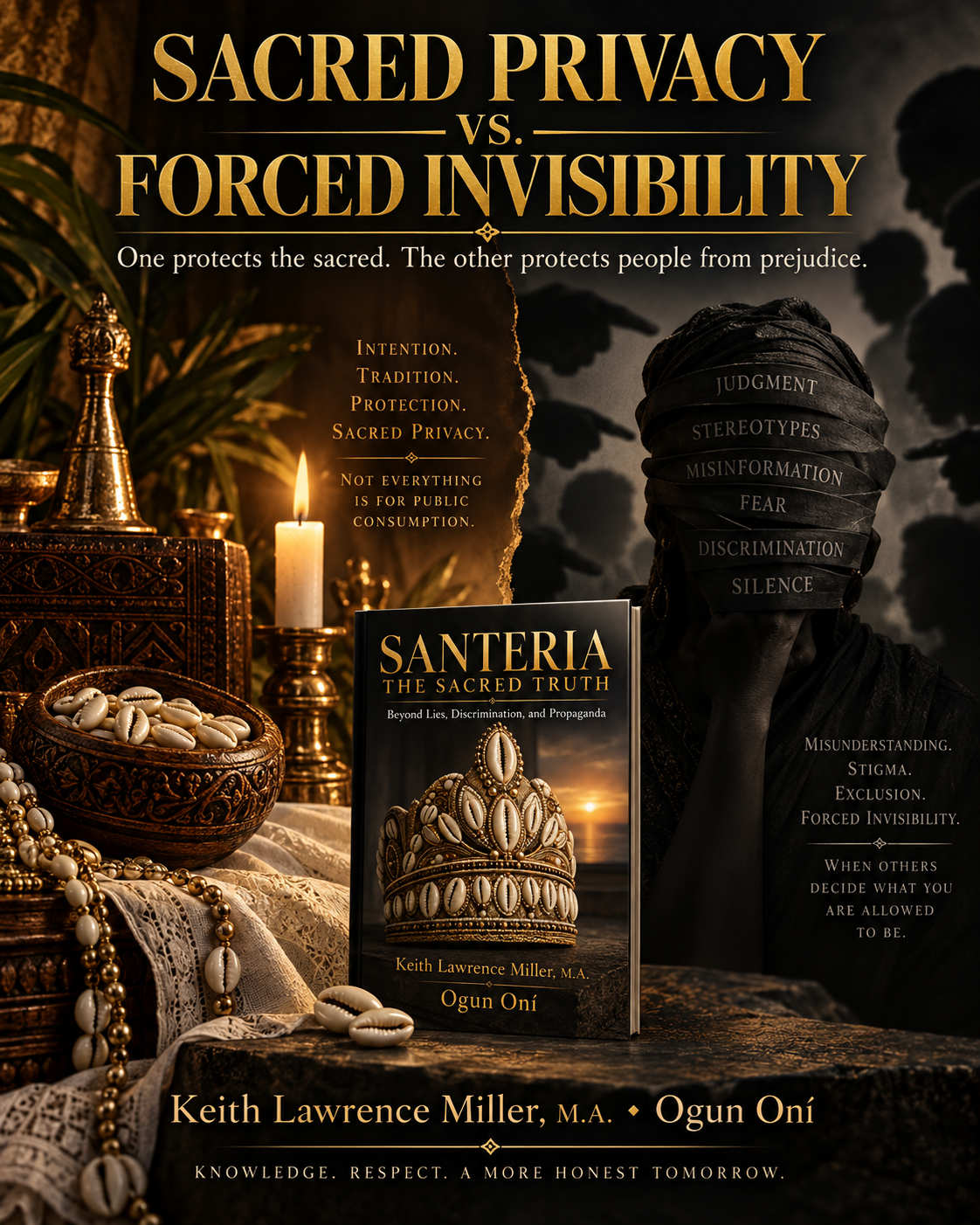
Sacred Privacy and Forced Invisibility Are Different
This distinction is particularly important because secrecy has been misunderstood from both directions.
Some sacred knowledge is protected because responsibility matters.
Initiation matters.
Lineage matters.
Office matters.
Preparation matters.
Timing matters.
A restricted teaching is not simply information someone is preventing you from seeing.
It may belong inside a relationship that determines who has been prepared and authorized to carry it.
That is sacred privacy.
Forced invisibility is different.
Forced invisibility occurs when someone hides even their religious identity because they anticipate ridicule, discrimination, employment consequences, family hostility, neighborhood suspicion, or damage to professional credibility.
One boundary protects the sacred.
The other protects the person from prejudice.
My own experience made that distinction personal. Concealment often seemed easier than educating every person who encountered Santería through stereotype, while the resulting public identity became incomplete because sacred relationships had been omitted from it.
I eventually reached the conclusion that I did not want fear to determine which parts of myself were respectable enough to acknowledge publicly.
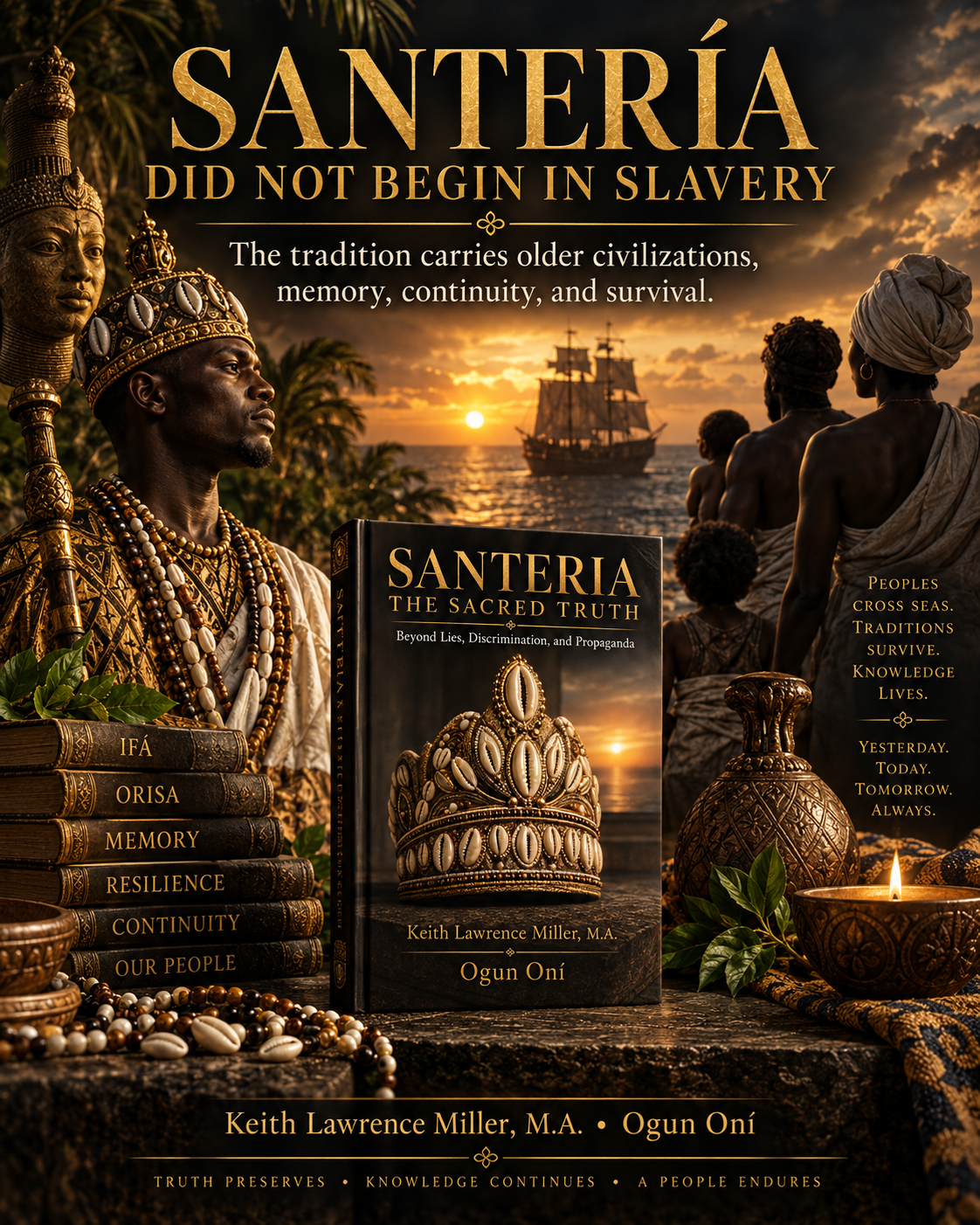
Santería Was Not Born in Slavery
Another important correction concerns history.
Santería did not begin when enslaved Africans arrived in Cuba.
The people carried across the Atlantic did not arrive without civilization, political organization, philosophy, religion, artistic traditions, technologies, priestly institutions, languages, or sacred knowledge.
Yoruba-speaking societies had complex religious and cultural worlds long before the Atlantic slave trade.
Enslavement ruptured those worlds.
It did not erase them.
In Cuba, people of African descent preserved, reorganized, adapted, and transformed religious knowledge under conditions shaped by slavery, Catholic power, racial hierarchy, forced conversion, migration, and cultural contact.
Songs survived.
Names survived.
Divination survived.
Sacred stories survived.
Relationships with Orisha survived.
Priestly knowledge survived.
New religious houses formed.
A diasporic religious world emerged through continuity, adaptation, memory, resistance, and reconstruction.
Understanding Santería only as a product of slavery accidentally erases the civilizations that existed before slavery.
The book therefore begins that historical section earlier.
Survival Required Intelligence
The survival of Lucumí religion is sometimes described as though it were accidental.
I see extraordinary intelligence in it.
A people subjected to displacement and coercion found ways to carry a sacred world through catastrophe.
Knowledge moved through memory.
Homes became religious institutions.
Relationships preserved authority.
Music preserved language and sacred pattern.
Catholic imagery could function inside complicated historical conditions without eliminating Orisha.
People rebuilt religious community under circumstances in which public power frequently belonged to institutions hostile to African religion.
That is not cultural stagnation.
It is adaptation under pressure.
The fact that the religion continues to exist is inseparable from generations of people who cooked, remembered, initiated, taught, served, sang, sacrificed, protected, corrected, and transmitted.
Their labor deserves more than a footnote in a story about oppression.
It deserves recognition as part of the religion itself.
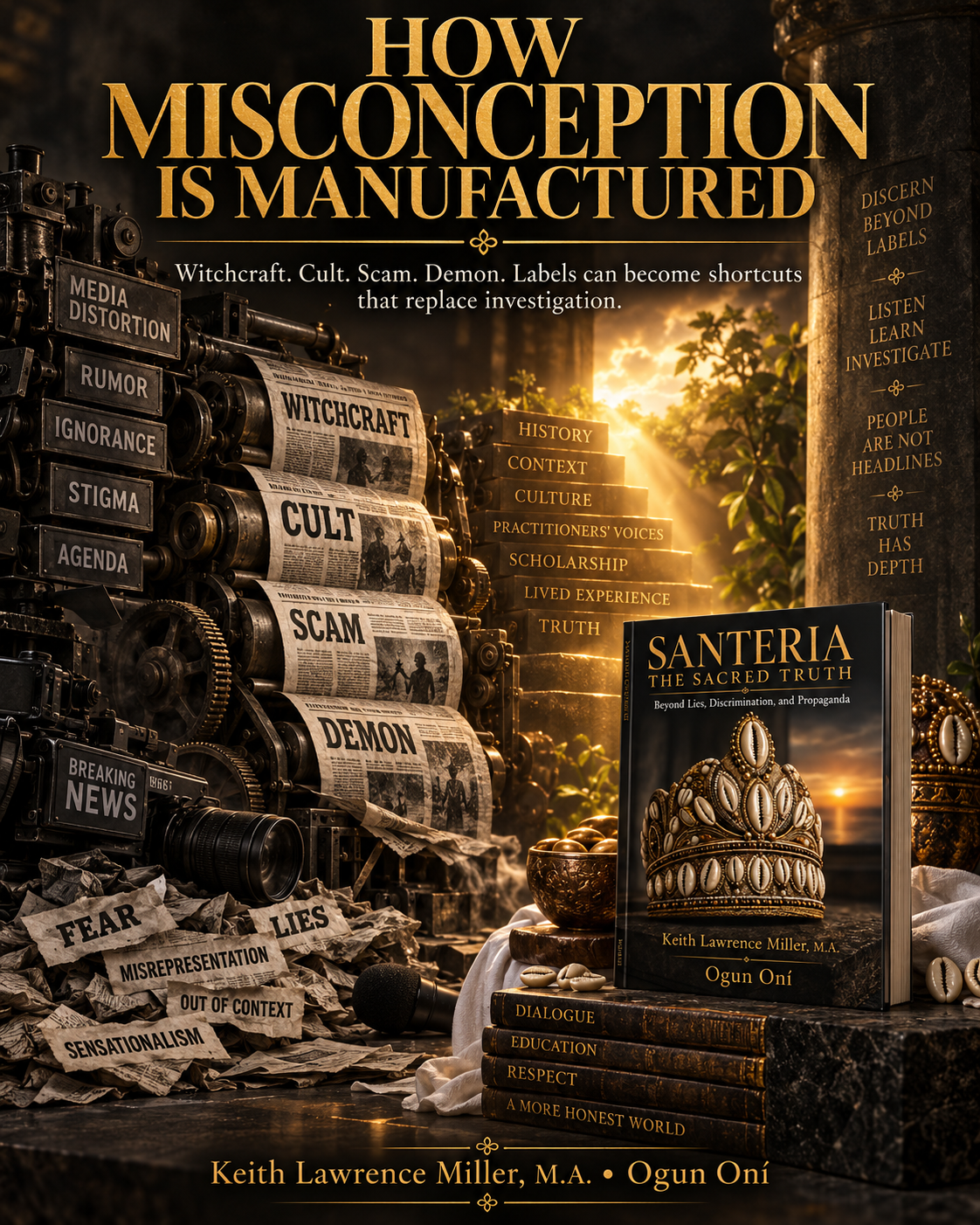
Misconception Is Manufactured
Stereotypes do not simply appear.
They are produced.
Repeated images become familiar.
Familiarity begins to feel like evidence.
The book devotes an entire section to how Santería became associated publicly with words such as witchcraft, cult, scam, demon, occult, crime, and horror.
Each word can operate as a compressed argument.
Call the religion a cult and readers may assume coercion before examining consent, leadership, accountability, or freedom to leave.
Call it a scam and every ceremonial cost begins to look fraudulent before anyone asks about materials, food, labor, musicians, priests, assistants, transportation, preparation, or the difference between legitimate cost and exploitation.
Call Orisha demons and a particular religious judgment is presented as though it were a neutral description of what Santería practitioners believe.
Call every African-derived tradition occult and important differences between Santería, Vodou, Hoodoo, Palo, Candomblé, Obeah, and other traditions disappear.
The book does not argue that difficult words should be banned.
It asks readers to identify the claim being made and examine whether the evidence supports it.
That is a much stronger standard.
Misconduct Should Be Confronted Without Turning It Into the Religion
Defending Santería against prejudice does not require pretending that every practitioner behaves ethically.
That would be intellectually dishonest.
Religious authority can be abused.
People can exploit fear.
Costs can be concealed.
Titles can be invented.
Vulnerable people can be manipulated.
Knowledge can be used to guide or to intimidate.
A closed community can make accountability difficult.
Those problems should be confronted directly.
The relevant questions are about conduct.
Was consent meaningful?
Were costs explained?
Was the person properly trained and authorized?
Was unnecessary work prescribed for money?
Could the godchild ask questions?
Was physical safety respected?
Was religious fear used to control someone?
Could the person leave without threats?
Those questions allow genuine misconduct to be identified.
Condemning an entire religion because misconduct occurs inside it accomplishes something very different.
Human beings remain human after initiation.
Every religious community has to face that reality.
Santería deserves the same analytical standard applied elsewhere.
Religious Costs Need Context
Ceremony can cost money.
Sometimes substantial money.
That fact is frequently used as evidence that Santería must be fraudulent.
The reasoning ignores the material reality of ceremony.
Food costs money.
Clothing costs money.
Animals cost money.
Sacred vessels and materials cost money.
Transportation costs money.
Musicians perform labor.
Cooks perform labor.
Assistants perform labor.
Priests may spend days preparing and serving.
Many people can be involved in one ceremony.
The existence of real cost does not remove the possibility of exploitation.
It creates the need to distinguish cost from exploitation.
That is a very different inquiry.
Transparency matters.
Consent matters.
Reasonable explanation matters.
Fear-based selling deserves criticism.
Invented emergencies deserve criticism.
False authority deserves criticism.
The fact that sacred work requires material resources is not itself evidence of fraud.
Animal Offerings Have to Be Understood Inside the Religion
Animal offerings are among the subjects most likely to trigger judgment before explanation.
That is exactly why the book addresses them.
The goal is not to force agreement.
The goal is understanding before judgment.
Within Santería, animal offerings belong inside larger religious ideas concerning life, reciprocity, sacred exchange, nourishment, obligation, sacrifice, and relationship.
Public discomfort is real.
Discomfort is not the same thing as religious literacy.
The book also places this controversy inside the history of religious freedom, including the Supreme Court's 1993 Church of Lukumi Babalu Aye v. City of Hialeah decision, because the dispute demonstrated how public hostility toward an unfamiliar faith could move into law.
The broader principle matters even for readers who disagree with the theology.
Religious freedom becomes weak when unfamiliar religions receive protection only after they begin resembling familiar ones.
Practitioners Need to Participate in Their Own Public Meaning
For generations, Santería has often been explained publicly by people standing outside it.
Missionaries.
Colonial authorities.
Journalists.
Police.
Academics.
Filmmakers.
Former practitioners.
Religious opponents.
Every outside perspective is not automatically hostile or useless. Scholarship has contributed enormously to preserving and understanding historical material.
The imbalance occurs when practitioners remain primarily objects of interpretation.
A living religion should contain intellectual agents capable of explaining their own sacred world.
That is one of the purposes behind what the book calls responsible public theology.
Practitioners can explain Orisha.
Destiny.
Offerings.
Initiation.
Character.
Divination.
Sacred objects.
Community.
Religious ethics.
History.
They can do that without publishing protected consecrations, private Itá, oath-bound liturgy, restricted invocations, or procedures that belong to initiated offices.
The public record becomes stronger when lived knowledge and critical scholarship can challenge and refine one another without pretending they are identical forms of authority.
Responsible Visibility Is the Future I Want
The internet has changed the conditions under which Santería exists publicly.
Information is everywhere.
Literacy is not.
A photograph can reveal a sacred object while explaining nothing about it.
A thirty-second video can expose part of a ceremony while removing lineage, preparation, meaning, and obligation.
A person can repeat an invented teaching confidently enough that repetition eventually makes it appear traditional.
At the same time, digital communication gives practitioners extraordinary opportunities to create serious educational resources, preserve history, connect communities, teach language, share scholarship, and challenge stereotypes.
That is one of the reasons I created SanteriaReligion.com and continued writing.
The answer to centuries of imposed invisibility cannot simply be total exposure.
The stronger path is disciplined visibility.
Explain what can responsibly be explained.
Protect what should be protected.
Identify the difference.
I Am No Longer Willing to Let Silence Do All the Talking
This book is personal for me because the public misunderstanding it addresses is not abstract.
When you practice a religion that people routinely associate with danger, fraud, demons, superstition, or ignorance, disclosure becomes a decision.
Eventually I decided that my own work had to contribute to a better public record.
That does not mean revealing everything.
My responsibility to Orisha includes restraint.
It includes respect for elders, houses, lineage, initiation, ceremony, and sacred boundaries.
It also includes refusing to allow people who have never lived within the religion to possess the entire public vocabulary for explaining it.
The balance I reached is the one that governs this book:
The page may explain; the house keeps the ceremony.
That sentence gives me room to speak without confusing public education with religious authority.
It allows me to discuss theology without turning consecration into content.
It allows me to defend practitioners without pretending practitioners cannot fail.
It allows me to confront prejudice without attacking another person's right to disagree religiously.
It allows me to describe my own testimony honestly without asking readers to mistake testimony for laboratory proof.
Most importantly, it allows Orisha to appear in public as more than accusations made against them.
I did not write Santería: The Sacred Truth because Santería needs me to create its dignity.
That dignity existed before me.
The religion survived people more powerful than the critics who misunderstand it today.
I wrote the book because public language matters.
What we call something shapes what we believe we are permitted to do to it.
A religion repeatedly described as primitive can be dismissed.
A religion described as dangerous can be controlled.
A religion described as fraudulent can be ignored when its practitioners report discrimination.
A religion described accurately has to be engaged with more intellectual honesty.
That is the work I wanted this book to begin.
Orisha deserve to be known with honor.
About the Book
Santería: The Sacred Truth: Beyond Lies, Discrimination, and Propaganda is Keith Lawrence Miller's comprehensive public introduction to Santería, Lucumí religious life, Orisha theology, destiny, divination, history, lived practice, religious freedom, practitioner experience, public misconception, and responsible visibility.
The First Edition contains 39 chapters across eight major parts, moving deliberately from religious literacy into history, controversy, religious freedom, and practitioner voice. The sequence begins with the sacred world itself so that Santería is understood before its stereotypes are examined.
The book distinguishes public explanation from consecrated knowledge. It is educational, historical, theological, cultural, and literary. It is not an initiation guide, ritual manual, divination authorization, or substitute for elders, godparents, recognized houses, lineage formation, consecration, or religious office.
The manuscript also distinguishes documented history, law, scholarship, lineage teaching, practitioner testimony, and the author's personal experience, preserving disagreement and uncertainty rather than filling gaps through invention.
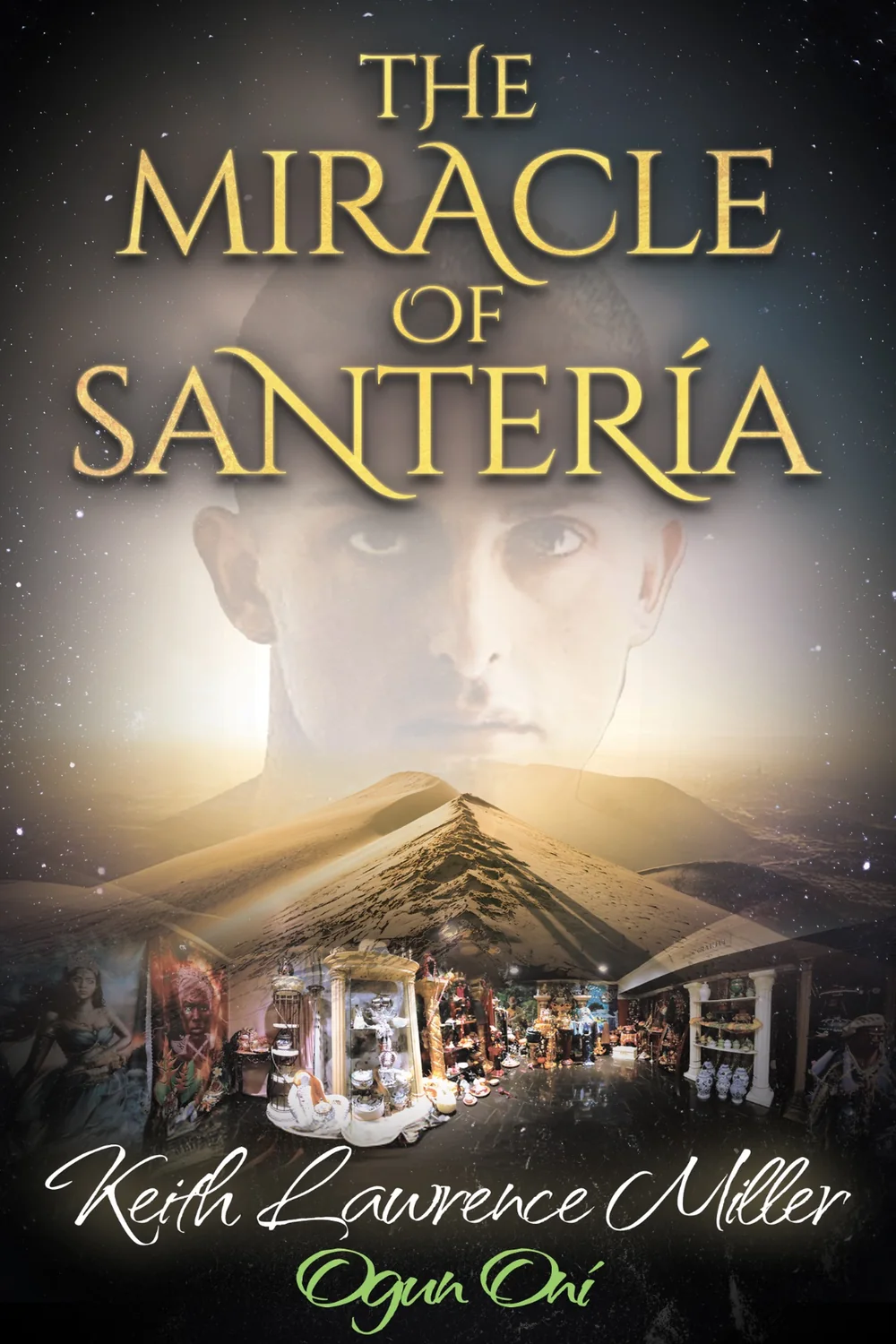
Keith Lawrence Miller, M.A. (Ogun Oní)First Edition · 2026ISBN: 9798188851354Publisher: Independently PublishedSanteriaReligion.com
The 39-chapter structure
The First Edition contains 39 chapters across eight major parts:
I. Entering the World of Orisha
II. Destiny, Character, and the Sacred Head
III. The Living Grammar of the Diloggún
IV. Meeting the Company of Orisha
V. How Santería Is Lived
VI. History, Survival, and the Hidden Religion
VII. How Misconception Is Manufactured
VIII. Religious Freedom, Practitioner Voice, and the Future