Behind the Curtain of Leadership
What Wizard of Oz Leadership Principle reveals about the authority, responsibility, and confidence that allow people to act

Consider a capable employee who knows how to resolve a customer's problem. The employee understands what happened, reviews the available options, and recommends a reasonable solution. Then the work stops while a manager approves it.
The manager reads the same information and agrees. The customer receives the solution the employee had already identified. Everyone moves on until the next decision returns to the same desk.
Over time, the manager may become known as the person who keeps the operation moving. The employee may become accustomed to waiting. Yet the sequence leaves a question unanswered: what did the manager contribute to the decision, and could that contribution have been made available earlier?
The answer matters. The manager might know about a commitment the employee cannot see. Several small decisions might create an obligation that requires broader oversight. Or the employee might already possess the judgment needed, while the organization has reserved permission for someone else.
That question runs through my book, Wizard of Oz Leadership Principle, subtitled Behind the Curtain: The Power to Act. I examine what a leader makes possible for people who arrive with capabilities of their own, and what those people should be able to rely on when they act.
Leadership becomes easier to understand when we look closely at that relationship. We can identify the work people already perform, the contribution the leader adds, and the responsibilities that remain after the leader leaves the room.
The ordinary person behind the position
The word leader can place an extraordinary burden on an ordinary person. We expect wisdom, patience, courage, empathy, decisiveness, and a reliable answer when events become difficult. A title can begin to sound like a promise that one person will possess every quality the situation might require.
Human beings are uneven. Someone can make a sound operational decision and struggle with a personal conversation. A person who brings order to a difficult period may be less effective when the organization needs experimentation. A leader can have something valuable to contribute while depending on other people's expertise.
A person who leads poorly can still exercise real influence or authority. Recognizing someone as a leader leaves the effectiveness of their conduct to be examined through what they do and what happens to the people relying on them.
The book begins by allowing the person behind the position to remain human. Leadership can occupy part of a life. Someone may lead a particular decision, follow a colleague's judgment in another, and return home with interests and responsibilities that have little to do with the role.
This makes the responsibility more specific. What does this person owe the people relying on them? Which decisions require their involvement? Where do their knowledge and authority end? Those questions give us a basis for evaluating conduct without asking the person to become a permanent ideal.
An ordinary person can accept a serious responsibility. They can obtain a resource, resolve a conflict, give someone authority, or answer for a commitment when keeping it becomes inconvenient. The contribution has value because of what it makes possible in the situation.
What the Wizard helps us see
In L. Frank Baum's original story, the companions demonstrate capacities before receiving the Wizard's gifts. They travel, solve problems, care about what happens, and face danger while believing that something essential is missing from them.
Their relationship with the Wizard invites us to examine where ability resides and why people may need recognition before they trust what they can already do. The figure at the center can come to represent powers distributed among the people around him.
That image has an organizational parallel. When an achievement becomes attached to one prominent name, the work behind it can fade from view. The specialist who understood the problem, the employee who noticed an error, and the colleagues who coordinated the solution may receive less attention than the person who announced the result.
Pulling back the curtain allows us to recover those contributions. It also allows us to examine what the recognized figure actually provided. Perhaps that person obtained the resources or protected the work when support weakened. Those actions belong in the explanation alongside the capabilities of the people who carried it out.
Baum's story contains another useful detail. Before leaving by balloon, the Wizard appoints the Scarecrow to rule in his absence and tells the citizens to obey him. Recognition now has a public consequence. The Scarecrow's role has been announced to the people expected to recognize it.
For an employee, a similar issue can arise between a private expression of confidence and authority the rest of the organization will respect. A supervisor may believe in someone's judgment. That belief becomes more useful when the person can make a decision that other people accept as theirs to make.
Earlier writers have drawn leadership lessons from Oz, and the book acknowledges that history. My argument connects the metaphor to the practical relationship among capability, confidence, authority, and continuing responsibility. The question is what the person behind the image enables others to do.
When capability becomes usable
People bring knowledge and experience into an organization. Some of it predates their employment. Some develops through repeated contact with customers, equipment, colleagues, or problems that a senior person encounters less frequently.
Possessing that knowledge does not automatically make it usable. An employee may understand a recurring failure and lack the authority to change the process that produces it. They may know how to resolve a complaint and have no access to the necessary information. They may have permission from one manager while another department rejects the resulting decision.
Leadership can become consequential at each of those points. A person with the relevant authority can remove the obstacle, clarify the decision, or obtain cooperation the employee cannot secure alone. The employee's capability remains their own. The leader supplies something that allows it to reach the work.
I express the book's central definition this way:
Effective leadership is being a symbol that allows others to have confidence, security, accountability, and the desire to perform beyond their capacity.
In the book's research interpretation, “beyond their capacity” means beyond perceived limits or previously demonstrated performance. People retain real limits on their time, knowledge, energy, and resources. The question is whether more of their capability can become usable.
The word symbol therefore carries an obligation. A title, a reputation, or a promise of support has to mean something in the circumstances where people act. Employees need a reason to believe that their decisions will count and that the support offered will remain available.
The practical value becomes visible when someone can proceed with a decision they are qualified and authorized to make. We can then examine what made that action possible, including the employee's own preparation and the leader's particular contribution.
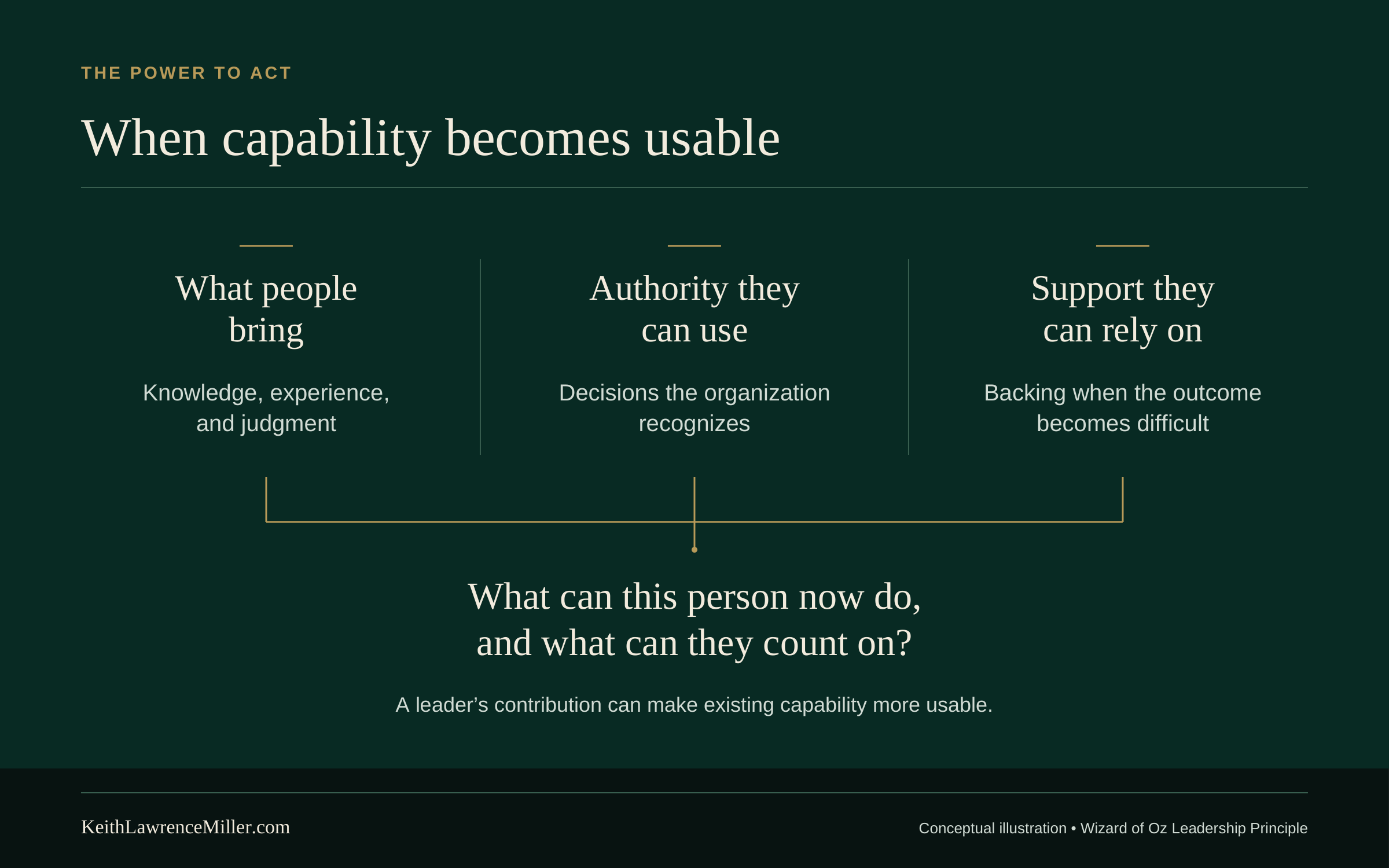
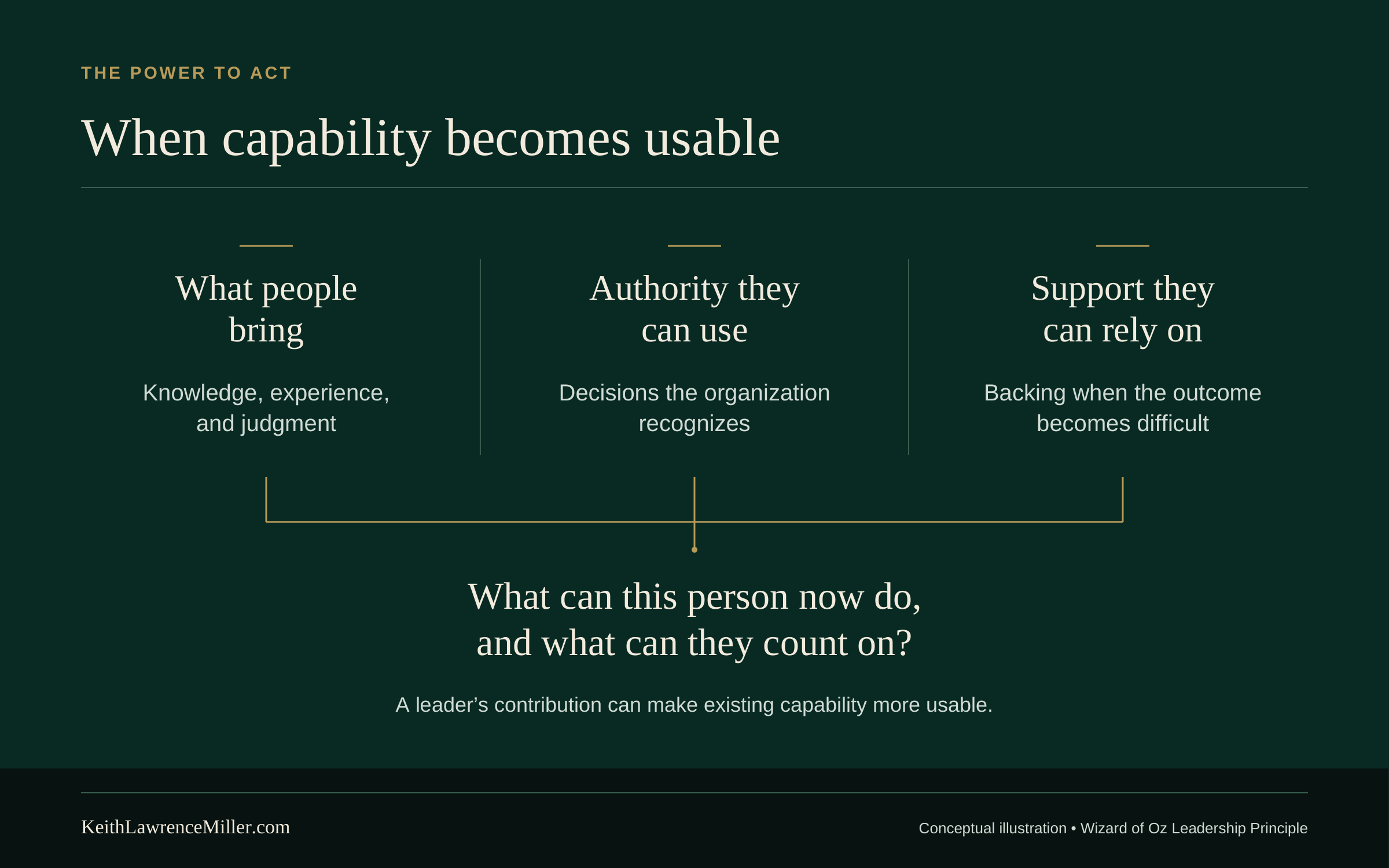
Read this diagram as text
- What people bring: Knowledge, experience, and judgment.
- Authority they can use: Decisions the organization recognizes.
- Support they can rely on: Backing when the outcome becomes difficult.
What can this person now do, and what can they count on?
How an approval queue can create indispensability
Return to the employee waiting for permission. If the same pattern repeats throughout an organization, the leader's day can fill with decisions that other people have already worked through.
The workload is real. The necessity of every approval still needs examination.
As I write in the book, “A person can appear indispensable because the organization has made their approval indispensable.” A crowded inbox tells us where the process sends its questions. It leaves open how much judgment the person receiving them actually adds.
This can become a difficult relationship for both sides. The leader may feel unable to step away because every decision comes back. Employees receive repeated practice in preparing recommendations, while the final authority remains elsewhere. Their hesitation can then be read as evidence that they need more supervision.
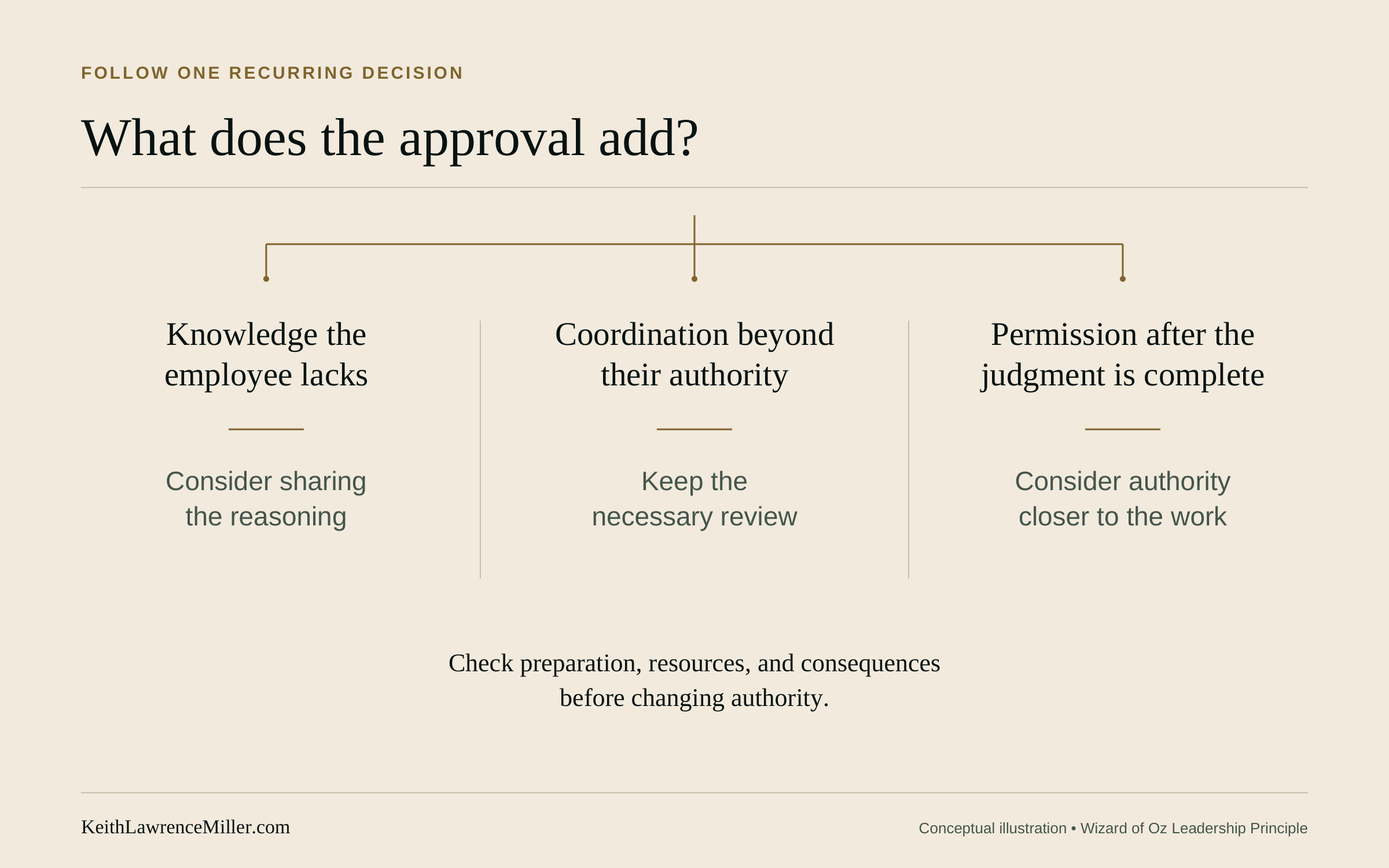
A useful starting point is one recurring decision. Follow it from the moment the problem appears. Who gathers the information? Who understands the options? What changes when the leader becomes involved? If the leader adds knowledge, that knowledge may need to be shared. If the leader resolves a competing obligation, the decision may need continued review. If the remaining contribution is permission, the organization can examine whether that permission belongs closer to the work.
This approach also respects how the current arrangement developed. If a supervisor has interpreted every unusual case for years, employees may need access to that reasoning before taking over. Removing the approval step cannot by itself transfer experience that has remained concentrated in one person's hands.
The purpose is to understand the dependency well enough to change it responsibly. A leader can become less occupied with routine decisions while remaining available for the questions that require their authority.
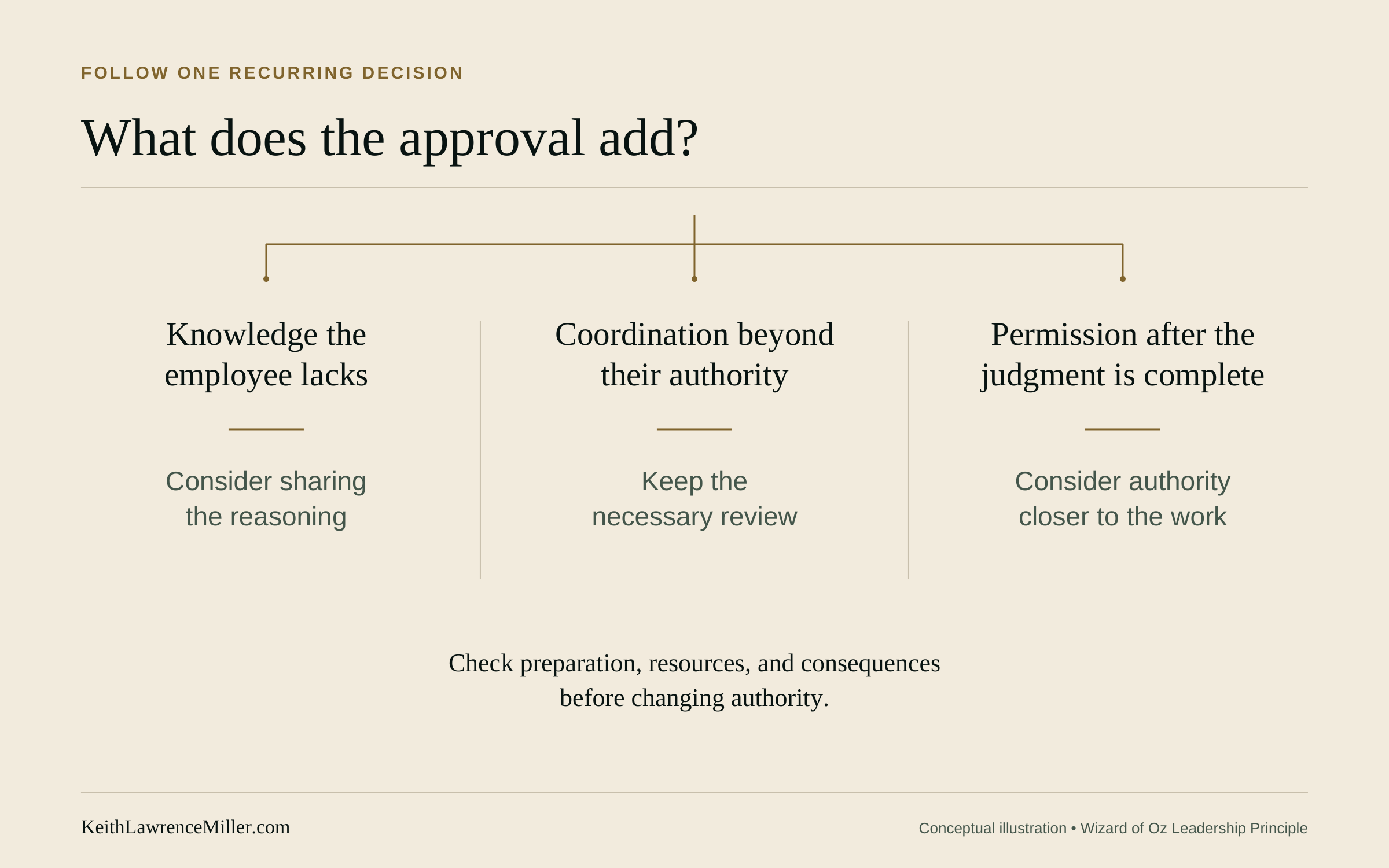
Read this diagram as text
- Knowledge the employee lacks: Consider sharing the reasoning.
- Coordination beyond their authority: Keep the necessary review.
- Permission after the judgment is complete: Consider authority closer to the work.
Check preparation, resources, and consequences before changing authority.
The promise that has to survive a difficult result
Permission becomes consequential when an employee considers what they can expect after acting. They may understand the assignment and still wonder whether a disappointing result will cause their authority to be questioned retroactively.
That expectation can shape how much initiative feels reasonable. An invitation to use judgment has limited value if the employee expects to stand alone whenever the outcome creates discomfort.
The safety net in my argument is the leader's credible willingness to answer for the responsibilities that accompany authorization. The employee remains responsible for the judgment they exercise. The leader remains answerable for the authority granted, the support promised, and the wider obligations associated with the arrangement.
Consider a hypothetical employee authorized to order a replacement component within an agreed budget. The employee checks the specification and receives confirmation that the component should work. Installation nevertheless fails. The immediate problem may now involve a supplier dispute, additional expenditure, or coordination the employee has no authority to command.
The leader's earlier involvement may have been brief. Their responsibility has become practical again. They need to establish what happened, address consequences within their control, and explain the arrangement under which the employee acted.
The review should follow the information available at the time. An ignored warning belongs in that account. So does an inaccurate specification or a promise from a supplier. The employee can remain accountable for their choices while the leader fulfills the obligations attached to the assignment.
People learn from what happens in this moment. If a leader denies having granted permission whenever the result disappoints, waiting becomes understandable. If the leader gives a fair account of the decision and carries the responsibilities they accepted, the employee has a firmer basis for acting next time.
The promise of support gains substance when it survives a result that makes it inconvenient to keep.
Responsibility can remain when direct involvement changes
A leader can be physically absent while employees remain dependent on their approval. A leader can also be nearby while other people exercise considerable judgment. Distance alone tells us little about the authority people actually possess.
What matters is how the work is arranged. Employees may make routine decisions and keep the leader informed. They may bring forward an issue when it exceeds their agreed scope. The leader can resolve that issue without taking permanent control of every decision around it.
One case I examine in the book comes from Anita Tucker and Amy Edmondson's study of nursing work. Nurses found immediate ways around missing supplies or information. An oncology nurse obtained linen from another unit, allowing care to continue while the supply problem remained unresolved.
The case raises a question about the reach of authority. A worker may be capable of restoring today's work while having little control over the arrangement that will interrupt tomorrow's. Praising the employee's resourcefulness leaves that larger obligation unresolved.
Someone with wider authority needs to give the information somewhere useful to go and pursue changes beyond the employee's reach. That may require direct involvement. The amount of involvement should follow what the work needs and what people can reasonably accomplish within their own authority.
Earlier preparation and recognized commitments can support independent work. When a new obstacle appears, a leader can supply a missing contribution and then return immediate decisions to the people doing the work. We can examine whether the intervention resolved the problem and whether the improvement remains after the leader steps away again.
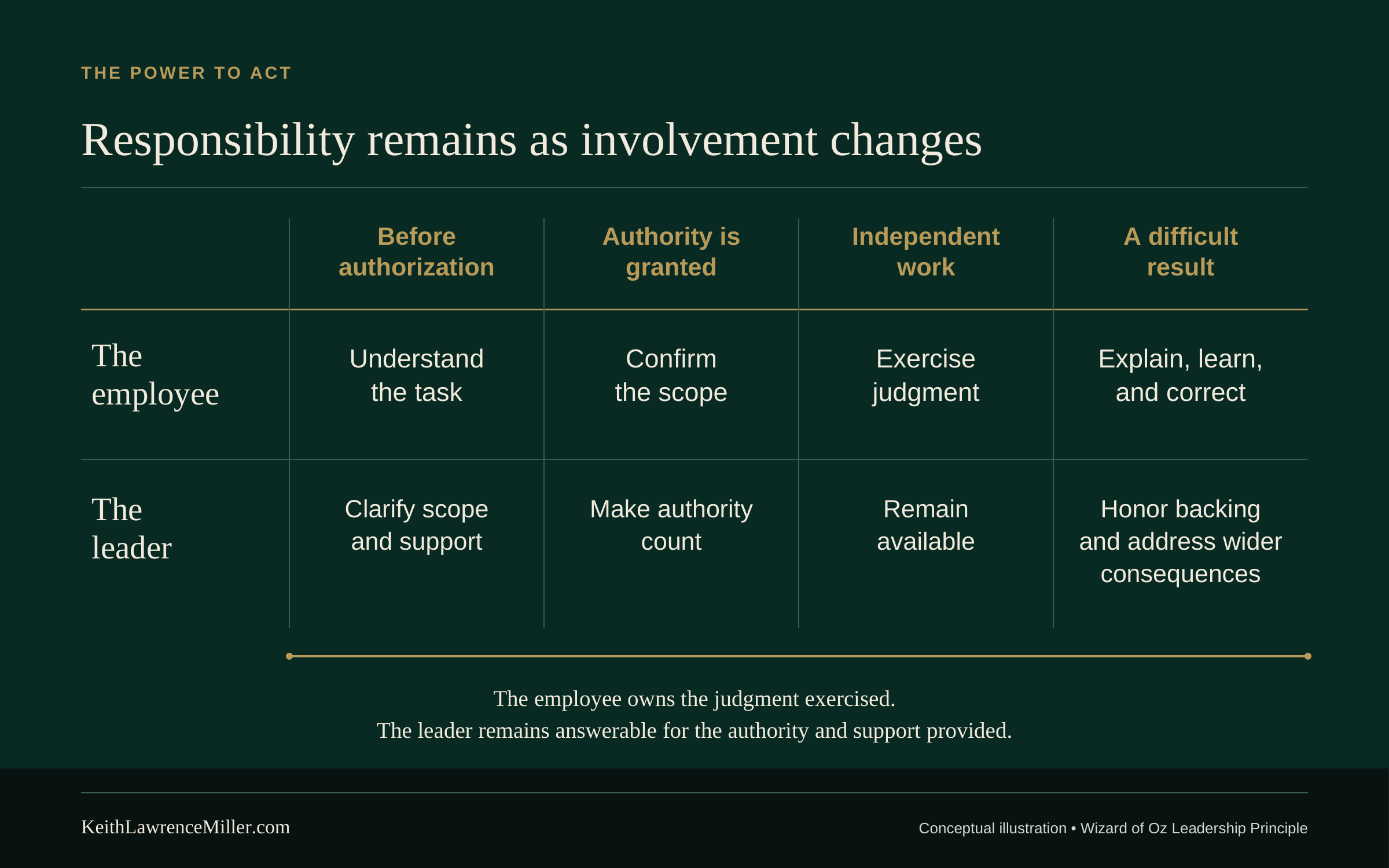
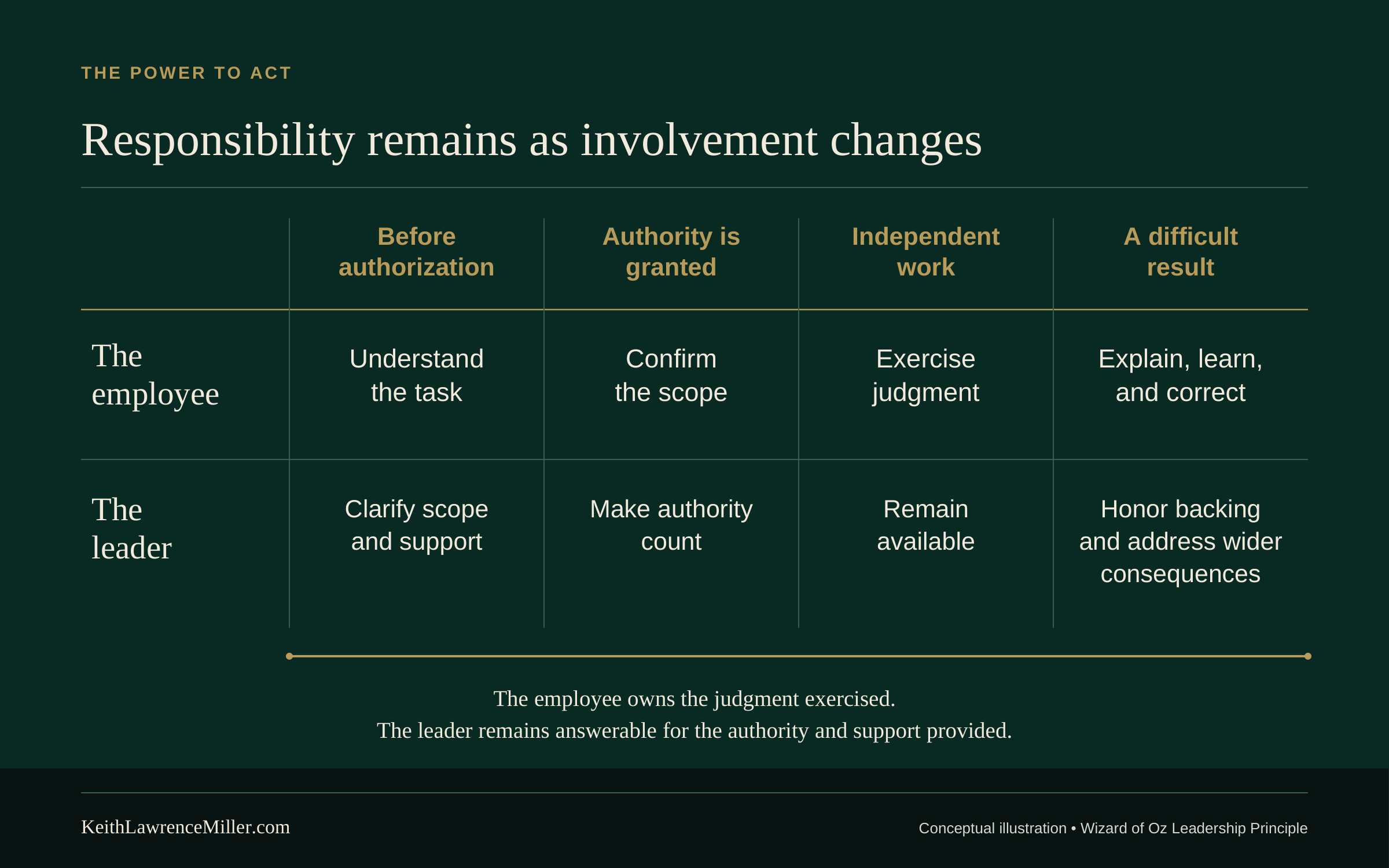
Read this diagram as text
| Role | Before authorization | Authority is granted | Independent work | A difficult result |
|---|---|---|---|---|
| The employee | Understand the task | Confirm the scope | Exercise judgment | Explain, learn, and correct |
| The leader | Clarify scope and support | Make authority count | Remain available | Honor backing and address wider consequences |
The employee owns the judgment exercised. The leader remains answerable for the authority and support provided.
Leadership changes as people and circumstances change
A decision that once required close direction may eventually become familiar work. People learn through repetition, discussion, and experience. The leader's earlier contribution may be one reason they can now proceed with less involvement.
Keeping the old arrangement indefinitely can obscure that development. A person who has acquired the judgment to decide may still be treated as though every case were their first. The procedure preserves an earlier relationship after the circumstances supporting it have changed.
The reverse can also occur. A new contract, unfamiliar technology, or a more demanding obligation may exceed what the current group knows. Useful independence requires attention to those changes. The organization has to examine what additional expertise, resources, or coordination the next task requires.
The same reasoning applies to the leader. Someone can serve one stage well and lack a capability needed in the next. Learning may be possible. Bringing in expertise, dividing the responsibility, or handing over may also serve the work.
This allows a contribution to have an honest ending. A manager who established dependable routine decisions does not have to become an expert in every future negotiation to justify that achievement. The next task can belong to someone whose experience fits it better.
A responsible handover preserves what people have been authorized to do and makes continuing commitments clear. The role can move while the organization remains answerable for promises already made.
There is room here for leadership that is useful, serious, and finite. A person can carry a responsibility well without becoming the permanent answer to everything that follows.
Giving an accurate account of the work
If we recognize that a leader's contribution can continue during an absence, we also need to examine when that explanation actually fits. A successful team may be using dependable backing. It may be relying on established policies and institutional support. It may also be compensating for an unreliable leader.
The result alone cannot settle which explanation is correct. Employees can succeed through their own resourcefulness, including under conditions that make their work harder than it should be.
An accurate account gives credit to the people who earned it. The leader may have obtained a resource or established authority. Employees may have designed the solution, corrected an error, and performed the work. Those contributions can be recognized together without making the whole achievement part of one person's reputation.
The same care applies when something goes wrong. Assigning responsibility begins an inquiry into what happened. It still leaves us to examine the decision, the available information, and the conditions under which people acted.
The book develops this argument through organizational research, documented cases, and clearly identified hypothetical examples. Research supports elements of the account; the complete Wizard of Oz formulation remains a proposal to examine. Its value depends on how well it explains what people can do and what a leader contributes.
The power to act
For someone holding authority, the book offers a more specific way to examine the next demand on their attention. What contribution does this situation require? Does the employee need instruction, access to a resource, a decision on competing priorities, or authority other people will recognize?
The answer can make leadership more manageable. The leader can concentrate on a responsibility they can fulfill and remain answerable for the promises that surround it. Their contribution may be substantial even when it occupies little of the immediate task.
For the employee, the same approach makes their own contribution visible. Their knowledge and judgment belong in the explanation of the work. So do the conditions they need to exercise that judgment responsibly. Permission should have enough substance to use, and support should remain dependable when an authorized decision becomes difficult.
That is what the subtitle, Behind the Curtain: The Power to Act, asks us to examine. Behind the image are people with capabilities, obligations, and limits. Understanding how they work together gives us a clearer account of leadership and a more useful way to practice it.
The book closes with a question that brings the argument back to the next ordinary encounter:
The useful question is what your presence allows other people to do, and what they can still count on when you leave the room.
For anyone who leads people or works under another person's authority, that question deserves an answer grounded in the work itself.

View Wizard of Oz Leadership Principle on Amazon
About the author
Keith Lawrence Miller, M.A., is an executive coach, career strategist, résumé writer, and author. He earned his master's degree in social-organizational psychology at Teachers College, Columbia University. Through Ivy League Coaching, he has worked with more than 5,000 professionals on career and leadership decisions. His writing examines leadership, organizational psychology, and professional development.
Book reference
Miller, Keith Lawrence. Wizard of Oz Leadership Principle: Behind the Curtain: The Power to Act. Independently published, 2026. ISBN 9798165092442. This article draws on the introduction, chapters 1–7, 9–10, and 13–15, and the conclusion. The quoted definition appears on page 5, the passage on indispensable approval on page 47, and the closing question on page 249.
Published 2026-10-25.