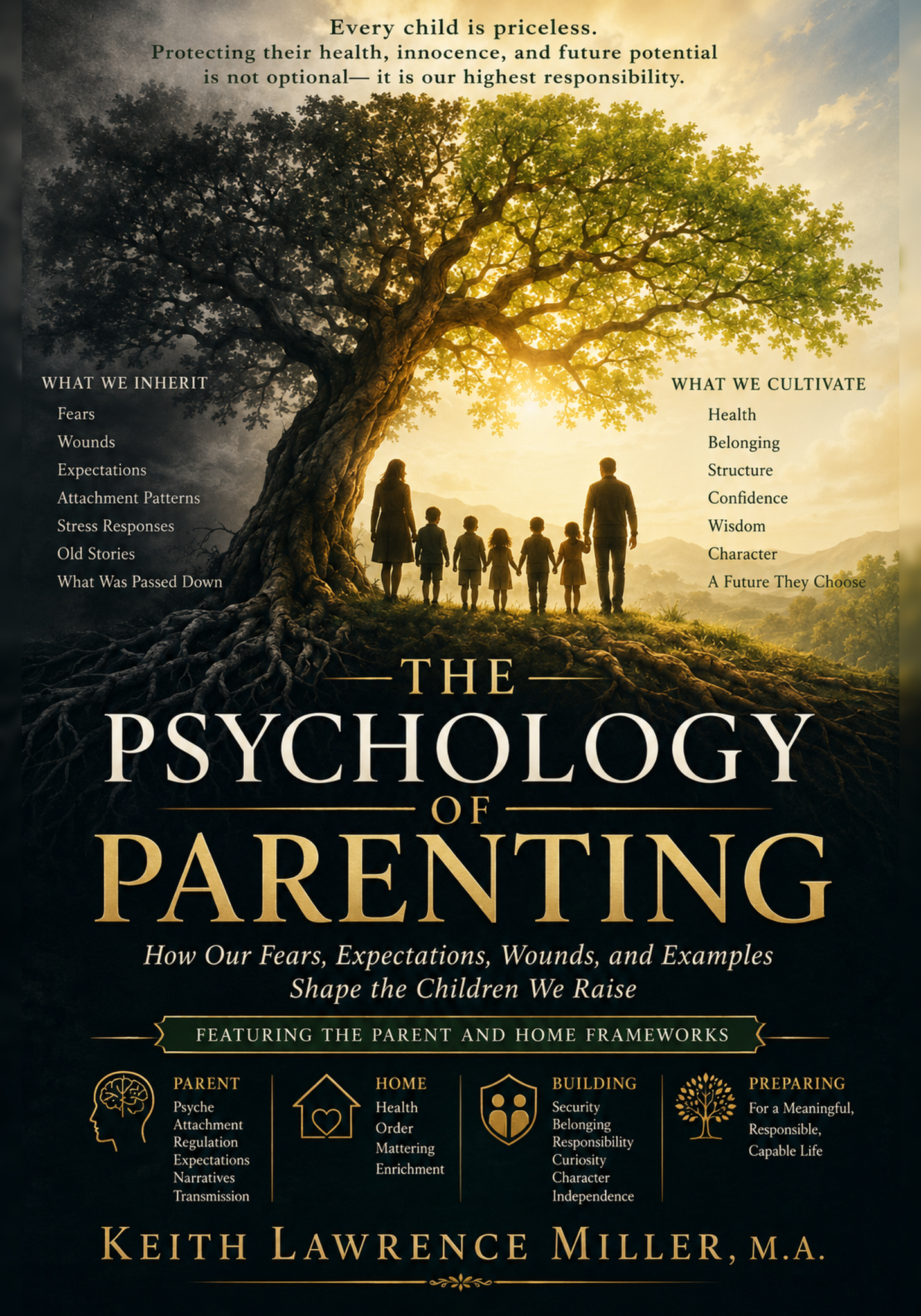
The Psychology of Parenting: What We Inherit, What We Choose, and What We Pass Forward
By Keith Lawrence Miller, M.A.
My understanding of parenting began long before I studied psychology.
It began with my father.
I was born into a difficult family situation. My father was fifty years old when I was born, and approximately six months later my mother suffered a massive stroke. Whatever plans he may have imagined for that stage of his life changed almost immediately. He had a young child who needed him, and he made the decision to put that child ahead of the rest of his life.
I was that child.
My father was not an expressive man. I do not remember him telling me that he loved me. Yet I grew up knowing that he did because I watched what he was willing to do.
He cared for me when no one else did. He remained patient during emotional situations when impatience would have been understandable. He carried responsibility without constantly reminding me of the sacrifice. He showed me through behavior that fatherhood was larger than affection expressed in words. It was presence, protection, restraint, responsibility, and the willingness to reorganize your life around the needs of someone who depended on you.
His example became even more meaningful to me as I grew older and understood more about his own life. My father had been adopted and had endured significant hardship himself. He had reasons to carry pain forward. Instead, in some of the moments that mattered most to me, he demonstrated that a difficult history does not have to dictate what the next generation receives.
That may have been my first important lesson in the psychology of parenting:
What happened to us matters. What we choose to pass forward matters too.
I Learned Parenting From Both Sides of the Relationship
My education in parenting did not remain observational.
My younger sister's childhood became difficult in a different way. My mother was found unable to care for her, and my sister was placed in foster care. Later, when I was old enough to assume that responsibility, I had the opportunity to raise her beginning at approximately fifteen years old.
That experience changed me.
I was no longer simply remembering how my father had cared for me. I had to decide what another young person needed from me.
Adolescence presents a very different parenting challenge from early childhood. At fifteen, a young person already has a history, opinions, wounds, strengths, habits, fears, abilities, and an emerging sense of identity. You cannot responsibly approach that person as though you are beginning with a blank page.
My role was to provide stability, guidance, expectations, education, and opportunity while respecting the person she was becoming. I helped guide her through high school and college, and in the process I learned something that later became fundamental to my thinking about parenting:
Parenting is neither control nor passive support. It is the deliberate creation of conditions in which another human being can become increasingly capable of directing their own life.
I had learned that first from my father.
Now I was responsible for applying it.
Then I Studied the Psychology Behind What I Had Already Seen
Experience came first for me.
Study came later.
When I began studying psychology seriously, I was not approaching human behavior as an abstraction. I already had questions.
Why can two adults experience the same behavior from a child so differently?
Why does one parent remain calm during an emotionally intense moment while another experiences the same situation as intolerable disrespect?
How does a parent's own childhood influence what they expect from their children?
Why do some adults repeat what was done to them while others make a conscious decision to interrupt it?
How do love, discipline, attachment, expectation, fear, reinforcement, identity, and family culture interact over time?
Psychology gave me language for processes I had already observed.
It helped me understand attachment, learning, reinforcement, emotional regulation, development, motivation, projection, expectations, identity, and the ways behavior is shaped by both the person and the environment.
It also gave me a more disciplined appreciation for complexity.
There is rarely one cause.
There is rarely one perfect method.
And children are not interchangeable units to whom the same technique can simply be applied.
Six More Children Made One-Size-Fits-All Parenting Impossible to Believe
Later, my wife and I raised six children together.
She brought her own expertise as a doctor of school psychology. I brought my graduate education in psychology, my professional work with behavior and human development, and the lessons I had accumulated from being raised by my father and from raising my younger sister.
We discussed our children's behavior, education, health, strengths, needs, and development constantly. I was often the primary architect and teacher of the behavioral systems we used, while my wife was my daily partner in evaluating, applying, questioning, and refining them.
Six children made simplistic parenting theories difficult to sustain.
The same household contained different personalities, intellectual profiles, sensitivities, ambitions, educational paths, developmental needs, and relationships to structure.
One child could experience a rule as reassuring while another experienced the same rule as unnecessarily restrictive.
One responded well to direct correction. Another needed time before the conversation could become productive.
One needed additional repetition.
Another needed substantially more intellectual challenge.
A method that worked beautifully with one child could be completely wrong for another without either child being the problem.
That experience forced me to distinguish between principles and methods.
Principles can remain stable.
Methods often have to change.
Health matters.
Safety matters.
Dignity matters.
Education matters.
Responsibility matters.
Belonging matters.
Preparation for independence matters.
How those principles are translated into daily parenting should reflect the actual child.
That became one of the foundations of The Psychology of Parenting.
Parenting Begins Before the Parent Responds
When we talk about parenting, we usually focus on what the adult does.
Set the boundary.
Apply the consequence.
Offer reassurance.
Correct the behavior.
Create the routine.
Teach the lesson.
But psychologically, something happens before all of those actions.
The parent interprets the child.
A teenager asks for privacy.
One parent sees healthy development.
Another experiences rejection.
A child receives a disappointing grade.
One parent sees information about where additional learning is needed.
Another sees a threat to the child's future.
A young child cries.
One adult hears distress.
Another hears manipulation.
The behavior can be identical.
What the behavior means to the adult may be completely different.
That interpretation is shaped by the parent's own history: how they were treated, what their family feared, what success meant, how emotion was handled, what counted as disrespect, whether affection was secure, whether mistakes were tolerated, and what consequences followed failure.
This is why I titled the book The Psychology of Parenting.
Parenting does not begin only with the psychology of the child.
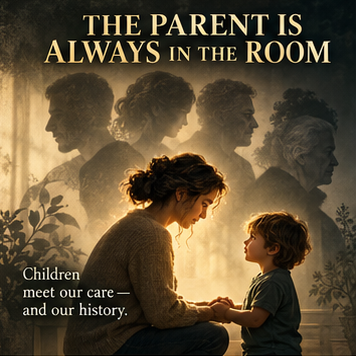
The parent is always in the room too.
What My Father Taught Me Without Teaching It
When I look back at my father's example now, I can see psychological principles that neither of us would have named at the time.
He demonstrated regulation.
He could remain patient during situations that were emotionally difficult.
He demonstrated responsibility.
Circumstances had radically changed his life, yet he did not make a young child responsible for the burden those circumstances created.
He demonstrated presence.
He stayed available when availability mattered.
And perhaps most importantly, he demonstrated that love can be communicated behaviorally.
I would not recommend that parents avoid telling their children they love them. Words matter.
But words are not the only evidence children receive.
Children also learn what love means by observing what adults repeatedly do when caring becomes inconvenient, exhausting, frightening, or costly.
My father did not give me a theory.
He gave me an example.
Years later, when I was responsible for my younger sister, and later when my wife and I were raising six children, that example remained with me.
I had seen what it looked like for an adult to place a child's welfare ahead of his own convenience.
That became a standard.
The Central Question Became: What Are We Passing Forward?
Every parent inherits something.
Some inherit extraordinary models.
Some inherit painful ones.
Most inherit a mixture.
My father's own difficult childhood could have become an explanation for emotional absence or instability.
Instead, some of what he passed to me was patience, responsibility, loyalty, and the conviction that caring for a child is something you demonstrate through action.
That does not mean every pattern disappeared.
No family works that way.
It means inheritance is not destiny.
We can examine what came to us.
Preserve what was valuable.
Repair what was harmful.
Develop what was missing.
And refuse to make children carry wounds simply because those wounds were handed to us first.
That insight eventually became the architecture of the book.
The PARENT framework asks what the adult brings into the relationship.
The HOME framework asks what the child repeatedly experiences inside it.
Together they address both sides of the same developmental reality.
And both sit beneath one principle that, for me, comes before every parenting technique:
Every child is priceless.
Their worth does not begin with achievement, obedience, intelligence, appearance, talent, diagnosis, productivity, or the ability to make a parent proud.
The job is to protect and develop a person whose value was already there.

The PARENT Framework: What Am I Bringing Into This Moment?
I developed the PARENT framework as a way of turning psychological reflection into practical questions.
The current manuscript defines six areas:
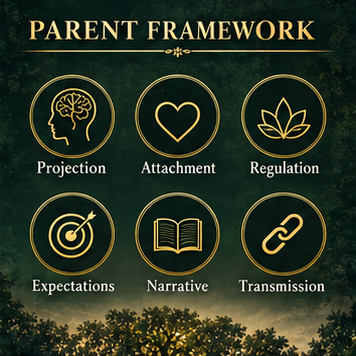
Projection. Attachment. Regulation. Expectations. Narrative. Transmission.
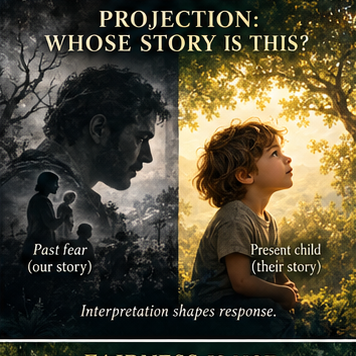
Projection asks whether I am responding to this child or to something the child represents to me.
Attachment asks what my response teaches about closeness, trust, comfort, separation, and repair.
Regulation asks what my own nervous system is teaching during moments of stress.
Expectations asks whether the standard is helping the child develop or helping the parent manage anxiety, status, comparison, or fear.
Narrative asks what identity story the family is repeatedly telling about the child.
Transmission asks what pattern, value, strength, fear, or unresolved experience may be moving into the next generation.
These questions are not designed to turn every ordinary interaction into a psychological investigation.
They become especially useful when the same conflict keeps returning, when the adult's reaction feels disproportionately intense, when siblings are being treated very differently without a clear developmental reason, or when the method being used conflicts with the parent's stated values.
The central question is simple:
Am I responding to the child who is here, or to something from my own history that has entered the room with us?
The HOME Framework: What Is the Child Repeatedly Experiencing?
Psychological insight about the parent is incomplete unless it changes the child's environment.
That is why the second framework is HOME:
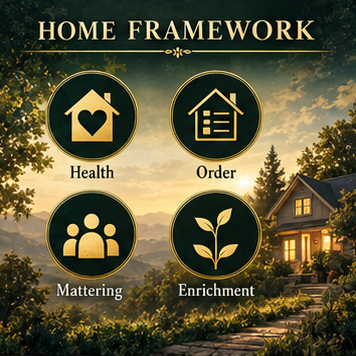
Health. Order. Mattering. Enrichment.
PARENT turns inward.
HOME turns outward.
One asks what the adult brings into the relationship.
The other asks what kind of developmental environment the adult is helping create.
They are designed to work together.
Good Intentions Are Not Enough
Most parents want good things for their children.
They want them healthy, capable, educated, emotionally secure, responsible, safe, and prepared for adulthood.
Good intentions matter.
They do not guarantee that the method communicates what the parent intends.
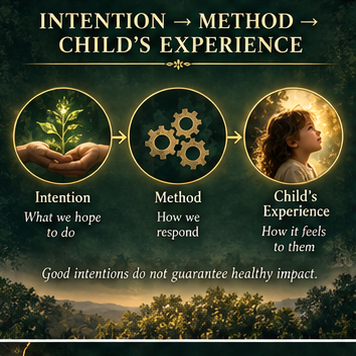
A parent can intend protection while the child experiences surveillance.
A parent can intend opportunity while the child experiences relentless pressure.
A parent can intend resilience while teaching the child that vulnerability is unacceptable.
A parent can intend kindness while becoming so reluctant to establish limits that the child experiences confusion.
This is one of the distinctions I return to throughout the book:
intention, method, and impact are not the same thing.
Parenting becomes more deliberate when we examine all three.
What was I trying to accomplish?
What did I actually do?
What did the child repeatedly experience?
That third question is especially important because children develop inside patterns.
One imperfect bedtime does not define a childhood.
One frustrated conversation does not define a relationship.
One mistake does not define a parent.
Repeated experiences matter much more.
Responsibility Without Omnipotence
Parenting advice can easily move toward one of two extremes.
At one extreme, parents are treated as though every characteristic, problem, strength, and outcome in a child's life can be traced back to something the parent did.
That creates anxiety, guilt, and control.
At the other extreme, parenting is treated as though the adult has very little influence because temperament, genetics, peers, schools, culture, health, chance, and the child's own choices also matter.
That can become an excuse for passivity.
I think both positions are inadequate.
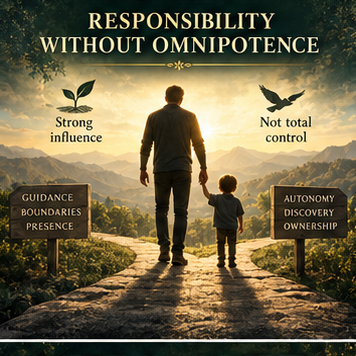
Parents have tremendous influence.
We shape much of the early environment. We establish routines, expectations, access, language, consequences, opportunities, models of relationships, attitudes toward learning, and what happens after someone makes a mistake.
We do not author the entire child.
Children arrive with characteristics of their own. They develop relationships outside the family. They encounter teachers, peers, institutions, opportunities, adversity, health conditions, culture, technology, and eventually adult freedom.
The healthier position is what I describe as responsibility without omnipotence.
Create the best conditions you reasonably can.
Remain accountable for your influence.
And resist the fantasy that good parenting gives anyone complete control over another human being's development.
That balance protects both the parent and the child.
Projection: When the Child Starts Carrying the Parent's Story
Projection can take obvious forms.
A parent who regrets a career decision may become intensely invested in the child's career.
A parent who struggled academically may become frightened by an ordinary disappointing grade.
A parent who once felt powerless may interpret hesitation as weakness.
A parent who experienced betrayal may treat ordinary privacy as evidence of secrecy.
Positive expectations can also become projections.
The child described continually as the smart one may begin to fear mistakes.
The mature child may learn that needing help disappoints people.
The talented child may feel responsible for maintaining the family's sense of exceptionalism.
The responsible child can quietly become the family's second adult.
None of these patterns necessarily begin with malice.
They often begin with love, pride, fear, or hope.
That is what makes them difficult to see.
The parent thinks they are describing the child.
Sometimes they are describing the role they need the child to play.
Expectations Should Guide Development, Not Define Worth
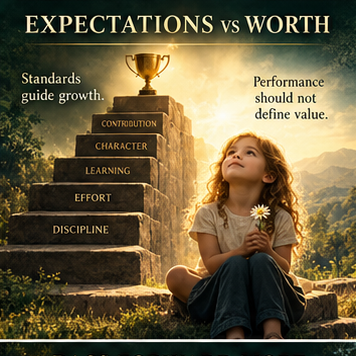
I believe in standards.
Children benefit from learning responsibility, persistence, contribution, respect, self-control, and how to follow through on commitments.
Removing expectations altogether does not produce freedom.
It can leave children without enough structure to become capable.
The danger comes when standards acquire another function.
A grade stops being information about learning and becomes information about whether the child is worthy.
An athletic performance becomes a referendum on the family's identity.
A college admission becomes evidence that the parenting worked.
A child's obedience becomes proof of parental authority.
At that point, the child is no longer simply developing.
The child is performing for the emotional security of the adults.
Strong expectations should answer:
What capacity am I trying to help this child develop?
They should not quietly answer:
What does this child need to accomplish so I can feel successful as a parent?
Those are entirely different questions.
Health: Look Beneath Behavior
Behavior is visible.
The conditions underneath it are often less visible.
Sleep matters.
Nutrition matters.
Pain matters.
Movement matters.
Sensory needs matter.
Illness matters.
Development matters.
Mental health matters.
The child's body and brain are part of every parenting interaction.
That does not mean parents should diagnose children themselves or reinterpret every difficult behavior as a medical condition.
It means behavior should not be separated artificially from physical and developmental context.
Sometimes the appropriate parenting decision is a clearer boundary.
Sometimes it is sleep, different instruction, a change in routine, or medical or developmental evaluation.
Knowing the difference requires humility.
Order: Structure Without Fear
Children need an understandable world.
They benefit from routines, expectations, responsibilities, predictable consequences, and knowing what happens next.
Order should make the environment easier to navigate.
It should not require humiliation.
Healthy authority can be firm. A parent can say no. A child can be disappointed. Privileges can be limited. Responsibilities can be required. Harm can require repair.
What matters is whether discipline teaches something useful or simply demonstrates who has more power.
The goal is for children eventually to develop enough judgment and self-regulation that external control can gradually decrease.
Parenting should move, over time, from direct management toward teaching, supervised practice, shared decision-making, and eventually consultation.
Independence is one of the outcomes.
Mattering: Love That Is Not Earned
One of the most important developmental messages a family communicates is whether belonging survives disappointment.
Does the child remain loved after a poor grade?
After breaking a rule?
After losing?
After changing direction?
After disagreeing?
After becoming less impressive than the parent hoped?
Mattering does not mean allowing every behavior.
It means separating the child's worth from the behavior being corrected.
A child should be able to learn:
What I did matters, and I still matter.
Children should not have to choose between accountability and belonging.
Enrichment: Opportunity Without Turning Childhood Into an Audition
Parents naturally want to create opportunities.
Reading, travel, sports, music, technology, languages, academic challenge, creative work, practical skills, culture, conversation, and exposure to ideas can dramatically enlarge a child's world.
Enrichment becomes psychologically complicated when opportunity turns into performance.
The child stops experiencing learning as discovery and begins experiencing every activity as evidence being collected for an imagined future.
Childhood becomes résumé preparation.
The family can provide substantial opportunity without communicating that the child has to maximize every advantage.
The purpose of enrichment is to expand capability, curiosity, expression, and possibility.
The child is still allowed to be a child.
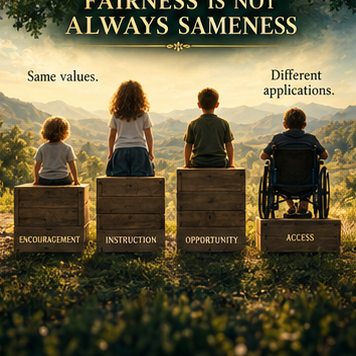
Fairness Does Not Always Mean Sameness
Raising multiple children taught me another lesson that I think is often underestimated:
equal treatment and fair treatment are not always the same.
Children differ in age, maturity, health, capacity, learning needs, responsibility, interests, and circumstances.
One may need greater structure.
Another may have earned greater independence.
One may need additional support.
Another may need greater challenge.
One may need privacy.
Another may temporarily require closer supervision.
A family can preserve the same values while applying them differently.
That difference should be explainable.
Individualization should never become favoritism.
Sameness should never become an excuse to ignore meaningful differences.
Repair Matters More Than Parental Perfection
Parents will make mistakes.
We will misread situations, lose patience, respond too quickly, use the wrong consequence, miss a signal, or say something we wish we could take back.
A psychology of parenting that requires flawless performance is useless to real families.
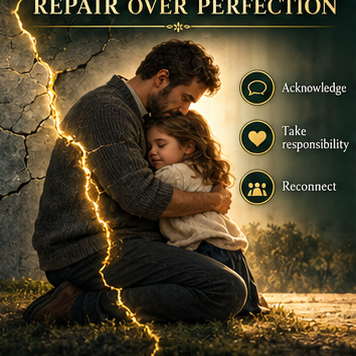
The more important capability is repair.
A meaningful repair identifies what the adult actually did, takes responsibility for the part that belongs to them, acknowledges the child's likely experience, preserves any legitimate boundary without using the boundary to excuse the adult's behavior, explains what should happen differently next time, and allows reconnection without demanding immediate forgiveness.
That does not weaken authority.
It teaches something sophisticated about authority:
power and accountability can coexist.
Protection Can Become Control
Parents are supposed to protect children.
The challenge is that protection can expand indefinitely.
A parent removes one risk, then another, then another. Eventually the child may become protected from ordinary frustration, independent problem-solving, social risk, disappointment, uncertainty, and consequences that would have helped build capability.
The parent experiences devotion.
The child may experience the repeated message:
You cannot handle this without me.
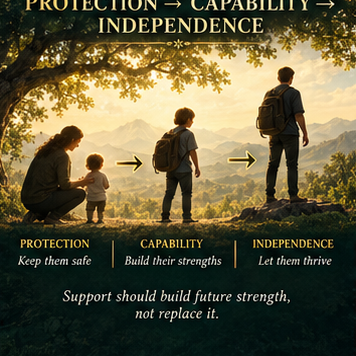
Healthy protection changes with development.
Infants require extraordinary adult control over their environment.
Adolescents require increasing opportunities to exercise judgment.
Young adults eventually need room to make decisions that parents might not choose for them.
The relationship should remain.
Control should not remain unchanged.
A useful parenting question is therefore:
Is the support I am providing increasing the child's future capability, or replacing it?
The Priceless Child Covenant
The frameworks rest on a principle more important than either framework.
Every child is priceless before achievement, obedience, intelligence, appearance, talent, diagnosis, productivity, or public recognition.
That conviction changes the interpretation of parenting.
Health matters because the child matters.
Education matters because the child matters.
Boundaries matter because the child and the people around them matter.
Safety matters.
Dignity matters.
Privacy matters.
Innocence matters.
Belonging matters.
Preparation for meaningful independence matters.
The child does not become valuable because the parent successfully develops these things.
The child is already valuable.
Our responsibility follows from that fact.
The covenant also creates limits.
Protect health without teaching fear.
Preserve innocence without creating ignorance.
Teach responsibility without making affection conditional.
Use authority without humiliation.
Create opportunity without turning the child into a performance.
Respect individuality without abandoning standards.
And when a problem exceeds ordinary parenting guidance, seek qualified help rather than trying to force a parenting philosophy to solve something it cannot solve.
The Goal Is Not to Produce a Child Who Validates the Parent
Parenting creates an unusual psychological challenge because success eventually means losing control.
A capable child becomes an increasingly independent person.
They develop preferences the parent did not select.
Relationships the parent did not create.
Ideas the parent may disagree with.
Career goals the parent might not have imagined.
A family culture should transmit values.
It should also make enough room for the next generation to become distinct from the previous one.
The purpose of parenting cannot be to produce a child whose achievements confirm that the parent was right.
It should be to use every responsible advantage available—knowledge, structure, health, education, repetition, technology, protection, encouragement, accountability, and love—to help another person become increasingly capable of directing a meaningful life.
That requires parents to tolerate an outcome they cannot completely design.
A Family Should Pass Forward More Wisdom Than Fear
Every family transmits something.
Some of it is deliberate: language, religion, traditions, recipes, education, stories, values, work ethic, ideas about responsibility.
Much of it is less deliberate: how adults behave when angry, how people apologize, whether disagreement is safe, whether vulnerability becomes ammunition, whether achievement determines worth, whether privacy is respected, whether affection disappears after conflict, whether help is treated as weakness, and whether mistakes can be repaired.
We cannot prevent transmission.
We can make more of it conscious.
That is the larger meaning behind PARENT.
What came through me?
What should continue?
What should stop?
What needs to be repaired before I pass it forward?

A Practical Reset Begins With One Observable Pattern
Families often respond to difficulty by trying to change everything at once.
That usually produces enthusiasm followed by exhaustion.
The book takes a narrower approach through a 30-Day Parent and Home Reset.
Choose one recurring problem.
Describe it behaviorally rather than turning it into a judgment about the child.
“My child is lazy” does not give anyone a useful target.
“Homework requires three reminders and usually ends in an argument” does.
“Our family is toxic” is too broad to guide action.
“Adults raise their voices during the evening transition most nights” identifies something observable.
Then examine the pattern through both frameworks.
What is the adult bringing into it?
What is the child repeatedly experiencing?
What small environmental change can be made consistently?
How will we know whether anything improved?
The goal is not instant transformation.
It is interruption of an automatic pattern.
Small changes become useful when they can survive ordinary life.
The Question I Would Ask Parents
There are many ways to raise a healthy child.
Culture matters.
Family circumstances matter.
Resources matter.
Disability and development matter.
Age matters.
Temperament matters.
There is no responsible framework that removes those differences.
But I think parents can ask themselves a common set of questions:
- What am I bringing into this moment that may belong to my own history rather than this child?
- What is my reaction teaching about safety, closeness, authority, emotion, and repair?
- Is my expectation developing capability, or has the child's performance become emotionally important to me?
- What story are we repeatedly telling this child about who they are?
- What is the child actually experiencing in this home: Health, Order, Mattering, and Enrichment?
- Is my help increasing independence or quietly replacing it?
- If I am wrong in this moment, will this family know how to repair it?
Those questions do not provide a script.
They provide a way to think.
That is more durable.
What We Pass Forward
My understanding of parenting began with a man who had every reason to be tired, wounded, or focused on his own survival, yet chose to care for a young child who needed him.
I later had the opportunity to make a similar kind of commitment when my younger sister needed stability during adolescence.
Then psychology gave me a language for what I had already been observing.
And raising six more children with my wife gave me enough variation to understand how dangerous simple formulas can become.
That sequence matters to me because the book did not begin with a framework.
The frameworks came after decades of observation, responsibility, study, application, correction, and adaptation.
PARENT asks what came into the room with us.
HOME asks what the child experiences once we are there.
The Priceless Child Covenant reminds us why either question matters.
Parents will never control every outcome.
We can influence what children repeatedly experience while they are with us.
We can examine what we bring into those experiences.
We can preserve what previous generations gave us that was good.
We can repair what should not continue.
We can seek help where our competence ends.
And we can decide, with greater awareness, what deserves to be passed forward.
The strongest inheritance is unlikely to be perfect parenting.
It is a family capable of reflection, responsibility, adaptation, love, and repair.
About the Book
The Psychology of Parenting: How Our Fears, Expectations, Wounds, and Examples Shape the Children We Raise is an educational examination of the interaction between parental psychology and the developmental environments children experience.
Drawing on Keith Lawrence Miller's graduate education in psychology, professional work with behavior and human development, published research, and decades of shared parenting with his wife, a doctor of school psychology, the book develops two complementary frameworks.
PARENT examines Projection, Attachment, Regulation, Expectations, Narrative, and Transmission—the psychological material adults bring into parenting.
HOME examines Health, Order, Mattering, and Enrichment—the conditions children repeatedly experience as they develop.
Both frameworks operate beneath the Priceless Child Covenant, which holds that a child's worth exists before achievement, obedience, intelligence, appearance, talent, diagnosis, productivity, or public recognition.
The frameworks are presented as experience-based, psychologically informed approaches rather than clinical instruments or guarantees of outcomes. The book provides general education and does not replace individualized medical, psychological, developmental, nutritional, educational, or legal evaluation.
Keith Lawrence Miller, M.A. First Edition · 2026 ISBN: 9798189435577 Current source status: Forthcoming / Pre-final