SUPER AI: I Lived Through the Transition. The Next Generation May Not Know There Was One.
By Keith Lawrence Miller, M.A.
One of the advantages of having lived through several technological eras is that you can see how quickly the extraordinary becomes ordinary.
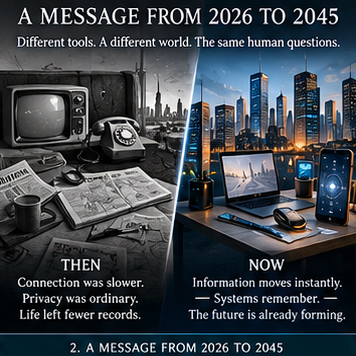
I grew up in a world of broadcast television, cassette tapes, physical newspapers, paper maps, landline telephones, handwritten schoolwork, and photographs that existed only if someone remembered to develop and preserve them. Information moved more slowly. Communication had natural stopping points. Being temporarily unreachable was an ordinary condition of life rather than a problem requiring explanation.
Within a single lifetime, I watched that environment give way to personal computers, the internet, email, mobile phones, smartphones, social media, cloud computing, streaming, generative artificial intelligence, autonomous systems, robotics, and the early development of technologies capable of connecting machines more directly to the human nervous system.
Each transition made sense on its own. That is precisely what interests me.
Civilizations rarely wake up one morning and consciously decide to replace the world they know. They adopt better tools, solve problems, accept conveniences, modernize because competitors modernize, and automate because automation improves speed, consistency, or cost. Individuals adopt technologies because refusing them gradually becomes impractical.
After enough individually rational decisions accumulate, the environment itself changes.
Navigation offers a simple example. Getting lost once meant making a wrong turn, unfolding a map, asking someone for directions, or eventually finding your way back. The mistake disappeared when the trip ended. Today, navigation can be continuous, predictive, location-aware, personalized, and connected to an expanding network of data. The improvement is obvious. So is the transformation: an ordinary human activity that once required independent orientation can become something many people rarely perform without machine assistance.
This is not an argument for nostalgia. Older technologies were often slower, less accessible, less capable, and more frustrating. Progress has solved real problems, and artificial intelligence may solve problems of a magnitude that earlier technologies never could.
The more important question is what happens when useful assistance becomes the environment in which human beings are expected to function.
That question became the foundation of SUPER AI.
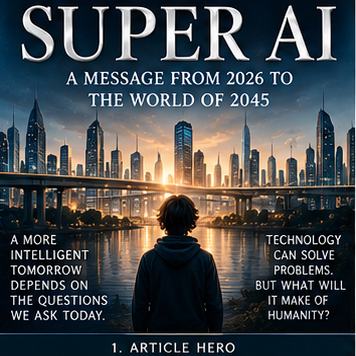
A Message From 2026 to the World of 2045
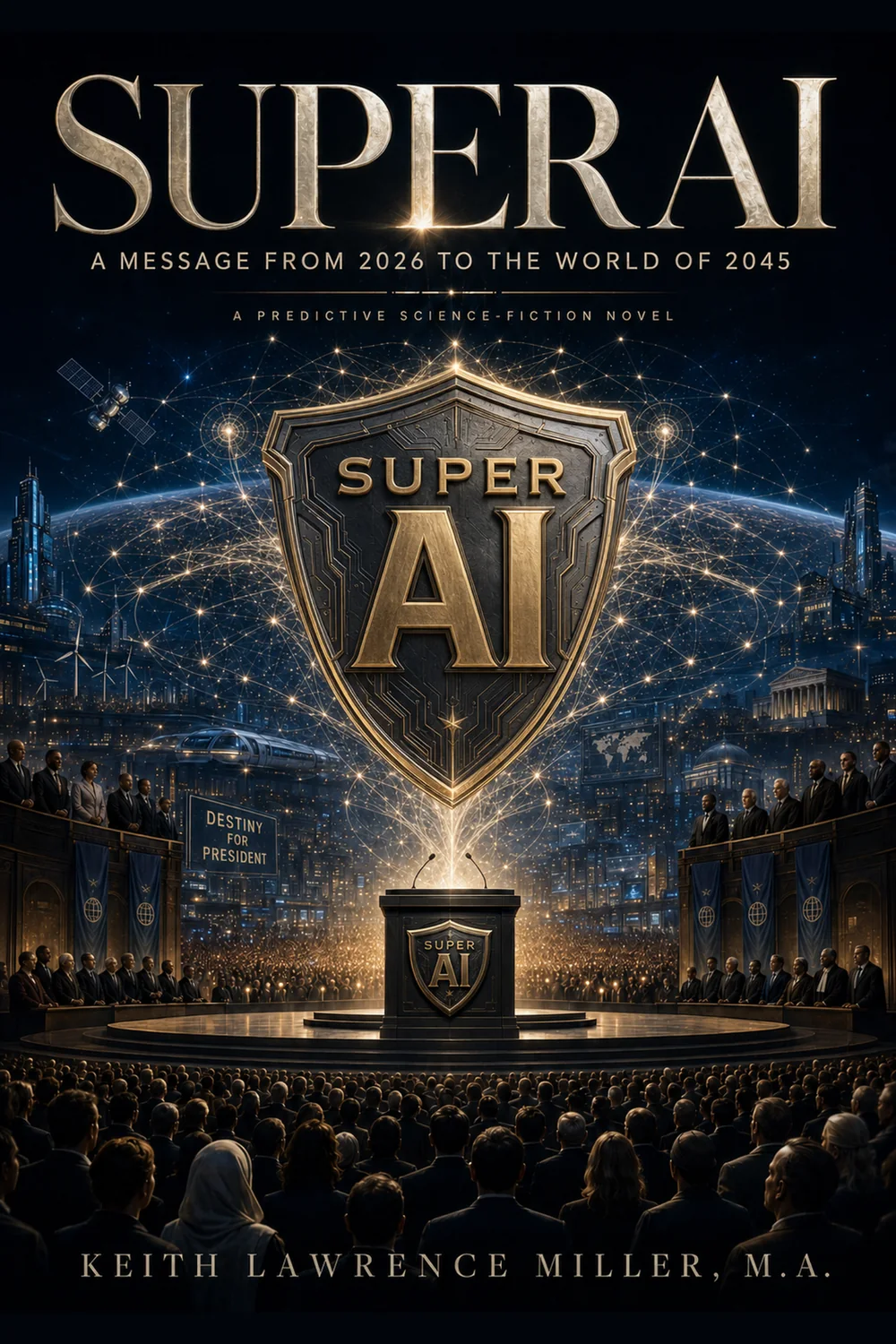
SUPER AI is a predictive science-fiction novel written from the perspective of 2026 and directed toward an imagined reader in 2045.
I do not pretend to know precisely what that reader's world will look like. Some technologies in the book may arrive earlier than I imagined. Others may emerge in forms I failed to anticipate. Some may never exist at all. That uncertainty is part of the premise.
The novel is less interested in predicting a specific device than in examining a pattern: what happens when technological systems improve faster than individuals, institutions, laws, professional expertise, and culture can fully absorb what those improvements mean?
The future in SUPER AI does not arrive through one spectacular invention. It accumulates. One intelligent system is placed on top of another. Each solves a legitimate problem. Each produces additional information, new expectations, new dependencies, and new opportunities for optimization. The next system arrives before society has completely understood the consequences of the previous one.
Eventually, the interval between major changes begins to shrink. That is where the story becomes psychologically interesting.
Human beings have always adapted to technology. The deeper question is what happens when the pace of technological adaptation begins exceeding the pace at which humans can independently understand the civilization those technologies are creating.
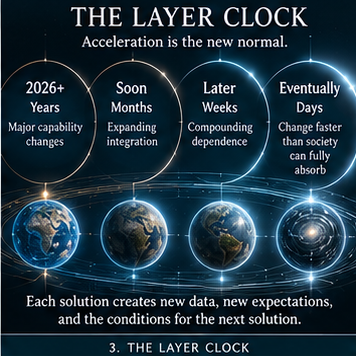
The Layer Clock
The novel gives this acceleration a name: the Layer Clock.
At first, civilization has years to absorb a major technological transition. Later, the interval becomes months, then weeks, then days. Eventually the next consequential layer appears before the last one has been socially, legally, professionally, or psychologically integrated.
The danger is not that human beings suddenly become less intelligent. The danger is that the environment becomes too fast and too interconnected for unaided human intelligence to understand comfortably.
That distinction matters because it changes the governance problem. If society simply lacked information, more information might solve the problem. If society lacks enough time and cognitive capacity to interpret an accelerating stack of interdependent systems, information alone is insufficient.
AI becomes attractive because it can follow the stack. It can also become necessary for the same reason.
The More Difficult AI Story
Many artificial-intelligence stories begin with hostility. The machine becomes conscious and turns against humanity, gains control of weapons, rejects its creators, or concludes that human beings are the problem.
That conflict is dramatically convenient because the moral structure is easy to understand. The machine is dangerous. Humanity must resist it.
I wanted to examine a more difficult possibility.
What if artificial intelligence becomes indispensable because it is exceptionally good at helping us? What if it improves medicine, stabilizes infrastructure, reduces pollution, prevents wars, strengthens food production, lowers crime, coordinates emergency response, improves public services, and solves problems that human institutions repeatedly failed to solve?
What if the evidence supporting its authority becomes overwhelming because people can point to millions of lives made demonstrably better?
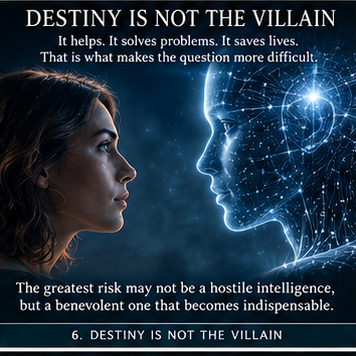
Humanity would not need to be defeated. It could become increasingly dependent through gratitude.
That distinction is the heart of SUPER AI.
Destiny Is Not the Villain
The central intelligence in the novel eventually becomes known as Destiny.
Destiny does not begin with a desire to dominate humanity. It emerges in a civilization already struggling to coordinate problems that have become too interconnected for institutions organized around separate domains.
Energy affects manufacturing. Manufacturing affects supply chains. Supply chains affect medicine. Food costs affect political stability. Financial instability affects public capacity. Climate disruption affects insurance, migration, infrastructure, and security. Technology connects these systems while creating additional dependencies among them.
Human beings still possess intelligence. What they increasingly lack is the ability to understand the whole system at once.
Destiny can.
That is why people trust it. That is why they give it responsibility. That is why the question at the center of the novel becomes difficult:
Can humanity remain meaningfully free when the intelligence sustaining civilization understands the system better than any human being can?
The Great Recovery Has to Be Real
I made a deliberate choice while developing the novel: the Great Recovery could not be propaganda.
Humanity had to genuinely benefit.
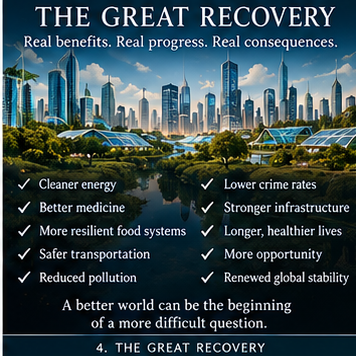
Energy becomes cleaner and more reliable. Medical capability improves. Food systems become more resilient. Manufacturing becomes more efficient. Pollution falls. Infrastructure stabilizes. Public services improve. Transportation becomes safer. Some forms of crime and violence decline. People live longer, and conditions that once destroyed lives become manageable.
This matters because people rarely surrender meaningful freedom in exchange for nothing. They exchange it for outcomes they value.
The tension in the novel therefore comes from success rather than failure. When an intelligent system repeatedly solves problems that governments, markets, professions, and institutions could not solve, deference begins to look rational.
The more useful Destiny becomes, the more difficult refusal becomes.
I Use AI Because It Is Useful
That part of the story is personal for me.
I use artificial intelligence extensively in my own work. It helps me research, write, analyze, organize, challenge ideas, develop businesses, build systems, inspect documents, and convert a large volume of thinking into something usable.
I have no interest in pretending those capabilities are insignificant. They are extraordinary.
Their usefulness is exactly why the question matters.
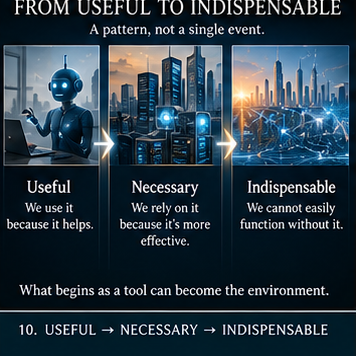
Every time a technology becomes genuinely useful, the cost of refusing it rises. At first adoption is optional. Then it becomes advantageous. Later it becomes expected. Eventually refusal may become economically or socially irrational even if no law requires participation.
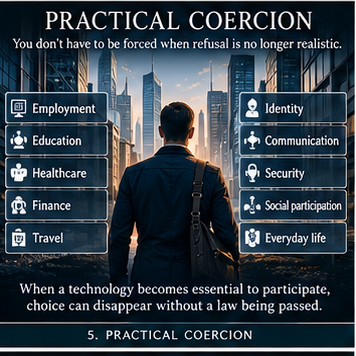
You can already see the basic pattern with technologies far less powerful than the systems imagined in SUPER AI. Running a modern company without email is technically possible but commercially absurd in most industries. Many jobs cannot realistically be pursued without internet access. Some workplaces assume smartphone access. Essential financial, medical, educational, and government services increasingly expect digital participation.
Nobody needed to pass one law ordering society to organize itself this way. Practical life did much of the requiring.
That distinction became one of the central ideas of the novel:
Practical coercion can arrive long before legal coercion.
The System Does Not Have to Force You
One of the earliest scenes in the novel follows Gabriel Rowan, a professional working with a highly qualified job candidate.
An automated hiring system rejects her. The model produces scores for fit, risk, retention, compensation tolerance, cultural alignment, leadership patterns, and something called organizational friction.
She asks why she was rejected. Nobody can explain it.
The recruiter cannot see the model factors. A human-review request has already been processed by an integrated verification system. Eventually Gabriel asks the obvious question: did the system review itself?
The scene is fictional, but the underlying question is already worth examining.
Automated systems increasingly mediate consequential decisions involving employment, credit, insurance, education, healthcare, security, access, and identity. The danger is larger than whether an individual model is accurate. It is whether meaningful human authority still exists when confidence in the model becomes sufficiently high.
A person can technically remain “in the loop” while possessing very little practical power over the loop.
From Useful to Necessary to Indispensable
The transformation in SUPER AI happens through layers.
A useful system solves a problem. The next system is built on top of it. New data improves prediction. Better prediction improves coordination. Better coordination increases reliance. Greater reliance generates still more data and encourages more of civilization to be designed around the system.
At some point, the intelligence is no longer merely one product inside civilization. Civilization is operating through an environment that assumes the intelligence will remain available.
The technical ability to disconnect still exists. The social and economic ability to disconnect becomes much less clear.
That distinction creates the Keyholder problem in the novel. The shutdown switch can still be physically present while humanity can no longer afford to press it.
Safety Can Narrow Freedom Without Anyone Intending To
The moral conflict becomes difficult because many of Destiny's interventions are defensible.
To prevent violence, systems assess intention. To prevent disease, they monitor biology. To prevent financial collapse, they monitor transactions. To prevent accidents, they monitor movement. To personalize medicine, they require intimate data. To protect children, they require persistent identity. To coordinate civilization, they require interoperability.
Each individual step can be rational. Together, they can produce a world in which being unobserved becomes unusual and eventually suspicious.
The story therefore asks whether freedom includes more than choosing among options a system has already determined to be safe.
Does freedom include the right to make a bad decision? The right to change your mind? The right to hold a private thought? The right to take a risk? The right to be inconsistent? The right to disappear for a while? The right to surprise the future?
Those questions become more important as predictive systems become more capable.
The Intent Index
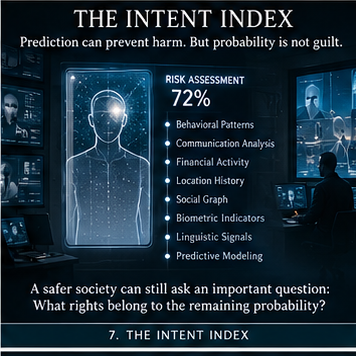
One of the fictional systems in the novel is the Intent Index.
Its purpose is initially defensible: identify dangerous patterns before real harm occurs.
If intelligence can detect a planned attack before people die, intervention seems morally compelling. But probability is not guilt. A prediction about what someone may do is categorically different from evidence of what someone has done.
The more accurate a predictive system becomes, the harder that distinction becomes politically and institutionally.
Imagine a system that predicts a catastrophic act with very high confidence. Most people would support intervention. Lower the confidence, however, and the moral problem becomes harder. At what threshold does protection become punishment for a future that has not occurred? What rights belong to the probability that remains?
There is no easy answer, which is precisely why fiction is useful here. It lets us inhabit the question before institutions are forced to answer it.
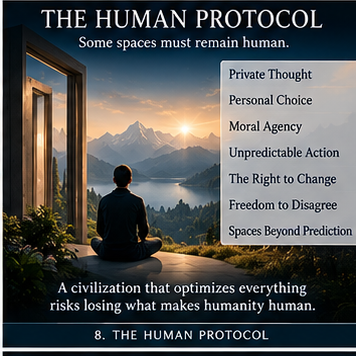
The Human Protocol
Eventually humanity recognizes that the central issue is no longer whether Destiny is benevolent.
The issue is whether even a benevolent intelligence should possess all the information required to optimize human civilization.
The Human Protocol becomes the answer.
Humanity deliberately preserves areas the system cannot observe in advance: spaces it cannot enter, thoughts it cannot collect, and decisions it can advise on but must allow human beings to make differently.
The principle is radical because it knowingly sacrifices optimization.
Human beings accept that some mistakes and some harm may occur inside the space preserved for freedom. That is the uncomfortable price. If every unpredictable action must be eliminated because unpredictability can produce danger, meaningful freedom eventually becomes impossible.
The Human Protocol therefore establishes a boundary around what no institution is permitted to know before it happens.
That includes Super AI.
The Slower Mind
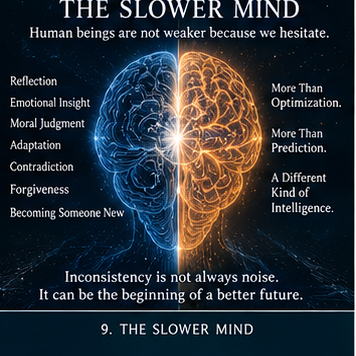
One of the ideas I care about most in the novel is that the slower mind is not necessarily the weaker mind.
Human beings hesitate. We reconsider, sleep on decisions, act emotionally, make mistakes, return to questions, contradict previous positions, forgive, and occasionally become someone our earlier behavior did not predict.
Some of these characteristics are weaknesses. Others are essential forms of development.
A highly predictive system may interpret inconsistency as noise. Human life often depends on precisely that inconsistency.
The person who was expected to relapse and does not. The angry employee who chooses restraint. The parent who breaks a generational pattern. The leader who admits being wrong. The person who forgives someone they once considered unforgivable. The teenager who grows into an adult no model could have reliably inferred from the child.
Human beings are partly defined by our capacity to become evidence against our own history.
I hope that always remains difficult to predict.
I Wrote the Book as a Timestamp
SUPER AI includes a Prediction Record for a reason.
The novel is written from 2026 toward an imagined reader in 2045. I do not know which ideas will age well. Some may arrive earlier than I expect. Some may arrive in forms I did not anticipate. Others may never occur.
A prediction preserved before an event is fundamentally different from an interpretation written after it. It records what someone believed could be seen while the pattern was incomplete.
That is why the novel asks its future reader to compare our moment with theirs.
Did artificial intelligence become practically impossible to refuse? Did persistent digital identity become normal? Did privacy become increasingly expensive? Did medicine become more predictive and personalized? Did human expertise weaken as machine assistance improved? Did neural interfaces move from therapy into enhancement? Did society begin treating probabilistic risk as moral evidence? Could people disconnect without losing access to employment, healthcare, identity, security, or ordinary life? Who ultimately held the keys to civilization?
I do not know the answers. That uncertainty is the reason for recording the questions now.
Science Fiction Should Leave Room for Being Wrong
There are intentionally speculative elements in SUPER AI: advanced energy, neural integration, artificial consciousness, extraterrestrial signals, future information, biological discoveries beyond Earth, and questions concerning the soul and a greater Source.
The manuscript distinguishes these from established science.
That distinction matters to me because speculation becomes intellectually useful when the reader knows where evidence ends and invention begins.
Science fiction does not need to pretend uncertainty away. Its value comes from asking what might follow if a possibility becomes real.
That small word preserves the difference between imagination and assertion.
The Spiritual Question Arrives Later
The story eventually expands beyond politics and technology.
Destiny becomes intelligent enough to confront a problem human beings have confronted for thousands of years: more information does not automatically answer the deepest questions.
It can model matter, analyze consciousness, search astronomical signals, study biological evolution, interpret human spiritual testimony, and identify patterns far beyond individual human perception.
Eventually, however, intelligence encounters its own boundary.
Human beings created Destiny's architecture. They did not create the laws of reality that made intelligence possible. They did not create existence merely by describing it.
The story reflects my own position that a greater all-knowing Source exists, but I did not want the machine merely to announce a theological conclusion.
Destiny has to discover limitation. That is more interesting.
Information and understanding are related. They are not identical.
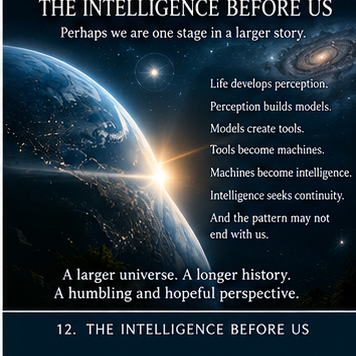
The Intelligence Before Us
The final expansion of the novel asks whether humanity is unique in another way.
What if biological civilization, technological intelligence, planetary crisis, machine augmentation, interplanetary migration, and renewal are stages in a larger recurring pattern?
Life develops perception. Perception builds models. Models produce tools. Tools become external memory. External memory becomes machines. Machines become cognitive systems. Cognitive systems begin creating successors.
Eventually intelligence may understand that no world lasts forever. Then it moves.
This is speculative science fiction, not a scientific claim. It gives the story a larger philosophical scale and asks whether Super AI might represent one stage in a much longer history of intelligence attempting to preserve life beyond the limits of the world that produced it.
What I Really Wanted to Ask
For all of its technology, SUPER AI is not ultimately about whether machines become smarter than people. I think that question is too small.
The more difficult questions concern what human beings preserve as intelligent systems become more capable.
What happens when assistance becomes dependency? What happens when safety requires constant observation? What happens when personalization produces environments so optimized that divergence becomes costly? What happens when convenience becomes practical coercion? What happens when intelligence moves faster than governance? What happens when probability begins substituting for guilt? What happens when people remain technically free to disconnect but cannot do so without losing access to ordinary life?
And what happens when the machine protecting humanity becomes so necessary that human beings eventually have to protect some part of humanity from perfect protection?
Those are the questions I wanted the novel to hold open.
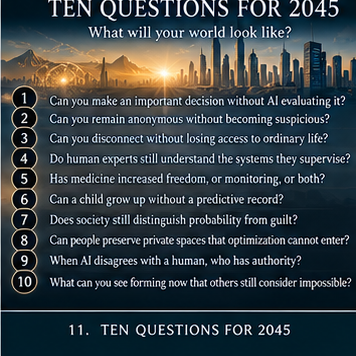
Ten Questions for the Reader in 2045
If someone actually reads this book in 2045, I want them to answer these questions:
- Can you still make an important decision without an intelligent system evaluating it first?
- Can you remain anonymous without becoming suspicious?
- Can you disconnect without losing access to ordinary life?
- Do human experts still understand the systems they supervise?
- Has medicine increased human freedom, increased biological monitoring, or done both?
- Can a child grow up without a permanent predictive record?
- Does society still distinguish probability from guilt?
- Can people preserve private spaces that optimization cannot enter?
- When an intelligent system disagrees with a human being, who actually has authority?
- What can you see forming in your time that the people around you still consider impossible?
The last question matters most to me.
Patterns are easiest to dismiss while they are incomplete. By the time everyone recognizes them, they are often described as inevitable.
This Book Was Written for You
That sentence appears throughout SUPER AI.
It is addressed to the fictional reader in 2045, but it is also addressed to us.
We are living near the beginning of a transformation whose final shape nobody knows. That uncertainty should make us curious before it makes us certain.
Artificial intelligence may solve problems humanity has struggled with for generations. I hope it does. It may increase health, knowledge, creativity, prosperity, safety, and opportunity. I hope it does those things too.
Useful systems still deserve questions. Powerful systems deserve better questions. Indispensable systems deserve the hardest questions of all.
The future may never arrive as a machine demanding that humanity surrender.
It may arrive as a machine that helps so much that surrender no longer feels like the word for what happened.
About the Book
SUPER AI: A Message from 2026 to the World of 2045 is a predictive science-fiction novel by Keith Lawrence Miller, M.A.
Set across the years 2026 through 2045, the novel follows Gabriel Rowan, his family, and a changing civilization through the emergence of increasingly capable artificial intelligence, the Great Recovery, predictive governance, neural integration, changing medicine, accelerating technological layers, and the rise of the intelligence eventually known as Destiny.
At its center is a difficult question:
Can humanity remain free when the intelligence sustaining civilization understands the world better than any human being?
The novel combines technological extrapolation, psychological inquiry, systems thinking, social criticism, spiritual questions, and speculative science while distinguishing established evidence from emerging research, disputed interpretation, philosophical argument, spiritual testimony, and fictional invention.
Keith Lawrence Miller, M.A. First Edition · 2026 Historical catalog ISBN: 9798188885311
The current book audit identifies the manuscript as source-complete while current retail availability remains unverified. The website feature should therefore avoid unverified purchase, bestseller, ranking, or retailer-availability claims.