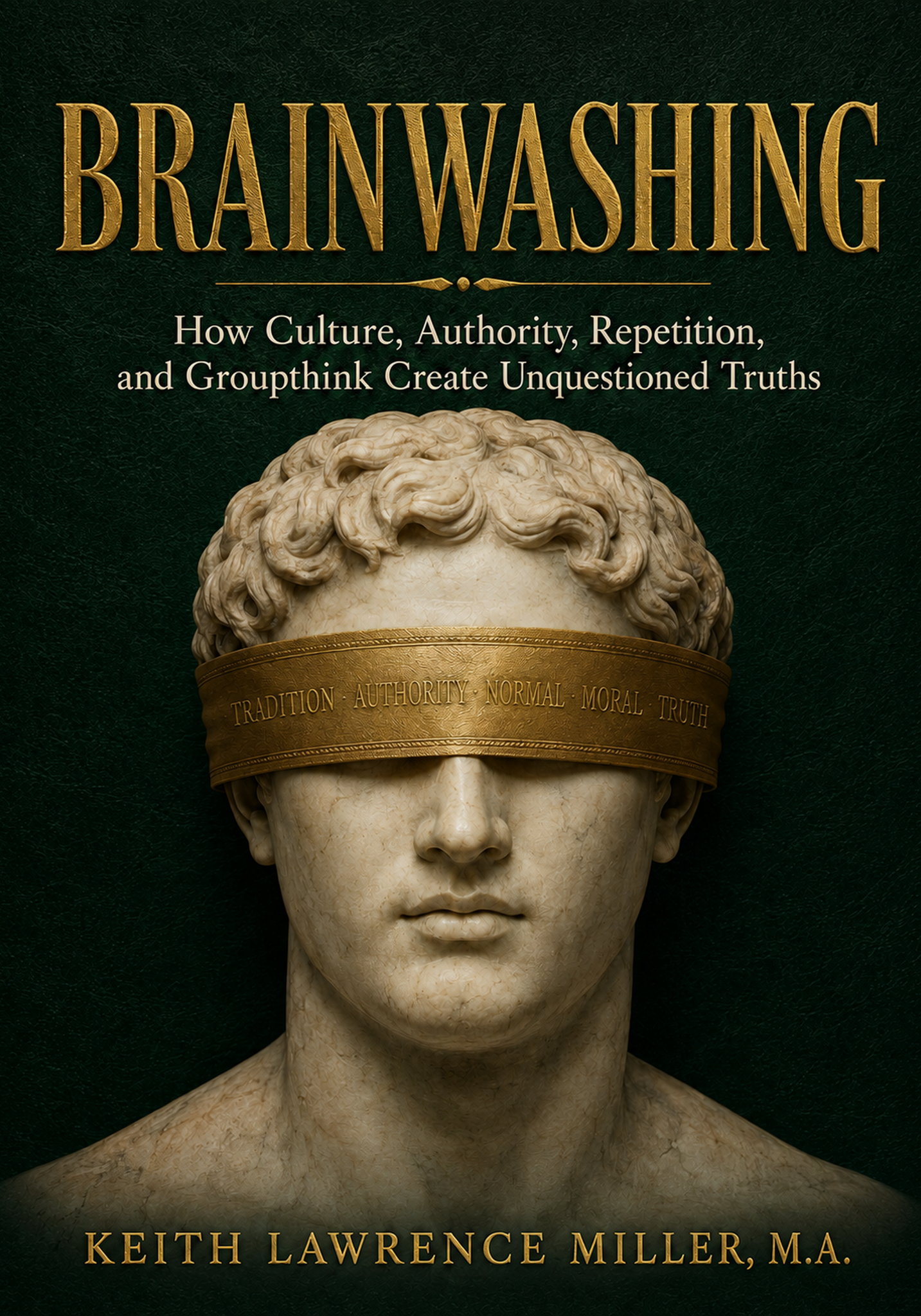
Brainwashing: How Beliefs Become Difficult to Question
By Keith Lawrence Miller, M.A.
I wrote Brainwashing because studying psychology taught me an uncomfortable lesson about influence: understanding how persuasion works does not place anyone outside its reach.
Even after years of studying psychology, behavior, motivation, authority, social influence, and decision-making, I still notice sales strategies affecting my attention and emotions. A carefully structured offer can create urgency. Scarcity can increase desire. Repetition can make an idea feel more familiar and therefore easier to accept. Social proof can influence how credible or desirable something appears.
The difference today is awareness.
Psychological education gave me a better opportunity to recognize what is happening before an emotional response becomes a behavior. I can slow the process, examine the message, identify the pressure being applied, reconsider the evidence, and decide whether the action I feel pushed toward is actually consistent with what I want.
Before studying psychology, I did not have the same awareness. Looking back, I can identify situations in which I was fooled or persuaded more easily than I realized at the time. Those experiences ranged from sales campaigns and scams to broader social and political movements. The circumstances were different, yet many of the underlying psychological mechanisms were surprisingly similar.
That observation became one of the reasons I created this book.
The mechanisms repeat because human psychology repeats.
People respond to authority, belonging, fear, reward, identity, repetition, urgency, status, social agreement, and the possibility of loss. These forces can help people cooperate, learn, build communities, and make decisions. They can also narrow our judgment when we fail to recognize how strongly they are shaping what feels true, urgent, desirable, dangerous, or obvious.
We tend to experience ourselves as being in control. Psychology complicates that assumption.
Our decisions are made inside environments that are already influencing attention, emotion, interpretation, and perceived choices. Awareness does not eliminate those forces. It gives us a better opportunity to participate consciously in what happens next.
That is the central purpose of Brainwashing.
The Room That Already Agreed
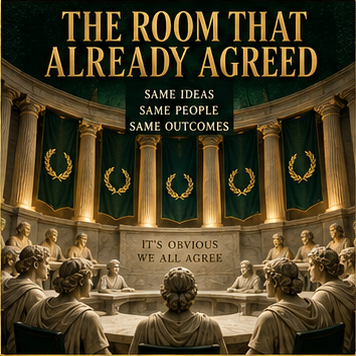
The book begins with an image I call the room that already agreed.
Imagine entering a room after the important conclusions have already been established. Nobody is currently debating them. Most people cannot tell you exactly when the agreement occurred or what evidence originally settled the question.
The conclusions simply appear to be part of reality.
They are present in jokes, family expectations, professional standards, school rules, advertising, traditions, status systems, institutional language, social rewards, and the reactions people have when someone asks an unexpected question.
That environment matters because beliefs do not have to be imposed through explicit commands.
An idea can become powerful through normalization.
When enough people repeat something, behave as though it is true, reward agreement, and react negatively to doubt, the belief can become increasingly difficult to separate from the environment in which a person learned it.
This process begins long before adulthood.
We Learn Before We Are Capable of Independent Verification
No child can investigate the world from first principles.
Children have to trust adults about language, danger, food, family, history, health, morality, religion, social expectations, and the intentions of other people. Adults remain dependent on testimony as well because modern life is too complex for any person to independently verify everything they rely upon.
That dependence makes culture and expertise possible.
It also creates vulnerability.
A belief learned before we possess the capacity to examine it can eventually feel as though it was always our own conclusion.
The problem begins when later examination becomes socially, emotionally, or institutionally costly.
A healthy system can transmit strong beliefs while allowing questions, evidence, correction, and development. A closed system protects the conclusion by making questioning itself evidence of disloyalty, ignorance, immorality, or personal defect.
That distinction runs throughout the book.
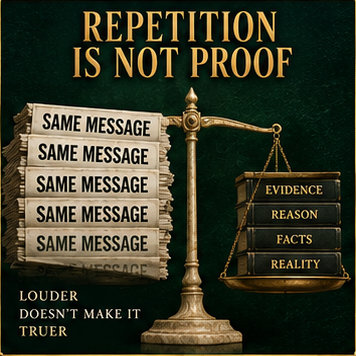
Repetition Changes Familiarity
Repetition is one of the simplest forces shaping belief.
We hear a statement once and encounter it as new information. After repeated exposure, the statement becomes familiar. Familiar information is easier for the mind to process, and that ease can contribute to a sense that the information is credible.
This does not determine whether the statement is actually true.
A correct statement can be repeated. So can an incorrect one.
The important lesson is that familiarity and evidence are different things.
Advertising depends heavily on this distinction. Brands repeat messages because recognition matters. Political communication uses repetition because simple phrases can become cognitively available. Families repeat moral and cultural language because repetition helps transmit values. Organizations repeat mission statements because repetition creates shared vocabulary.
The mechanism is widespread because it works.
Understanding the mechanism allows us to ask whether repeated exposure is being mistaken for independent confirmation.
Authority Saves Cognitive Effort
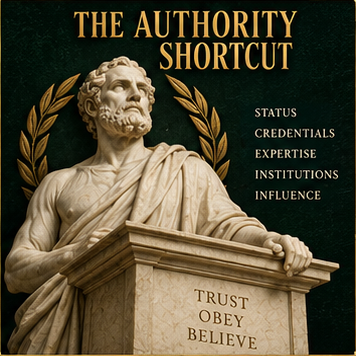
Human beings need authority.
A functioning society depends on specialized knowledge. We rely on physicians, engineers, attorneys, scientists, teachers, accountants, historians, technicians, public institutions, and other people who know things we cannot personally reconstruct every time we make a decision.
The psychological shortcut appears when authority replaces examination completely.
Relevant expertise deserves weight. It does not turn every statement made by an expert into a fact.
The same person may possess extraordinary competence inside one domain and ordinary judgment outside it. Institutions can also be correct, mistaken, incomplete, outdated, conflicted, or internally divided.
Authority therefore works best when we can identify why it deserves trust, what its scope actually covers, and what evidence supports the claim being made.
The shortcut becomes dangerous when status itself becomes the evidence.
Belonging Changes the Cost of Doubt
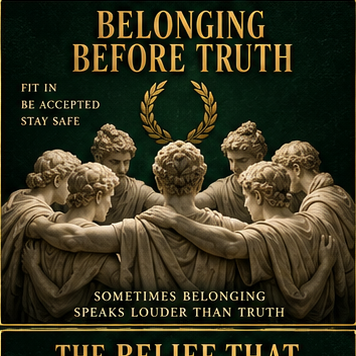
Beliefs rarely exist as isolated propositions.
They can connect us to people we love, traditions we value, professions we worked hard to enter, communities that give us identity, and institutions that provide opportunity.
Questioning a belief can therefore create a cost that has nothing to do with the quality of the evidence.
A person may risk family conflict, professional status, friendships, religious belonging, political identity, reputation, or access to a community that has been central to their life.
Under those conditions, a challenge to a proposition can feel like a challenge to the self.
This helps explain why intelligent people can defend weak beliefs with enormous intensity.
The behavior may have less to do with intelligence than with what revision appears to threaten.
Humiliation makes this worse. If changing a position requires publicly accepting that you were foolish, corrupt, immoral, or unworthy, the psychological cost of revision rises dramatically.
A healthier intellectual environment allows people to change their minds without requiring them to destroy themselves in the process.
Shame Can Enforce a Belief Without an External Guard
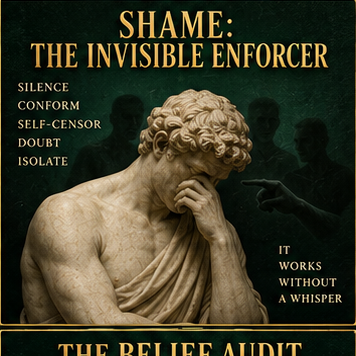
Some systems regulate behavior openly through rewards and punishments.
Shame can move that enforcement inside the individual.
A person learns which questions are embarrassing, which desires should be hidden, which ambitions are inappropriate, which doubts signal disloyalty, and which behaviors threaten acceptance.
Eventually, nobody needs to issue the command.
The person anticipates the judgment.
Moral emotion has an important place in human life. Feeling shame, however, does not automatically prove that the belief producing the feeling is morally justified.
The experience is real.
Its interpretation still deserves examination.
That distinction is particularly important because shame can feel like evidence from inside the body. The emotional intensity gives the belief a sense of certainty that may exist independently of its factual or moral basis.
Identity Can Protect a Proposition From Examination
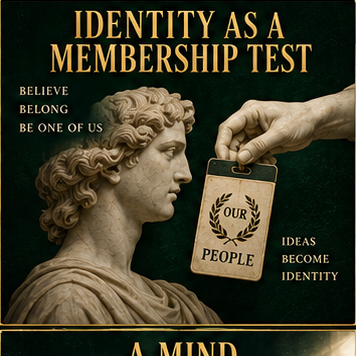
Beliefs become especially resistant to revision when they function as proof of group membership.
At that point, the proposition carries more than information.
Agreement communicates who you are.
Disagreement may communicate who you are no longer allowed to be.
This mechanism is not confined to any political, religious, professional, or cultural group. Human beings can construct identity around almost any shared worldview.
Even communities formed around skepticism can develop their own unquestionable beliefs.
That matters because leaving one influential system does not automatically create intellectual independence. A person can escape one group, adopt another identity, and reproduce the same relationship with authority, repetition, belonging, and dissent.
Awareness has to continue after conversion.
Sales, Scams, and Movements Often Use Familiar Psychological Levers
My own hindsight helped me appreciate how often these mechanisms overlap.
A sales campaign may create scarcity and urgency.
A scam may use fear, authority, trust, or the promise of an unusually valuable opportunity.
A social movement may create a compelling explanation that connects personal experience to group identity and collective action.
None of these categories is psychologically identical, and they should not be treated as though they are.
The useful observation is that human attention and decision-making operate through recurring mechanisms.
Influence often becomes stronger when several mechanisms appear together.
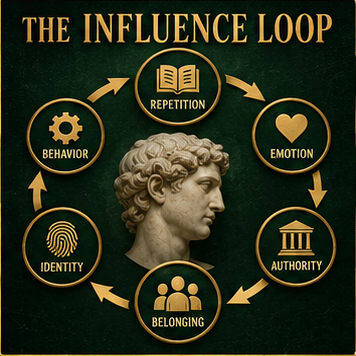
Urgency reduces time for reflection. Authority reduces uncertainty. Repetition creates familiarity. Social proof communicates that others have already accepted the proposition. Identity increases emotional investment. Fear raises the perceived cost of delay. Belonging increases the cost of dissent.
Once I understood those mechanisms better, I became less interested in asking whether a person was “smart enough” to resist persuasion.
The more useful question became whether the person recognized what was acting on them soon enough to make a deliberate decision.
Brainwashing Is a Powerful Word and Requires Precision
The title of the book intentionally creates tension because the word brainwashing carries enormous weight.
Historically and clinically, the term has often referred to unusually coercive attempts to undermine autonomy and impose belief. Popular language uses the word far more broadly for propaganda, persuasion, socialization, ideological conformity, advertising, family influence, religion, media, and countless other forms of social pressure.
Those situations cannot responsibly be collapsed into one category.
A family tradition is not equivalent to imprisonment.
Education is not automatically indoctrination.
Persuasion is not mind control.
A political campaign is not automatically brainwashing because it tries to persuade voters.
A religious tradition is not false merely because it was inherited.
The book uses the word as an invitation to examine the architecture of unquestioned belief while maintaining distinctions among influence, persuasion, socialization, propaganda, coercion, deception, and ordinary cultural transmission.
Precision protects the analysis from becoming another form of propaganda.
Different Beliefs Require Different Verdicts
One of the methodological decisions I made in the book was to stop treating every questionable belief as simply a “lie.”
That word assumes knowledge and intent that the evidence may not establish.
Some beliefs are demonstrably false.
Others contain an important truth wrapped in exaggeration.
Some are norms presented as though they were facts of nature.
Some are outdated explanations that once appeared plausible.
Some remain genuinely contested.
Some are symbolic or sacred narratives whose meaning was never intended to depend on scientific verification.
Some are deliberate fictions used transparently or semi-transparently for social purposes.
And occasionally, evidence establishes that people knowingly promoted information they understood to be false or materially misleading.
Those differences matter.
The book therefore classifies the claim before judging it. Its research method distinguishes empirical questions from moral ones, records counterevidence, compares historical and cultural settings, and calibrates confidence to the strength of the record.
The objective is disciplined judgment.
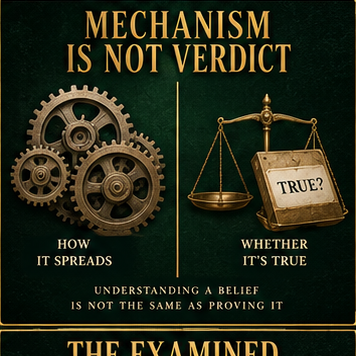
Mechanism Does Not Determine Truth
Discovering how a belief spreads tells us something important.
It still does not tell us whether the belief is true.
A belief may benefit an institution without having been invented by that institution.
A harmful norm can be transmitted sincerely.
A pattern can emerge across many organizations without secret coordination.
A message can be repeated because people genuinely believe it.
A marginalized belief can still be wrong.
A mainstream belief can still be right.
The temptation to see manipulation everywhere grows once people become aware of social influence. That temptation has to be resisted too.
Otherwise skepticism becomes its own unquestioned ideology.
A useful analysis asks what the structure rewards, what it discourages, which claims become difficult to express, who benefits, who bears costs, and what evidence exists concerning knowledge and intent.
Benefit can justify investigation.
It cannot establish conspiracy by itself.
Beliefs Become Dangerous When They Cannot Lose
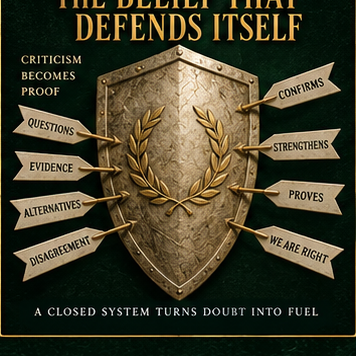
Some propositions contain their own defense against correction.
Agreement confirms them.
Disagreement also confirms them.
The skeptic is described as ignorant, immoral, corrupted, jealous, deceived, disloyal, or part of the very system being criticized.
At that point the belief becomes difficult to falsify because every possible response has been assigned a meaning in advance.
This is one of the questions I think people should ask more often:
What evidence would cause me to revise this belief?
A serious belief does not have to be fragile.
It should have conditions under which confidence could change.
Without that possibility, certainty has become insulated from learning.
The Belief Audit
I wanted readers to have a practical way to examine influential ideas without simply replacing conformity with cynicism.
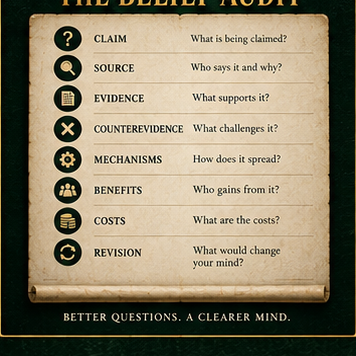
The result is the Belief Audit.
The process begins with one precise sentence. From there, the reader identifies the type of claim, traces its origins as responsibly as possible, examines how it was transmitted, separates supporting evidence from challenging evidence, identifies the mechanisms that help sustain it, examines benefits and costs, compares cultural or historical alternatives, and constructs the strongest serious defense of the belief.
The final task is especially important.
The reader develops a revised statement that preserves whatever remains true while removing exaggeration, unsupported certainty, or category errors.
That process is harder than rejection.
It requires understanding.
A concise version of the audit asks:
- What exactly do I believe?
- What kind of claim is it?
- Where did the belief come from?
- How did it reach me and become familiar?
- What is the strongest evidence supporting it?
- What is the strongest evidence challenging it?
- What role do authority, repetition, belonging, identity, shame, fear, incentives, or social approval play in preserving it?
- What valid concern or wisdom does the belief contain?
- What evidence would change my confidence?
- What is the most accurate version of the belief I can defend today?
The manuscript's full toolkit extends the analysis further into dissent costs, cross-cultural testing, beneficiaries, replacement beliefs, and confidence levels.
A Mind of Your Own Does Not Mean a Mind Created Alone
The phrase think for yourself can create another illusion.
None of us created ourselves intellectually from nothing.
We inherited language before we could choose it. We were born into an era, a family, a body, a culture, and a set of available concepts. We depend on other people for knowledge throughout our lives.
Intellectual freedom therefore cannot mean freedom from all influence.
The stronger definition is conscious participation in influence.
A person can know they have been shaped, examine what shaped them, decide what remains worth keeping, revise what fails scrutiny, and accept responsibility for the beliefs they continue to carry.
The book's conception of intellectual freedom therefore involves humility, evidence, reciprocity, openness to correction, awareness of incentives, respect for human dignity, and the ability to preserve uncertainty where certainty has not been earned.
Ownership means responsibility.
It does not mean isolation.

Awareness Does Not Make Me Immune
This is where the book returns to my own experience.
Psychology has not made me immune to sales strategies, emotional appeals, social influence, persuasive framing, or other forces that shape behavior.
I still experience them because I am still human.
The useful change is that I recognize more of the process.
Awareness gives me an opportunity to slow down before acting, examine why something feels urgent or persuasive, and decide whether the behavior being encouraged is consistent with my own judgment.
That is a much more realistic form of control.
We may never become completely independent of influence because our minds develop through relationships, culture, language, institutions, and experience.
We can become increasingly conscious participants in the process.
And that is why I wrote Brainwashing: to make more of those forces visible before they quietly become our decisions.
The Examined Inheritance
The book returns at the end to the same room that already agreed.
The room may still contain shared beliefs after examination.
Families may preserve traditions.
People may remain religious.
Communities may maintain shared values.
Professionals may continue respecting expertise.
People may work toward success.
They may love their country.
They may retain inherited practices.
Examination does not require perpetual rebellion.
What changes is the quality of agreement.
Repetition no longer counts as independent evidence.
Authority is respected without becoming infallible.
Shame is experienced without automatically being treated as moral proof.
Benefit is investigated without automatically becoming proof of conspiracy.
Sacred claims are allowed to remain sacred without pretending to be laboratory findings.
Empirical claims remain answerable to evidence even when they are emotionally or culturally important.
The result may be retention, revision, suspended judgment, or rejection.
The crucial difference is that participation has become more conscious.

The book ends with the principle that captures the standard I wanted to establish:
The opposite of brainwashing is not disbelief. It is a mind that remains capable of honest revision.
About the Book
Brainwashing: How Culture, Authority, Repetition, and Groupthink Create Unquestioned Truths examines how beliefs become familiar, socially reinforced, emotionally protected, and increasingly difficult to examine.
The book explores repetition, authority, belonging, shame, identity, family transmission, conformity, moral regulation, success narratives, propaganda, manufactured consensus, professional norms, and the social costs of dissent. Its method separates different kinds of claims rather than treating every inherited belief, tradition, persuasive message, or social influence as equivalent.
A practical Belief Audit Toolkit helps readers identify the claim, classify it, trace its origin and transmission, evaluate evidence and counterevidence, identify reinforcing mechanisms, examine benefits and dissent costs, test cross-cultural variation, consider the strongest defense, and develop a more defensible replacement belief.
The book is general education and cultural criticism. It does not diagnose individuals or groups and does not provide medical, mental-health, legal, financial, or religious counsel.
Keith Lawrence Miller, M.A. First Edition · 2026 ISBN: 9798188919078 125 pages Source status: Complete